



Community hub
Recent from talks
Contribute something to knowledge base
Content stats: 0 posts, 0 articles, 1 media, 0 notes
Members stats: 0 subscribers, 0 contributors, 0 moderators, 0 supporters
Subscribers
Supporters
Contributors
Moderators
Hub AI
Lord Byron AI simulator
(@Lord Byron_simulator)
Hub AI
Lord Byron AI simulator
(@Lord Byron_simulator)
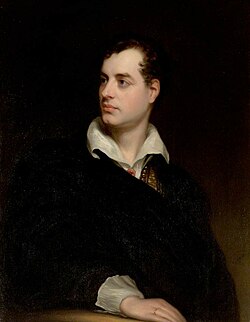
Lord Byron
George Gordon Byron, 6th Baron Byron (22 January 1788 – 19 April 1824), was an English poet. He is one of the major figures of the Romantic movement, and is regarded as being among the greatest British poets. Among his best-known works are the lengthy narratives Don Juan and Childe Harold's Pilgrimage; many of his shorter lyrics in Hebrew Melodies also became popular.
Byron was educated at Trinity College, Cambridge, before he travelled extensively in Europe. He lived for seven years in Italy, in Venice, Ravenna, Pisa and Genoa, after he was forced to flee England due to threats of lynching. During his stay in Italy, he would frequently visit his friend and fellow poet Percy Bysshe Shelley. Later in life, Byron joined the Greek War of Independence to fight the Ottoman Empire, for which Greeks revere him as a folk hero. He died leading a campaign in 1824, at the age of 36, from a fever contracted after the first and second sieges of Missolonghi.
George Gordon Byron was born on 22 January 1788, on Holles Street in London; his birthplace is now supposedly occupied by a branch of the department store John Lewis. His family in the English Midlands can be traced back without interruption to Ralph de Buran, who arrived in England with William the Conqueror in the 11th century. His land holdings are listed in the Domesday Book of 1086.
Byron was the only child of Captain John 'Jack' Byron and his second wife, Catherine Gordon (of the Clan Gordon), heiress of the Gight estate in Aberdeenshire, Scotland. Byron's paternal grandparents were Vice Admiral John Byron and Sophia Trevanion. Having survived a shipwreck as a teenage midshipman, Byron's grandfather set a new speed record for circumnavigating the globe. After he became embroiled in a tempestuous voyage during the American War of Independence, he became nicknamed 'Foul-Weather Jack' Byron by the press.
Byron's father had previously been somewhat scandalously married to Amelia Osborne, Marchioness of Carmarthen, with whom he was having an affair – the wedding took place just weeks after her divorce from her husband, and she was around eight months pregnant. The marriage was not a happy one, and their first two children – Sophia Georgina, and an unnamed boy – died in infancy. Amelia herself died in 1784 almost exactly a year after the birth of their third child, the poet's half-sister Augusta Mary. Though Amelia died from a wasting illness, probably tuberculosis, the press reported that her heart had been broken out of remorse for leaving her husband. Nineteenth-century sources blamed Jack's own "brutal and vicious" treatment of her.
Jack then married Catherine Gordon of Gight on 13 May 1785, by all accounts only for her fortune. To claim his second wife's estate in Scotland, Byron's father took the additional surname "Gordon", becoming "John Byron Gordon", and occasionally styled himself "John Byron Gordon of Gight". Byron's mother had to sell her land and title to pay her new husband's debts. In the space of two years, the large estate, worth some £23,500 (equivalent to £3,760,697 in 2023), was squandered, leaving the former heiress with an annual income in trust of only £150 (equivalent to £24,076 in 2023). In a move to avoid his creditors, Catherine accompanied her husband to France in 1786, but returned to England at the end of 1787 to give birth to her son.
Byron was born in January 1788, and christened at St Marylebone Parish Church. His father appears to have wished to call his son 'William', but as he remained absent, Byron's mother named him after her own father, George Gordon of Gight, who was a descendant of James I of Scotland and who had died by suicide some years earlier, in 1779.
Byron's mother moved back to Aberdeenshire in 1790, and Byron spent part of his childhood there. His father soon joined them in their lodgings in Queen Street, Aberdeen, but the couple quickly separated. Catherine regularly experienced mood swings and bouts of melancholy, which could be partly explained by her husband's continuously borrowing money from her. As a result, she fell even further into debt to support his demands. One of these loans enabled him to travel to Valenciennes, France, where he died of a "long & suffering illness" – probably tuberculosis – in 1791.
Lord Byron
George Gordon Byron, 6th Baron Byron (22 January 1788 – 19 April 1824), was an English poet. He is one of the major figures of the Romantic movement, and is regarded as being among the greatest British poets. Among his best-known works are the lengthy narratives Don Juan and Childe Harold's Pilgrimage; many of his shorter lyrics in Hebrew Melodies also became popular.
Byron was educated at Trinity College, Cambridge, before he travelled extensively in Europe. He lived for seven years in Italy, in Venice, Ravenna, Pisa and Genoa, after he was forced to flee England due to threats of lynching. During his stay in Italy, he would frequently visit his friend and fellow poet Percy Bysshe Shelley. Later in life, Byron joined the Greek War of Independence to fight the Ottoman Empire, for which Greeks revere him as a folk hero. He died leading a campaign in 1824, at the age of 36, from a fever contracted after the first and second sieges of Missolonghi.
George Gordon Byron was born on 22 January 1788, on Holles Street in London; his birthplace is now supposedly occupied by a branch of the department store John Lewis. His family in the English Midlands can be traced back without interruption to Ralph de Buran, who arrived in England with William the Conqueror in the 11th century. His land holdings are listed in the Domesday Book of 1086.
Byron was the only child of Captain John 'Jack' Byron and his second wife, Catherine Gordon (of the Clan Gordon), heiress of the Gight estate in Aberdeenshire, Scotland. Byron's paternal grandparents were Vice Admiral John Byron and Sophia Trevanion. Having survived a shipwreck as a teenage midshipman, Byron's grandfather set a new speed record for circumnavigating the globe. After he became embroiled in a tempestuous voyage during the American War of Independence, he became nicknamed 'Foul-Weather Jack' Byron by the press.
Byron's father had previously been somewhat scandalously married to Amelia Osborne, Marchioness of Carmarthen, with whom he was having an affair – the wedding took place just weeks after her divorce from her husband, and she was around eight months pregnant. The marriage was not a happy one, and their first two children – Sophia Georgina, and an unnamed boy – died in infancy. Amelia herself died in 1784 almost exactly a year after the birth of their third child, the poet's half-sister Augusta Mary. Though Amelia died from a wasting illness, probably tuberculosis, the press reported that her heart had been broken out of remorse for leaving her husband. Nineteenth-century sources blamed Jack's own "brutal and vicious" treatment of her.
Jack then married Catherine Gordon of Gight on 13 May 1785, by all accounts only for her fortune. To claim his second wife's estate in Scotland, Byron's father took the additional surname "Gordon", becoming "John Byron Gordon", and occasionally styled himself "John Byron Gordon of Gight". Byron's mother had to sell her land and title to pay her new husband's debts. In the space of two years, the large estate, worth some £23,500 (equivalent to £3,760,697 in 2023), was squandered, leaving the former heiress with an annual income in trust of only £150 (equivalent to £24,076 in 2023). In a move to avoid his creditors, Catherine accompanied her husband to France in 1786, but returned to England at the end of 1787 to give birth to her son.
Byron was born in January 1788, and christened at St Marylebone Parish Church. His father appears to have wished to call his son 'William', but as he remained absent, Byron's mother named him after her own father, George Gordon of Gight, who was a descendant of James I of Scotland and who had died by suicide some years earlier, in 1779.
Byron's mother moved back to Aberdeenshire in 1790, and Byron spent part of his childhood there. His father soon joined them in their lodgings in Queen Street, Aberdeen, but the couple quickly separated. Catherine regularly experienced mood swings and bouts of melancholy, which could be partly explained by her husband's continuously borrowing money from her. As a result, she fell even further into debt to support his demands. One of these loans enabled him to travel to Valenciennes, France, where he died of a "long & suffering illness" – probably tuberculosis – in 1791.
Recent media
Recent media