
Recent from talks
Lotus 15
Knowledge base stats:
Talk channels stats:
Members stats:
Lotus 15
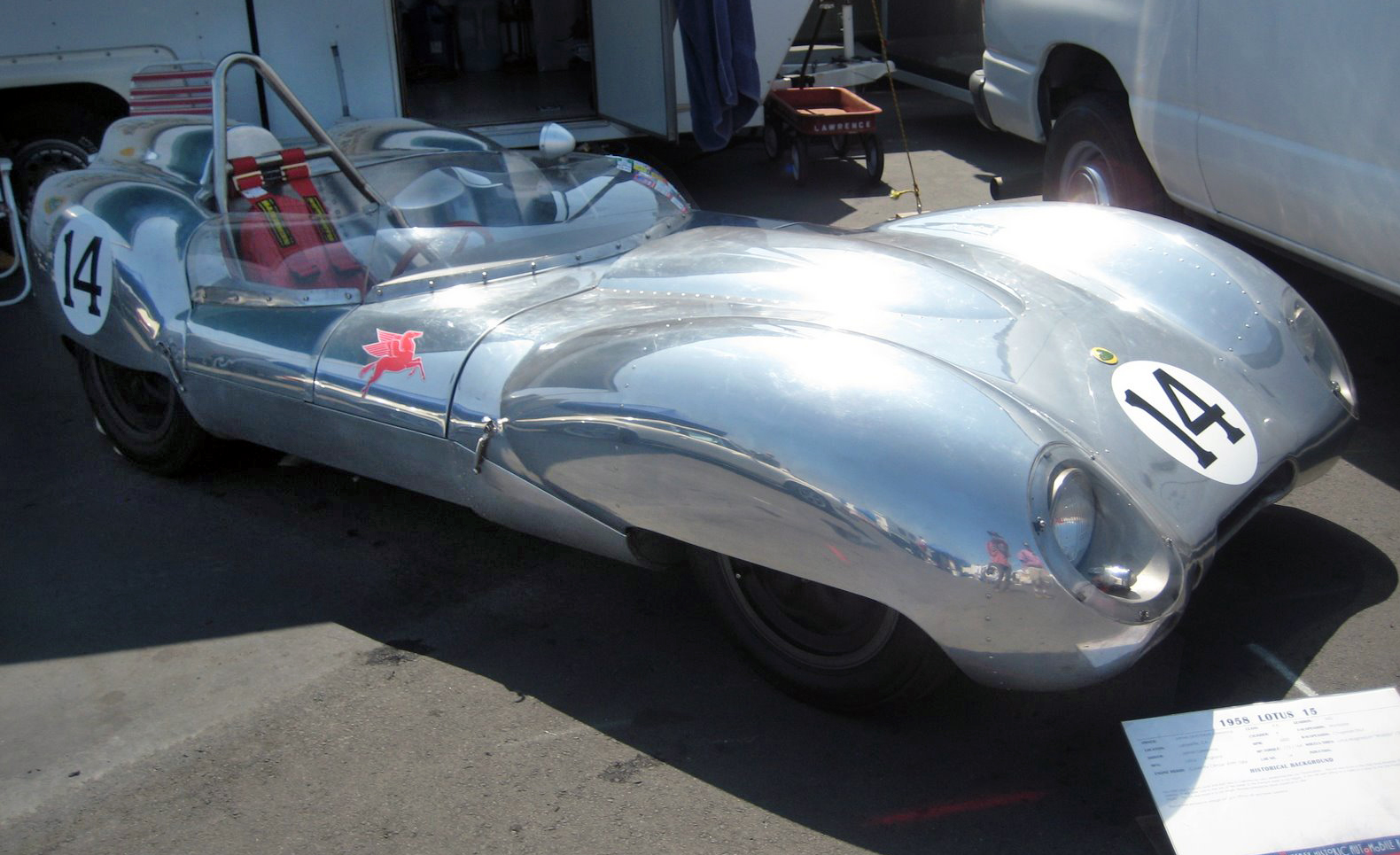
The Lotus 15 is a front-engine sports racing car designed by Colin Chapman of Lotus, built from 1958 until 1960.
The 15 is a two-seater, front-engine, rear wheel drive sports racer with an aluminium body over a space frame configuration. As opposed to the six cylinder Bristol 2L engine in its predecessor Lotus Mk.X, the Mk.15 was designed with a dry-sump, all aluminium, DOHC four cylinder Coventry Climax FPF engine of 1.5 to 2.5 Litre displacement built for Formula Two and Grand Prix racing, mated to Lotus' own 5 speed sequential transaxle nicknamed 'Queerbox'. It was designed in 1957, and the production began in late 1957.
The spaceframe was similar to Lotus Eleven except for the Chapman strut rear suspension with inboard brakes and the accommodations for a larger engine, which included a slightly (7.5 degrees) tilted engine mounting space on the plan view, shifted to the right of the centerline in the front and left at the rear of the engine. This arrangement gave a larger space for the driver than the normally non-existing passenger.
The larger body of "English rolled" aluminum was also similar in appearance to the smaller and successful Lotus 11, with a major difference of a full-width windscreen, and the lower scuttle/screen height. Unlike the 11 which was designed by Frank Costin, the body design was a result of the collaboration between Chapman and the coachbuilder Williams & Pritchard.
It was available as a fully assembled form sans the engine at £2885, or as a kit of parts for £2395.
Lotus 15's debut was in Sussex Trophy at Goodwood on 7 April 1958 in the hands of Graham Hill who immediately set the lap record, but failed to finish the race due to a gearbox problem.
This constant mesh, sequential-shift, 5 speed gearbox combined with ZF limited-slip differential in the transaxle configuration was compact, light (85 lbs including inboard brakes and halfshafts) and quick shifting, but the reliability problem had been carried over from the F1 and F2 Lotus 12 single seater.
Colin Chapman hired a young and talented gearbox engineer, Keith Duckworth, to solve this problem, but the priority needed to be on Lotus 16 for Grands Prix, which shared the Queerbox problem, so a newer version Series 2 was born while the update was in development in July, 1958 with BMC B-series four speed gearbox attached directly behind the engine, and a conventional differential housing with brake disc calipers mounted on the sides.
Hub AI
Lotus 15 AI simulator
(@Lotus 15_simulator)
Lotus 15
The Lotus 15 is a front-engine sports racing car designed by Colin Chapman of Lotus, built from 1958 until 1960.
The 15 is a two-seater, front-engine, rear wheel drive sports racer with an aluminium body over a space frame configuration. As opposed to the six cylinder Bristol 2L engine in its predecessor Lotus Mk.X, the Mk.15 was designed with a dry-sump, all aluminium, DOHC four cylinder Coventry Climax FPF engine of 1.5 to 2.5 Litre displacement built for Formula Two and Grand Prix racing, mated to Lotus' own 5 speed sequential transaxle nicknamed 'Queerbox'. It was designed in 1957, and the production began in late 1957.
The spaceframe was similar to Lotus Eleven except for the Chapman strut rear suspension with inboard brakes and the accommodations for a larger engine, which included a slightly (7.5 degrees) tilted engine mounting space on the plan view, shifted to the right of the centerline in the front and left at the rear of the engine. This arrangement gave a larger space for the driver than the normally non-existing passenger.
The larger body of "English rolled" aluminum was also similar in appearance to the smaller and successful Lotus 11, with a major difference of a full-width windscreen, and the lower scuttle/screen height. Unlike the 11 which was designed by Frank Costin, the body design was a result of the collaboration between Chapman and the coachbuilder Williams & Pritchard.
It was available as a fully assembled form sans the engine at £2885, or as a kit of parts for £2395.
Lotus 15's debut was in Sussex Trophy at Goodwood on 7 April 1958 in the hands of Graham Hill who immediately set the lap record, but failed to finish the race due to a gearbox problem.
This constant mesh, sequential-shift, 5 speed gearbox combined with ZF limited-slip differential in the transaxle configuration was compact, light (85 lbs including inboard brakes and halfshafts) and quick shifting, but the reliability problem had been carried over from the F1 and F2 Lotus 12 single seater.
Colin Chapman hired a young and talented gearbox engineer, Keith Duckworth, to solve this problem, but the priority needed to be on Lotus 16 for Grands Prix, which shared the Queerbox problem, so a newer version Series 2 was born while the update was in development in July, 1958 with BMC B-series four speed gearbox attached directly behind the engine, and a conventional differential housing with brake disc calipers mounted on the sides.
Recent media