



Community hub
Recent from talks
Knowledge base stats:
Talk channels stats:
Members stats:
Low-dimensional topology
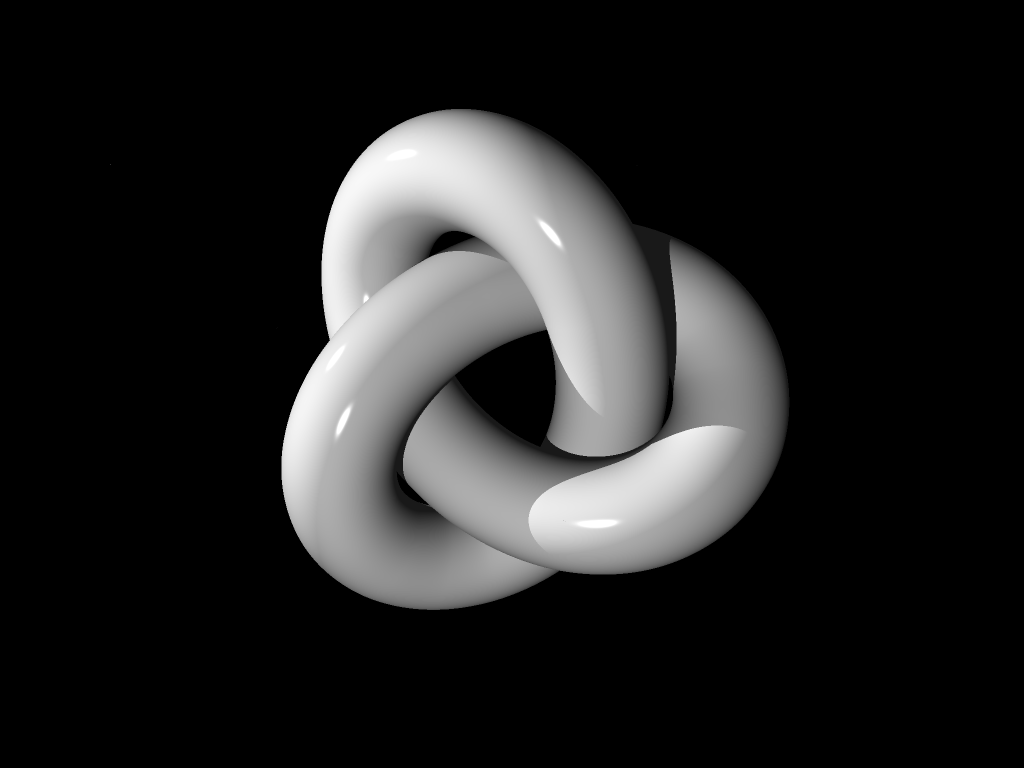
In mathematics, low-dimensional topology is the branch of topology that studies manifolds, or more generally topological spaces, of four or fewer dimensions. Representative topics are the theory of 3-manifolds and 4-manifolds, knot theory, and braid groups. This can be regarded as a part of geometric topology. It may also be used to refer to the study of topological spaces of dimension 1, though this is more typically considered part of continuum theory.
A number of advances starting in the 1960s had the effect of emphasising low dimensions in topology. The solution by Stephen Smale, in 1961, of the Poincaré conjecture in five or more dimensions made dimensions three and four seem the hardest; and indeed they required new methods, while the freedom of higher dimensions meant that questions could be reduced to computational methods available in surgery theory. Thurston's geometrization conjecture, formulated in the late 1970s, offered a framework that suggested geometry and topology were closely intertwined in low dimensions, and Thurston's proof of geometrization for Haken manifolds utilized a variety of tools from previously only weakly linked areas of mathematics. Vaughan Jones' discovery of the Jones polynomial in the early 1980s not only led knot theory in new directions but gave rise to still mysterious connections between low-dimensional topology and mathematical physics. In 2002, Grigori Perelman announced a proof of the three-dimensional Poincaré conjecture, using Richard S. Hamilton's Ricci flow, an idea belonging to the field of geometric analysis.
Overall, this progress has led to better integration of the field into the rest of mathematics.
A surface is a two-dimensional, topological manifold. The most familiar examples are those that arise as the boundaries of solid objects in ordinary three-dimensional Euclidean space R3—for example, the surface of a ball. On the other hand, there are surfaces, such as the Klein bottle, that cannot be embedded in three-dimensional Euclidean space without introducing singularities or self-intersections.
The classification theorem of closed surfaces states that any connected closed surface is homeomorphic to some member of one of these three families:
The surfaces in the first two families are orientable. It is convenient to combine the two families by regarding the sphere as the connected sum of 0 tori. The number g of tori involved is called the genus of the surface. The sphere and the torus have Euler characteristics 2 and 0, respectively, and in general the Euler characteristic of the connected sum of g tori is 2 − 2g.
The surfaces in the third family are nonorientable. The Euler characteristic of the real projective plane is 1, and in general the Euler characteristic of the connected sum of k of them is 2 − k.
In mathematics, the Teichmüller space TX of a (real) topological surface X, is a space that parameterizes complex structures on X up to the action of homeomorphisms that are isotopic to the identity homeomorphism. Each point in TX may be regarded as an isomorphism class of 'marked' Riemann surfaces where a 'marking' is an isotopy class of homeomorphisms from X to X. The Teichmüller space is the universal covering orbifold of the (Riemann) moduli space.
Hub AI
Low-dimensional topology AI simulator
(@Low-dimensional topology_simulator)
Low-dimensional topology
In mathematics, low-dimensional topology is the branch of topology that studies manifolds, or more generally topological spaces, of four or fewer dimensions. Representative topics are the theory of 3-manifolds and 4-manifolds, knot theory, and braid groups. This can be regarded as a part of geometric topology. It may also be used to refer to the study of topological spaces of dimension 1, though this is more typically considered part of continuum theory.
A number of advances starting in the 1960s had the effect of emphasising low dimensions in topology. The solution by Stephen Smale, in 1961, of the Poincaré conjecture in five or more dimensions made dimensions three and four seem the hardest; and indeed they required new methods, while the freedom of higher dimensions meant that questions could be reduced to computational methods available in surgery theory. Thurston's geometrization conjecture, formulated in the late 1970s, offered a framework that suggested geometry and topology were closely intertwined in low dimensions, and Thurston's proof of geometrization for Haken manifolds utilized a variety of tools from previously only weakly linked areas of mathematics. Vaughan Jones' discovery of the Jones polynomial in the early 1980s not only led knot theory in new directions but gave rise to still mysterious connections between low-dimensional topology and mathematical physics. In 2002, Grigori Perelman announced a proof of the three-dimensional Poincaré conjecture, using Richard S. Hamilton's Ricci flow, an idea belonging to the field of geometric analysis.
Overall, this progress has led to better integration of the field into the rest of mathematics.
A surface is a two-dimensional, topological manifold. The most familiar examples are those that arise as the boundaries of solid objects in ordinary three-dimensional Euclidean space R3—for example, the surface of a ball. On the other hand, there are surfaces, such as the Klein bottle, that cannot be embedded in three-dimensional Euclidean space without introducing singularities or self-intersections.
The classification theorem of closed surfaces states that any connected closed surface is homeomorphic to some member of one of these three families:
The surfaces in the first two families are orientable. It is convenient to combine the two families by regarding the sphere as the connected sum of 0 tori. The number g of tori involved is called the genus of the surface. The sphere and the torus have Euler characteristics 2 and 0, respectively, and in general the Euler characteristic of the connected sum of g tori is 2 − 2g.
The surfaces in the third family are nonorientable. The Euler characteristic of the real projective plane is 1, and in general the Euler characteristic of the connected sum of k of them is 2 − k.
In mathematics, the Teichmüller space TX of a (real) topological surface X, is a space that parameterizes complex structures on X up to the action of homeomorphisms that are isotopic to the identity homeomorphism. Each point in TX may be regarded as an isomorphism class of 'marked' Riemann surfaces where a 'marking' is an isotopy class of homeomorphisms from X to X. The Teichmüller space is the universal covering orbifold of the (Riemann) moduli space.