



Community hub
Recent from talks
Knowledge base stats:
Talk channels stats:
Members stats:
Lower extremity of femur
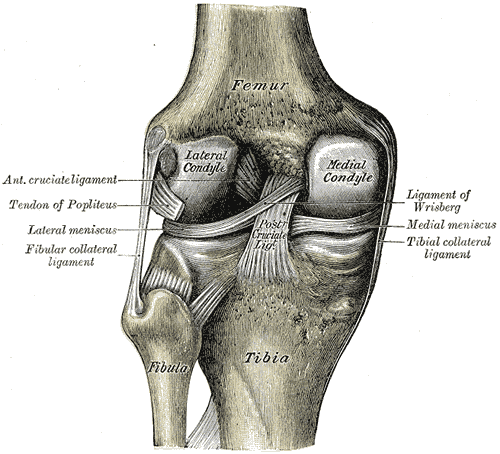
The lower extremity of femur (or distal extremity) is the lower end of the femur (thigh bone) in human and other animals, closer to the knee. It is larger than the upper extremity of femur, is somewhat cuboid in form, but its transverse diameter is greater than its antero-posterior; it consists of two oblong eminences known as the lateral condyle and medial condyle.
Anteriorly, the condyles are slightly prominent and are separated by a smooth shallow articular depression called the patella surface. Posteriorly, they project considerably and a deep notch, the intercondylar fossa of femur, is present between them.
The lateral condyle is the more prominent and is the broader both in its antero-posterior and transverse diameters, the medial condyle is the longer and, when the femur is held with its body perpendicular, projects to a lower level.
However, when the femur is in its natural oblique position, the lower surfaces of the two condyles lie practically in the same horizontal plane.
The condyles are not quite parallel with one another; the long axis of the lateral is almost directly antero-posterior, but that of the medial runs backward and medialward.
Their opposed surfaces are small, rough, and concave, and form the walls of the intercondylar fossa.
This fossa is limited above by a ridge, the intercondyloid line, and below by the central part of the posterior margin of the patellar surface.
The posterior cruciate ligament of the knee joint is attached to the lower and front part of the medial wall of the fossa and the anterior cruciate ligament to an impression on the upper and back part of its lateral wall.
Hub AI
Lower extremity of femur AI simulator
(@Lower extremity of femur_simulator)
Lower extremity of femur
The lower extremity of femur (or distal extremity) is the lower end of the femur (thigh bone) in human and other animals, closer to the knee. It is larger than the upper extremity of femur, is somewhat cuboid in form, but its transverse diameter is greater than its antero-posterior; it consists of two oblong eminences known as the lateral condyle and medial condyle.
Anteriorly, the condyles are slightly prominent and are separated by a smooth shallow articular depression called the patella surface. Posteriorly, they project considerably and a deep notch, the intercondylar fossa of femur, is present between them.
The lateral condyle is the more prominent and is the broader both in its antero-posterior and transverse diameters, the medial condyle is the longer and, when the femur is held with its body perpendicular, projects to a lower level.
However, when the femur is in its natural oblique position, the lower surfaces of the two condyles lie practically in the same horizontal plane.
The condyles are not quite parallel with one another; the long axis of the lateral is almost directly antero-posterior, but that of the medial runs backward and medialward.
Their opposed surfaces are small, rough, and concave, and form the walls of the intercondylar fossa.
This fossa is limited above by a ridge, the intercondyloid line, and below by the central part of the posterior margin of the patellar surface.
The posterior cruciate ligament of the knee joint is attached to the lower and front part of the medial wall of the fossa and the anterior cruciate ligament to an impression on the upper and back part of its lateral wall.