
Recent from talks
Loyalty Day (Argentina)
Knowledge base stats:
Talk channels stats:
Members stats:
Loyalty Day (Argentina)
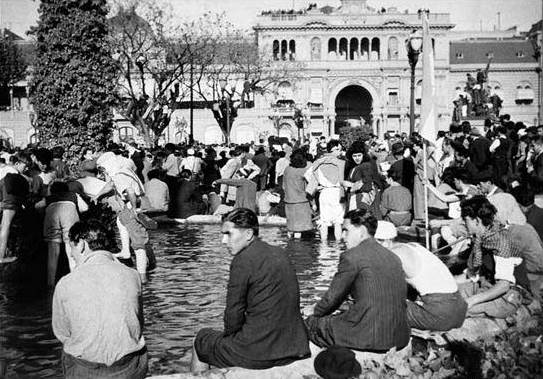
Loyalty Day (Spanish: Día de la lealtad) is a commemoration day in Argentina. It remembers 17 October 1945, when a large labour demonstration at the Plaza de Mayo, in downtown Buenos Aires, demanded the liberation of Juan Domingo Perón, who was jailed in Martín García island. It is considered the foundational moment of the Peronist movement.
On 4 June 1943, nationalist sectors of the Argentine Armed Forces led by General Arturo Rawson orchestrated a coup d'état against President Ramón Castillo, the last president of the Infamous Decade, a line of corrupt governments that had imposed the so-called "patriotic fraud" since the end of the José Félix Uriburu administration.
The labor movement was against the coup, initially perplexed and undecided about the position that should be adopted. It was divided into the four main groups (CGT N º 1, CGT No. 2, USA and FORA). One of the first actions was to dissolve the government CGT No. 2 (led by the socialist Francisco Pérez Leirós), the Employees' Union of trade unions of Borlenghi and the communist-led unions (construction workers, meatpackers, etc.). It led to a number of unions that formed it to return to the CGT N º 1 (general secretary José Domenech). Shortly after, the government passed a law on trade unions that met some expectations except for union, while allowing them to intervene by the State. Then the military government applied this law to the powerful rail unions involved and the heart of the CGT, the Union Railway and the Brotherhood. In October a series of strikes were answered with the arrest of dozens of labor leaders. It soon became apparent that the military government was composed of influential anti-union sectors.
Under these conditions some union socialists, trade unionists and some communist revolutionaries led by Ángel Borlenghi (a socialist and secretary general of the powerful General Confederation of Employees of Commerce in the dissolved socialist CGT No. 2), Francisco Pablo Capozzi (PFI), Juan Bramuglia (Railway Union), among others, agreed, albeit with reservations and distrust, to undertake a series of alliances with certain sectors of the military government which shared the union demands. Among young military colonels were Juan D. Perón and Domingo Mercante.
The union proposed the military create a Ministry of Labor, strengthen the CGT and enact a series of labor laws that accepted the historical claims of the Argentine labor movement. Soon after, the alliance between trade unionists and military government appointed Perón as Director of the Department of Labor, a position apparently worthless. A month later, the status of the organism raised to a Secretary of State (December 2, 1943). From the Department of Labor, Perón, with the support of the unions began to develop much of the historic union agenda: it created employment tribunals; 33.302/43 Decree was passed extending the severance pay to all workers, more than two million people were beneficiaries of the retirement was enacted the Statute of farm workers and the status of the journalist, it created the Polyclinic Hospital for railway workers, prohibiting private placement agencies, the Technical Schools aimed at workers; 123 more decrees were signed. In 1944 collective agreements reached more than 1,400,000 workers and employees, and in 1945 another 347 covered 2,186,868 workers. Additionally Perón succeeded to repeal the decree-law regulating unions sanctioned in the first days of military rule.
Within this framework, the unions began a period of high growth, and what was even more important, they began to recruit large numbers to the "new" workers, who were migrating en masse to the city from the countryside, called "morochos "" fat "and" black heads "with the middle and upper classes and the workers themselves" old "descendants of European immigration.
Soon after, some unions that had remained aloof, the CGT N º 1, the USA and the autonomous unions, are beginning to unite around the Secretary of Labor. But to the contrary, in September 1945, 4 major unions split from the CGT: Fraternity, the Textile Workers Union, the Confederation of Commercial Employees and the Union of Footwear.
The alliance between unions and the group of young military officers led by Perón immediately generated strong opposition from conservative political, economic and military, with support from the U.S. Embassy (Ambassador Braden) that generates a high polarization for 1945. The events unfolded rapidly.
Hub AI
Loyalty Day (Argentina) AI simulator
(@Loyalty Day (Argentina)_simulator)
Loyalty Day (Argentina)
Loyalty Day (Spanish: Día de la lealtad) is a commemoration day in Argentina. It remembers 17 October 1945, when a large labour demonstration at the Plaza de Mayo, in downtown Buenos Aires, demanded the liberation of Juan Domingo Perón, who was jailed in Martín García island. It is considered the foundational moment of the Peronist movement.
On 4 June 1943, nationalist sectors of the Argentine Armed Forces led by General Arturo Rawson orchestrated a coup d'état against President Ramón Castillo, the last president of the Infamous Decade, a line of corrupt governments that had imposed the so-called "patriotic fraud" since the end of the José Félix Uriburu administration.
The labor movement was against the coup, initially perplexed and undecided about the position that should be adopted. It was divided into the four main groups (CGT N º 1, CGT No. 2, USA and FORA). One of the first actions was to dissolve the government CGT No. 2 (led by the socialist Francisco Pérez Leirós), the Employees' Union of trade unions of Borlenghi and the communist-led unions (construction workers, meatpackers, etc.). It led to a number of unions that formed it to return to the CGT N º 1 (general secretary José Domenech). Shortly after, the government passed a law on trade unions that met some expectations except for union, while allowing them to intervene by the State. Then the military government applied this law to the powerful rail unions involved and the heart of the CGT, the Union Railway and the Brotherhood. In October a series of strikes were answered with the arrest of dozens of labor leaders. It soon became apparent that the military government was composed of influential anti-union sectors.
Under these conditions some union socialists, trade unionists and some communist revolutionaries led by Ángel Borlenghi (a socialist and secretary general of the powerful General Confederation of Employees of Commerce in the dissolved socialist CGT No. 2), Francisco Pablo Capozzi (PFI), Juan Bramuglia (Railway Union), among others, agreed, albeit with reservations and distrust, to undertake a series of alliances with certain sectors of the military government which shared the union demands. Among young military colonels were Juan D. Perón and Domingo Mercante.
The union proposed the military create a Ministry of Labor, strengthen the CGT and enact a series of labor laws that accepted the historical claims of the Argentine labor movement. Soon after, the alliance between trade unionists and military government appointed Perón as Director of the Department of Labor, a position apparently worthless. A month later, the status of the organism raised to a Secretary of State (December 2, 1943). From the Department of Labor, Perón, with the support of the unions began to develop much of the historic union agenda: it created employment tribunals; 33.302/43 Decree was passed extending the severance pay to all workers, more than two million people were beneficiaries of the retirement was enacted the Statute of farm workers and the status of the journalist, it created the Polyclinic Hospital for railway workers, prohibiting private placement agencies, the Technical Schools aimed at workers; 123 more decrees were signed. In 1944 collective agreements reached more than 1,400,000 workers and employees, and in 1945 another 347 covered 2,186,868 workers. Additionally Perón succeeded to repeal the decree-law regulating unions sanctioned in the first days of military rule.
Within this framework, the unions began a period of high growth, and what was even more important, they began to recruit large numbers to the "new" workers, who were migrating en masse to the city from the countryside, called "morochos "" fat "and" black heads "with the middle and upper classes and the workers themselves" old "descendants of European immigration.
Soon after, some unions that had remained aloof, the CGT N º 1, the USA and the autonomous unions, are beginning to unite around the Secretary of Labor. But to the contrary, in September 1945, 4 major unions split from the CGT: Fraternity, the Textile Workers Union, the Confederation of Commercial Employees and the Union of Footwear.
The alliance between unions and the group of young military officers led by Perón immediately generated strong opposition from conservative political, economic and military, with support from the U.S. Embassy (Ambassador Braden) that generates a high polarization for 1945. The events unfolded rapidly.
Recent media