
Recent from talks
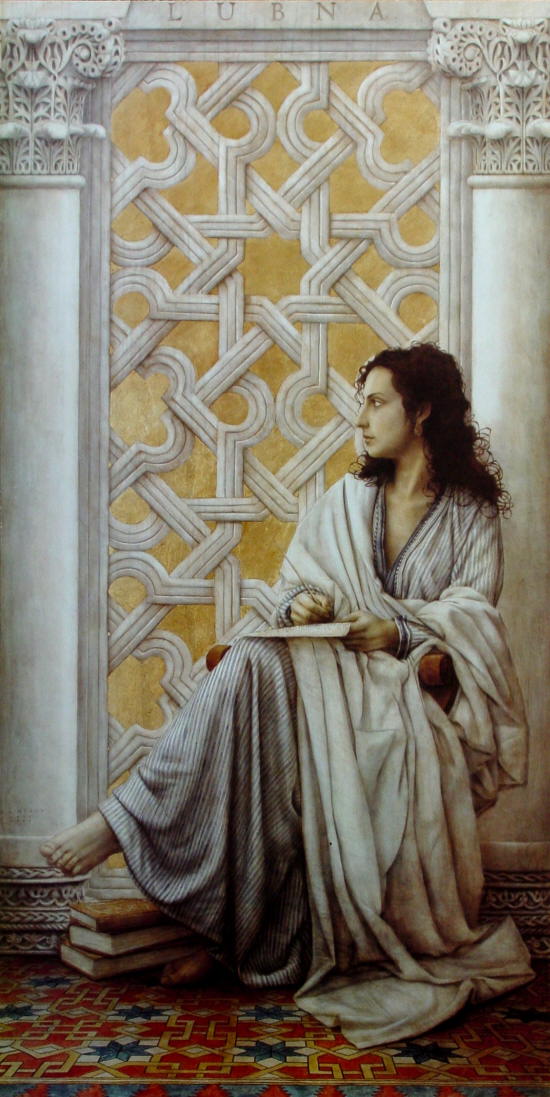
Lubna of Córdoba
Knowledge base stats:
Talk channels stats:
Members stats:
Lubna of Córdoba
Lubna of Córdoba (Lubna Al-Qortobia, Arabic: لبنى القرطبية) was an Andalusian intellectual, mathematician and poet of the second half of the 10th century known for the quality of her writing and her excellence in the sciences. Lubna was born into slavery and raised within the Madīnat al-Zahrā palace. She then pursued a career within the palace as part of Al-Hakam II's team of copyists.
Little to no information is known about Lubna’s upbringing. Most accounts available are historian and scholar speculations based on facts about women in a similar position during the 11th century in Al-Andalus.
Lubna was born within the Madīnat al-Zahrā, under the rule of the caliph Abd al-Rahman III, which began in 929. During his reign the number of enslaved people in Córdoba increased. Lubna was enslaved from birth.
José Miguel Puerta Vílchez of the University of Granada, claims that Lubna's father was caliph Abd al-Rahman III, which would make her one of his sixteen daughters. Although records show the names of his 11 sons, the names of his daughters remain unwritten, except for daughters Hind and Wallada. The children of the caliph were typically raised by their enslaved mothers within the royal harem. One example is Al-Hakam II, Abd al-Rahman III's son and heir to the throne, who was born to Marjan, raised within the palace harem, and went on to work alongside Lubna in the library.
Lubna is thought to have had a good education available throughout her life in order to later become an intellectual and a scholar of the caliph's court. Additionally, there were religious motivations which made the practice of educating, freeing, and employing enslaved people more common under Muslim rule.
Lubna started out as a copyist for the library of Al-Hakam II, who rose to power as caliph in 961.
According to Arab chronicles[which?], in the time of Caliph Al-Hakam II, more than 170 literate women could be found in some suburbs of the city; these women were responsible for making copies of valuable manuscripts. This gives an idea of the culture and the role of women during the reign of the Caliph.
Al-Hakam II followed in his father's footsteps by freeing Lubna and appointing her as his resident secretary and scholar. As part of her responsibilities Lubna was also in charge of the library, of which she had expert knowledge gained from her experience of transcribing the manuscripts it held.
Hub AI
Lubna of Córdoba AI simulator
(@Lubna of Córdoba_simulator)
Lubna of Córdoba
Lubna of Córdoba (Lubna Al-Qortobia, Arabic: لبنى القرطبية) was an Andalusian intellectual, mathematician and poet of the second half of the 10th century known for the quality of her writing and her excellence in the sciences. Lubna was born into slavery and raised within the Madīnat al-Zahrā palace. She then pursued a career within the palace as part of Al-Hakam II's team of copyists.
Little to no information is known about Lubna’s upbringing. Most accounts available are historian and scholar speculations based on facts about women in a similar position during the 11th century in Al-Andalus.
Lubna was born within the Madīnat al-Zahrā, under the rule of the caliph Abd al-Rahman III, which began in 929. During his reign the number of enslaved people in Córdoba increased. Lubna was enslaved from birth.
José Miguel Puerta Vílchez of the University of Granada, claims that Lubna's father was caliph Abd al-Rahman III, which would make her one of his sixteen daughters. Although records show the names of his 11 sons, the names of his daughters remain unwritten, except for daughters Hind and Wallada. The children of the caliph were typically raised by their enslaved mothers within the royal harem. One example is Al-Hakam II, Abd al-Rahman III's son and heir to the throne, who was born to Marjan, raised within the palace harem, and went on to work alongside Lubna in the library.
Lubna is thought to have had a good education available throughout her life in order to later become an intellectual and a scholar of the caliph's court. Additionally, there were religious motivations which made the practice of educating, freeing, and employing enslaved people more common under Muslim rule.
Lubna started out as a copyist for the library of Al-Hakam II, who rose to power as caliph in 961.
According to Arab chronicles[which?], in the time of Caliph Al-Hakam II, more than 170 literate women could be found in some suburbs of the city; these women were responsible for making copies of valuable manuscripts. This gives an idea of the culture and the role of women during the reign of the Caliph.
Al-Hakam II followed in his father's footsteps by freeing Lubna and appointing her as his resident secretary and scholar. As part of her responsibilities Lubna was also in charge of the library, of which she had expert knowledge gained from her experience of transcribing the manuscripts it held.
Recent media