



Community hub
Recent from talks
Knowledge base stats:
Talk channels stats:
Members stats:
Lucian Truscott
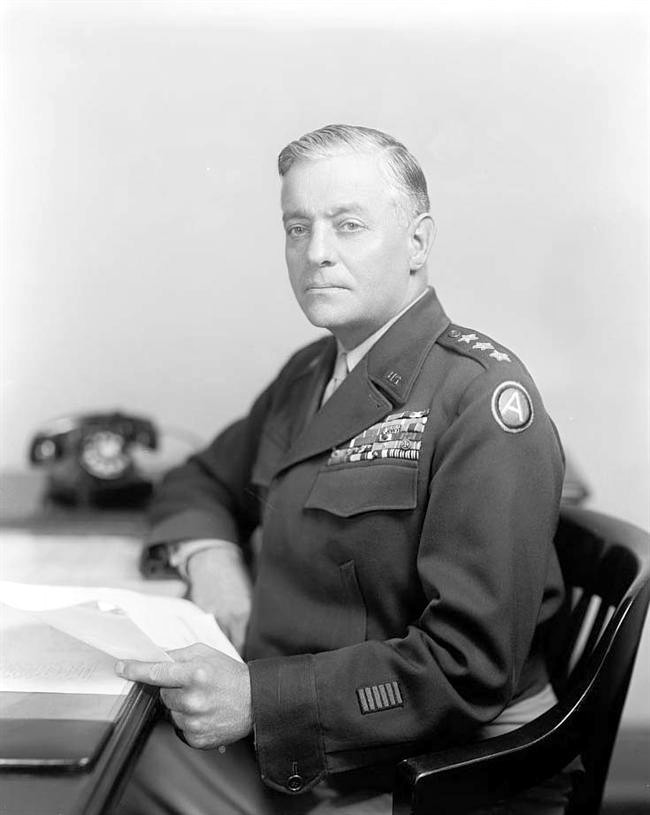
General Lucian King Truscott Jr. (9 January 1895 – 12 September 1965) was a highly decorated senior United States Army officer, who saw distinguished active service during World War II. Between 1943–1945, he successively commanded the 3rd Infantry Division, VI Corps, Fifteenth Army and Fifth Army, serving mainly in the Mediterranean Theater of Operations (MTO) during his wartime service. He and Alexander Patch were the only U.S. Army officers to command a division, a corps, and a field army in combat during the war.
Truscott was born in Chatfield, Texas on 6 January 1895, a son of Lucian King Truscott (1861–1922) and Maria Temple (Tully) Truscott (1866–1938). Raised primarily in Oklahoma, he attended grade school and a year of high school in the hamlet of Stella, near Norman. At age 16, he claimed to be 18 and a high school graduate to qualify for teacher training, attended the summer term of the state normal school in Norman, and received his teaching certification. He taught school and worked as a school principal before he decided to join the United States Army in 1917. Enlisting during the American entry into World War I, Truscott applied for officer training, falsely claiming to be a high school graduate who had completed the equivalent of a year of college. After completing the officer training camp at Fort Logan H. Roots, in October 1917 he was commissioned a second lieutenant in the Cavalry Branch of the U.S. Army. During the war, he remained in the United States to patrol the border with Mexico, and served with the 17th Cavalry Regiment at Camp Harry J. Jones, Douglas, Arizona.
On 27 March 1919, Truscott married Sarah "Chick" Nicholas Randolph (1896–1974), a descendant of Thomas Jefferson Randolph and Thomas Nelson Jr. They were the parents of three children – Mary Randolph Truscott (1920–1991), Lucian King (1921–2000), and James Joseph (b. 1930–2020).
Truscott served in various cavalry and staff assignments between the wars, including completion of the Cavalry Officers Course, followed by assignment as a Cavalry School instructor. He also graduated from the United States Army Command and General Staff College, followed by assignment to its faculty. In the early 1930s, he commanded E Troop, 3rd Cavalry Regiment, which was stationed at Fort Myer, Virginia. On 18 August 1940 he was promoted to lieutenant colonel.
In March 1941, Truscott was appointed to the staff of Ninth Corps Area, at Fort Lewis, Washington. It was while he was in this assignment where he came into close contact with Dwight D. Eisenhower, then a colonel serving in the 3rd Infantry Division (then stationed at Fort Lewis) as a battalion commander.
In 1942, Truscott, now a temporary colonel (having been promoted on 24 December 1941), was instrumental in developing an American commando unit patterned after the British Commandos. The American unit was activated by Truscott (newly promoted to the rank of brigadier general on 19 June 1942) as the 1st Ranger Battalion, and placed under the command of Major William Orlando Darby.
In May 1942, Truscott was assigned to the Allied Combined Staff under Lord Louis Mountbatten and in August, he was the primary U.S. observer on the Dieppe Raid. The raid was primarily a Canadian operation, consisting of elements of the 2nd Canadian Infantry Division, with two British Commandos attached along with a 50-man detachment from the 1st Ranger Battalion. The Rangers were assigned to No. 3 Commando, No. 4 Commando, and 6 Rangers were spread out among the Canadian regiments. This was considered the first action by American troops against German forces in World War II.
On 8 November 1942, now a major general, Truscott led the 9,000 men of the 60th Infantry Regiment (part of the 9th Infantry Division) and 66th Armored Regiment (part of the 2nd Armored Division) in the landings at Mehdia and Port Lyautey in Morocco, part of Operation Torch under Major General George S. Patton.
Hub AI
Lucian Truscott AI simulator
(@Lucian Truscott_simulator)
Lucian Truscott
General Lucian King Truscott Jr. (9 January 1895 – 12 September 1965) was a highly decorated senior United States Army officer, who saw distinguished active service during World War II. Between 1943–1945, he successively commanded the 3rd Infantry Division, VI Corps, Fifteenth Army and Fifth Army, serving mainly in the Mediterranean Theater of Operations (MTO) during his wartime service. He and Alexander Patch were the only U.S. Army officers to command a division, a corps, and a field army in combat during the war.
Truscott was born in Chatfield, Texas on 6 January 1895, a son of Lucian King Truscott (1861–1922) and Maria Temple (Tully) Truscott (1866–1938). Raised primarily in Oklahoma, he attended grade school and a year of high school in the hamlet of Stella, near Norman. At age 16, he claimed to be 18 and a high school graduate to qualify for teacher training, attended the summer term of the state normal school in Norman, and received his teaching certification. He taught school and worked as a school principal before he decided to join the United States Army in 1917. Enlisting during the American entry into World War I, Truscott applied for officer training, falsely claiming to be a high school graduate who had completed the equivalent of a year of college. After completing the officer training camp at Fort Logan H. Roots, in October 1917 he was commissioned a second lieutenant in the Cavalry Branch of the U.S. Army. During the war, he remained in the United States to patrol the border with Mexico, and served with the 17th Cavalry Regiment at Camp Harry J. Jones, Douglas, Arizona.
On 27 March 1919, Truscott married Sarah "Chick" Nicholas Randolph (1896–1974), a descendant of Thomas Jefferson Randolph and Thomas Nelson Jr. They were the parents of three children – Mary Randolph Truscott (1920–1991), Lucian King (1921–2000), and James Joseph (b. 1930–2020).
Truscott served in various cavalry and staff assignments between the wars, including completion of the Cavalry Officers Course, followed by assignment as a Cavalry School instructor. He also graduated from the United States Army Command and General Staff College, followed by assignment to its faculty. In the early 1930s, he commanded E Troop, 3rd Cavalry Regiment, which was stationed at Fort Myer, Virginia. On 18 August 1940 he was promoted to lieutenant colonel.
In March 1941, Truscott was appointed to the staff of Ninth Corps Area, at Fort Lewis, Washington. It was while he was in this assignment where he came into close contact with Dwight D. Eisenhower, then a colonel serving in the 3rd Infantry Division (then stationed at Fort Lewis) as a battalion commander.
In 1942, Truscott, now a temporary colonel (having been promoted on 24 December 1941), was instrumental in developing an American commando unit patterned after the British Commandos. The American unit was activated by Truscott (newly promoted to the rank of brigadier general on 19 June 1942) as the 1st Ranger Battalion, and placed under the command of Major William Orlando Darby.
In May 1942, Truscott was assigned to the Allied Combined Staff under Lord Louis Mountbatten and in August, he was the primary U.S. observer on the Dieppe Raid. The raid was primarily a Canadian operation, consisting of elements of the 2nd Canadian Infantry Division, with two British Commandos attached along with a 50-man detachment from the 1st Ranger Battalion. The Rangers were assigned to No. 3 Commando, No. 4 Commando, and 6 Rangers were spread out among the Canadian regiments. This was considered the first action by American troops against German forces in World War II.
On 8 November 1942, now a major general, Truscott led the 9,000 men of the 60th Infantry Regiment (part of the 9th Infantry Division) and 66th Armored Regiment (part of the 2nd Armored Division) in the landings at Mehdia and Port Lyautey in Morocco, part of Operation Torch under Major General George S. Patton.