Hubbry Logo
Ludgate HillLudgate HillMain
Open search
Ludgate Hill
Community hub
Ludgate Hill
logo
8 pages, 0 posts
0 subscribers
Be the first to start a discussion here.
Ludgate Hill
Ludgate Hill
from Wikipedia

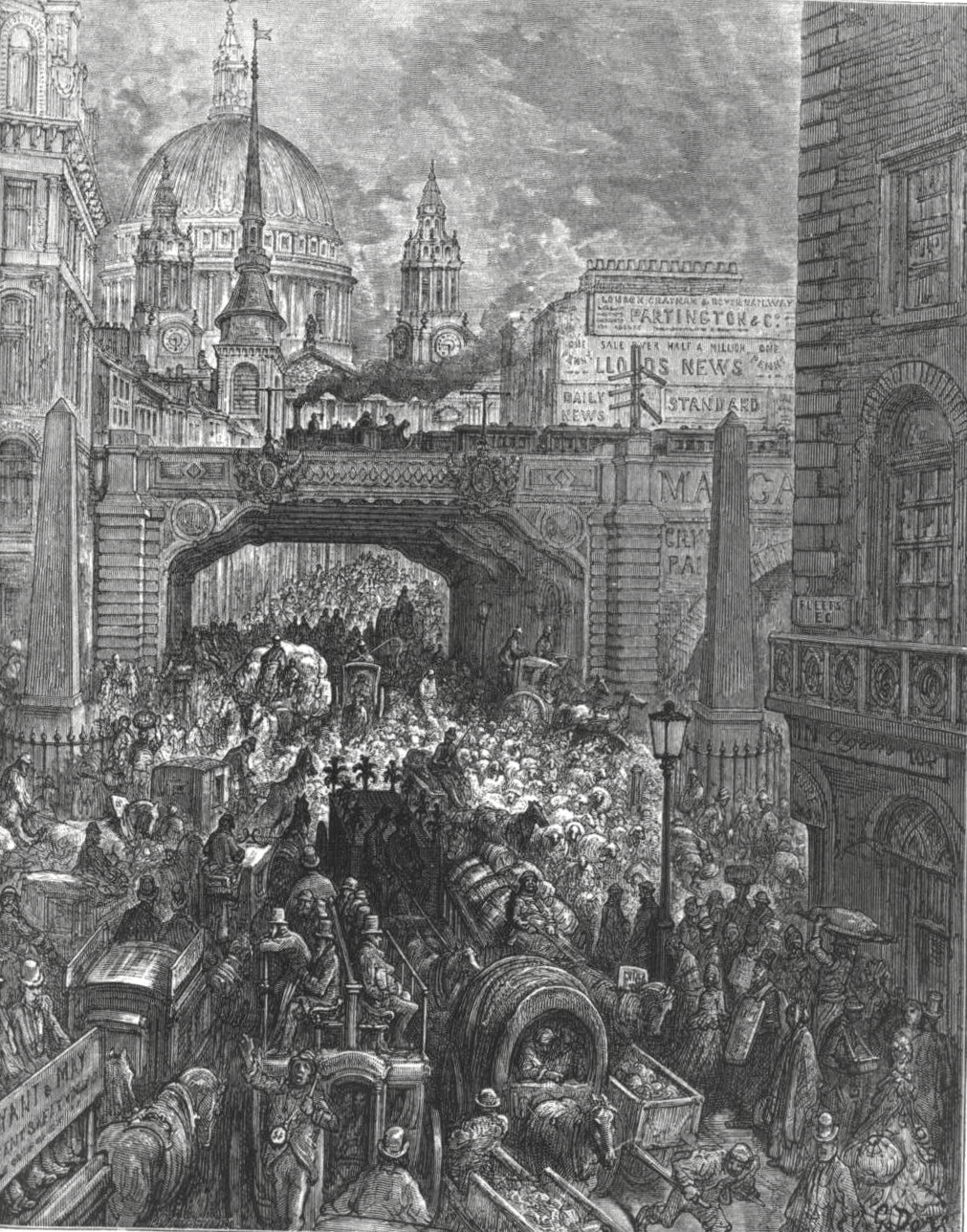
Ludgate Hill – A block in the street, by Gustave Doré (1872)
Ludgate Hill looking east from the foot of Fleet Street, 1970
Ludgate Hill in 2006

Ludgate Hill is a street and surrounding area, on a small hill in the City of London, England. The street passes through the former site of Ludgate, a city gate that was demolished – along with a gaol attached to it – in 1760.

The area includes St Paul's Cathedral. The modern cathedral, it has been claimed, was built on a site that – during the Roman British era of the early first millennium – was occupied by a major Roman temple, dedicated to the goddess Diana.

Ludgate Hill itself is traditionally regarded as one of a trio of hills in Central London, the others being Tower Hill and Cornhill. The highest point in the City is just north of St Paul's, at 17.6 metres (58 ft) above sea level.[1]

The modern street named Ludgate Hill, which was previously a much narrower thoroughfare named Ludgate Street, runs between St Paul's Churchyard and Ludgate Circus (built in 1864), at which point it becomes Fleet Street.

Etymology

[edit]

Ludgate is generally accepted to derive from the Old English term "hlid-geat"[2][3][4][5][6] from "hlid" ("lid, cover, opening, gate")[7] and "geat" or "gæt" ("gate,[2] opening, passage")[8] and was a common Old English compound meaning "postern" or "swing gate"[2][3][4][6] and survives in various place names across England[4] as well as in surnames.[9]

Ludgate is mentioned in Geoffrey of Monmouth's Historia Regum Britanniae, written around 1136. According to the pseudohistorical work[10][11] the name comes from the mythic Welsh king Lud son of Heli whom he claims also gave his name to London.[12] The Cronycullys of Englonde tell us of an early king of Britain: "he lete make a fayre gate and called hit Lud Gate after his name" in the year 66 BC, but it is more likely that the Romans were the first to build it, and that it is simply named after him. One proposed derivation, entirely prosaic, is that the name is a variation on "Fleodgaet", or "Fleet-gate".

Description

[edit]

Many small alleys on Ludgate Hill were swept away in the mid 1860s to build Ludgate Hill railway station between Water Lane and New Bridge Street, a station of the London, Chatham and Dover Railway. It was closed to passengers in 1929 and the railway bridge and viaduct between Holborn Viaduct and Blackfriars stations was demolished in 1990 to enable the construction of the City Thameslink railway station in a tunnel. This also involved the regrading of the slope of Ludgate Hill at the junction.

There is a blue plaque near the bottom of the hill with these words: "In a house near this site was published in 1702 The Daily Courant first London daily newspaper".

About halfway up Ludgate Hill is the church of St Martin, Ludgate, once physically joined to the Ludgate.

Paternoster Square, home of the London Stock Exchange since 2004, is on the hill, immediately to the north of St Paul's Cathedral.

Literary associations

[edit]

At the bottom of Ludgate Hill, on the north side, is Limeburner Lane. This may sound like a quaint survival from medieval times, but it was actually constructed in the 1990s, where Seacoal Lane used to be. This was the location of the Bell Savage Inn, first mentioned in 1452 where plays were performed. According to surveyor John Stow the name was derived from Isabella Savage, but Addison claimed it was "La belle Sauvage", a woman in the wilderness. The clown Richard Tarlton used to perform here. It is mentioned in Thomas Hughes' Tom Brown's Schooldays and Charles Dickens' The Pickwick Papers. In October 1684, a "Rynoceros lately brought from the East Indies" was put on show there.[13] The inn was demolished in 1873. In 1851, part of it was rented out to John Cassell (1817–1865), a notable publisher. At this time it was still called La Belle Sauvage Yard and the firm of Cassell used "la Belle Sauvage" in some of their imprints.

The prison is mentioned in Daniel Defoe's Roxana: The Fortunate Mistress.

From 1731, the "London Coffee House" was next to St Martin's, Ludgate, at 24–26 Ludgate Hill. It was frequented by Joseph Priestley and Benjamin Franklin. When the juries at the Old Bailey failed to reach a verdict, they were housed here overnight. In 1806, a Roman hexagonal altar dedicated to Claudia Martina by her husband, now in the Guildhall, was found here together with a statue of Hercules.[14] The London Coffee House was closed in 1867, and is now occupied by a pub called "Ye Olde London".

Edmund Spenser's The Shepheardes Calender was printed by Hugh Singleton at the sign of the "Gylden tunne" in Creed Lane in 1579. John Evelyn lived in the Hawk and Pheasant on Ludgate Hill in 1658–59.

The Blackfriars, or Dominicans, first came to London in 1221. In 1278, they moved from Holborn to an area south of Ludgate, where they built a friary. By 1320, they had demolished the Roman wall to build a new wall for the friary. This was demolished at the Reformation, but the name persisted – in 1596 James Burbage, the manager of Shakespeare's acting company, The Lord Chamberlain's Men, acquired the lease to a part of the property that was already being used as a theatre. His intention appears to have been to have the Lord Chamberlain's Men act here. However, local opposition meant that the more fashionable children's acting companies who were already performing here continued to act here for some years instead. It wasn't until 1609 that Shakespeare's company of actors (by then called The King's Men) was able to act at the Blackfriars Theatre. In 1613, Shakespeare bought the Blackfriars gate-house.

Pageantmaster Court is almost opposite St. Martin's. The name is not medieval but dates from 1993. However, to the west is King's Arms Court, which existed until recently. Grinling Gibbons lived there. According to Stow, the gate acquired statues in 1260. In the reign of Edward VI the heads were "smitten off" and a few years later "Queen Mary did set new heads upon their old bodies again".[15]

William Hone, journalist and publisher, had an office near Ludgate Hill and the Old Bailey during the mid 1800s.

Notable residents

[edit]

References

[edit]
[edit]
Revisions and contributorsEdit on WikipediaRead on Wikipedia
from Grokipedia
Ludgate Hill is a historic street and elevated ridge in the , , extending approximately 0.3 miles (0.5 km) from Circus at the eastern end of uphill to St. Paul's Churchyard, where it culminates at the summit occupied by . As one of London's three ancient hills—alongside Cornhill and —Ludgate Hill rises to about 58 feet (18 meters) above sea level, making it one of the highest points in the and a prominent topographical feature since Roman times. The hill's name derives from , the westernmost gate in the Roman city wall of , constructed around 200 AD as a fortified entrance near the present-day site of St. Paul's; this gate, rebuilt in the medieval period, served as a for freemen debtors from 1378 until its in 1760 to widen the street. At the base of the hill, the now-buried historically flowed, marking the boundary with Farringdon Ward Without and contributing to the area's early development as a key route from the city's center westward. The hill's significance deepened in the early medieval era, when the first St. Paul's Cathedral was established atop it in 604 CE, possibly on a site used for Christian worship since Roman times; this location leveraged the elevation for visibility and symbolic prominence, positioning the cathedral as the focal point of London's religious, political, and social life through the . Old St. Paul's, built from 1087 to 1314, dominated the skyline until its destruction in the in 1666, after which Sir designed the present cathedral, completed in 1710, which remains the hill's defining landmark and a . Nearby, Wren also rebuilt St. Martin Ludgate in the 1670s, its distinctive spiky steeple contrasting with the cathedral's dome and underscoring the area's post-fire reconstruction. From the through the early , Ludgate Hill emerged as a hub for the and industries, fueled by its proximity to St. Paul's Churchyard—long a center for booksellers—and the rising literacy rates that spurred demand for books, newspapers, satirical pamphlets, and illustrated broadsheets. Shops along the street displayed symbolic signs, such as teapots for teahouses, while the area's role in persisted until the mid-1900s, when began to eclipse print; notable included Ludgate Hill railway station (opened 1865, closed 1929), which facilitated commuter access until its demolition in the 1990s. Today, Ludgate Hill forms part of the London Cycle Network, with ongoing conservation efforts in the Conservation Area preserving its architectural heritage amid modern commercial and pedestrian use.

Geography

Location and Topography

Ludgate Hill is located at approximately 51.514°N 0.103°W within the , the historic core of the British capital, and forms one of the three principal ancient hills in the area, alongside Cornhill to the east and to the southeast. The of Ludgate Hill features a modest elevation, with its highest point reaching 17.6 meters above just north of the central area. This natural rise in the landscape provided a foundational prominence in the prehistoric and early urban development of the region. Geologically, Ludgate Hill is integrated into the broader terrain, characterized by gravel and clay deposits that shaped the area's early settlement patterns. Its elevated position relative to the surrounding floodplain offered strategic high ground, facilitating crossings over the River Thames and influencing the site's selection for ancient fortifications and structures, traditionally believed to include a dedicated to Diana, though no archaeological evidence supports this.

Route and Key Boundaries

Ludgate Hill serves as a prominent east-west thoroughfare in the , extending approximately 400 meters from St Paul's Churchyard at its eastern terminus to Ludgate Circus at the western end. This linear route was formalized in its contemporary configuration around , coinciding with the development of Ludgate Circus at the junction with to accommodate growing urban traffic and infrastructure needs. The street's path ascends gently westward, providing a direct processional approach toward . The key boundaries of Ludgate Hill delineate a compact urban zone integral to the surrounding street grid. To the north, it is bordered by Ave Maria Lane and Paternoster Row, which connect northward to areas historically associated with the book trade and precincts. On the southern side, the boundary aligns with Carter Lane, an established residential corridor that parallels the hill and links to the legal district of the Temples. At the eastern extremity near St Paul's Churchyard, Ludgate Hill seamlessly integrates with Newgate Street, facilitating connectivity to the broader northern network of the . Within the urban fabric, Ludgate Hill serves as a primary east-west , channeling traffic and movement between key commercial and institutional hubs in the financial . The hill's modest elevation, reaching about 17.6 meters above at its peak near the , contributes to its strategic visibility and historical defensibility.

History

Origins and Etymology

The name Ludgate Hill derives from the nearby , which most etymologists trace to the terms hlidgeat or hlydgeat, meaning "" or "swing gate," referring to a back or side entrance in fortifications. This etymology first appears in records as Lutgata between 1100 and 1135, evolving to Ludgate by 1235. An alternative interpretation, recorded by chronicler , suggests an earlier form Fludsgate or "flood gate," possibly alluding to the proximity of the River Fleet, which historically flowed nearby and may have influenced the site's early nomenclature. Mythic origins attribute the name to , a legendary pre-Roman British ruler described as the son of Heli in Geoffrey of Monmouth's 12th-century . According to this account, Lud constructed the gate around 66 BC and named it Portlud in British or Ludesgata in Saxon tongue; upon his death, his body was reportedly preserved and buried adjacent to the structure, perpetuating the association with the hill. This narrative, echoed in medieval chronicles like Stow's A Survey of London (1598), blended with pseudo-history to imbue the site with ancient royal significance, though modern scholarship views it as legendary rather than factual. Roman connections suggest the hill's name may stem from a pre-Anglo-Saxon or temple site, as served as one of the original western entrances to , constructed around 200 AD to facilitate access to the fortified settlement. Archaeological indicates an ancient origin for the gate, predating Saxon naming conventions, while holds that a dedicated to the goddess Diana occupied the hill's summit, later influencing the location of . These elements underscore Ludgate Hill's role as an early defensive feature in the city's layout.

Medieval and Early Modern Developments

Ludgate, the westernmost gate in London's defensive walls, originated in the Roman period around AD 200, serving as a key entry point along the road from toward the Thames. It was rebuilt in the medieval era, with significant reconstruction in using materials from demolished Jewish houses during the barons' occupation of the city in support of the . Further rebuilding occurred in 1260 amid ongoing fortifications, and in 1586 under city mason William Kerwin, who incorporated statues of Queen Elizabeth I and the legendary , enhancing its symbolic role. From 1378, the upper chambers of functioned as a for freemen debtors, expanded in 1454 by benefactor Agnes Foster to accommodate more inmates, reflecting the gate's dual defensive and institutional purposes. As part of the Roman city wall constructed around AD 200 and renewed in the medieval period to over 10 meters in height, integrated with Ludgate Hill's topography, aligning the fortifications along the natural rise to protect the western approach to the city until the . The Dominican friary known as Blackfriars, established in 1221 by de Burgh just east of near the Fleet River, marked a major institutional development on the hill. Initially located in , the friars relocated in 1276 to a site granted by King Edward I, including the former Baynard area for their church and cloisters. Expansion necessitated alterations to the city wall; in 1283–1284, the friars were permitted to demolish a portion, prompting the city to rebuild it farther east around the precinct, a process incomplete by 1315 despite customs revenues allocated for its completion. The friary, which included St. Ann's Church and extensive priory buildings, thrived until its dissolution on November 12, 1538, under Henry VIII's reforms, after which its lands were repurposed. Within the former Blackfriars precinct, the second opened in 1609 after James Burbage's sons and acquired and converted the property in 1596, initially used by child actors but later leased to the King's Men, Shakespeare's company. This indoor venue, accommodating about 700 spectators with candlelit performances, hosted key plays including late Shakespearean works like , contrasting with outdoor theaters like the . It operated until closure in 1642 at the onset of the , when Puritan authorities suppressed public playacting, and the structure was demolished in 1655. The Bell Savage Inn, established around 1452 on the north side of Ludgate Hill, emerged as a prominent medieval feature, functioning as a with 40 rooms and stables for 100 horses, while also serving as an early venue for dramatic performances before dedicated playhouses. In 1684, it gained notoriety for exhibiting a imported from the , the first such animal seen in Britain, drawing crowds to the site. Ludgate itself was finally demolished in 1760 to alleviate , with its materials auctioned for £148 and the statue relocated to St. Dunstan-in-the-West church; the prison inmates were transferred to a .

19th to 20th Century Changes

During the , Ludgate Hill underwent significant transformations to accommodate growing urban traffic and infrastructure needs. In 1864, Ludgate Circus was established as a major traffic junction at the intersection of Ludgate Hill, , and New Bridge Street, with surrounding concave-arched façades constructed from Haytor granite between 1864 and 1875 to enhance the area's connectivity and aesthetic appeal. This development marked a shift from the medieval Ludgate's site, evolving it into a modern circulatory hub that improved access to . The era also saw the demolition of historic structures, including the Bell Savage Inn on the north side of Ludgate Hill, which was razed in 1873 to facilitate the construction of a railway viaduct, reflecting the prioritization of rail expansion over preservation. The railway's arrival further reshaped the landscape. Ludgate Hill railway station opened on June 1, 1865, serving as the City terminus for the London, Chatham and Dover Railway, with a viaduct spanning the street to connect to broader networks despite initial opposition from the over aesthetic concerns. The station operated until its closure to passengers on March 3, 1929, due to low usage and redundancy amid competing lines, after which the site remained derelict; the structures were fully demolished in 1990 to make way for the City Thameslink station, underscoring the area's ongoing adaptation to transport evolution. A blue plaque at 12 Ludgate Circus, erected by the Corporation of London, commemorates the nearby publication of The Daily Courant in 1702, London's first daily newspaper, highlighting the site's enduring journalistic legacy amid 19th-century commemorative efforts. The 20th century brought further upheaval, particularly during World War II, when the Blitz devastated parts of Ludgate Hill and adjacent areas; on September 15, 1940, a unexploded bomb prompted the closure of the street for disposal near St. Paul's Cathedral, while broader raids in 1940-1941 damaged surrounding infrastructure, including the near-total destruction of Paternoster Square to the north by incendiary and high-explosive bombs. Post-war rebuilding in the 1960s focused on utilitarian reconstruction, with Paternoster Square redeveloped into a modernist precinct of multi-story office blocks like the 18-story Sudbury House, designed to restore commercial functionality but often criticized for its stark Brutalist style that clashed with St. Paul's historic surroundings. This phase emphasized rapid economic recovery over architectural harmony, setting the stage for later 1990s redevelopment.

Landmarks and Architecture

Religious and Historical Sites

St. Paul's Cathedral stands as the preeminent religious landmark on Ludgate Hill, its elevated position on the hill's summit enhancing its visual and spiritual dominance over the surrounding cityscape. The origins of a cathedral on this site trace back to 1087, when construction began on the first Norman structure following the destruction of earlier Anglo-Saxon buildings by fire. The current edifice, designed by in the style, was constructed between 1675 and 1710 after the razed the medieval predecessor, incorporating innovative dome engineering that symbolizes resilience and faith. This architectural masterpiece serves as the mother church of the , hosting significant ecclesiastical events and preserving a continuum of Christian worship amid urban transformation. Adjacent to the cathedral's shadow, St. Martin within Ludgate represents a longstanding with deep historical roots, first recorded around 1138 as a medieval foundation within the city's ancient walls. Destroyed in the 1666 Great Fire, it was rebuilt between 1677 and 1684 under Wren's oversight, possibly with contributions from his associate , resulting in a compact Greek-cross plan topped by a slender lead spire that punctuates the Ludgate Hill skyline. The interior retains much of its 17th-century character, including original woodwork and a . The cleric and travel writer served as rector from 1614 to 1626 and documented global explorations in his influential works. Ludgate Hill also bears physical traces of London's defensive past through remnants of the Roman city walls and Ludgate foundations, underscoring the area's layered historical significance. The church of St. Martin within rests on Roman-era foundations, with sections of the 2nd-century wall visible in nearby basements and excavations, illustrating the hill's role as a fortified since antiquity. A on the church wall commemorates the site's proximity to the medieval Ludgate prison, used for debtors from the until its demolition in 1760. Further down the hill, another marks the publication site of in 1702, Britain's first daily newspaper, highlighting the transition from medieval enclosures to early modern information hubs while preserving the street's historical narrative.

Commercial and Public Structures

Paternoster Square, immediately north of Ludgate Hill, traces its origins to the medieval Paternoster Row, an area developed for trade in religious artifacts, with significant reconstruction in the 17th century after the in 1666. The square was largely destroyed by bombing in 1940 during and rebuilt in a modernist style during the 1950s and 1960s. A major redevelopment in the and early transformed it into a contemporary business district, featuring low-rise buildings with stone facades and a central plaza, owned by Europe. The site has hosted the London since 2004 at 10 Paternoster Square, a glass-fronted pavilion known as King Edward Court, designed by Eric Parry Architects to integrate with the historic surroundings. Historically, Ludgate Hill was home to several inns that facilitated and . The Bell Savage Inn, first recorded in 1453, operated as a and early playhouse venue until its demolition in 1873 to accommodate a railway . Public offices along Ludgate Hill emphasize administrative and professional functions. At 29 Ludgate Hill, a comprehensive refurbishment completed in September 2025 restored approximately 33,500 square feet of Category A across six floors, preserving the period facade while adding modern amenities such as breakout areas, meeting rooms, and energy-efficient systems. Similarly, 100 Ludgate Hill is undergoing feasibility studies for extensions that would expand floorplates and introduce enhanced amenities, including collaborative spaces and features, to meet contemporary workplace demands. These structures underscore Ludgate Hill's role in London's commercial landscape, bolstered by its proximity to , which adds prestige to the surrounding business environment.

Transportation Features

Ludgate Circus, located at the base of Ludgate Hill, has served as a major road junction since its formation between 1864 and 1869, where , Newgate Street, Ludgate Hill, Farringdon Street, St. Bride Street, and Bridewell Place converge. This intersection replaced the historic Fleet Bridge over the now-underground and functions as a key traffic management hub within the Road Network, facilitating vehicular and cycling flows along the ancient processional route to . The area's railway infrastructure began with the opening of Ludgate Hill station on 1 June 1865 by the London, Chatham and Dover Railway as a City terminus for commuter services from south London, following a temporary setup in 1864 and delays due to concerns over the supporting viaduct. The station handled local passenger traffic and later accommodated services from the London and South Western Railway and Great Northern Railway after they contributed to extension costs, but it declined with the rerouting of express trains and closed on 30 October 1929. This facility was succeeded by City Thameslink station, which opened on 29 May 1990 (initially as St. Paul's Thameslink) to support the expanded network, featuring two underground platforms accessed via lifts from Ludgate Hill for step-free connectivity. The station's southern entrance directly opens onto Ludgate Hill, enhancing commuter access midway up the hill. Ludgate Hill forms part of the principal road network linking to the , which terminates near , supporting east-west traffic through the City. Nearby , approximately 500 meters south, provides overground services and access on the Circle and lines, with pedestrian routes connecting via Queen Victoria Street. Additionally, pedestrian pathways from the hill lead to the Millennium Bridge via Peter's Hill, offering direct access across the Thames to the since the bridge's public opening in 2000.

Cultural and Literary Significance

Literary References

Ludgate Hill features prominently in early modern English literature through allusions to its legendary origins and urban topography. In Edmund Spenser's epic poem The Faerie Queene (1590), the hill is evoked via references to the mythic King Lud, the supposed founder of London who rebuilt the city's gates, including Ludgate at the hill's base; this connection underscores themes of British antiquity and chivalric heritage in Book II, Canto X, where the gate symbolizes civic renewal amid contemporary political tensions. Similarly, John Stow's Survey of London (1598) provides a detailed topographical account of Ludgate Hill as a vital western thoroughfare in Farringdon Ward Within, describing its alignment from St. Paul's Cathedral to the Fleet River, its role in medieval processions, and its prison history for freemen debtors since 1378, blending historical chronicle with literary topography to preserve London's evolving streetscape. By the 18th century, Daniel Defoe's travelogue A Tour Thro' the Whole Island of Great Britain (1724) captures Ludgate Hill's commercial vibrancy as part of London's expansive urban grid, portraying it as a bustling extension of the and Street, filled with spreading buildings that merge into a continuous thoroughfare toward , emblematic of the city's mercantile energy and unchecked growth. This depiction influenced later prose, notably in the Romantic era, where reflects on the hill's visual prominence in his poetry and prose descriptions of London; in notes accompanying The Ecclesiastical Sonnets (1821), he recalls the "elegant line of the curve of Ludgate Hill" terminating an avenue toward the "huge and majestic form" of , evoking the hill's role in framing the city's monumental skyline against industrial encroachment. Charles Dickens frequently invoked Ludgate Hill in his Victorian novels to convey the clamor and grit of mid-19th-century . In Barnaby Rudge (1841), the hill appears amid the , with crowds surging from Ludgate Hill toward in a chaotic mass, illustrating the area's centrality to urban unrest and the fragility of . Likewise, in Little Dorrit (1857), protagonist Arthur Clennam gazes from a coffee-house window on Ludgate Hill, enveloped by "ten thousand responsible houses" and a Sunday pall of gloom, symbolizing the soul-crushing routine of the modern city and themes of imprisonment beyond physical bars. The Bell Savage Inn, a historic house on Ludgate Hill, recurs in literary tales and plays as a site of and intrigue. Elizabethan inn-yard at the Bell Savage hosted early , including works by touring companies, embedding the location in dramatic lore as a hub for popular entertainment before dedicated playhouses like the . Its fame endures in 17th-century exhibition narratives, such as the 1684 arrival of England's first , displayed there for public viewing at two shillings per person, inspiring tales of exotic wonder that echoed in later prose like Dickens's sketches of London's curiosities.

Notable Events and Art Installations

Ludgate Hill has a rich theatrical heritage dating back to the medieval period. The Bell Savage Inn, located on the north side of Ludgate Hill since at least the early , served as one of London's earliest playhouses, hosting performances in its courtyard from around 1575 to 1594. This inn-yard venue was among the first to stage commercial plays, contributing to the development of in the city before dedicated playhouses emerged. Later, the , an indoor playhouse built in 1596 within the former Dominican priory precincts near Ludgate Hill, became a key venue for the King's Men, William Shakespeare's acting company, from 1609 until its closure in 1642 during the . The theater hosted premieres of several Shakespeare plays, such as and , and marked a shift toward more intimate, candlelit performances for elite audiences during the winter season. In the early , Ludgate Hill gained prominence in the of British journalism with the launch of the Daily Courant on March 11, 1702, from premises near Fleet Bridge at the base of the hill. Published by Edward Mallet and his wife Elizabeth, this tri-weekly (later daily) paper was the first of its kind in England, pioneering a concise format focused on foreign news without editorial commentary. The publication's location underscored Ludgate Hill's role as a hub for printing and dissemination of information in an era when Fleet Street and its extensions were central to the trade. During , Ludgate Hill and its surrounding cultural sites endured significant damage from bombing raids. , the hill's dominant landmark, was struck multiple times, including a major incendiary attack on October 10, 1940, that caused fires and structural harm but spared the dome through vigilant firefighting efforts. The devastating raid of December 29, 1940, further scarred the area, destroying nearby medieval and early modern buildings and disrupting cultural activities, though survival became a symbol of national resilience. The hill has also featured in modern ceremonial events, notably royal processions. On July 29, 1981, the wedding procession of Prince Charles and Lady Diana Spencer passed along Ludgate Hill en route to , drawing massive crowds and highlighting the site's enduring ceremonial importance. In contemporary times, Ludgate Hill hosted a notable installation by in August 2024, transforming a sentry box into an aquarium-like scene by spray-painting a of fish on the glass panels. The artwork, titled Piranhas, appeared overnight and was confirmed by the artist via , sparking public discourse on authority and environmental themes. In August 2025, the intact piece was relocated to secure storage by the for eventual permanent display at the new London Museum in Smithfield, preserving it as a .

Notable People

Historical Residents

One prominent historical resident of Ludgate Hill was the renowned woodcarver Grinling Gibbons (1648–1721), who established his workshop and home there in the early 1670s after moving from Deptford. Gibbons resided at the Bell Savage inn on Ludgate Hill by 1672, a location that facilitated his commissions for intricate limewood carvings in nearby ecclesiastical sites, including the choir stalls and reredos at St Paul's Cathedral and decorative elements in churches such as St James Garlickhythe and St Mary Abchurch. His work on Ludgate Hill exemplified the Restoration-era revival of ornamental craftsmanship, blending natural motifs with architectural grandeur. John Evelyn (1620–1706), the influential diarist and horticulturalist, briefly resided on Ludgate Hill at the Hawk and Pheasant inn during 1658–1659, a period marked by his observations of London's urban life and religious tensions. From this vantage, Evelyn documented the area's bustling commercial atmosphere and its proximity to St Paul's, later referencing the hill in his vivid accounts of the in 1666, where he walked through the devastated streets including Ludgate Hill en route to surveying the destruction. His stay underscored Ludgate Hill's role as a transient hub for intellectuals amid the era's uncertainties. In the early 19th century, William Hone (1780–1842), a radical bookseller, publisher, and satirist, operated his shop at 45 Ludgate Hill starting in 1817, serving as both his business and personal base for over two decades. From this address, Hone produced influential political pamphlets and parodies, including the bestselling The Political House that Jack Built (1819), which critiqued government corruption through accessible verse and illustrations, contributing to public discourse on reform. His Ludgate Hill premises became a gathering point for dissenters, reflecting the street's evolution into a center for and radical thought during the Regency period.

Associated Figures

Charles Dickens, the renowned Victorian novelist, maintained a strong literary association with Ludgate Hill through his frequent visits and vivid depictions in his works, though he did not reside there. In A Tale of Two Cities (1859), he describes characters descending Ludgate Hill toward Fleet Street, capturing the area's bustling atmosphere as a narrative backdrop for urban life in London. Similarly, in Little Dorrit (1857), he references a coffee house on Ludgate Hill, drawing from his observations of the street's commercial vibrancy near St. Paul's Cathedral. In the , Ludgate Hill's proximity to linked it to key figures in global following the London Stock Exchange's relocation there in 2004. Clara Furse, who served as Chief Executive of the London Stock Exchange from 2001 to 2009, spearheaded the move to the new headquarters at 10 , enhancing the area's role as a financial hub adjacent to Ludgate Hill. Under her leadership, the exchange modernized its operations in this location, solidifying ties between the hill's historic landscape and contemporary capital markets. The area's artistic connections extended into the 21st century with street artist 's installation on Ludgate Hill in August 2024. transformed a sentry box on the hill into a depicting a school of piranhas swimming inside the glass structure, part of a series of animal-themed works appearing across that week. The piece, confirmed by via his account, was later relocated to Yard for preservation, highlighting Ludgate Hill's role in contemporary urban art interventions. Ludgate Hill's adjacency to Fleet Street also fostered associations with 20th-century journalists and editors whose work evolved from the traditions of early publications like the Daily Courant. Charles Wintour (1917–1999), editor of the London Evening Standard from 1959 to 1976, operated from offices and influenced modern British journalism with his emphasis on lively, accessible reporting, shaping the style of newspapers in the vicinity of Ludgate Hill. This legacy continued into the late 20th century with figures like (born 1945), who edited the Daily Telegraph (based on until 1986) and the Evening Standard, contributing to the area's transition from print hubs to digital media influences.

Modern Developments

Urban Renewal and Refurbishments

In the early 2000s, Ludgate Hill underwent significant with the redevelopment of , adjacent to the hill and . Completed between 2003 and 2004, this project transformed a previously fragmented area into a cohesive public plaza featuring modern office buildings, retail spaces, and the relocated . Designed under the masterplan by Sir William Whitfield of Whitfield Partners, the scheme included buildings by his firm and others, emphasizing pedestrian-friendly design and historical sensitivity to restore the site's vitality after decades of post-war decline. Recent office refurbishments have continued this modernization trend. At 29 Ludgate Hill, a Category A fit-out was completed in September 2025 by Parkeray on behalf of owner Hertshten Properties, delivering a contemporary workspace with a double-height reception, upgraded lifts, and four light-filled floors to enhance occupancy appeal. Meanwhile, a for 100 Ludgate Hill, managed by V7 for , remains ongoing as of 2025, exploring comprehensive refurbishment and extensions to the 111,497 sq ft building, including improved floorplates, new amenities like private terraces, and sustainability targets such as Outstanding and EPC A ratings while retaining the existing structure. Other projects highlight in the area. In 2023, the approved the redevelopment of Fleet House at 8-12 New Bridge Street, near Ludgate Hill, adding 1,800 m² of office space to support over 250 jobs through retrofit enhancements. Separately, 30-32 Ludgate Hill was listed for sale in 2024 with a proposal to convert the functionally obsolete office building into a 35-room apart-hotel (Class C1) featuring kitchenettes on upper floors and retained commercial space at ground level, aiming for low-carbon, all-electric operations; the property was acquired off-market in November 2025 for £9.5 million, with planning secured to proceed with the conversion. A key legal development influencing these renewals occurred in 2025 with the ruling in Cooper v Ludgate House Ltd and Powell v Ludgate House Ltd EWHC 1724 (Ch), concerning rights of light at Ludgate House on . The court favored awarding negotiating damages over injunctions to affected leaseholders, interpreting Section 203 of the Housing and Planning Act 2016 to allow local authorities to override certain easements for urban development, thereby facilitating projects like the site's potential while compensating impacted parties—such as the £850,000 awarded to claimants for overshadowed flats.

Recent Events and Projects

In August 2024, an unauthorized artwork by the street artist appeared on a sentry box on Ludgate Hill, depicting a of fish swimming inside the glass structure, as part of a series of animal-themed murals across . The piece, confirmed by via his account, transformed the 1990s-era box into a satirical "aquarium" and drew immediate public attention near . It was removed for safekeeping in August 2024 and relocated to Guildhall Yard; in February 2025, the acquired the artwork for display in the new London Museum opening in 2026. Cultural initiatives in the Ludgate Hill area have advanced through the ongoing restoration of Smithfield Market, announced in 2023 and progressing into 2025, which integrates with the new London Museum by repurposing the historic and General Market buildings into a cultural hub expected to draw millions of visitors annually. Key milestones include the completion of the Market's dome roof restoration in December 2023 and continued interior works by contractors like in 2025. These efforts complement enhanced pedestrian walkways along Ludgate Hill, designed to restore unobstructed sightlines to and improve connectivity between the market site and surrounding landmarks. Post-2024 infrastructure upgrades at Ludgate Circus focused on , including widened pavements, sustainable drainage systems, and tree planting along Ludgate Broadway to reduce urban heat and support greener commuting. These improvements, part of the broader Transforming Fleet Street initiative approved in late 2024, prioritize pedestrian and cyclist safety by reallocating carriageway space and enhancing crossings at the busy junction. The changes align with the City of London's 2036 Local Plan goals for safer, low-carbon transport environments. At 29 Ludgate Hill, a Category A fit-out was completed in September 2025 by Parkeray on behalf of owner Hertshten Properties, transforming 39,192 square feet across four floors into modern office space.

References

Add your contribution
Related Hubs
User Avatar
No comments yet.