Hubbry Logo
The Daily CourantThe Daily CourantMain
Open search
The Daily Courant
Community hub
The Daily Courant
logo
8 pages, 0 posts
0 subscribers
Be the first to start a discussion here.
The Daily Courant
The Daily Courant
from Wikipedia
A marker in London, close to where The Daily Courant was first published

Key Information

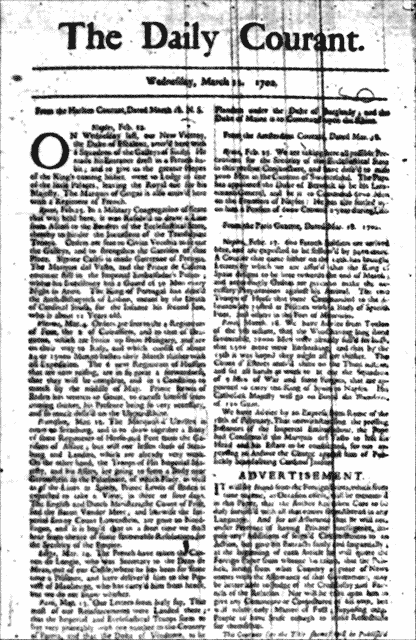
The Daily Courant, initially published on  [O.S. 11 March] 1702, was the first British daily newspaper. It was produced by Elizabeth Mallet at her premises next to the King's Arms tavern at Fleet Bridge in London.[1] The newspaper consisted of a single page, with advertisements on the reverse side.[2] Mallet advertised that she intended to publish only foreign news and would not add any comments of her own, supposing her readers to have "sense enough to make reflections for themselves".[3]

A 'courant', in this context, is derived from the Scottish dialect of the English language and refers to a newspaper or newsletter.[4]

After only forty days Mallet sold The Daily Courant to Samuel Buckley, who moved it to premises in the area of Little Britain in London, at "the sign of the Dolphin". Buckley later became the publisher of The Spectator.[5] The Daily Courant lasted until 1735, when it was merged with the Daily Gazetteer.[6]

References

[edit]
Revisions and contributorsEdit on WikipediaRead on Wikipedia
from Grokipedia
The Daily Courant was the first daily newspaper in England, launched on 11 March 1702 in London by printer and publisher Elizabeth Mallet. Published from Mallet's premises near Fleet Street, it marked a pivotal shift in British journalism by providing regular, daily news updates during the reign of Queen Anne. The newspaper's inaugural issues were produced by , who emphasized factual reporting without editorial opinions or "conjectures," aiming to deliver concise foreign news drawn primarily from Dutch sources such as the Leiden Gazette and Amsterdam Courant. Its single-sheet format, often limited to one page of international dispatches organized by originating publication rather than geography, contrasted with the more speculative and infrequent newsbooks of the era, promoting transparency by citing sources to allow readers to verify credibility. After 40 days of publication under her control, sold the paper to bookseller Samuel Buckley, who expanded it slightly by adding advertisements while maintaining its objective style. The Daily Courant ran until 1735, spanning over 33 years and influencing the growth of London's print industry and establishing as a hub for . As the pioneering daily following the lapse of the Licensing Act in 1695, it exemplified the emerging culture of accountable dissemination, setting precedents for modern reporting practices in Britain.

History

Founding

The Daily Courant was established on 11 March 1702 (Old Style) by Elizabeth Mallet, a printer and bookseller, at her premises opposite the King's Arms near Fleet Bridge in London. This launch responded to enhancements in postal services between London and continental Europe, particularly the daily route to Dover, which facilitated the timely receipt of foreign news and made daily publication feasible. Mallet's prior experience printing almanacs, ballads, and other ephemera provided the necessary resources and expertise for the endeavor. The inaugural issue appeared as a single-sheet leaflet in two columns, priced at one penny, with no advertisements on the front page. Its content consisted of translated excerpts from foreign gazettes, including the Haarlem Courant and Amsterdam Courant, reporting factual accounts of military developments in the ongoing , such as actions in the , without any editorial commentary. From the outset, the newspaper was issued daily except Sundays, establishing it as Britain's first such publication. Early distribution targeted middle-class readers with an interest in international affairs, yielding limited initial uptake but laying the groundwork for consistent daily . After roughly 40 issues, sold the paper to Buckley, who continued its operations.

Publication Under Samuel Buckley

Samuel Buckley acquired The Daily Courant in the spring of 1702, shortly after its founding by Elizabeth , following approximately 40 days (and issues) of publication; he assumed the roles of both printer and publisher thereafter. Under his management, the newspaper quickly established itself as London's sole daily, emphasizing concise translations of foreign news dispatches while adhering to a neutral editorial stance. Buckley relocated the operations from the original address to premises at the sign of the in Little Britain by 1703, reflecting the growing demands of daily production. Around 1710, further expansion led to a move to new facilities near Amen Corner and Paternoster Row, still under the sign, which facilitated better access to the city's printing and distribution networks. To sustain the rigorous daily schedule—publishing through without interruption—Buckley introduced more consistent advertisements on the reverse side of the single-sheet format, transforming it from a purely news-oriented publication into a hybrid that included commercial notices for books, medicines, and auctions. Over time, he gradually expanded coverage to incorporate domestic news, such as ship arrivals and local events, alongside the dominant foreign reports, thereby broadening its appeal while preserving its reputation for factual brevity. During Buckley's tenure, The Daily Courant offered straightforward, unembellished reporting on pivotal historical developments, including the ongoing from its early stages in 1702 through 1714, drawing from European corantos for battlefield updates and diplomatic shifts. Similarly, in 1720, it chronicled the speculative frenzy and collapse of the South Sea Bubble with objective accounts of stock fluctuations and parliamentary inquiries, avoiding partisan commentary. By the 1710s, the paper's circulation had expanded to several thousand copies per issue, primarily sold through coffee houses, taverns, and booksellers in , capitalizing on the rising public demand for timely news amid wartime and economic turbulence. Buckley's oversight continued until the newspaper's merger with the Daily Gazetteer in 1735, after which it lost its independent identity; he himself passed away on 8 1741, leaving a legacy of steady innovation in daily .

Cessation and Merger

The decline of The Daily Courant in the 1730s was influenced by several factors, including persistent economic pressures from the of 1712, which imposed a halfpenny tax per sheet on newspapers and raised advertising duties, effectively doubling production costs and prompting price increases—such as the Courant's rise from one penny to three halfpence per issue. This taxation, intended to curb seditious publications, strained smaller or fact-focused outlets like the Courant while favoring wealthier competitors. Additionally, shifting reader preferences toward more interpretive and opinionated content eroded its market share, as papers like the Daily Journal (launched in 1719) gained popularity by blending news with commentary, contrasting the Courant's neutral, foreign-news-heavy style. The newspaper ceased independent publication on June 28, 1735, when it was absorbed into the Daily Gazetteer, a pro-government title founded earlier that year at the behest of Sir Robert Walpole to consolidate Whig influence and supplant rival periodicals, including the Courant. The merger preserved select elements of the Courant, such as its emphasis on continental foreign dispatches, within the Gazetteer's expanded format, marking the end of the original title after 33 years. Surviving issues of The Daily Courant have been digitized and are accessible through collections like the , facilitating modern scholarly access to its historical content. The publication is cataloged under OCLC number 4203980 in , aiding library preservation efforts. Unlike some contemporaneous titles that were revived, The Daily Courant did not re-emerge under its original name, though an unrelated appeared later in the as a regional weekly.

Format and Content

Physical Characteristics

The Daily Courant was issued as a single-sheet broadside in folio format, typically measuring about 7 by 14 inches (18 by 35 cm), with text arranged in two narrow columns. Early issues from 1702 were printed on one side only, focusing exclusively on content, while after Buckley took over later that year, the reverse side began featuring advertisements, effectively utilizing both sides of the sheet. The masthead was straightforward, bearing the title "The Daily Courant" along with the date and issue number, without illustrations, headlines, or decorative elements typical of later newspapers. Production relied on hand-operated wooden presses common in early 18th-century London printing shops, where compositors typeset the content using metal type and pressmen applied basic black ink—typically a mixture of linseed oil, pine resin, and soot—to transfer the text onto locally sourced rag paper. Paper quality was modest, derived from recycled linen and cotton rags processed in nearby mills, ensuring affordability for daily output. The layout remained austere throughout its run, prioritizing dense text over visual variety, though printing clarity improved over time with refinements in typefaces and inking techniques under publisher Samuel Buckley. Issues were folded for easy handling and primarily hawked by on London streets or distributed through coffee houses, where readers consumed them as ephemeral items without binding. While the standard single-sheet form prevailed, rare variations included occasional double-sided expansions or extra sheets during periods of heightened news demand, such as major political events, to accommodate additional content.

Editorial Policy

The editorial policy of The Daily Courant was founded on a commitment to strict neutrality, explicitly avoiding editorials, opinions, or any form of commentary on the news it reported. In its inaugural issue on March 11, 1702, the publisher declared: "Nor will [the author] take upon him to give any Comments or Conjectures of his own, but will relate only matters of fact; supposing other People, as much as himself, capable of making Remarks upon them." This , "to give only Matters of Fact without Remark," encapsulated the paper's guiding principle of , limiting content to a single half-sheet page to prioritize brevity and exclude "impertinences" common in other publications. This policy served a practical rationale in the politically charged environment of Queen Anne's reign (1702–1714), where laws against posed significant risks to publishers who expressed views that could be deemed critical of the or . By eschewing interpretation, The Daily Courant minimized exposure to prosecution, as neutral reporting of facts was less likely to incite charges under existing statutes like those governing libel, even after the lapse of the Licensing Act in 1695. The approach also appealed to readers amid the Whig-Tory divides and the , offering unbiased foreign intelligence that allowed audiences to form their own judgments without the paper's influence, thereby building trust in an era of widespread suspicion toward partisan media. Implementation adhered closely to this neutrality through verbatim translations of foreign news dispatches, drawn primarily from European sources such as the Paris Gazette, corantos, and Dutch publications like the Leiden Gazette and Haarlem Courant. Content was organized by source rather than geographic location, with explicit citations to promote transparency and enable readers to assess the credibility of reports—Dutch papers, for instance, accounted for about 80% of citations in the first 30 issues. Domestic political coverage was deliberately minimal and unbiased, avoiding any alignment with factions during heated partisan conflicts. Under Samuel Buckley, who assumed control shortly after launch in 1702, the policy remained consistent, preserving the focus on factual reporting without editorial intrusion. By the 1720s, the paper subtly incorporated more domestic items alongside its foreign emphasis, yet maintained the prohibition on opinion to uphold its reputation for reliability. In contrast to contemporaries like The Tatler (1709–1711), which featured satirical essays and social commentary from writers such as and , The Daily Courant distinguished itself through unadorned factualism, fostering reader trust in an age when tri-weekly papers often blended news with partisan wit.

News Coverage

The Daily Courant placed a strong emphasis on foreign news, which constituted the vast majority of its content, often around 80 percent derived from European sources. This included detailed reports on ongoing conflicts such as the , trade developments, and diplomatic exchanges across the continent. Primary sources for this material were Dutch gazettes like the Amsterdam Courant and Leiden Gazette, which accounted for approximately 80 percent of cited foreign papers, alongside French newsletters and postal dispatches from cities including , , and ; in the first thirty issues, fourteen relied exclusively on Dutch publications. This foreign-centric approach reflected the paper's commitment to translating and relaying "matter of fact" intelligence without editorial commentary, organized by source for transparency. Domestic news received limited coverage, restricted largely to non-political items such as updates, market prices, shipping arrivals and departures, and notices, avoiding sensitive political matters to maintain impartiality. Following the in 1714, which concluded the , the inclusion of such domestic content increased slightly, allowing for broader but still restrained reporting on British affairs. Notable examples of foreign coverage included extensive accounts of the in August 1704, where the paper detailed the Allied victory over French and Bavarian forces based on dispatches arriving in . Trade news often highlighted European commercial activities, such as negotiations involving northern alliances, underscoring the interconnectedness of continental economies. The reverse side of each issue was dedicated to advertisements, featuring classifieds for books, medicines, patents, and various services, which served as a key revenue stream without intruding on the content. These ads were practical and promotional, promoting items like new publications and remedies, and helped sustain the paper's daily production. In terms of length and style, issues typically comprised concise paragraphs totaling a few hundred words across a single half-sheet page in two columns, written in formal 18th-century English that prioritized clarity and factual reporting over elaboration.

Key Figures

Elizabeth Mallet

Elizabeth Mallet (fl. 1672–1706) was an English printer and bookseller active in during the late 17th and early 18th centuries. Little is known of her early life, including her birth date, but she entered the trade by 1672 when she married David Mallet, a printer based in St Martin Ludgate. Upon David's death on 3 April 1683, she administered his estate and continued the business, operating two printing presses in Black Horse Alley near Fleet Bridge from 1685 onward. In her pre-Courant career, specialized in affordable popular prints, particularly broadsides of execution speeches and proceedings from the commissioners, which she produced with her husband and later alongside her son David, whom she apprenticed after David's death. These items catered to a broad public appetite for sensational , establishing her reputation in the burgeoning periodical market. By the late 1690s, she had expanded into publications, launching The New State of Europe on 20 September 1701, a thrice-weekly news sheet that translated and summarized foreign . Mallet played a pioneering role in British journalism as the sole proprietor, editor, and printer of the initial issues of The Daily Courant, England's first daily , which she launched on 11 1702 from her premises next to the King's Arms tavern at Fleet Bridge. Drawing on her experience with periodical news sheets amid rising demand for timely information, she innovated a concise, single-sheet format limited to foreign news dispatches without editorial commentary, aiming for factual reliability by citing sources. She published the paper for approximately 40 days before selling it to Samuel Buckley due to operational challenges in sustaining daily production. Regarding her , managed the family enterprise as a , with records indicating financial incentives from the expanding news trade influenced her ventures, though the demands of daily output proved burdensome. Some accounts suggest a possible marriage to an Edward around 1700, but this remains disputed and unconfirmed in primary records. In her later years, continued other works, including almanacs and ballads, until at least 1706, after which she fades from historical records; her death date is unknown.

Samuel Buckley

Samuel Buckley (c. 1673–1741) was an English printer and bookseller who served as the primary publisher of The Daily Courant for over three decades, providing the stability that allowed it to become England's longest-running early . Born around 1673 or 1674, Buckley trained in the and was recorded as a bookseller in from 1696, transitioning to shortly thereafter. As a member of the Stationers' Company, the guild overseeing the English book , he established himself in the industry before entering publishing. In early 1702, shortly after Elizabeth Mallet founded The Daily Courant on March 11, Buckley acquired the paper from her after approximately forty days, drawn by its innovative daily format and potential for growth. He relocated operations to better premises in Little Britain, at the sign of the , and invested in expanded distribution networks, including carriers to provincial areas, to broaden its readership and ensure reliable delivery. These changes helped transform the modest single-sheet publication into a more robust enterprise. Under Buckley's management, the newspaper benefited from his , particularly in diversifying revenue sources. He quickly introduced and expanded advertisements, which became a key financial pillar, allowing the paper to sustain its neutral, fact-based editorial policy without opinion pieces. As an accomplished linguist fluent in Latin, French, Dutch, and Italian, Buckley personally contributed to content by translating foreign news dispatches, while acting as the editor to maintain consistency and adherence to the publication's objective stance. Buckley continued to oversee The Daily Courant until its cessation and merger with the Daily Gazetteer in 1735. He remained active in printing and bookselling afterward, producing works such as editions of The Spectator in collaboration with publishers like Jacob Tonson. Dying in 1741 at about age 67 or 68, Buckley left no direct heirs in the printing trade; his estate featured an extensive personal library of over 1,100 volumes, auctioned in London over ten days starting December 7, 1741.

Significance and Legacy

Innovations in Journalism

The Daily Courant represented a pioneering breakthrough in journalistic frequency by becoming Britain's first consistent daily , published every weekday starting from its inaugural issue on 11 1702. Prior to this, dissemination in relied on tri-weekly corantos and irregular newsbooks, which limited the timeliness of information. The Courant's daily schedule, excluding Sundays, capitalized on improvements in the postal system to deliver foreign more promptly, translating and summarizing dispatches from that arrived via post riders and enabling readers to stay abreast of international developments with unprecedented regularity. In terms of editorial approach, the newspaper established a model of neutrality through strict fact-based reporting, eschewing opinions, conjectures, or domestic commentary to focus solely on translated foreign news. Its publisher announced in the first issue that it would "give no comments" of its own, supposing readers capable of forming their own judgments, a stance designed to avoid government prosecution under laws against seditious libel. This commitment to objective presentation proved viable commercially and editorially, setting a precedent for impartial journalism that influenced subsequent publications. The Courant's distribution innovations leveraged London's burgeoning coffee house culture, where copies were readily available for purchase and discussion among merchants, intellectuals, and the public, fostering a communal reading environment that amplified its reach. It also employed numbered issues sequentially, imparting a serialized quality that encouraged habitual readership akin to ongoing narratives. These methods expanded access beyond elite circles, aligning with the paper's single-sheet format printed on one side with news and the reverse dedicated to advertisements. Economically, the newspaper pioneered an ad-supported model for by reserving the back side for classified advertisements—such as notices for books, services, and lost items—while pricing each issue at just one , a low cost that democratized news consumption for the emerging . This dual-revenue from sales and ads ensured without relying on partisan . Technologically, though employing rudimentary wooden presses and basic type, the Courant optimized with its compact single-sheet , establishing a standard for concise, reproducible daily output that accommodated the era's limitations while maximizing production speed.

Cultural and Historical Impact

The Daily Courant played a pivotal role in fostering an informed public during the Enlightenment by providing regular, factual reports on international affairs, which encouraged rational discourse among readers. Its editorial policy of presenting foreign news "plainly and impartially" without commentary promoted unbiased engagement with global events, distinguishing it from partisan publications and contributing to the era's emphasis on objective information. This approach aligned with the burgeoning coffee house culture, where the newspaper served as a key resource for debates on and , helping to democratize access to news across social classes in early . The newspaper's daily format and neutral tone influenced subsequent 18th-century publications, establishing a model for frequent, fact-based reporting that spurred the growth of the British press. By 1709, alone hosted at least 18 , many adopting elements of the Courant's structure for timeliness and reliability in covering foreign intelligence. This legacy extended to modern , where the Courant's focus on unadorned international inspired the development of dedicated foreign desks prioritizing verification over . As a , The Daily Courant offers invaluable insights into early 18th-century European news networks, documenting the transmission of information from continental correspondents to British audiences. Historians studying media evolution frequently reference it to trace the shift toward daily cycles and the of reporting. Projects like the Universal Short Title Catalogue (USTC) utilize its issues to analyze the broader culture of print and dissemination in the period, highlighting its role in shaping public awareness of geopolitical events. Preservation efforts have ensured the survival of nearly complete runs held in major archives such as the British Library's Burney Collection. Digitization initiatives, including those by the starting in the early 2000s, have made these materials accessible for scholarly , facilitating analyses of historical practices without reliance on physical copies. Elizabeth Mallet's proprietorship and initial editorship of The Daily Courant marked a significant milestone, underscoring women's involvement in the trade well before formalized female leadership in became common. As one of the few women operating presses in late 17th- and early , her management of the challenged prevailing norms and paved the way for greater female participation in publishing.

References

Add your contribution
Related Hubs
User Avatar
No comments yet.