Hubbry Logo
Lug wrenchLug wrenchMain
Open search
Lug wrench
Community hub
Lug wrench
logo
8 pages, 0 posts
0 subscribers
Be the first to start a discussion here.
Lug wrench
Lug wrench
from Wikipedia
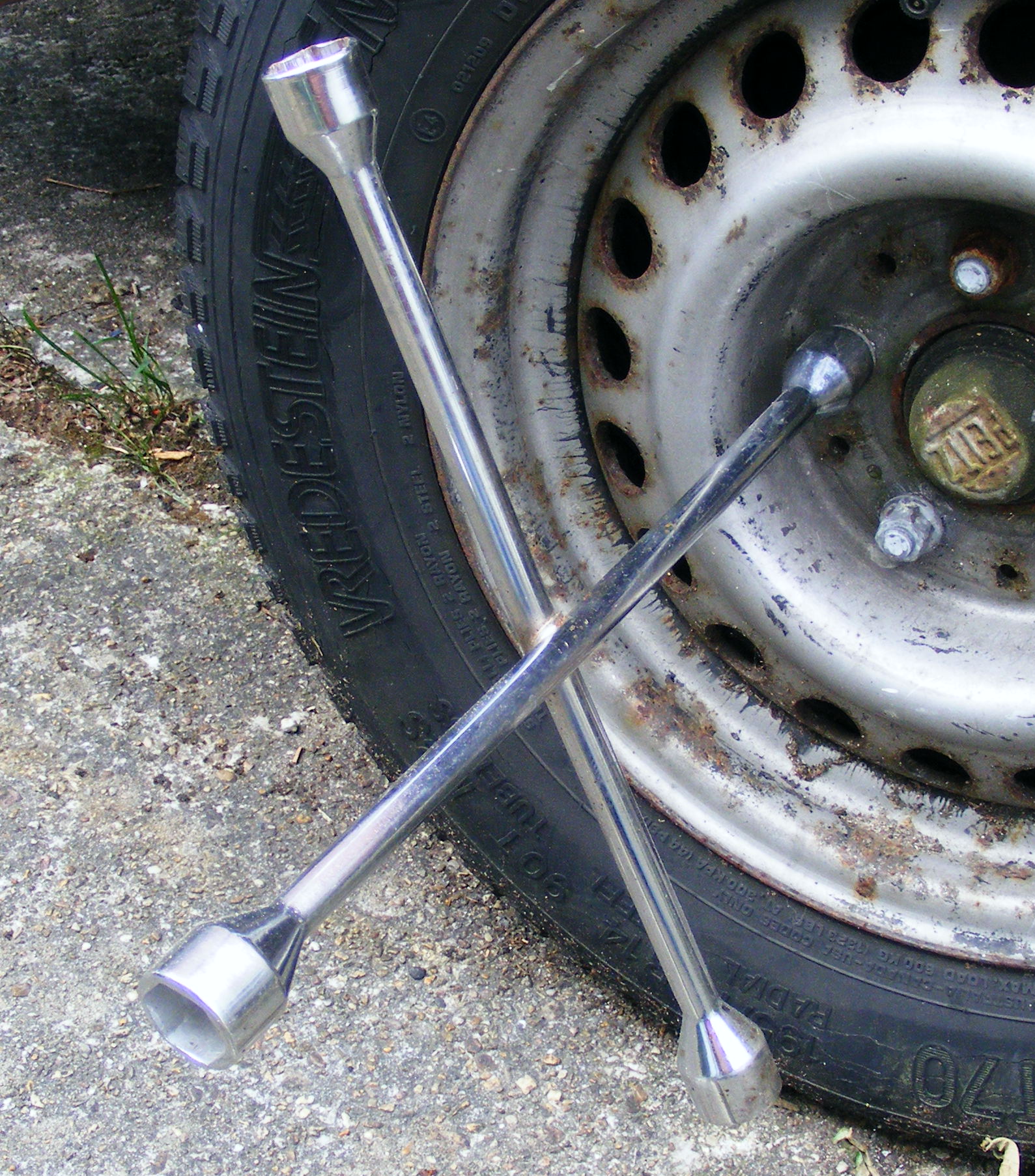
Spider-type lug wrench
An ambulance driver using a lug wrench, 1940

A lug wrench, also colloquially known as a tire iron, is the name for a type of socket wrench used to loosen and tighten lug nuts on automobile wheels. In the United Kingdom and Australia, it is commonly known as a wheel brace.

Forms

[edit]

Lug wrenches may be L-shaped, or X-shaped. The form commonly found in car trunks is an L-shaped metal rod with a socket wrench on the bent end and a prying tip on the other end. The prying tip is mainly intended to remove hub caps or wheel covers that may be covering a wheel's lug nuts.

Another common type, sometimes called a spider wrench, is made in the shape of a cross with different sized sockets on each of the four ends. Other names are four way wheel wrench, spanner, brace, or cross.

Technique

[edit]
A lug wrench

Ideally, the nuts (or bolts) should be tightened with a torque wrench. Lug wrenches are much less expensive because they lack the ability to measure or limit the force used. Installing a wheel with a lug wrench thus requires a bit of rough guessing about proper tightness. Excessive force can strip threads or make the nuts very difficult to remove. Also, uneven torque between the various lug nuts, or excessive torque, can lead to warping of the brake rotor if the car is equipped with disc brakes. For this reason, impact wrenches should properly be used only for removing lug nuts, not for tightening them, although in practice this rule is often ignored for convenience's sake, even by professional mechanics.

When re-fitting a wheel, the nuts (or bolts) should be tightened in a criss-cross pattern (to even out the forces) and initially should only be tightened "finger tight" on all nuts. In this context "finger tight" is tight enough to reach the point where free play is taken up and proper tightening is about to begin, say, the tightening force using the lug wrench/wheel brace like a screwdriver. This should be repeated twice, to ensure the wheel is properly centered and restrained by all nuts (as often the first nut that is tightened will be slightly loose after completing the set for the first time), then the wheel should be lowered to the ground and the criss-cross tightening pattern repeated to modest torque (say few fingers force on the lug wrench/wheel brace arm), and then finally repeated to full hand force.

Rarely, and more often with large trucks and lorries, insufficient force can lead to the nuts coming undone while in use. Because of this, it is best to use a torque wrench or similar tool to finally tighten the wheel lug nuts to the proper torque specification as soon as possible after using a lug wrench to affix a wheel. At the very least, the lug nuts should be checked for tightness after 50–100 km/miles when things have been subject to some vibration and thermal cycling.

This tool also has a secondary usage: it can be used to remove vehicles that are stuck in the snow by breaking up ice so it can be easily shovelled away from the drive wheels.[1]

References

[edit]
[edit]
Revisions and contributorsEdit on WikipediaRead on Wikipedia
from Grokipedia
A lug wrench, also known as a in and a wheel brace in and , is a specialized designed primarily for loosening and tightening lug nuts that secure to such as automobiles, trucks, and motorcycles. This tool typically features a long handle to provide mechanical leverage, enabling users to apply sufficient to overcome the high from rusted or overtightened nuts without requiring advanced equipment. Commonly constructed from durable chrome-molybdenum steel or similar alloys for strength and corrosion resistance, lug wrenches are a standard item in tool kits, often stored in trunks for roadside tire changes. Lug wrenches come in several forms to suit different applications and user preferences. The most basic is the L-shaped lug wrench, which resembles a bent rod with a socket at one end for engaging the lug nut and a crossbar or at the other for turning. Another popular variant is the four-way or X-shaped () lug wrench, featuring a central with four perpendicular arms, each tipped with sockets of varying sizes (commonly 17mm, 19mm, 21mm, and 23mm) to accommodate multiple vehicle types. Telescoping models extend for additional leverage, while compact or folding designs prioritize portability for emergency use. These types ensure versatility, though selection depends on factors like vehicle lug nut size and the requirements, which can exceed 100 foot-pounds for safe wheel installation. Beyond basic wheel maintenance, lug wrenches play a critical role in and repair, often used alongside jacks for rotations, replacements, or balancing. Their design dates back to the early with the rise of mass-produced automobiles like the , evolving from simpler iron tools to modern ergonomic versions that reduce user strain. While pneumatic or electric impact wrenches have become common in settings for faster operation, manual lug wrenches remain essential for DIY and remote scenarios due to their , affordability, and lack of need for power sources.

Definition and Purpose

Overview

A lug wrench is a specialized type of designed for loosening and tightening lug nuts on vehicle wheels. Lug nuts are threaded fasteners, typically large and heavy-duty, that secure wheels to axles or hubs by screwing onto studs protruding from the vehicle's wheel assembly. Also known as a , from its association with tire maintenance tasks. The term "tire iron" originally referred to iron components on wheels in the 1850s and was later applied to the tool around 1909. Its primary function is to provide the leverage and grip necessary to rotate these often tightly secured nuts, making it indispensable for routine automotive maintenance. The lug wrench serves as an essential tool for wheel removal in contexts such as , replacement, or repairs, ensuring safe and efficient access to wheels.

Applications

Lug wrenches are primarily employed in passenger cars and light trucks for routine maintenance tasks, such as loosening and tightening lug nuts during and replacements. These tools provide the necessary leverage to handle standard lug nut sizes, typically ranging from 17mm to 21mm, ensuring secure attachment without specialized equipment. In heavier vehicles like semi-trucks and buses, lug wrenches facilitate changes on larger wheels, where higher is required to manage industrial-grade lug nuts. Beyond automotive applications, lug wrenches find use in industrial settings, such as maintaining wheels on like tractors and machinery, where they aid in securing robust hubs under demanding conditions. A key role of the lug wrench is in emergency roadside repairs, particularly for addressing flat tires by quickly removing damaged wheels to install spares. This capability is essential for minimizing downtime in both personal and commercial scenarios, allowing drivers to restore mobility without professional assistance. Lug wrenches are often integrated with jacks to perform complete wheel service, where the wrench loosens lug nuts after the jack elevates the , enabling safe swapping. This combination is standard in factory-supplied tool kits for efficient roadside interventions.

History

Origins

The lug emerged in the late 19th and early 20th centuries, coinciding with the advent of the automobile as a practical mode of transportation. As transitioned from experimental horseless carriages to mass-produced models around the to , the need arose for specialized tools to secure and remove wheel components, particularly the lug nuts that fastened rims to axles. Early iterations drew from existing designs used in industrial and agricultural settings, evolving to meet the demands of automotive assembly and maintenance. Initial designs were adaptations of general socket wrenches, modified specifically for the hexagonal or square lug nuts on early car wheels. By 1906, manufacturers like Walden & Worcester introduced wire-handled ratchet wrenches intended as tire bolt tools for nascent automobiles, providing leverage for tightening wheel fasteners without requiring full rotations. These were further refined into pressed-steel socket sets by 1911, including compact kits tailored for vehicles such as the , which featured demountable wheels secured by multiple lug nuts. A key 1909 (#928,719) by F.E. Walden enabled efficient production of such ratcheting mechanisms, marking a pivotal step in standardizing socket-based tools for automotive use. The development of early automotive tools benefited from precision machining techniques developed in the bicycle industry during the and , which transferred to the production of small fasteners and wheel components. The lug wrench saw its first widespread adoption in garages and among mechanics during the post-1900 automobile boom, when vehicle ownership surged and roadside repairs became commonplace. With models like the dominating roads from 1908 onward, these tools became essential in dealership service kits and owner tool rolls, enabling efficient wheel changes amid expanding road networks. By the 1910s, innovations such as the 1918 patent (#1,282,028) for detachable sockets by W.S. Bellows enhanced portability and applicability, solidifying the lug wrench's role in early automotive culture.

Developments

The L-shaped lug wrench emerged in the as a key innovation, offering superior leverage compared to earlier straight-handle designs by allowing users to apply force from an angled position. This configuration addressed the challenges of accessing lug nuts on early automobiles, where space constraints around wheels demanded more efficient application. The Walden X1960 model, patented in under US Patent 1,559,543 by F.H. Bellows, exemplified this design with its offset socket and elongated arm, measuring approximately 10.8 inches in length for enhanced during changes. Parallel to the L-shaped evolution, the four-way lug wrench appeared in the early , introducing a cross-shaped that enabled multi-directional for loosening nuts from various angles without repositioning the tool. Walden-Worcester's 1452 model, launched around 1923 and utilizing socket attachment technology from US Patent 1,282,028 (issued ), featured interchangeable sockets in sizes from 5/8 to 7/8 inches, making it adaptable to different configurations. This gained prominence by the mid-20th century, becoming a staple in toolkits for its ability to handle diverse lug patterns efficiently. In 1978, the step-on lug wrench represented a significant refinement for applying high-impact force, particularly to lug nuts overtightened by emerging power tools like impact wrenches. US Patent 4,070,931, granted to William J. Schwalbe, described a device with a reinforced and socket that allowed users to step on it for steady or percussive , reducing the physical strain of manual twisting while maintaining compatibility with standard lug sizes. Modern developments in the focused on portability and user convenience, with telescoping handles enabling lug wrenches to for storage in compact compartments while extending to provide up to 21 inches of leverage. A 2004 innovation outlined in British GB2395454A by Aaron Alfred Sykes detailed an extendible, retractable handle integrated with socket heads for precise torque on lug nuts, reflecting the era's emphasis on multifunctional tools for roadside emergencies.

Design and Construction

Components

A lug wrench is composed of essential structural elements that facilitate the application of to vehicle lug nuts. The primary components include the socket end, , grip features, and optional extensions, each serving a specific mechanical function in the loosening and tightening process. The socket end forms the interface with the lug nut, featuring a hexagonal (6-point) configuration to securely engage the nut's flats and prevent during . These fittings are sized to accommodate standard lug nut dimensions, with 17 mm to 21 mm being prevalent for passenger cars, ensuring compatibility across a wide range of . The serves as the main lever arm, typically a straight or angled bar that amplifies user-applied force into rotational on the socket. Lengths commonly range from 12 to 24 inches, balancing portability with sufficient for effective nut manipulation. Grip features integrated into the , such as knurled texturing or rubberized coverings, provide enhanced to maintain user control and reduce slippage under high- conditions. Optional extensions, including joints or attachments, allow the to navigate confined spaces or extend reach, thereby adapting to varied configurations without compromising delivery.

Materials

Lug wrenches are primarily constructed from high-strength steels, with chrome-vanadium (Cr-V) steel being the most common choice due to its exceptional toughness and resistance to deformation under the high loads typical of operations. This , often specified as 6140 or 50BV30 grade, incorporates for enhanced hardness and for improved , ensuring the tool withstands repeated bending stresses without failure. To protect against , the sockets and contact surfaces of lug wrenches receive , a thin electroplated layer that inhibits formation and in humid or salted conditions. This finish not only extends the tool's lifespan but also minimizes during nut engagement, allowing for more efficient and precise application of force. Handle construction varies by model, with standard lug wrenches employing solid for maximum durability and load-bearing capacity, while portable or racing-oriented versions incorporate aluminum alloys to achieve significant weight reductions, facilitating easier transport and use in field applications. For user comfort and safety, many lug wrenches feature ergonomic grips coated in rubber or plastic materials, which provide non-slip traction, reduce hand fatigue during prolonged use, and offer basic electrical insulation against accidental shocks. These coatings are typically molded or dipped onto the handle ends, balancing flexibility with resistance to oils and abrasion.

Types

L-shaped lug wrench

The L-shaped lug wrench, also known as a , consists of a bent handle forming an L shape with a single socket at one end designed to engage lug nuts on wheels. This configuration enables the application of perpendicular force to the lug nut, facilitating generation through the longer arm of the L for leverage while the shorter arm allows positioning close to the wheel hub. The design prioritizes simplicity and direct in rotational force. Typical dimensions include overall lengths of 14 to 20 inches to balance portability and leverage, with the socket end sized to match standard lug nuts such as 19 mm for many passenger sedans or 21 mm for light trucks. Socket sizes generally align with metric standards like 17 mm, 19 mm, 21 mm, and 22 mm, or SAE equivalents including 11/16 inch and 3/4 inch, ensuring compatibility across common automotive applications. These specifications allow the tool to fit within vehicle spare tire compartments without excessive bulk. One key advantage of the L-shaped design is its compactness, making it suitable for storage in trunks or onboard tool kits where space is limited, while still delivering sufficient leverage for initial loosening of moderately tight lug nuts during roadside changes. Its straightforward construction enhances durability under repeated use, often at a lower cost compared to more complex variants. A notable limitation is the need for greater physical effort when dealing with highly seized or overtightened lug nuts, as the single-plane application lacks the multi-directional support of cross-shaped alternatives, potentially increasing user in demanding scenarios.

Four-way lug wrench

The four-way lug wrench features a distinctive cross-shaped with a central hub connecting four arms, each ending in a socket sized for common lug nuts, enabling application from multiple angles for improved accessibility around the . Unlike the simpler L-shaped lug wrench, this configuration provides greater versatility by allowing rotation and positioning adjustments during use. The arms typically measure 8 to 12 inches in length, contributing to an overall tool span of about 20 inches, which balances leverage with portability for storage in vehicle compartments. Socket sizes generally cover 17mm, 19mm, 21mm, and 22mm, supporting lug nuts on passenger cars, SUVs, and light trucks. This design excels in providing enhanced , as the extended arms allow users to apply substantial force, including by stepping on them with body weight, making it ideal for loosening rusted or over-tightened lug nuts in challenging conditions.

Telescoping lug wrench

Telescoping lug wrenches feature an adjustable handle that extends to provide additional leverage, typically ranging from 15 to 28 inches in length when fully extended. They often include reversible sockets for multiple sizes, such as 17mm/19mm and 21mm/22mm, making them versatile for various vehicles. This type combines compactness for storage with extended reach for tough lug nuts.

Folding lug wrench

Folding or compact lug wrenches are designed for portability, often collapsing into a smaller size for easy storage in glove compartments or tool kits. They may have a single or dual socket and a that folds, with lengths around 12-16 inches when deployed. Ideal for emergency use where space is limited.

Usage

Basic technique

To use a lug effectively for changing a , begin with proper preparation to ensure stability and accessibility. Park the on a flat, level surface away from , turn on hazard lights, and firmly engage the to prevent any movement. Locate the lug nuts on the affected wheel, removing any hubcap or wheel cover if present to expose them, and clear debris such as dirt or mud from the nuts for better grip. Next, loosen the lug nuts while the remains on the ground to avoid spinning the . Position the securely over the first lug nut, ensuring a firm fit on the nut's , and turn it counterclockwise—typically a quarter to half turn—applying steady downward force, such as by pushing with your legs or standing on the handle if necessary, to break the nuts free without fully removing them. Repeat this process for all lug nuts in a consistent order, such as starting at the top and working around the , but keep the nuts in place to maintain stability. Once all lug nuts are loosened, raise the using the appropriate jack placed at the manufacturer's recommended jacking point, lifting until the is off the ground and can rotate freely. Fully unscrew the lug nuts by hand or with the , setting them aside in a safe spot like the , then pull the straight toward yourself to remove it from the hub. For reinstallation, align the spare 's bolt holes with the wheel studs and slide it onto the hub, then thread the lug nuts on by hand in a direction until snug to hold the in place. Lower the gradually until the touches the ground, remove the jack, and use the lug to tighten the nuts further in a star or crisscross pattern—alternating opposite nuts—to ensure even seating and balance. This basic manual approach applies to standard lug designs, with grip positioning varying slightly by type such as L-shaped or four-way.

Advanced methods

In challenging scenarios where lug nuts are seized due to rust, over-torquing, or corrosion, mechanics often pair a lug wrench with a breaker bar to extend the effective handle length and generate greater torque. A breaker bar, typically a 1/2-inch drive tool with a long, rigid handle (often 18 to 24 inches), attaches to a compatible socket that fits the lug nut, allowing the user to apply sustained leverage without the limitations of a standard lug wrench's shorter arm. This method is particularly effective for initial loosening while the wheel remains on the ground, reducing the risk of rounding the nut compared to shorter tools. For even more stubborn fasteners, a cheater pipe can be combined with the lug wrench or to amplify leverage further. This involves sliding a section of metal pipe (commonly 1 to 2 inches in and 12 to 24 inches long) over the wrench handle, effectively lengthening the moment arm and multiplying the applied force according to basic principles of (force times ). The technique requires the pipe to fit snugly to prevent slippage, and it is applied by pushing or pulling on the extended end while maintaining control of the socket on the . While useful for break-loose efforts, this modification demands caution to avoid tool failure under high stress. When rotational force alone proves insufficient, impact application techniques can provide the initial jolt needed to break the nut free. One common approach is to position the lug wrench on the nut and apply body weight by stepping firmly on the handle end, using the foot to deliver downward pressure in a controlled manner—this leverages the user's mass for added without additional tools. Alternatively, a gentle bouncing motion on the handle can create repeated impacts to overcome friction, particularly effective on mildly seized nuts before transitioning to steady turning. These methods build on standard loosening procedures but are reserved for cases where manual effort falls short. In professional auto shop environments, lug wrenches are frequently integrated with air-powered extensions, such as pneumatic impact wrenches equipped with torque-limiting extensions or torque sticks, to handle high-volume wheel services efficiently. These setups use compressed air to drive a hammering mechanism that delivers rapid, high-torque pulses (often 200 to 800 ft-lbs) through a 1/2-inch socket adapter, far exceeding manual capabilities for removing or installing lug nuts on multiple vehicles. Torque sticks, color-coded extensions inserted between the impact wrench and socket, flex under load to limit final tightening torque to manufacturer specifications (e.g., 80-100 ft-lbs for many sedans), preventing damage in assembly-line scenarios like tire rotations. This combination is standard in garages for its speed and precision, often paired with protective socket sleeves to safeguard alloy wheels.

Safety and Maintenance

Torque specifications

, in the context of lug nuts, refers to the rotational force applied to secure the to the , typically measured in foot-pounds (ft-lb) or Newton-meters (Nm), which ensures the wheel remains firmly attached without loosening during operation or causing structural damage. This precise application of force is critical to vehicle safety, as it distributes clamping pressure evenly across the wheel assembly, preventing vibrations that could lead to component failure. Standard torque specifications for lug nuts vary by type and manufacturer, but common ranges for cars are 80-100 ft-lb, while light trucks often require 120-140 ft-lb. For example, many and models specify around 80 ft-lb, whereas trucks call for 140 ft-lb; always consult the specific vehicle's for exact values, as they can differ based on size, material, and design. Using a calibrated is strongly recommended over relying on manual feel or impact tools for final tightening, as it provides accurate to meet manufacturer specifications and avoids inconsistencies from operator variability. This tool allows for precise post-installation adjustment, ensuring all lug nuts achieve the intended in a star pattern to promote uniform seating. Over-torquing lug nuts can lead to stud breakage or thread stripping due to excessive stress on the fasteners, while under-torquing risks detachment as the assembly loosens under road forces, potentially causing . Both scenarios compromise vehicle stability and highlight the need for adherence to specified values to mitigate these hazards.

Precautions and care

When using a lug wrench, one primary is the tool slipping off the lug nuts, which can result in sudden release of force and potential to the user's hands or body. Another significant risk involves vehicle instability during , where the vehicle may shift or fall, leading to crushing or fatalities if the user is positioned underneath. To address these dangers, operators should always wear protective gloves to safeguard against cuts, abrasions, or impacts from the wrench or lug nuts. Wheel chocks must be placed in front of and behind the tires on the wheels remaining on the ground to prevent unintended vehicle movement. Users must never position themselves or work under a vehicle that is supported solely by a jack, as jacks are designed for lifting only and not for load-bearing; stable jack stands are required for any under-vehicle tasks. Proper torque application during lug nut tightening is vital to prevent wheel loosening or damage, as further outlined in the Torque specifications section. For long-term reliability, store the lug wrench in a dry, clean environment to avoid moisture-induced that could compromise its structural . Prior to each use, thoroughly inspect the wrench for cracks, bends, or wear that might lead to failure under load. After use, wipe the tool clean with a dry cloth to remove grease, dirt, or corrosive residues; if the wrench features any adjustable or pivoting components, apply a light to maintain smooth operation and prevent seizing.

References

Add your contribution
Related Hubs
User Avatar
No comments yet.