


Community hub
Recent from talks
Contribute something
Nothing was collected or created yet.
Brake
View on Wikipedia
A brake is a mechanical device that inhibits motion by absorbing energy from a moving system.[1] It is used for slowing or stopping a moving vehicle, wheel, axle, or to prevent its motion, most often accomplished by means of friction.[2]
Background
[edit] | This section needs additional citations for verification. (February 2016) |
Most brakes commonly use friction between two surfaces pressed together to convert the kinetic energy of the moving object into heat, though other methods of energy conversion may be employed. For example, regenerative braking converts a significant portion of the otherwise wasted kinetic energy of a moving vehicle into electrical energy, which can be stored in batteries for later use.[3] Other methods convert kinetic energy into potential energy in such stored forms as pressurized air or pressurized oil. Eddy current brakes use magnetic fields to convert kinetic energy into electric current in the brake disc, fin, or rail, which is converted into heat. Still other braking methods transform the kinetic energy into different forms, for example, by transferring the energy to a rotating flywheel.
Brakes are generally applied to rotating axles or wheels, but may also take other forms, such as the surface of a moving fluid (flaps deployed into water or air). Some vehicles utilize a combination of braking mechanisms, such as drag racing cars equipped with both wheel brakes and a parachute, or airplanes that employ both wheel brakes and flaps raised into the air during landing.
Since kinetic energy increases quadratically with velocity (), an object moving at 10 m/s has 100 times as much energy as one of the same mass moving at 1 m/s. Consequently, the theoretical braking distance, when braking at the traction limit, is up to 100 times as long. In practice, fast vehicles typically experience significant air drag, and the energy lost to air drag increases rapidly with speed.

Almost all wheeled vehicles have a brake of some sort. Even baggage carts and shopping carts may have them for use on a moving ramp. Most fixed-wing aircraft are fitted with wheel brakes on the undercarriage. Some aircraft also feature air brakes designed to reduce their speed in flight. Notable examples include gliders and some World War II-era aircraft, primarily some fighter aircraft and many dive bombers of the era. These allow the aircraft to maintain a safe speed in a steep descent. The Saab B 17 dive bomber and Vought F4U Corsair fighter used the deployed undercarriage as an air brake.
Friction brakes on automobiles store braking heat in the drum brake or disc brake while braking, then conduct it to the air gradually. When traveling downhill, some vehicles can use their engines to brake.
When the brake pedal of a modern vehicle with hydraulic brakes is pushed against the master cylinder, ultimately a piston pushes the brake pad against the brake disc, which slows the wheel down. In a brake drum design, a similar action is employed, involving a cylinder that pushes the brake shoes against the drum, thereby slowing the rotation.
Types
[edit]

Brakes may be broadly described as using friction, pumping, or electromagnetics. One brake may use several principles: for example, a pump may pass fluid through an orifice to create friction:
Frictional
[edit]
FAD: Brake disc front
FPD: Brake disc rear
FPT: Rear brake drum
CF: Brake control
SF: servo brake
PF: Brake Pump
SLF: Brake Fluid Reservoir
RF: Splitter braking
FS: Parking Brake
Frictional brakes are most common and can be divided broadly into "shoe" or "pad" brakes, using an explicit wear surface, and hydrodynamic brakes, such as parachutes, which use friction in a working fluid and do not explicitly wear. Typically the term "friction brake" is used to mean pad/shoe brakes and excludes hydrodynamic brakes, even though hydrodynamic brakes use friction. Friction (pad/shoe) brakes are often rotating devices with a stationary pad and a rotating wear surface. Common configurations include shoes that contract to rub on the outside of a rotating drum, such as a band brake; a rotating drum with shoes that expand to rub the inside of a drum, commonly called a "drum brake", although other drum configurations are possible; and pads that pinch a rotating disc, commonly called a "disc brake". Other brake configurations are used, but less often. For example, PCC trolley brakes include a flat shoe which is clamped to the rail with an electromagnet; the Murphy brake pinches a rotating drum, and the Ausco Lambert disc brake uses a hollow disc (two parallel discs with a structural bridge) with shoes that sit between the disc surfaces and expand laterally.
A drum brake is a vehicle brake in which the friction is caused by a set of brake shoes that press against the inner surface of a rotating drum. The drum is connected to the rotating roadwheel hub.
Drum brakes generally can be found on older car and truck models. However, because of their low production cost, drum brake setups are also installed on the rear of some low-cost newer vehicles. Compared to modern disc brakes, drum brakes wear out faster due to their tendency to overheat.
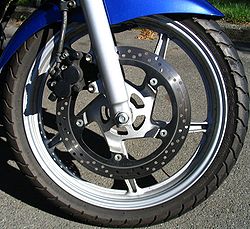
The disc brake is a device for slowing or stopping the rotation of a road wheel. A brake disc (or rotor in U.S. English), usually made of cast iron or ceramic, is connected to the wheel or the axle. To stop the wheel, friction material in the form of brake pads (mounted in a device called a brake caliper) is forced mechanically, hydraulically, pneumatically or electromagnetically against both sides of the disc. Friction causes the disc and attached wheel to slow or stop.
Pumping
[edit]Pumping brakes are often used where a pump is already part of the machinery. For example, an internal-combustion piston motor can have the fuel supply stopped, and then internal pumping losses of the engine create some braking. Some engines use a valve override called a Jake brake to greatly increase pumping losses. Pumping brakes can dump energy as heat, or can be regenerative brakes that recharge a pressure reservoir called a hydraulic accumulator.
Electromagnetic
[edit]Electromagnetic brakes are likewise often used where an electric motor is already part of the machinery. For example, many hybrid gasoline/electric vehicles use the electric motor as a generator to charge electric batteries and also as a regenerative brake. Some diesel/electric railroad locomotives use the electric motors to generate electricity which is then sent to a resistor bank and dumped as heat. Some vehicles, such as some transit buses, do not already have an electric motor but use a secondary "retarder" brake that is effectively a generator with an internal short circuit. Related types of such a brake are eddy current brakes, and electro-mechanical brakes (which actually are magnetically driven friction brakes, but nowadays are often just called "electromagnetic brakes" as well).
Electromagnetic brakes slow an object through electromagnetic induction, which creates resistance and in turn either heat or electricity. Friction brakes apply pressure on two separate objects to slow the vehicle in a controlled manner.
Characteristics
[edit]Brakes are often described according to several characteristics including:
- Peak force – The peak force is the maximum decelerating effect that can be obtained. The peak force is often greater than the traction limit of the tires, in which case the brake can cause a wheel skid.
- Continuous power dissipation – Brakes typically get hot in use and fail when the temperature gets too high. The greatest amount of power (energy per unit time) that can be dissipated through the brake without failure is the continuous power dissipation. Continuous power dissipation often depends on e.g., the temperature and speed of ambient cooling air.
- Fade – As a brake heats, it may become less effective, called brake fade. Some designs are inherently prone to fade, while other designs are relatively immune. Further, use considerations, such as cooling, often have a big effect on fade.
- Smoothness – A brake that is grabby, pulses, has chatter, or otherwise exerts varying brake force may lead to skids. For example, railroad wheels have little traction, and friction brakes without an anti-skid mechanism often lead to skids, which increases maintenance costs and leads to a "thump thump" feeling for riders inside.
- Power – Brakes are often described as "powerful" when a small human application force leads to a braking force that is higher than typical for other brakes in the same class. This notion of "powerful" does not relate to continuous power dissipation, and may be confusing in that a brake may be "powerful" and brake strongly with a gentle brake application, yet have lower (worse) peak force than a less "powerful" brake.
- Pedal feel – Brake pedal feel encompasses subjective perception of brake power output as a function of pedal travel. Pedal travel is influenced by the fluid displacement of the brake and other factors.
- Drag – Brakes have varied amount of drag in the off-brake condition depending on design of the system to accommodate total system compliance and deformation that exists under braking with ability to retract friction material from the rubbing surface in the off-brake condition.
- Durability – Friction brakes have wear surfaces that must be renewed periodically. Wear surfaces include the brake shoes or pads, and also the brake disc or drum. There may be tradeoffs, for example, a wear surface that generates high peak force may also wear quickly.
- Weight – Brakes are often "added weight" in that they serve no other function. Further, brakes are often mounted on wheels, and unsprung weight can significantly hurt traction in some circumstances. "Weight" may mean the brake itself, or may include additional support structure.
- Noise – Brakes usually create some minor noise when applied, but often create squeal or grinding noises that are quite loud.
Foundation components
[edit]Foundation components are the brake-assembly components at the wheels of a vehicle, named for forming the basis of the rest of the brake system. These mechanical parts contained around the wheels are controlled by the air brake system.
The three types of foundation brake systems are “S” cam brakes, disc brakes and wedge brakes.[4]
Brake boost
[edit]
Most modern passenger vehicles, and light vans, use a vacuum assisted brake system that greatly increases the force applied to the vehicle's brakes by its operator.[5] This additional force is supplied by the manifold vacuum generated by air flow being obstructed by the throttle on a running engine. This force is greatly reduced when the engine is running at fully open throttle, as the difference between ambient air pressure and manifold (absolute) air pressure is reduced, and therefore available vacuum is diminished. However, brakes are rarely applied at full throttle; the driver takes the right foot off the gas pedal and moves it to the brake pedal - unless left-foot braking is used.
Because of low vacuum at high RPM, reports of unintended acceleration are often accompanied by complaints of failed or weakened brakes, as the high-revving engine, having an open throttle, is unable to provide enough vacuum to power the brake booster. This problem is exacerbated in vehicles equipped with automatic transmissions as the vehicle will automatically downshift upon application of the brakes, thereby increasing the torque delivered to the driven-wheels in contact with the road surface.
Heavier road vehicles, as well as trains, usually boost brake power with compressed air, supplied by one or more compressors.
Noise
[edit]
Although ideally a brake would convert all the kinetic energy into heat, in practice a significant amount may be converted into acoustic energy instead, contributing to noise pollution.
For road vehicles, the noise produced varies significantly with tire construction, road surface, and the magnitude of the deceleration.[6] Noise can be caused by different things. These are signs that there may be issues with brakes wearing out over time.
Fires
[edit]Railway brake malfunctions can produce sparks and cause forest fires.[7] In some very extreme cases, disc brakes can become red hot and set on fire. This happened in the Tuscan GP, when the Mercedes car, the W11 had its front carbon disc brakes almost bursting into flames, due to low ventilation and high usage.[8] These fires can also occur on some Mercedes Sprinter vans, when the load adjusting sensor seizes up and the rear brakes have to compensate for the fronts.[9]
Inefficiency
[edit]A significant amount of energy is always lost while braking, even with regenerative braking which is not perfectly efficient. Therefore, a good metric of efficient energy use while driving is to note how much one is braking. If the majority of deceleration is from unavoidable friction instead of braking, one is squeezing out most of the service from the vehicle. Minimizing brake use is one of the fuel economy-maximizing behaviors.
While energy is always lost during a brake event, a secondary factor that influences efficiency is "off-brake drag", or drag that occurs when the brake is not intentionally actuated. After a braking event, hydraulic pressure drops in the system, allowing the brake caliper pistons to retract. However, this retraction must accommodate all compliance in the system (under pressure) as well as thermal distortion of components like the brake disc or the brake system will drag until the contact with the disc, for example, knocks the pads and pistons back from the rubbing surface. During this time, there can be significant brake drag. This brake drag can lead to significant parasitic power loss, thus impacting fuel economy and overall vehicle performance.
History
[edit]Early brake system
[edit]In the 1890s, Wooden block brakes became obsolete when Michelin brothers introduced rubber tires.[10]
During the 1960s, some car manufacturers replaced drum brakes with disc brakes.[10]
Electronic brake system
[edit]In 1966, an ABS was fitted in the Jensen FF grand tourer. There was no electronic control: wheel lock-up was detected mechanically by a Dunlop Maxaret unit fitted to the centre differential of the Ferguson four wheel drive system and brake pressure was modulated by a solenoid actuated valve.[10]
In 1978, Bosch and Mercedes updated their 1936 anti-lock brake system for the Mercedes S-Class. That ABS is a fully electronic, four-wheel and multi-channel system that later became standard.[10]
In 2005, ESC — which automatically applies the brakes to avoid a loss of steering control — become compulsory for carriers of dangerous goods without data recorders in the Canadian province of Quebec.[11]
Since 2017, numerous United Nations Economic Commission for Europe (UNECE) countries use Brake Assist System (BAS) a function of the braking system that deduces an emergency braking event from a characteristic of the driver's brake demand and under such conditions assist the driver to improve braking.[12]
In July 2013[12] UNECE vehicle regulation 131 was enacted. This regulation defines Advanced Emergency Braking Systems (AEBS) for heavy vehicles to automatically detect a potential forward collision and activate the vehicle braking system.
On 23 January 2020[12] UNECE vehicle regulation 152 was enacted, defining Advanced Emergency Braking Systems for light vehicles.
From May 2022, in the European Union, by law, new vehicles will have advanced emergency-braking system.[13]
See also
[edit]- Adapted automobile
- Air brake (rail)
- Air brake (road vehicle)
- Anchor
- Advanced Emergency Braking System
- Anti-lock braking system
- Archaic past tense of the verb 'to break' (see brake)
- Band brake
- Bicycle brake systems
- Brake-by-wire (or electromechanical braking)
- Brake bleeding
- Brake lining
- Brake tester
- Brake wear indicator
- Braking distance
- Breeching (tack)
- Bundy tube
- Carriage brake
- Caster brake
- Counter-pressure brake
- Disc brake
- Drum brake
- Dynamic braking
- Electromagnetic brake
- Regenerative brake
- Electronic Parking Brake
- Emergency brake (train)
- Engine braking
- Hand brake
- Hydraulic brake
- Line lock
- Overrun brake
- Parking brake
- Railway brake
- Retarder
- Threshold braking
- Trail braking
- Vacuum brake
- Wagon brake
References
[edit]- ^ Bhandari, V.B. (2010). Design of machine elements. Tata McGraw-Hill. p. 472. ISBN 9780070681798. Retrieved 9 February 2016.
- ^ "Definition of brake". The Collins English Dictionary. Retrieved 9 February 2016.
- ^ "Braking Part 1". afdc.energy.gov. Retrieved 16 October 2025.
- ^ "Foundation Brakes". ontario.ca. Retrieved 2017-07-22.
- ^ Nice, Karim (2000-08-22). "How Power Brakes Work". Howstuffworks.com. Retrieved 2011-03-12.
- ^ Hogan, C. Michael (1973). "Analysis of highway noise". Water, Air, and Soil Pollution. 2 (3): 387–392. Bibcode:1973WASP....2..387H. doi:10.1007/BF00159677. S2CID 109914430.
- ^ David Hench (May 8, 2014). "Train-sparked fires cause explosions, destroy trailers, force evacuations". Portland Press Herald.
- ^ "Mercedes explains Hamilton brake fire on Mugello F1 grid". www.motorsport.com. 16 September 2020. Retrieved 2020-11-21.
- ^ "Sprinter 311 Rear Brakes on fire". Mercedes-Benz Owners' Forums. March 2007. Retrieved 2020-11-21.
- ^ a b c d "The History of Brakes | Did You Know Cars". 28 August 2017.
- ^ Roll Stability Control system (RSC) Archived 2011-07-16 at the Wayback Machine
- ^ a b c Agreement concerning the Adoption of Harmonized Technical United Nations Regulations for Wheeled Vehicles unece.org
- ^ "Parliament approves EU rules requiring life-saving technologies in vehicles | News | European Parliament". Europarl.europa.eu. 2019-04-16. Retrieved 2020-08-31.
External links
[edit]
Car interior | |
|---|---|
Part of a series of articles on cars | |
| Instruments | |
| Controls | |
| Anti-theft | |
| Other elements | |
| Convenience | |


| International | |
|---|---|
| National | |
| Other | |

Brake
View on GrokipediaOverview
Definition and Purpose
A brake is a mechanical device that inhibits motion by absorbing energy from a moving system, typically converting kinetic energy into heat or other forms such as potential energy or electrical energy.[2] This process applies resistance to rotating or linear components, enabling controlled deceleration, complete stops, or stationary holding of loads.[7] The primary purposes of brakes encompass deceleration to ensure safety during operation, maintaining stationary positions for loads in various systems, and regulating speed in dynamic environments like machinery, vehicles, and elevators.[8] In essence, brakes counteract the natural tendency of objects in motion to continue moving, as described by Newton's first law of motion, which states that an object remains in uniform motion unless acted upon by an external force.[9] During braking, this opposing force—often generated through friction between brake components and the moving parts—produces deceleration in accordance with Newton's second law, where the net force equals mass times acceleration (F = ma), allowing the system to slow or halt predictably.[10] Brakes find essential applications across diverse sectors, including automotive vehicles for routine stopping and emergency maneuvers, rail systems for managing train speeds on tracks, aviation for aircraft landing and taxiing, and industrial settings for controlling heavy machinery and conveyor operations.[2][11][12][8] Effective braking plays a critical role in safety, with advanced systems like automatic emergency braking (AEB) projected to prevent at least 360 fatalities and 24,000 injuries annually in the United States by reducing rear-end and pedestrian crashes.[13] Studies indicate that such technologies can lower rear-end crash rates by 46-52% in passenger vehicles, contributing to overall collision reductions of up to 50% in equipped vehicles.[14]Historical Context
Early wheeled vehicles in ancient civilizations relied primarily on controlling draft animals to stop, with mechanical braking mechanisms emerging much later. Simple friction brakes, such as wooden blocks or spoons pressed against wheels, appeared in horse-drawn carriages by the 17th century.[15] The Industrial Revolution brought significant progress, particularly in rail transport, where iron-shod wheels and basic lever systems were developed for locomotives. Early locomotives like George Stephenson's Rocket, introduced in 1829, lacked dedicated brakes, relying on engine reversal; manual wheel brakes were soon applied to tenders and cars in the 1830s to manage speeds on early railways.[16] In the early 20th century, automobiles drove further innovation, with cable-operated drum brakes adopted by 1900 in vehicles like the Maybach, enclosing brake shoes within a drum for enhanced durability and weather resistance. Hydraulic systems followed, patented by Malcolm Loughead in 1918 for a fluid-actuated design that transmitted pressure evenly to all wheels.[17] This hydraulic evolution addressed limitations of mechanical linkages, enabling safer and more consistent braking as vehicle speeds increased.Types
Friction Brakes
Friction brakes are the most prevalent braking systems in automotive applications, relying on the direct contact between frictional surfaces to decelerate vehicles by converting kinetic energy into thermal energy.[2] These systems generate stopping force through the rubbing action of brake pads or shoes against rotating components, dissipating heat to slow or halt motion.[18] The core mechanism involves applying normal force to press friction materials against a rotating surface, producing a tangential frictional force that opposes wheel motion. This process follows Coulomb's law of dry friction, where the maximum frictional force is expressed aswith as the coefficient of friction and as the normal force perpendicular to the contact surfaces.[19] The resulting heat from friction must be effectively dissipated to maintain performance, as inadequate cooling can lead to thermal issues.[20] Key subtypes include disc brakes and drum brakes. Disc brakes feature a rotating rotor (disc) attached to the wheel, clamped by brake pads housed in a caliper that applies hydraulic pressure for even force distribution on both sides.[21] This design, patented by Frederick William Lanchester in 1902, provides superior heat dissipation due to exposed surfaces.[22] Drum brakes, conversely, use internal expanding shoes pressed against the inner surface of a rotating drum, a configuration often employed on rear wheels for its self-energizing effect and integration with parking mechanisms.[18][23] Friction materials have evolved significantly for safety and performance. Historically, asbestos-based composites dominated due to their high thermal stability and durability, but health risks from inhalation prompted a phase-out beginning in the 1980s, with most manufacturers ceasing production by the 1990s. More recently, the U.S. Environmental Protection Agency finalized a ban on chrysotile asbestos in 2024, effectively eliminating its remaining use in automotive brakes.[24][25] Modern alternatives include semi-metallic pads, incorporating steel or copper fibers for enhanced heat resistance and torque, and ceramic composites, which use carbon or aramid fibers for low noise, minimal dust, and operation at temperatures up to 800°C.[20] These materials balance friction coefficients typically between 0.3 and 0.5 while reducing wear on mating surfaces.[26] Friction brakes offer advantages such as high braking torque for rapid deceleration, mechanical simplicity in design, and cost-effectiveness compared to advanced alternatives.[27] However, wear factors like heat dissipation are critical; poor ventilation can cause brake fade, a progressive loss of effectiveness when interface temperatures exceed 500°C, reducing the friction coefficient by up to 50% due to material degradation or fluid vaporization.[28] Effective cooling, often via ventilated rotors or airflow, mitigates this, ensuring sustained performance under repeated loading.[29]