



Community hub
Recent from talks
Knowledge base stats:
Talk channels stats:
Members stats:
Lugares colombinos
The Lugares colombinos ("Columbian places") is a tourist route in the Spanish province Huelva, which includes several places that have special relevance to the preparation and realization of the first voyage of Cristopher Columbus. That voyage is widely considered to constitute the discovery of the Americas by Europeans. It was declared a conjunto histórico artístico ("historic/artistic grouping") by a Spanish law of 1967.
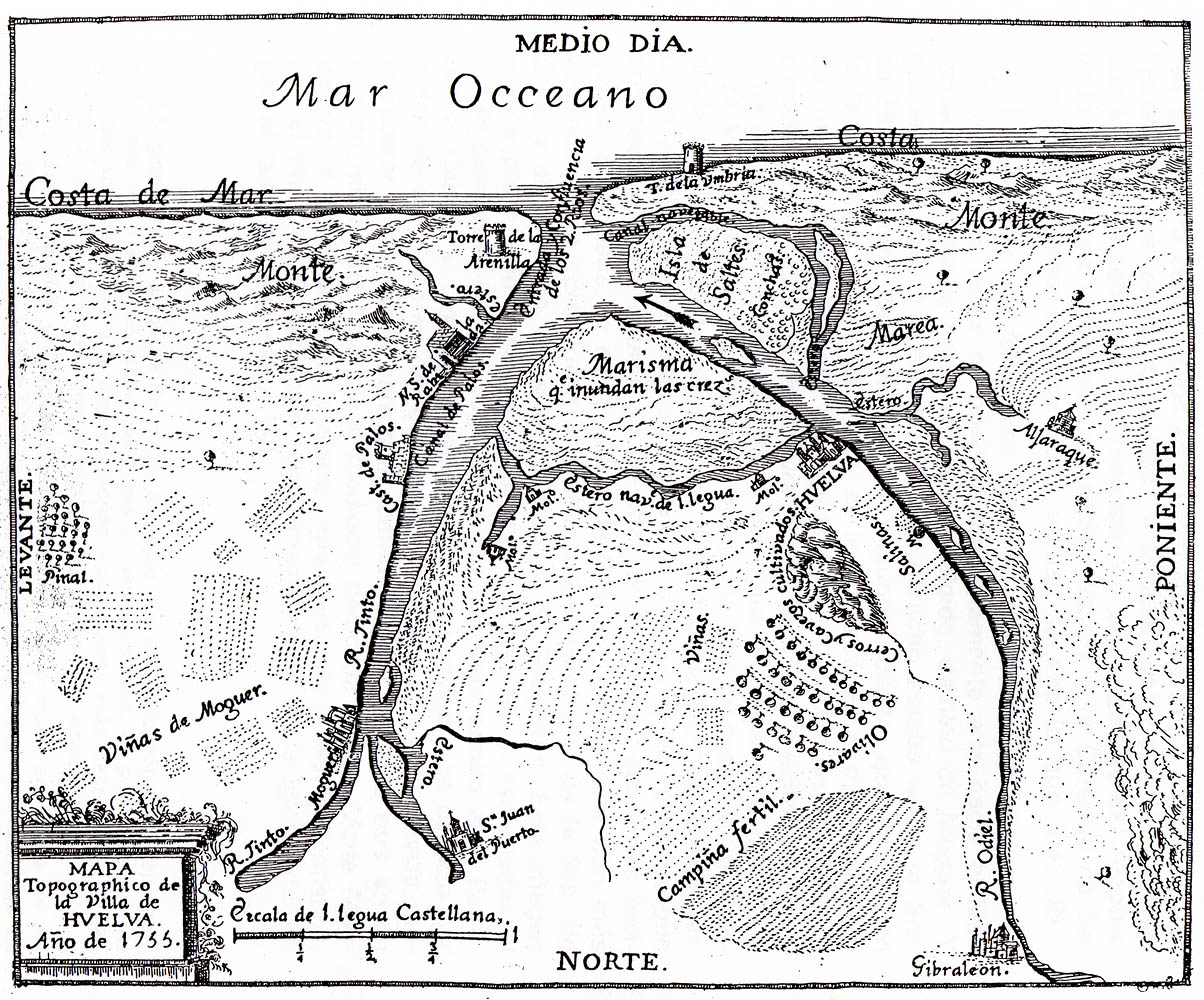
There are two localities so honored: Palos de la Frontera (both the old center and the La Rábida Monastery 3 kilometres (1.9 mi) distant), and Moguer. Columbus visited each of these places several times, and people associated with each played roles in his voyage. He received help and collaboration for his projected voyage from the brothers of the La Rábida Monastery, the Pinzón Brothers of Palos de la Frontera, the Niño Brothers of Moguer and other prestigious families of mariners in the area who were further distinguished by their participation in the voyage of discovery.
In the years following Columbus's voyage this area of Spain, especially Palos, suffered a great economic decline, owing in part to emigration to the newly discovered territories overseas. The recuperation of the historical importance of this region with respect to the Spanish discovery and conquest of the Americas (and the interest in preserving and restoring the buildings associated with Columbus) began, in part, with the nineteenth-century writer Washington Irving, from the United States, whose travels in Spain included this area. His diary entries for 12–14 August 1828 deal with the Lugares colombinos; that same year he would publish A History of the Life and Voyages of Christopher Columbus; he also published a short essay about Palos as an appendix to Voyages and Discoveries of the Companions of Columbus.
The Lugares colombinos remain a strong reminder of the history linking Spain to Latin America, and are the most noted historical and cultural sites in the province of Huelva.
Palos de la Frontera describes itself as the "cradle of the Discovery of America". The royal provision undertaking to provide two caravels for Columbus was read out at the fourteenth century Church of Saint George the Martyr (Iglesia de San Jorge Mártir) on 30 April 1492. It was declared a National Monument in 1931.
Near this church is the Fontanilla, the public fountain from which, according to tradition, Columbus's boats drew the fresh water for their voyage. The fountain lay between the church's Puerta de los Novios and the wharf from which Columbus's expedition departed. The base of the fountain dates back to Roman times and it is protected by a tetrapylum, a sort of gazebo, constructed of stone in the thirteenth century in the Mudéjar style.
The Pinzón Brothers (Martín Alonso Pinzón, Vicente Yañez Pinzón, and Francisco Martín Pinzón), co-discoverers of America, were from Palos. The oldest, Martín Alonso, played a decisive role in the voyage. His prestige as a shipowner and marine expert encouraged the mariners throughout the district; he also put up one third of the cost of the voyage and, rejecting the first ships provided for Columbus, obtained others that were more appropriate. The house of the brothers, also, in Palos, is now the Casa Museo de Martín Alonso Pinzón, and conserves its fifteenth century façade and part of its original flooring.
One can also walk along the banks of the Rio Tinto near the Calzadilla wharf from which the Plus Ultra flying boat took off on the first Trans-Atlantic flight between Spain and South America in January 1926. Quite near that is the historic port of Palos—now disappeared because of decreased river flow and silting—and the old rural road leading to La Rábida.
Hub AI
Lugares colombinos AI simulator
(@Lugares colombinos_simulator)
Lugares colombinos
The Lugares colombinos ("Columbian places") is a tourist route in the Spanish province Huelva, which includes several places that have special relevance to the preparation and realization of the first voyage of Cristopher Columbus. That voyage is widely considered to constitute the discovery of the Americas by Europeans. It was declared a conjunto histórico artístico ("historic/artistic grouping") by a Spanish law of 1967.
There are two localities so honored: Palos de la Frontera (both the old center and the La Rábida Monastery 3 kilometres (1.9 mi) distant), and Moguer. Columbus visited each of these places several times, and people associated with each played roles in his voyage. He received help and collaboration for his projected voyage from the brothers of the La Rábida Monastery, the Pinzón Brothers of Palos de la Frontera, the Niño Brothers of Moguer and other prestigious families of mariners in the area who were further distinguished by their participation in the voyage of discovery.
In the years following Columbus's voyage this area of Spain, especially Palos, suffered a great economic decline, owing in part to emigration to the newly discovered territories overseas. The recuperation of the historical importance of this region with respect to the Spanish discovery and conquest of the Americas (and the interest in preserving and restoring the buildings associated with Columbus) began, in part, with the nineteenth-century writer Washington Irving, from the United States, whose travels in Spain included this area. His diary entries for 12–14 August 1828 deal with the Lugares colombinos; that same year he would publish A History of the Life and Voyages of Christopher Columbus; he also published a short essay about Palos as an appendix to Voyages and Discoveries of the Companions of Columbus.
The Lugares colombinos remain a strong reminder of the history linking Spain to Latin America, and are the most noted historical and cultural sites in the province of Huelva.
Palos de la Frontera describes itself as the "cradle of the Discovery of America". The royal provision undertaking to provide two caravels for Columbus was read out at the fourteenth century Church of Saint George the Martyr (Iglesia de San Jorge Mártir) on 30 April 1492. It was declared a National Monument in 1931.
Near this church is the Fontanilla, the public fountain from which, according to tradition, Columbus's boats drew the fresh water for their voyage. The fountain lay between the church's Puerta de los Novios and the wharf from which Columbus's expedition departed. The base of the fountain dates back to Roman times and it is protected by a tetrapylum, a sort of gazebo, constructed of stone in the thirteenth century in the Mudéjar style.
The Pinzón Brothers (Martín Alonso Pinzón, Vicente Yañez Pinzón, and Francisco Martín Pinzón), co-discoverers of America, were from Palos. The oldest, Martín Alonso, played a decisive role in the voyage. His prestige as a shipowner and marine expert encouraged the mariners throughout the district; he also put up one third of the cost of the voyage and, rejecting the first ships provided for Columbus, obtained others that were more appropriate. The house of the brothers, also, in Palos, is now the Casa Museo de Martín Alonso Pinzón, and conserves its fifteenth century façade and part of its original flooring.
One can also walk along the banks of the Rio Tinto near the Calzadilla wharf from which the Plus Ultra flying boat took off on the first Trans-Atlantic flight between Spain and South America in January 1926. Quite near that is the historic port of Palos—now disappeared because of decreased river flow and silting—and the old rural road leading to La Rábida.