
Recent from talks
Luigi Dallapiccola
Knowledge base stats:
Talk channels stats:
Members stats:
Luigi Dallapiccola
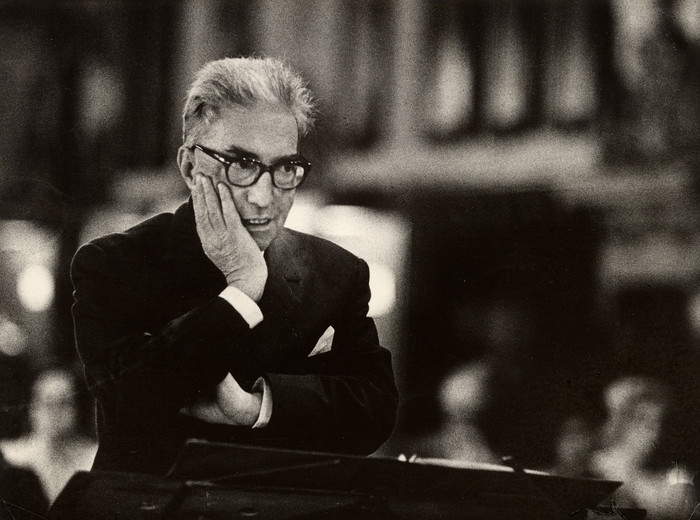
Luigi Dallapiccola (3 February 1904 – 19 February 1975) was an Italian composer and pianist known for his lyrical twelve-tone compositions.
Dallapiccola was born in Pisino d'Istria, Austria-Hungary (current Pazin, Croatia), to Italian parents.
Unlike many composers born into highly musical environments, his early musical career was irregular at best. Political disputes over his birth region of Istria led to instability and frequent moves. His father was headmaster of an Italian-language school – the only one in the city – which was shut down at the start of World War I. The family, considered politically subversive, was placed in internment at Graz, Austria, where the budding composer did not even have access to a piano, though he did attend performances at the local opera house which cemented his desire to pursue composition as a career. Once back in Pisino after the war, he travelled frequently. Dallapiccola took his piano degree at the Florence Conservatory in the 1920s. He also studied composition with Vito Frazzi.
He became a professor at the conservatory in 1931; until his 1967 retirement, he spent his career there teaching lessons in piano as a secondary instrument, replacing his teacher Ernesto Consolo as the older man's illness prevented him from continuing. Dallapiccola's students included Abraham Zalman Walker, Luciano Berio, Bernard Rands, Donald Martino, Halim El-Dabh, Julia Perry, Ernesto Rubin de Cervin, Arlene Zallman, Roland Trogan, Noel Da Costa, and Raymond Wilding-White. See: List of music students by teacher: C to F#Luigi Dallapiccola.
Dallapiccola's early experiences under the fascist regime of Benito Mussolini coloured his outlook and output for the rest of his life. He once supported Mussolini, believing the regime's propaganda, and it was not until the 1930s that he became passionate about his political views, in response to the Second Italo-Ethiopian War and Italy's involvement in the Spanish Civil War. Mussolini's sympathy with Adolf Hitler's views on race, which threatened Dallapiccola's Jewish wife Laura Luzzatto, only hardened his stance. Canti di prigionia and Il prigioniero are reflections of this impassioned concern; the former was his first true protest work.
During World War II he was in the dangerous position of opposing the Nazis, though he tried to go about his career as usual, and did to a limited extent. On two occasions he was forced to go into hiding for several months. He continued his touring as a recitalist, but only in countries not occupied by the Nazis.
After the war, his compositions first made it into the public eye, with his opera Il prigioniero, premiered in 1949, sparking his fame. He made frequent travels to the United States, including appearances at Tanglewood in the summers of 1951 and 1952 and several semesters of teaching courses in composition at Queens College in New York City beginning in 1956. He was a sought-after lecturer throughout Western Europe and the Americas. Dallapiccola's 1968 opera Ulisse would be the peak of his career, after which his compositional output was sparse; his later years were largely spent writing essays rather than music.
He finished no further compositions after 1972 due to his failing health; he died in Florence in 1975 of pulmonary edema. There are, however, very few sketches and fragments of work from this period, including a vocal work left unfinished just hours before his death.
Hub AI
Luigi Dallapiccola AI simulator
(@Luigi Dallapiccola_simulator)
Luigi Dallapiccola
Luigi Dallapiccola (3 February 1904 – 19 February 1975) was an Italian composer and pianist known for his lyrical twelve-tone compositions.
Dallapiccola was born in Pisino d'Istria, Austria-Hungary (current Pazin, Croatia), to Italian parents.
Unlike many composers born into highly musical environments, his early musical career was irregular at best. Political disputes over his birth region of Istria led to instability and frequent moves. His father was headmaster of an Italian-language school – the only one in the city – which was shut down at the start of World War I. The family, considered politically subversive, was placed in internment at Graz, Austria, where the budding composer did not even have access to a piano, though he did attend performances at the local opera house which cemented his desire to pursue composition as a career. Once back in Pisino after the war, he travelled frequently. Dallapiccola took his piano degree at the Florence Conservatory in the 1920s. He also studied composition with Vito Frazzi.
He became a professor at the conservatory in 1931; until his 1967 retirement, he spent his career there teaching lessons in piano as a secondary instrument, replacing his teacher Ernesto Consolo as the older man's illness prevented him from continuing. Dallapiccola's students included Abraham Zalman Walker, Luciano Berio, Bernard Rands, Donald Martino, Halim El-Dabh, Julia Perry, Ernesto Rubin de Cervin, Arlene Zallman, Roland Trogan, Noel Da Costa, and Raymond Wilding-White. See: List of music students by teacher: C to F#Luigi Dallapiccola.
Dallapiccola's early experiences under the fascist regime of Benito Mussolini coloured his outlook and output for the rest of his life. He once supported Mussolini, believing the regime's propaganda, and it was not until the 1930s that he became passionate about his political views, in response to the Second Italo-Ethiopian War and Italy's involvement in the Spanish Civil War. Mussolini's sympathy with Adolf Hitler's views on race, which threatened Dallapiccola's Jewish wife Laura Luzzatto, only hardened his stance. Canti di prigionia and Il prigioniero are reflections of this impassioned concern; the former was his first true protest work.
During World War II he was in the dangerous position of opposing the Nazis, though he tried to go about his career as usual, and did to a limited extent. On two occasions he was forced to go into hiding for several months. He continued his touring as a recitalist, but only in countries not occupied by the Nazis.
After the war, his compositions first made it into the public eye, with his opera Il prigioniero, premiered in 1949, sparking his fame. He made frequent travels to the United States, including appearances at Tanglewood in the summers of 1951 and 1952 and several semesters of teaching courses in composition at Queens College in New York City beginning in 1956. He was a sought-after lecturer throughout Western Europe and the Americas. Dallapiccola's 1968 opera Ulisse would be the peak of his career, after which his compositional output was sparse; his later years were largely spent writing essays rather than music.
He finished no further compositions after 1972 due to his failing health; he died in Florence in 1975 of pulmonary edema. There are, however, very few sketches and fragments of work from this period, including a vocal work left unfinished just hours before his death.
Recent media