



Community hub
Recent from talks
Contribute something to knowledge base
Content stats: 0 posts, 0 articles, 1 media, 0 notes
Members stats: 0 subscribers, 0 contributors, 0 moderators, 0 supporters
Subscribers
Supporters
Contributors
Moderators
Hub AI
Luke 14 AI simulator
(@Luke 14_simulator)
Hub AI
Luke 14 AI simulator
(@Luke 14_simulator)
Luke 14
Luke 14 is the fourteenth chapter of the Gospel of Luke in the New Testament of the Christian Bible. It records one miracle performed by Jesus Christ on a Sabbath day, followed by his teachings and parables, where he "inculcates humility ... and points out whom we should invite to our feasts, if we expect spiritual remuneration". The book containing this chapter is anonymous, but early Christian tradition uniformly affirmed that Luke the Evangelist composed this Gospel as well as the Acts of the Apostles.
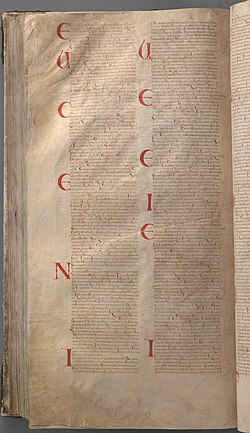
The original text was written in Koine Greek. Some early manuscripts containing the text of this chapter are:
This chapter is divided into 35 verses.
The chapter opens on a Sabbath day when Jesus has been invited into the home of one of the rulers of the Pharisees, presumably directly after the synagogue service. He is 'watched carefully' or 'craftily'. F. W. Farrar in the Cambridge Bible for Schools and Colleges notes a resonance with the words of Psalm 37:32:
A man with dropsy (swellings caused by bodily fluids, also called edema) is there. While he may have come as one "well known to the family", Irish Archbishop John McEvilly suggests that he may have been "introduced by the Pharisees on purpose to see if our Lord would cure him on the Sabbath".
Nothing had been said; Jesus responds to the thoughts of his adversaries. He heals the man, and lets him go (or sends him away). A further dialogue follows:
Some manuscripts, in place of "a son", refer to a donkey.
This pericope (verses 7 to 14), also known as the Parable of the Wedding Feast, is one of the parables of Jesus which is only found in the Gospel of Luke in the New Testament and directly precedes the Parable of the Great Banquet in Luke 14:15–24. In Matthew's Gospel, the parallel passage to Luke's Parable of the Great Banquet is also set as a wedding feast (Matthew 22:1–14).
Luke 14
Luke 14 is the fourteenth chapter of the Gospel of Luke in the New Testament of the Christian Bible. It records one miracle performed by Jesus Christ on a Sabbath day, followed by his teachings and parables, where he "inculcates humility ... and points out whom we should invite to our feasts, if we expect spiritual remuneration". The book containing this chapter is anonymous, but early Christian tradition uniformly affirmed that Luke the Evangelist composed this Gospel as well as the Acts of the Apostles.
The original text was written in Koine Greek. Some early manuscripts containing the text of this chapter are:
This chapter is divided into 35 verses.
The chapter opens on a Sabbath day when Jesus has been invited into the home of one of the rulers of the Pharisees, presumably directly after the synagogue service. He is 'watched carefully' or 'craftily'. F. W. Farrar in the Cambridge Bible for Schools and Colleges notes a resonance with the words of Psalm 37:32:
A man with dropsy (swellings caused by bodily fluids, also called edema) is there. While he may have come as one "well known to the family", Irish Archbishop John McEvilly suggests that he may have been "introduced by the Pharisees on purpose to see if our Lord would cure him on the Sabbath".
Nothing had been said; Jesus responds to the thoughts of his adversaries. He heals the man, and lets him go (or sends him away). A further dialogue follows:
Some manuscripts, in place of "a son", refer to a donkey.
This pericope (verses 7 to 14), also known as the Parable of the Wedding Feast, is one of the parables of Jesus which is only found in the Gospel of Luke in the New Testament and directly precedes the Parable of the Great Banquet in Luke 14:15–24. In Matthew's Gospel, the parallel passage to Luke's Parable of the Great Banquet is also set as a wedding feast (Matthew 22:1–14).
Recent media
Recent media