
Recent from talks
Lumbricus terrestris
Knowledge base stats:
Talk channels stats:
Members stats:
Lumbricus terrestris
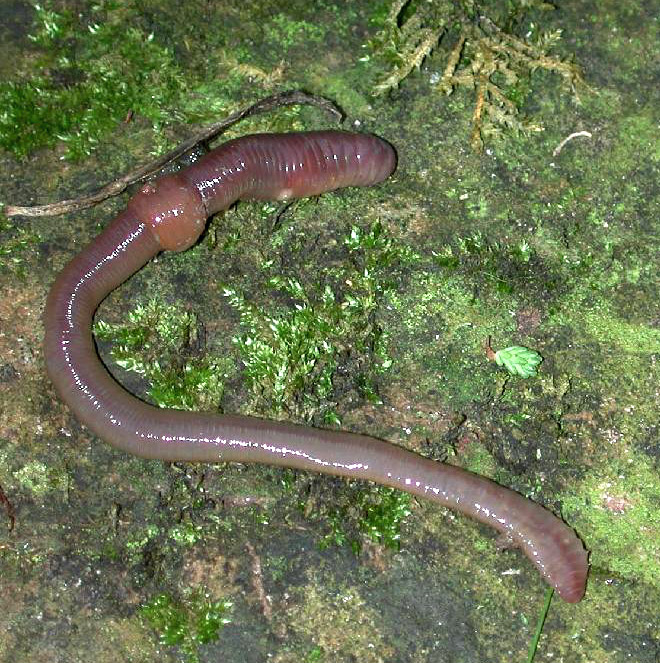
Lumbricus terrestris is a large, reddish worm species thought to be native to Western Europe, now widely distributed around the world (along with several other lumbricids). In some areas where it is an introduced species, some people consider it to be a significant pest for out-competing native worms.
Through much of Europe, it is the largest naturally occurring species of earthworm, typically reaching 20 to 25 cm in length when extended.
Because it is widely known, L. terrestris goes under a variety of common names. In Britain, it is primarily called the common earthworm or lob worm (though the name is also applied to a marine polychaete). In North America, the term nightcrawler (or vitalis) is also used, and more specifically Canadian nightcrawler, referring to the fact that the large majority of these worms sold commercially (usually as fishing bait) are from Southern Ontario. In Canada, it is also called the dew worm, or "Grandaddy Earthworm". In several Germanic languages, it is called variants of "rain worm", for example in German Gemeiner Regenwurm ("common rain worm") or in Danish Stor regnorm ("large rain worm"). In the rest of the world, many references are just to the scientific name, though with occasional reference to the above names.
Although this is not the most abundant earthworm, even in its native range, it is a very conspicuous and familiar earthworm species in garden and agricultural soils of the temperate zone, and is frequently seen on the surface, unlike most other earthworms. It is also used as the example earthworm for millions of biology students around the world, even in areas where the species does not exist. However, 'earthworm' can be a source of confusion since, in most of the world, other species are more typical. For example, through much of the unirrigated temperate areas of the world, the "common earthworm" is actually Aporrectodea (=Allolobophora) trapezoides, which in those areas is a similar size and dark colour to L. terrestris.
Lumbricus terrestris is relatively large, pinkish to reddish-brown in colour, generally 110–200 millimetres (4.3–7.9 in) in length and about 7–10 millimetres (0.28–0.39 in) in diameter. It has around 120–170 segments, often 135–150. The body is cylindrical in the cross section, except for the broad, flattened posterior section. Head end dark brown to reddish brown lateral, dorsal pigmentation fading towards the back.
The worm has a hydrostatic skeleton and moves by longitudinal and circular muscular contractions. Setae – tiny hair-like projections – provide leverage against the surrounding soil, using slime liquid. Surface movements on moist, flat terrain were reported at a speed of 20 m/h and, based on measurements of the length of the trail, nocturnal activity away from the burrow was estimated at up to 19 m during a single surface foray. Such movement is apparent during and after heavy rainfall and usually happens when people become aware of relatively large numbers of earthworms in, for example, urban ecosystems. This form of activity is often considered a way to escape floods and waterlogged burrows. However, this cannot be the case since L. terrestris, like other earthworms, can live in oxygenated water for long periods of time, stretching to weeks. Under less severe environmental conditions where air temperature and moisture are sufficient, the worm often moves around on the surface. This may be driven by resource availability or the desire to avoid mating with close relatives.
Lumbricus terrestris is a deep-burrowing anecic earthworm, that is, it builds deep vertical burrows and surfaces to feed, as opposed to burrowing through the soil for its food as endogeic species. It removes litter from the soil surface, pulling it down into the mineral layer, and deposit casts of mixed organic and mineral material on the soil surface. It lives in semi-permanent burrows and can reside in or escape to deeper soil layers.
Its activity is limited by temperature and humidity. High soil and night air temperatures inhibit activity, as do low night moisture and dry soil. During such times, particularly in the summer, the worms will retreat to the deepest parts of their burrows. Winter temperatures can also reduce activity, while activity in maritime climates can continue through winter.
Hub AI
Lumbricus terrestris AI simulator
(@Lumbricus terrestris_simulator)
Lumbricus terrestris
Lumbricus terrestris is a large, reddish worm species thought to be native to Western Europe, now widely distributed around the world (along with several other lumbricids). In some areas where it is an introduced species, some people consider it to be a significant pest for out-competing native worms.
Through much of Europe, it is the largest naturally occurring species of earthworm, typically reaching 20 to 25 cm in length when extended.
Because it is widely known, L. terrestris goes under a variety of common names. In Britain, it is primarily called the common earthworm or lob worm (though the name is also applied to a marine polychaete). In North America, the term nightcrawler (or vitalis) is also used, and more specifically Canadian nightcrawler, referring to the fact that the large majority of these worms sold commercially (usually as fishing bait) are from Southern Ontario. In Canada, it is also called the dew worm, or "Grandaddy Earthworm". In several Germanic languages, it is called variants of "rain worm", for example in German Gemeiner Regenwurm ("common rain worm") or in Danish Stor regnorm ("large rain worm"). In the rest of the world, many references are just to the scientific name, though with occasional reference to the above names.
Although this is not the most abundant earthworm, even in its native range, it is a very conspicuous and familiar earthworm species in garden and agricultural soils of the temperate zone, and is frequently seen on the surface, unlike most other earthworms. It is also used as the example earthworm for millions of biology students around the world, even in areas where the species does not exist. However, 'earthworm' can be a source of confusion since, in most of the world, other species are more typical. For example, through much of the unirrigated temperate areas of the world, the "common earthworm" is actually Aporrectodea (=Allolobophora) trapezoides, which in those areas is a similar size and dark colour to L. terrestris.
Lumbricus terrestris is relatively large, pinkish to reddish-brown in colour, generally 110–200 millimetres (4.3–7.9 in) in length and about 7–10 millimetres (0.28–0.39 in) in diameter. It has around 120–170 segments, often 135–150. The body is cylindrical in the cross section, except for the broad, flattened posterior section. Head end dark brown to reddish brown lateral, dorsal pigmentation fading towards the back.
The worm has a hydrostatic skeleton and moves by longitudinal and circular muscular contractions. Setae – tiny hair-like projections – provide leverage against the surrounding soil, using slime liquid. Surface movements on moist, flat terrain were reported at a speed of 20 m/h and, based on measurements of the length of the trail, nocturnal activity away from the burrow was estimated at up to 19 m during a single surface foray. Such movement is apparent during and after heavy rainfall and usually happens when people become aware of relatively large numbers of earthworms in, for example, urban ecosystems. This form of activity is often considered a way to escape floods and waterlogged burrows. However, this cannot be the case since L. terrestris, like other earthworms, can live in oxygenated water for long periods of time, stretching to weeks. Under less severe environmental conditions where air temperature and moisture are sufficient, the worm often moves around on the surface. This may be driven by resource availability or the desire to avoid mating with close relatives.
Lumbricus terrestris is a deep-burrowing anecic earthworm, that is, it builds deep vertical burrows and surfaces to feed, as opposed to burrowing through the soil for its food as endogeic species. It removes litter from the soil surface, pulling it down into the mineral layer, and deposit casts of mixed organic and mineral material on the soil surface. It lives in semi-permanent burrows and can reside in or escape to deeper soil layers.
Its activity is limited by temperature and humidity. High soil and night air temperatures inhibit activity, as do low night moisture and dry soil. During such times, particularly in the summer, the worms will retreat to the deepest parts of their burrows. Winter temperatures can also reduce activity, while activity in maritime climates can continue through winter.
Recent media