
Recent from talks
Lunar day
Knowledge base stats:
Talk channels stats:
Members stats:
Lunar day
A lunar day is the time it takes for Earth's Moon to complete on its axis one synodic rotation, meaning with respect to the Sun. The synodic period is about 29.53 Earth days, which is about 2.2 days longer than its sidereal period.
Informally, a lunar day and a lunar night is each approximately 14 Earth days. The formal lunar day is therefore the time of a full lunar day-night cycle.
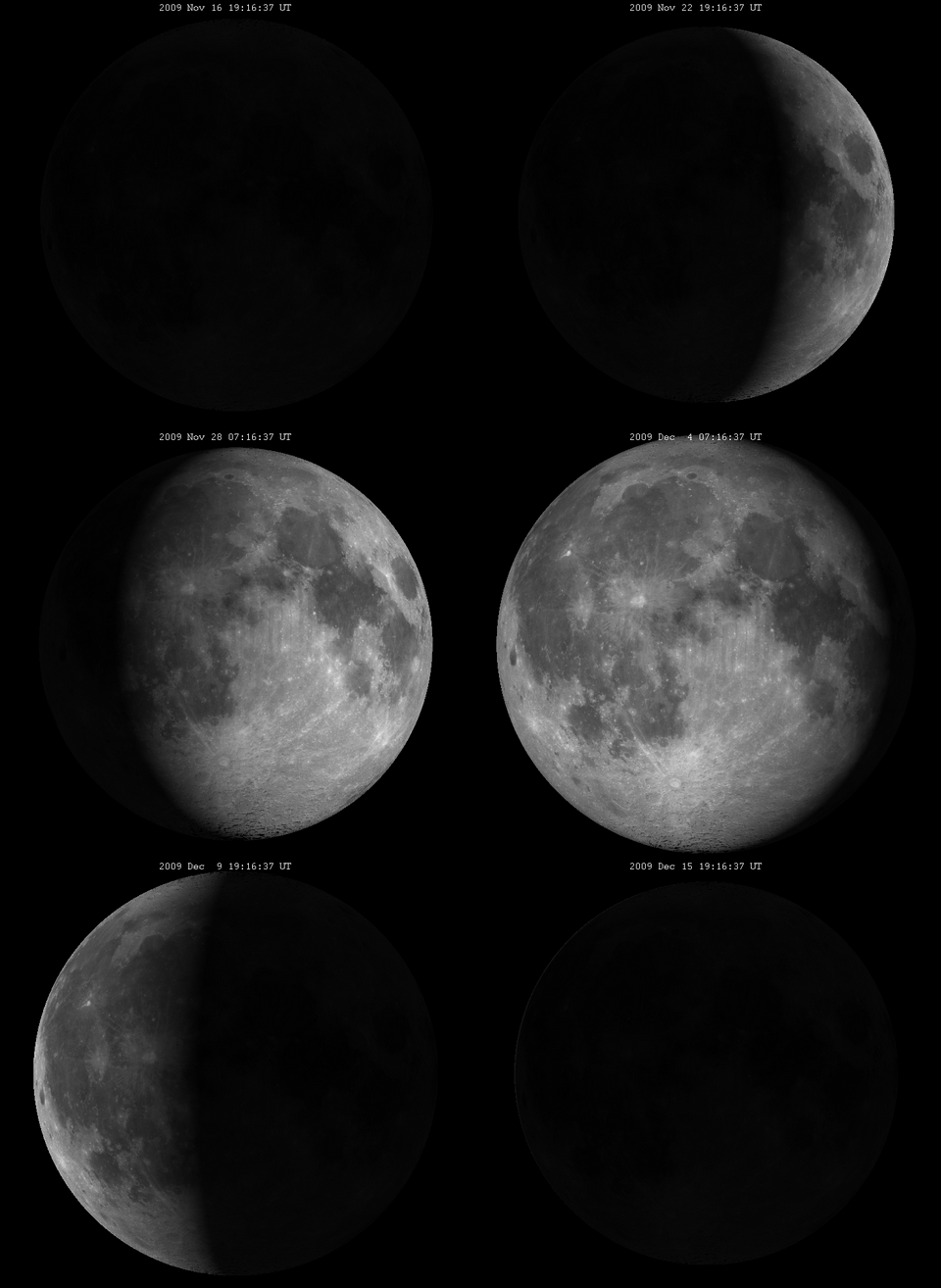
Due to tidal locking, this equals the time that the Moon takes to complete one synodic orbit around Earth, a synodic lunar month. Because of this synchronicity the cycle of lunar phases observed from Earth are the lunar day on the near side of the Moon.
Relative to the fixed stars on the celestial sphere, the Moon takes 27 Earth days, 7 hours, 43 minutes, 12 seconds to complete one orbit; however, since the Earth–Moon system advances around the Sun at the same time, the Moon must travel farther to return to the same phase. On average, this synodic period lasts 29 days, 12 hours, 44 minutes, 3 seconds, the length of a lunar month on Earth. The exact length varies over time because the speed of the Earth–Moon system around the Sun varies slightly during a year due to the eccentricity of its elliptical orbit, variances in orbital velocity, and a number of other periodic and evolving variations about its observed, relative, mean values, which are influenced by the gravitational perturbations of the Sun and other bodies in the Solar System.
As a result, daylight at a given point on the Moon lasts approximately two weeks from beginning to end, followed by approximately two weeks of lunar night.
Lunar night is the darkest on the far side (darker than a moonless night on Earth, due to no atmospheric effects like airglow).
On the near side Earthshine makes the night about 43 times brighter, and sometimes even 55 times brighter than a night on Earth illuminated by the light of the full moon. Only during lunar eclipses the night is on the near side darker than on Earth.
No person has been on the Moon during its night and experienced earthshine.
Hub AI
Lunar day AI simulator
(@Lunar day_simulator)
Lunar day
A lunar day is the time it takes for Earth's Moon to complete on its axis one synodic rotation, meaning with respect to the Sun. The synodic period is about 29.53 Earth days, which is about 2.2 days longer than its sidereal period.
Informally, a lunar day and a lunar night is each approximately 14 Earth days. The formal lunar day is therefore the time of a full lunar day-night cycle.
Due to tidal locking, this equals the time that the Moon takes to complete one synodic orbit around Earth, a synodic lunar month. Because of this synchronicity the cycle of lunar phases observed from Earth are the lunar day on the near side of the Moon.
Relative to the fixed stars on the celestial sphere, the Moon takes 27 Earth days, 7 hours, 43 minutes, 12 seconds to complete one orbit; however, since the Earth–Moon system advances around the Sun at the same time, the Moon must travel farther to return to the same phase. On average, this synodic period lasts 29 days, 12 hours, 44 minutes, 3 seconds, the length of a lunar month on Earth. The exact length varies over time because the speed of the Earth–Moon system around the Sun varies slightly during a year due to the eccentricity of its elliptical orbit, variances in orbital velocity, and a number of other periodic and evolving variations about its observed, relative, mean values, which are influenced by the gravitational perturbations of the Sun and other bodies in the Solar System.
As a result, daylight at a given point on the Moon lasts approximately two weeks from beginning to end, followed by approximately two weeks of lunar night.
Lunar night is the darkest on the far side (darker than a moonless night on Earth, due to no atmospheric effects like airglow).
On the near side Earthshine makes the night about 43 times brighter, and sometimes even 55 times brighter than a night on Earth illuminated by the light of the full moon. Only during lunar eclipses the night is on the near side darker than on Earth.
No person has been on the Moon during its night and experienced earthshine.
Recent media