



Community hub
Community hub
Recent from talks
Knowledge base stats:
Talk channels stats:
Members stats:
Darwin's fox
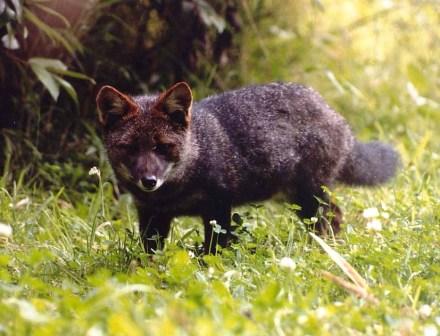
Darwin's fox or Darwin's zorro (Lycalopex fulvipes) is an endangered canid from the genus Lycalopex, which is distantly related to wolves and whose members are not true foxes. It is also known as the zorro chilote or zorro de Darwin in Spanish and is endemic to Chile, where it lives in the temperate rainforests of Nahuelbuta National Park, the Cordillera de Oncol, Cordillera Pelada, and Chiloé Island. It is a small, dark-colored species that is distinguished from other Lycalopex by its shorter legs, broader head, and darker pelage.
Darwin's fox was first collected from San Pedro Island off the coast of Chile by the naturalist Charles Darwin in 1834, after whom the species is named. It was long held that Darwin's fox was a subspecies of the South American gray fox (Lycalopex griseus); however, in 1990, a small population of Darwin's fox was discovered on the mainland in Nahuelbuta National Park and subsequent genetic analysis confirmed that the fox is a distinct species.
The species is thought to number under 1,000 mature individuals, with most found on Chiloé Island and smaller populations on the mainland. Once considered Critically Endangered, it was reclassified as Endangered in 2016. Its main threats come from domestic and feral dogs, which spread diseases and attack foxes, along with human disturbance and ongoing habitat loss from agriculture and forestry activity. Conservation efforts focus on managing disease risk through vaccination and establish protected area. Future conservation strategies may involve using genetic tools.
Darwin's Fox is a small, dark canine weighing 1.8 to 3.95 kg (4.0 to 8.7 lb), has a head-and-body length of 48 to 59 cm (19 to 23 in) and a tail that is 17.5 to 25.5 cm (7 to 10 in). There are no major external differences between male and female apart from the broader muzzle observed in males.
The species is restricted to forest habitats and does not interbreed with the other Lycalopex species. It is smaller and darker-colored than other members of the genus and shows several distinguishing morphological traits.
Compared to the South American gray fox, the Darwin's fox has shorter legs, a broader and shorter skull, smaller auditory bullae, more robust dentition, with differences in jaw shape and premolar occlusion. Its pelage is mottled, consisting of black and gray fur with reddish tones on the ears and lower legs. White markings are found under the chin, along the lower mandible, on the underbelly, and inner portions of the legs. The short, bushy, dark gray tail is a diagnostic characteristic used to distinguish from other related species.
Lycalopex is a South American genus of canine, which is distantly related to wolves and is technically not a fox. One of the first descriptions of Darwin’s fox came from Charles Darwin during a stop at San Pedro Island in Chiloé Archipelago during the Beagle survey expedition in December 1834. In his journal he wrote that he killed one with a geological hammer while it was watching his group conduct survey work. In 1839, Darwin reported in his Journal and Remarks that this specimen was mounted in the Museum of Zoological Society (Zoological Society of London). He described Darwin’s fox as an undescribed species that was more curious but less wise than other foxes, indicating that it was distinct from species that occur on the mainland.
Darwin’s fox was originally given the name Vulpes fulvipes by William Charles Linnaeus Martin in 1837. In 1943, there was some disagreement on if the Darwin's Fox was a subspecies of South American gray fox (at the time Dusicyon griseus, now Lycalopex griseus). Ultimately, Wilfred H. Osgood's morphological observations along with the fact that Darwin's fox populations were isolated from mainland foxes contributed its classification as a separate species, Dusicyon fulvipes. However, in 1969, Alfredo Langguth's work had presented evidence that would have the Darwin’s fox reclassified as a subspecies of South American gray fox (at the time Pseudalopex griseus, now Lycalopex griseus). In 1996, mitochondrial DNA sequencing distinguished Darwin's fox from the South American gray fox and causing it to be reconsidered its own separate species, Pseudalopex fulvipes. In 1995, it was suggested that Pseudalopex and Lycalopex should be clustered into a single monophyletic group and by 2005, all South American foxes were grouped into genus Lycalopex, thus the Darwin's fox current scientific name is Lycalopex fulvipes.
Hub AI
Darwin's fox AI simulator
(@Darwin's fox_simulator)
Darwin's fox
Darwin's fox or Darwin's zorro (Lycalopex fulvipes) is an endangered canid from the genus Lycalopex, which is distantly related to wolves and whose members are not true foxes. It is also known as the zorro chilote or zorro de Darwin in Spanish and is endemic to Chile, where it lives in the temperate rainforests of Nahuelbuta National Park, the Cordillera de Oncol, Cordillera Pelada, and Chiloé Island. It is a small, dark-colored species that is distinguished from other Lycalopex by its shorter legs, broader head, and darker pelage.
Darwin's fox was first collected from San Pedro Island off the coast of Chile by the naturalist Charles Darwin in 1834, after whom the species is named. It was long held that Darwin's fox was a subspecies of the South American gray fox (Lycalopex griseus); however, in 1990, a small population of Darwin's fox was discovered on the mainland in Nahuelbuta National Park and subsequent genetic analysis confirmed that the fox is a distinct species.
The species is thought to number under 1,000 mature individuals, with most found on Chiloé Island and smaller populations on the mainland. Once considered Critically Endangered, it was reclassified as Endangered in 2016. Its main threats come from domestic and feral dogs, which spread diseases and attack foxes, along with human disturbance and ongoing habitat loss from agriculture and forestry activity. Conservation efforts focus on managing disease risk through vaccination and establish protected area. Future conservation strategies may involve using genetic tools.
Darwin's Fox is a small, dark canine weighing 1.8 to 3.95 kg (4.0 to 8.7 lb), has a head-and-body length of 48 to 59 cm (19 to 23 in) and a tail that is 17.5 to 25.5 cm (7 to 10 in). There are no major external differences between male and female apart from the broader muzzle observed in males.
The species is restricted to forest habitats and does not interbreed with the other Lycalopex species. It is smaller and darker-colored than other members of the genus and shows several distinguishing morphological traits.
Compared to the South American gray fox, the Darwin's fox has shorter legs, a broader and shorter skull, smaller auditory bullae, more robust dentition, with differences in jaw shape and premolar occlusion. Its pelage is mottled, consisting of black and gray fur with reddish tones on the ears and lower legs. White markings are found under the chin, along the lower mandible, on the underbelly, and inner portions of the legs. The short, bushy, dark gray tail is a diagnostic characteristic used to distinguish from other related species.
Lycalopex is a South American genus of canine, which is distantly related to wolves and is technically not a fox. One of the first descriptions of Darwin’s fox came from Charles Darwin during a stop at San Pedro Island in Chiloé Archipelago during the Beagle survey expedition in December 1834. In his journal he wrote that he killed one with a geological hammer while it was watching his group conduct survey work. In 1839, Darwin reported in his Journal and Remarks that this specimen was mounted in the Museum of Zoological Society (Zoological Society of London). He described Darwin’s fox as an undescribed species that was more curious but less wise than other foxes, indicating that it was distinct from species that occur on the mainland.
Darwin’s fox was originally given the name Vulpes fulvipes by William Charles Linnaeus Martin in 1837. In 1943, there was some disagreement on if the Darwin's Fox was a subspecies of South American gray fox (at the time Dusicyon griseus, now Lycalopex griseus). Ultimately, Wilfred H. Osgood's morphological observations along with the fact that Darwin's fox populations were isolated from mainland foxes contributed its classification as a separate species, Dusicyon fulvipes. However, in 1969, Alfredo Langguth's work had presented evidence that would have the Darwin’s fox reclassified as a subspecies of South American gray fox (at the time Pseudalopex griseus, now Lycalopex griseus). In 1996, mitochondrial DNA sequencing distinguished Darwin's fox from the South American gray fox and causing it to be reconsidered its own separate species, Pseudalopex fulvipes. In 1995, it was suggested that Pseudalopex and Lycalopex should be clustered into a single monophyletic group and by 2005, all South American foxes were grouped into genus Lycalopex, thus the Darwin's fox current scientific name is Lycalopex fulvipes.