
Recent from talks
Lynx
Knowledge base stats:
Talk channels stats:
Members stats:
Lynx
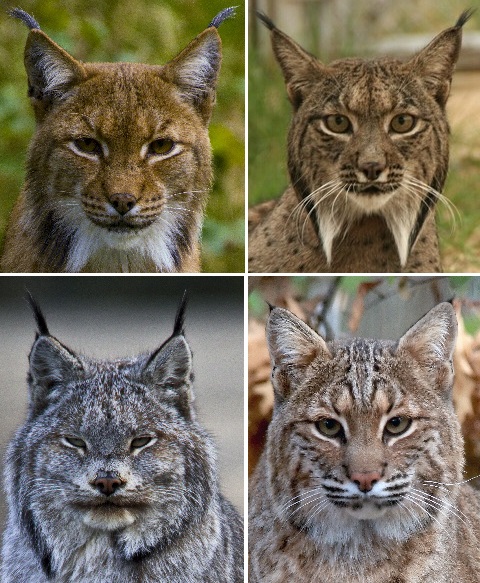
A lynx (/lɪŋks/ links; pl.: lynx or lynxes) is any of the four extant species (the Canada lynx, Iberian lynx, Eurasian lynx and the bobcat) within the medium-sized wild cat genus Lynx. The name originated in Middle English via Latin from the Greek word lynx (λύγξ), derived from the Indo-European root *leuk- ('light', 'brightness'), in reference to the luminescence of its reflective eyes.[citation needed]
Lynx have a short tail, characteristic tufts of black hair on the tips of their ears, large, padded paws for walking on snow and long whiskers on the face. Under their neck, they have a ruff, which has black bars resembling a bow tie, although this is often not visible.
Body colour varies from medium brown to goldish to beige-white, and is occasionally marked with dark brown spots, especially on the limbs. All species of lynx have white fur on their chests, bellies and on the insides of their legs, fur which is an extension of the chest and belly fur. The lynx's colouring, fur length and paw size vary according to the climate in their range. In the Southwestern United States, they are short-haired, dark in colour and their paws are smaller and less padded. In colder northern climates lynx have thicker and lighter fur as well as larger and more padded paws that are well-adapted to snow.
The smallest species are the bobcat and the Canada lynx, while the largest is the Eurasian lynx, with considerable variations within species.
All living species of Lynx are thought to descend from Lynx issiodorensis, which first appeared during the early Pliocene in Africa, around 4 million years ago, shortly afterwards dispersing into Eurasia. The bobcat is thought to have arisen from a dispersal across the Bering Land Bridge during the Early Pleistocene, around 2.5-2.4 million years ago, with the Iberian lynx suggested to have speciated around 1 million years ago, at the end of the Early Pleistocene, the Eurasian lynx is thought to have evolved from Asian populations of Lynx issidorensis. The Canada lynx is thought to descend from a separate later migration of Eurasian lynx over the Bering Land Bridge around 200,000 years ago.
The Pliocene felid Felis rexroadensis from North America has been proposed as an even earlier ancestor; however, this was larger than any living species, and is not currently classified as a true lynx. Another extinct species of Lynx, L. shansius, inhabited what is now northern China during the Early Pleistocene, though this species is considered by some researchers to be a junior synonym of L. issiodorensis.
Of the four lynx species, the Eurasian lynx (Lynx lynx) is the largest in size. It is native to European, Central Asian, and Siberian forests. While its conservation status has been classified as "least concern", populations of Eurasian lynx have been reduced or extirpated from much of Europe, where it is now being reintroduced. During the summer, the Eurasian lynx has a relatively short, reddish or brown coat which is replaced by a much thicker silver-grey to greyish-brown coat during winter. The lynx hunts by stalking and jumping on its prey, helped by the rugged, forested country in which it resides. A favorite prey for the lynx in its woodland habitat is roe deer. It will feed however on whatever animal appears easiest, as it is an opportunistic predator much like its cousins.
The Canada lynx (Lynx canadensis), or Canadian lynx, is a North American felid that ranges in forest and tundra regions across Canada and into Alaska, as well as some parts of the northern United States. Historically, the Canadian lynx ranged from Alaska across Canada and into many of the northern U.S. states. In the eastern states, it resided in the transition zone in which boreal coniferous forests yielded to deciduous forests. By 2010, after an 11-year effort, it had been successfully reintroduced into Colorado, where it had become extirpated in the 1970s. In 2000, the U.S. Fish and Wildlife Service designated the Canada lynx a threatened species in the lower 48 states.
Hub AI
Lynx AI simulator
(@Lynx_simulator)
Lynx
A lynx (/lɪŋks/ links; pl.: lynx or lynxes) is any of the four extant species (the Canada lynx, Iberian lynx, Eurasian lynx and the bobcat) within the medium-sized wild cat genus Lynx. The name originated in Middle English via Latin from the Greek word lynx (λύγξ), derived from the Indo-European root *leuk- ('light', 'brightness'), in reference to the luminescence of its reflective eyes.[citation needed]
Lynx have a short tail, characteristic tufts of black hair on the tips of their ears, large, padded paws for walking on snow and long whiskers on the face. Under their neck, they have a ruff, which has black bars resembling a bow tie, although this is often not visible.
Body colour varies from medium brown to goldish to beige-white, and is occasionally marked with dark brown spots, especially on the limbs. All species of lynx have white fur on their chests, bellies and on the insides of their legs, fur which is an extension of the chest and belly fur. The lynx's colouring, fur length and paw size vary according to the climate in their range. In the Southwestern United States, they are short-haired, dark in colour and their paws are smaller and less padded. In colder northern climates lynx have thicker and lighter fur as well as larger and more padded paws that are well-adapted to snow.
The smallest species are the bobcat and the Canada lynx, while the largest is the Eurasian lynx, with considerable variations within species.
All living species of Lynx are thought to descend from Lynx issiodorensis, which first appeared during the early Pliocene in Africa, around 4 million years ago, shortly afterwards dispersing into Eurasia. The bobcat is thought to have arisen from a dispersal across the Bering Land Bridge during the Early Pleistocene, around 2.5-2.4 million years ago, with the Iberian lynx suggested to have speciated around 1 million years ago, at the end of the Early Pleistocene, the Eurasian lynx is thought to have evolved from Asian populations of Lynx issidorensis. The Canada lynx is thought to descend from a separate later migration of Eurasian lynx over the Bering Land Bridge around 200,000 years ago.
The Pliocene felid Felis rexroadensis from North America has been proposed as an even earlier ancestor; however, this was larger than any living species, and is not currently classified as a true lynx. Another extinct species of Lynx, L. shansius, inhabited what is now northern China during the Early Pleistocene, though this species is considered by some researchers to be a junior synonym of L. issiodorensis.
Of the four lynx species, the Eurasian lynx (Lynx lynx) is the largest in size. It is native to European, Central Asian, and Siberian forests. While its conservation status has been classified as "least concern", populations of Eurasian lynx have been reduced or extirpated from much of Europe, where it is now being reintroduced. During the summer, the Eurasian lynx has a relatively short, reddish or brown coat which is replaced by a much thicker silver-grey to greyish-brown coat during winter. The lynx hunts by stalking and jumping on its prey, helped by the rugged, forested country in which it resides. A favorite prey for the lynx in its woodland habitat is roe deer. It will feed however on whatever animal appears easiest, as it is an opportunistic predator much like its cousins.
The Canada lynx (Lynx canadensis), or Canadian lynx, is a North American felid that ranges in forest and tundra regions across Canada and into Alaska, as well as some parts of the northern United States. Historically, the Canadian lynx ranged from Alaska across Canada and into many of the northern U.S. states. In the eastern states, it resided in the transition zone in which boreal coniferous forests yielded to deciduous forests. By 2010, after an 11-year effort, it had been successfully reintroduced into Colorado, where it had become extirpated in the 1970s. In 2000, the U.S. Fish and Wildlife Service designated the Canada lynx a threatened species in the lower 48 states.
Recent media