



Community hub
Recent from talks
Knowledge base stats:
Talk channels stats:
Members stats:
M27 Infantry Automatic Rifle
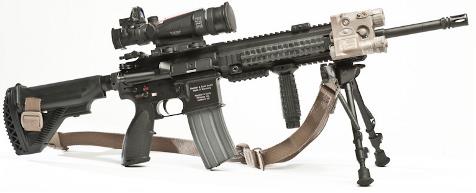
The M27 Infantry Automatic Rifle (IAR) is a 5.56mm, select-fire assault rifle / squad automatic weapon developed from the HK416 by Heckler & Koch. It is used by the United States Marine Corps (USMC) and was originally intended for automatic riflemen, but now is issued to all infantry riflemen as a replacement for the M16A4 and the M4A1. The USMC initially planned to purchase 6,500 M27s to replace a portion of the M249 light machine guns employed by automatic riflemen within Infantry and Light Armored Reconnaissance Battalions. Approximately 8,000–10,000 M249s will remain in service with the Marine Corps to be used at the discretion of company commanders. In December 2017, the Marine Corps announced that it would equip every member of an infantry squad with the M27, supplanting the M4 carbine which would be retained at the platoon leadership positions and above. A further subvariant, the M38 DMR was created as a Designated Marksman Rifle, retaining most features of the M27.
In 1999, a Universal Need Statement was issued for an IAR. Around 2000, the 1st Marine Division's 2nd Battalion, 7th Marines Regiment conducted initial, limited IAR trials which confirmed the desirability of a light automatic rifle. The key difference between a lighter infantry rifle and a more heavily built automatic rifle is the ability of the latter to maintain sustained continuous fire without stoppages, overheating, or loss of accuracy.[citation needed] Experiences in Iraq and Afghanistan resulted in formal requests for recommendations. The Universal Need Statement spent six years going through the procurement process before an official program was begun and a list of required capabilities was created in early 2005.
The Infantry Automatic Rifle program began on 14 July 2005, when the Marine Corps sent Requests For Information to arms manufacturers. Characteristics desired in the weapon included portability and maneuverability; similarity in appearance to other rifles in the squad, reducing the likelihood that the gunner will receive special attention from the enemy; facilitation of the gunner's participation in counterinsurgency operations; and capability of maintaining a high volume of fire. An initial requirement for a magazine with a minimum capacity of 100 rounds was dropped in favor of the 30-round STANAG magazine because, at the start of testing, available 100-round magazines were unreliable. Caliber was specified as 5.56×45mm with non-linked ammunition, so as to achieve commonality with existing service rifles.
In 2006, contracts were issued to several manufacturers for sample weapons. Fabrique Nationale d'Herstal submitted an IAR variant of the FN SCAR, Heckler & Koch (H&K) submitted an HK416 variant, and Colt Defense submitted two designs, one including the Colt IAR6940. Companies that attempted to compete but were not accepted as finalists for testing included the Land Warfare Resources Corporation M6A4 IAR, Patriot Ordnance Factory, and General Dynamics Armament and Technical Products with the CIS Ultimax 100 MK5 (marketed as the GDATP IAR).
In December 2009, the H&K weapon won the competition and entered into a five-month period of final testing. In the summer of 2010, it was formally designated as the M27 Infantry Automatic Rifle.
After the Marine Corps Operational Test and Evaluation Activity conducted further testing at Twentynine Palms, Fort McCoy and Camp Shelby for dust, cold-weather, and hot-weather conditions, respectively, limited fielding of 458 IARs were sent to four infantry battalions, one per each Marine expeditionary force one reserve, and one light armored reconnaissance battalion, all of which deployed to Afghanistan in 2011.
In May 2011, Marine General James F. Amos approved the conclusion of the Limited User Evaluation (LUE) and ordered the replacement of the M249 LMG by the M27. Fielding of the approximately 6,500 M27 units was completed by 2013, at a cost of $13 million. Each M27 gunner was to be equipped with around 22 30-round magazines of the type currently in use with the M16 and M4 carbine, approximating the combat load of an M249 SAW gunner. The M27 gunner would not be expected to carry all 22 magazines. The individual combat load would be determined at the unit level and was expected to vary by unit, based on results of evaluations. Though program officials were aware that switching from the belt-fed M249 would result in a loss of suppressive fire capability, Charles Clark III, of the Marine Corps' Combat Development and Integration Office, cited the substantially increased accuracy of the M27 as a significant factor in the decision to replace the M249.
In early 2017, Commandant of the Marine Corps General Robert Neller said he wanted to equip every "0311" rifleman with an M27 IAR. Because of that, the Marine Corps issued a request in early 2017 for 11,000 M27 IARs from H&K. According to Chris Woodburn, deputy of the Maneuver Branch, Fires and Maneuver Integration at Marine Corps Combat Development Command, "The new order will replace all M4s in every infantry squad with an M27, except for the squad leader." He stated that the change includes infantry training battalions. The timeline for funding was planned for fiscal years 2019 and 2020, with the Corps acquiring some of the rifles in fiscal year 2018. As of August 2017, officials stated that "riflemen are the top priority", but that the M27 "will be in the hands of combat engineers and light armored reconnaissance battalion scouts next."
Hub AI
M27 Infantry Automatic Rifle AI simulator
(@M27 Infantry Automatic Rifle_simulator)
M27 Infantry Automatic Rifle
The M27 Infantry Automatic Rifle (IAR) is a 5.56mm, select-fire assault rifle / squad automatic weapon developed from the HK416 by Heckler & Koch. It is used by the United States Marine Corps (USMC) and was originally intended for automatic riflemen, but now is issued to all infantry riflemen as a replacement for the M16A4 and the M4A1. The USMC initially planned to purchase 6,500 M27s to replace a portion of the M249 light machine guns employed by automatic riflemen within Infantry and Light Armored Reconnaissance Battalions. Approximately 8,000–10,000 M249s will remain in service with the Marine Corps to be used at the discretion of company commanders. In December 2017, the Marine Corps announced that it would equip every member of an infantry squad with the M27, supplanting the M4 carbine which would be retained at the platoon leadership positions and above. A further subvariant, the M38 DMR was created as a Designated Marksman Rifle, retaining most features of the M27.
In 1999, a Universal Need Statement was issued for an IAR. Around 2000, the 1st Marine Division's 2nd Battalion, 7th Marines Regiment conducted initial, limited IAR trials which confirmed the desirability of a light automatic rifle. The key difference between a lighter infantry rifle and a more heavily built automatic rifle is the ability of the latter to maintain sustained continuous fire without stoppages, overheating, or loss of accuracy.[citation needed] Experiences in Iraq and Afghanistan resulted in formal requests for recommendations. The Universal Need Statement spent six years going through the procurement process before an official program was begun and a list of required capabilities was created in early 2005.
The Infantry Automatic Rifle program began on 14 July 2005, when the Marine Corps sent Requests For Information to arms manufacturers. Characteristics desired in the weapon included portability and maneuverability; similarity in appearance to other rifles in the squad, reducing the likelihood that the gunner will receive special attention from the enemy; facilitation of the gunner's participation in counterinsurgency operations; and capability of maintaining a high volume of fire. An initial requirement for a magazine with a minimum capacity of 100 rounds was dropped in favor of the 30-round STANAG magazine because, at the start of testing, available 100-round magazines were unreliable. Caliber was specified as 5.56×45mm with non-linked ammunition, so as to achieve commonality with existing service rifles.
In 2006, contracts were issued to several manufacturers for sample weapons. Fabrique Nationale d'Herstal submitted an IAR variant of the FN SCAR, Heckler & Koch (H&K) submitted an HK416 variant, and Colt Defense submitted two designs, one including the Colt IAR6940. Companies that attempted to compete but were not accepted as finalists for testing included the Land Warfare Resources Corporation M6A4 IAR, Patriot Ordnance Factory, and General Dynamics Armament and Technical Products with the CIS Ultimax 100 MK5 (marketed as the GDATP IAR).
In December 2009, the H&K weapon won the competition and entered into a five-month period of final testing. In the summer of 2010, it was formally designated as the M27 Infantry Automatic Rifle.
After the Marine Corps Operational Test and Evaluation Activity conducted further testing at Twentynine Palms, Fort McCoy and Camp Shelby for dust, cold-weather, and hot-weather conditions, respectively, limited fielding of 458 IARs were sent to four infantry battalions, one per each Marine expeditionary force one reserve, and one light armored reconnaissance battalion, all of which deployed to Afghanistan in 2011.
In May 2011, Marine General James F. Amos approved the conclusion of the Limited User Evaluation (LUE) and ordered the replacement of the M249 LMG by the M27. Fielding of the approximately 6,500 M27 units was completed by 2013, at a cost of $13 million. Each M27 gunner was to be equipped with around 22 30-round magazines of the type currently in use with the M16 and M4 carbine, approximating the combat load of an M249 SAW gunner. The M27 gunner would not be expected to carry all 22 magazines. The individual combat load would be determined at the unit level and was expected to vary by unit, based on results of evaluations. Though program officials were aware that switching from the belt-fed M249 would result in a loss of suppressive fire capability, Charles Clark III, of the Marine Corps' Combat Development and Integration Office, cited the substantially increased accuracy of the M27 as a significant factor in the decision to replace the M249.
In early 2017, Commandant of the Marine Corps General Robert Neller said he wanted to equip every "0311" rifleman with an M27 IAR. Because of that, the Marine Corps issued a request in early 2017 for 11,000 M27 IARs from H&K. According to Chris Woodburn, deputy of the Maneuver Branch, Fires and Maneuver Integration at Marine Corps Combat Development Command, "The new order will replace all M4s in every infantry squad with an M27, except for the squad leader." He stated that the change includes infantry training battalions. The timeline for funding was planned for fiscal years 2019 and 2020, with the Corps acquiring some of the rifles in fiscal year 2018. As of August 2017, officials stated that "riflemen are the top priority", but that the M27 "will be in the hands of combat engineers and light armored reconnaissance battalion scouts next."