


Community hub
Recent from talks
Contribute something to knowledge base
Content stats: 0 posts, 0 articles, 1 media, 0 notes
Members stats: 0 subscribers, 0 contributors, 0 moderators, 0 supporters
Subscribers
Supporters
Contributors
Moderators
Hub AI
Squad automatic weapon AI simulator
(@Squad automatic weapon_simulator)
Hub AI
Squad automatic weapon AI simulator
(@Squad automatic weapon_simulator)
Squad automatic weapon
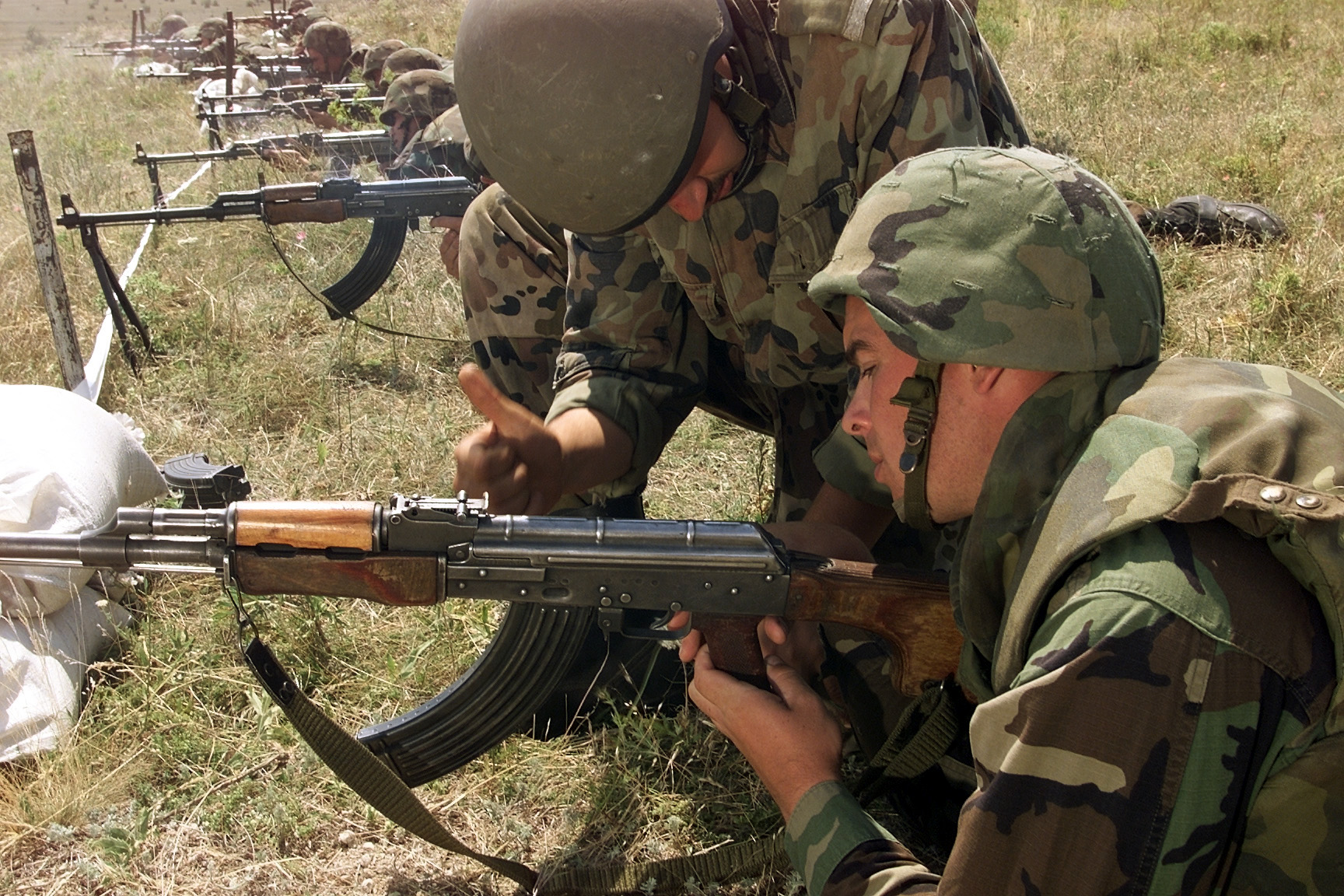
A squad automatic weapon (SAW), also known as a section automatic weapon or light support weapon (LSW), is a man-portable automatic firearm attached to infantry squads or sections as a source of rapid direct firepower. Weapons fulfilling this role can be light machine guns, or modified selective-fire rifles fitted with a heavier barrel, bipod and a belt/drum-fed design.
Squad automatic weapons usually fire the same cartridge (though heavier-bullet variants are preferred) as the assault rifles or battle rifles carried by other members of the unit. This reduces logistical requirements by making it only necessary to supply one type of service ammunition to a unit. These weapons are light enough to be carried and operated by one infantryman, unlike medium machine guns (such as the M1919 Browning) that require a crew to operate at full effectiveness; or heavy machine guns (such as the M2 Browning or the DShK) which fire more powerful cartridges but are also crew-served and typically also require a mounting platform to be operable.
One of the first weapons used in this role was the Madsen machine gun. Although limited in today's terms, the Madsen was introduced in an era when the standard infantry rifle was a bolt-action repeater with fixed magazines reloaded with single rounds or chargers; sustained rapid fire with these weapons could be maintained only for very short periods of time. The Madsen was capable of fully automatic fire; despite having only limited magazine capacity, this was still more than that of the infantry rifle, and it was of the quick change detachable box magazine type. Though over 100 years old, the Madsen is still in limited use today. The standard machine guns of this era were of the Maxim type. Used by the British, Germans, and the Russians, these weapons were bulky, heavy, tripod-based, and water-cooled, they required a team of four men and, although excellent in the defence, were not suited to manoeuvre warfare.
Another pioneering weapon in this role was the Browning automatic rifle (BAR). Introduced late in World War I, it remained in front-line service into the Vietnam War. Intended originally as an automatic rifle capable of delivering suppressing "walking fire" in the advance, the BAR came to be used in the light machine gun role. During World War II, as the importance of having a source of mobile automatic fire increased, the number of BARs in a unit also increased, until in some units it represented 1 in 4 of the weapons present in a squad. During its long service in the US military, it was pivotal in the evolution of U.S. fireteam tactics and doctrine that continues to the present day.
Modern squad automatic weapons (such as the RPK and L86) are modified assault rifles or battle rifles (e.g. FN FAL 50.41[broken anchor] and M14A1) that may have increased ammunition capacity and heavier barrels to withstand continued fire and will almost always have a bipod. In the case of some assault rifles, such as the H&K G36 or Steyr AUG, the SAW is simply the standard rifle with a few parts replaced. However, the Austrian Army, though issuing the Steyr AUG rifle, does not issue the HBAR (heavy barrel) variant. Instead, the 7.62mm caliber MG74, a derivative of WW2-era German MG 42, is issued.
Light machine guns, either belt-fed or magazine-fed, may be used as squad automatic weapons, as may general-purpose machine guns; for example, during most of the Cold War period, the standard squad automatic weapon in the British Army was the FN Mag-derived L7. The most common squad automatic weapons in use today are derived from two basic patterns: the Kalashnikov-based RPK or the purpose-designed FN Minimi.
The People's Liberation Army initially used the Type 56 LMG as the primary light machine gun to replace all of its obsolete WW2 LMGs. After the Sino-Vietnamese War, the PLA adopted the drum-fed Type 81 LMG for high mobility, which was later replaced by QJB-95 since the adoption of QBZ-95. However, the PLA changed back to belt-fed QJB-201 light machine guns since 2021.
West Germany's original plan in the late 1980s was to adopt the new 5.56mm Heckler & Koch G41 assault rifle (a variant of the HK33) to replace the 7.62mm Heckler & Koch G3 battle rifle and the 4.7mm Heckler & Koch G11 carbine to replace the 9mm IMI MP2 Uzi and Heckler & Koch MP5. The end of the Cold War and the reunification of Germany in 1990 forced everyone to scramble for a cheap alternative. The G36 family was created from a proof-of-concept prototype rechambered to fire the 5.56mm NATO cartridge. It is composed of an assault rifle (G36), light machine gun (MG36), assault carbine (G36K), and PDW (G36C). Though produced, presented and ordered, the MG36 was never adopted by the German Army as the differences and benefits to the G36 were seen as marginal, resulting in the order being cancelled. The 5.56mm NATO MG4 is the standard platoon-level support weapon of the German Army, adopted in 2005. The 7.62mm NATO MG5 resembles the MG4 and is the new general-purpose machine gun of the German Army, adopted in 2015.
Squad automatic weapon
A squad automatic weapon (SAW), also known as a section automatic weapon or light support weapon (LSW), is a man-portable automatic firearm attached to infantry squads or sections as a source of rapid direct firepower. Weapons fulfilling this role can be light machine guns, or modified selective-fire rifles fitted with a heavier barrel, bipod and a belt/drum-fed design.
Squad automatic weapons usually fire the same cartridge (though heavier-bullet variants are preferred) as the assault rifles or battle rifles carried by other members of the unit. This reduces logistical requirements by making it only necessary to supply one type of service ammunition to a unit. These weapons are light enough to be carried and operated by one infantryman, unlike medium machine guns (such as the M1919 Browning) that require a crew to operate at full effectiveness; or heavy machine guns (such as the M2 Browning or the DShK) which fire more powerful cartridges but are also crew-served and typically also require a mounting platform to be operable.
One of the first weapons used in this role was the Madsen machine gun. Although limited in today's terms, the Madsen was introduced in an era when the standard infantry rifle was a bolt-action repeater with fixed magazines reloaded with single rounds or chargers; sustained rapid fire with these weapons could be maintained only for very short periods of time. The Madsen was capable of fully automatic fire; despite having only limited magazine capacity, this was still more than that of the infantry rifle, and it was of the quick change detachable box magazine type. Though over 100 years old, the Madsen is still in limited use today. The standard machine guns of this era were of the Maxim type. Used by the British, Germans, and the Russians, these weapons were bulky, heavy, tripod-based, and water-cooled, they required a team of four men and, although excellent in the defence, were not suited to manoeuvre warfare.
Another pioneering weapon in this role was the Browning automatic rifle (BAR). Introduced late in World War I, it remained in front-line service into the Vietnam War. Intended originally as an automatic rifle capable of delivering suppressing "walking fire" in the advance, the BAR came to be used in the light machine gun role. During World War II, as the importance of having a source of mobile automatic fire increased, the number of BARs in a unit also increased, until in some units it represented 1 in 4 of the weapons present in a squad. During its long service in the US military, it was pivotal in the evolution of U.S. fireteam tactics and doctrine that continues to the present day.
Modern squad automatic weapons (such as the RPK and L86) are modified assault rifles or battle rifles (e.g. FN FAL 50.41[broken anchor] and M14A1) that may have increased ammunition capacity and heavier barrels to withstand continued fire and will almost always have a bipod. In the case of some assault rifles, such as the H&K G36 or Steyr AUG, the SAW is simply the standard rifle with a few parts replaced. However, the Austrian Army, though issuing the Steyr AUG rifle, does not issue the HBAR (heavy barrel) variant. Instead, the 7.62mm caliber MG74, a derivative of WW2-era German MG 42, is issued.
Light machine guns, either belt-fed or magazine-fed, may be used as squad automatic weapons, as may general-purpose machine guns; for example, during most of the Cold War period, the standard squad automatic weapon in the British Army was the FN Mag-derived L7. The most common squad automatic weapons in use today are derived from two basic patterns: the Kalashnikov-based RPK or the purpose-designed FN Minimi.
The People's Liberation Army initially used the Type 56 LMG as the primary light machine gun to replace all of its obsolete WW2 LMGs. After the Sino-Vietnamese War, the PLA adopted the drum-fed Type 81 LMG for high mobility, which was later replaced by QJB-95 since the adoption of QBZ-95. However, the PLA changed back to belt-fed QJB-201 light machine guns since 2021.
West Germany's original plan in the late 1980s was to adopt the new 5.56mm Heckler & Koch G41 assault rifle (a variant of the HK33) to replace the 7.62mm Heckler & Koch G3 battle rifle and the 4.7mm Heckler & Koch G11 carbine to replace the 9mm IMI MP2 Uzi and Heckler & Koch MP5. The end of the Cold War and the reunification of Germany in 1990 forced everyone to scramble for a cheap alternative. The G36 family was created from a proof-of-concept prototype rechambered to fire the 5.56mm NATO cartridge. It is composed of an assault rifle (G36), light machine gun (MG36), assault carbine (G36K), and PDW (G36C). Though produced, presented and ordered, the MG36 was never adopted by the German Army as the differences and benefits to the G36 were seen as marginal, resulting in the order being cancelled. The 5.56mm NATO MG4 is the standard platoon-level support weapon of the German Army, adopted in 2005. The 7.62mm NATO MG5 resembles the MG4 and is the new general-purpose machine gun of the German Army, adopted in 2015.
Recent media
Recent media