Hubbry Logo
MOS 0311MOS 0311Main
Open search
MOS 0311
Community hub
MOS 0311
logo
8 pages, 0 posts
0 subscribers
Be the first to start a discussion here.
MOS 0311
MOS 0311
from Wikipedia
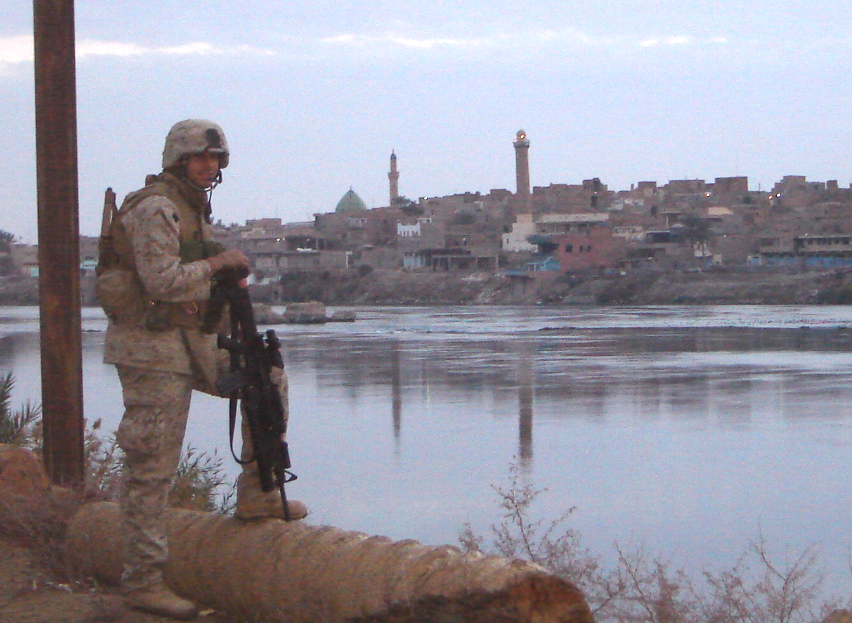
A U.S. Marine Infantryman (0311) with 1/2 Bravo Company patrols alongside the Euphrates River in Hīt, Iraq, 2005.

MOS 0311 is the United States Marine Corps (USMC) Military Occupational Specialty (MOS) code for infantry rifleman. It is the primary infantry MOS for enlisted Marines.

General information

[edit]

A rifleman may employ the M4 carbine, the M203 grenade launcher, the M27 Infantry Automatic Rifle, AT4 and M72 LAW rockets. Riflemen are the primary scouts, assault troops, and close combat forces available to the Marine Air Ground Task Force. They are the foundation of the Marine infantry organization, and as such are the nucleus of the fire team in the rifle squad, the scout team in the LAR squad, scout snipers in the infantry battalion, and reconnaissance or assault team in the reconnaissance units. Noncommissioned officers are assigned as fire team leaders, scout team leaders, rifle squad leaders, or rifle platoon guides. The mission of the Marine Corps rifle squad is to locate, close with and destroy the enemy by fire and maneuver or to repel the enemy's assault by fire and close combat.

Training

[edit]

Training for this MOS is conducted at the United States Marine Corps School of Infantry located at Camp Geiger, North Carolina or Camp Pendleton, California. The training period is 59 days.

See also

[edit]
[edit]
Revisions and contributorsEdit on WikipediaRead on Wikipedia
from Grokipedia
MOS 0311 is the Military Occupational Specialty (MOS) designation for the rifleman, the foundational enlisted role within the Marine Corps' that serves as the primary assault, scout, and close combat force of the Marine Air-Ground Task Force (MAGTF). Riflemen form the nucleus of fire teams in rifle squads, scout teams in light armored reconnaissance squads, and scout platoons in infantry battalions, employing weapons such as the , , and M3E1 Multi-role Anti-armor Anti-personnel Weapon System (MAAWS) to locate, close with, and destroy or repel enemy forces through fire and maneuver. As the core of the Marine Corps' organization—the largest occupational field (03XX)—riflemen execute offensive and defensive operations, including , maneuvers, and tactical engagements, while supporting broader missions under the direction of infantry officers. Non-commissioned officers (NCOs) in this MOS often lead fire teams, scout teams, or rifle squads, emphasizing leadership in small-unit tactics from early in their careers. Training for MOS 0311 occurs through the 14-week Marine Course (IMC) at the School of Infantry (SOI) at either Camp Lejeune, , or Camp Pendleton, , focusing on the Marine Corps warfighting philosophy, weapons proficiency, , , immediate action drills, and call-for-fire procedures. This rigorous preparation ensures riflemen are versatile and lethal, capable of operating in diverse environments as the tip of the spear in Marine Corps operations.

Overview

Definition and Role

MOS 0311 designates the Military Occupational Specialty (MOS) for in the United States Marine Corps, falling within the 03 occupational field of . This MOS represents the core enlisted position, where serve as the primary in Marine Air-Ground Task Force (MAGTF) operations. The system of MOS codes, including 0311, was formalized after to organize and classify military roles across the armed services. The primary role of an MOS 0311 is to act as the foundational combatant in Marine units, engaging enemy forces directly through fire and maneuver or repelling assaults in close combat. form the nucleus of fire teams within rifle squads, scout teams in light armored reconnaissance units, and scout platoons in battalions, emphasizing their function as scouts, assault troops, and close combat specialists. They focus on locating, closing with, and destroying the enemy using , serving as the tip of the spear in ground operations. To qualify for enlistment leading to MOS 0311, candidates must be U.S. citizens or legal U.S. residents (permanent residents) between the ages of 17 and 28, possess a or equivalent, and achieve a qualifying score on the Armed Services Vocational Aptitude Battery (ASVAB), including a minimum Armed Forces Qualification Test (AFQT) percentile of 31 for enlistment and a General Technical (GT) score of at least 80 for MOS 0311 assignment. These prerequisites ensure recruits meet the basic physical, educational, and aptitude standards necessary for service. In terms of billet progression, MOS 0311 Marines advance from entry-level roles as privates in fire teams to positions up to , where they may lead rifle squads, serve as team leaders, or fill platoon-level billets within organizations. This path emphasizes within the structure, with promotions tied to demonstrated proficiency in skills and unit responsibilities.

Significance in Marine Corps Operations

MOS 0311 riflemen serve as the primary and close combat forces within the Marine Corps, embodying the "tip of the spear" in by delivering offensive and defensive capabilities across varied environments such as urban settings, amphibious assaults, and arid regions. As the foundational element of Marine units, they enable the Corps to conduct rapid force projection, ensuring immediate responsiveness to global contingencies through , , and direct roles. This versatility allows riflemen to adapt to dynamic operational demands, maintaining in fluid, high-intensity scenarios. As of 2025, MOS 0311 roles continue to evolve under Marine Corps Force Design initiatives to enhance lethality in contested environments. Within the Marine Air-Ground Task Force (MAGTF) structure, MOS 0311 personnel form the backbone of the (GCE), providing the core strength that integrates with other components to achieve mission success. As the nucleus of fire teams, scout teams, and rifle squads, they constitute the majority of the force, supporting the Corps' emphasis on and sustained operations. This composition—where riflemen represent the primary enlisted MOS—facilitates swift deployment and execution of tactics in various conflicts. The strategic significance of MOS 0311 extends to enhancing and operational adaptability, where noncommissioned officers lead small teams to synchronize efforts with supporting arms such as and . By fostering tight-knit formations capable of independent action yet scalable for larger maneuvers, riflemen ensure the MAGTF's overall lethality and resilience, allowing the Marine Corps to project decisive power while minimizing vulnerabilities in expeditionary contexts.

Historical Background

Origins in the Marine Corps

The origins of the rifleman role in the United States Marine Corps trace back to the establishment of the Continental Marines on November 10, 1775, when the Second Continental Congress authorized the formation of two battalions to serve as shipboard security and amphibious infantry for the Continental Navy. These early Marines functioned primarily as riflemen, conducting boarding actions, providing close-quarters fire support, and executing landing operations against British forces during the American Revolutionary War. This foundational infantry mission evolved over the subsequent decades, solidifying the Corps' identity as a naval infantry force capable of independent ground combat. During the 19th century, the rifleman role became more formalized through participation in major conflicts, notably the Mexican-American War (1846–1848), where Marines served as elite infantry units attached to naval forces. In operations such as the storming of in 1847, Marine riflemen advanced under fire, employing disciplined and charges to capture key objectives, which helped cement their reputation for aggressive, close-combat . These engagements refined the ' doctrinal emphasis on riflemen as versatile, expeditionary troops, bridging naval and land operations while adapting to diverse terrains. Following , the Marine Corps underwent significant reorganization in 1920 amid postwar demobilization, reducing its strength from over 75,000 to approximately 17,000 personnel while prioritizing expeditionary capabilities through the Advanced Base Force concept. This restructuring emphasized infantry modernization, leading to the development of standardized tactics in via publications like Infantry in Battle (1939), which drew on lessons to outline small-unit maneuvers, fire and movement, and squad-level coordination essential for Marine rifle platoons. The adoption of the in 1936 by the U.S. Army, with Marines receiving initial issuances by 1940, further shaped doctrine by enabling sustained and rapid target engagement, transitioning from bolt-action reliance to semi-automatic firepower in infantry assaults. The formalization of occupational specialties advanced with the introduction of the Military Occupational Specialty (MOS) system in the early 1940s, aligned with broader War Department directives to classify personnel by skills amid World War II expansions. For the Marine Corps, this system evolved postwar, with MOS 0311 designated for riflemen, reflecting refined requirements for basic infantry proficiency including marksmanship, patrolling, and squad tactics; it was further codified and expanded during the Vietnam-era buildup in the 1960s to meet surging demand for ground combat forces.

Evolution Through Major Conflicts

During , the role of Marine Corps riflemen evolved significantly through the Pacific island-hopping campaign, where they adapted to amphibious assaults against heavily fortified Japanese positions. Tactics emphasized fire and maneuver at the squad and platoon levels, with riflemen organized into three-man fire teams supported by light machine guns and mortars to advance through coral reefs, dense jungles, and bunker complexes. This shift was evident in operations like and Saipan, where small-unit leaders coordinated with tanks and to suppress defenses, using flamethrowers and demolitions for close-quarters cave clearances. By 1945, over 100,000 Marines had served in roles across six divisions, reflecting the Corps' expansion to meet the demands of sequential island seizures that secured airfields and advanced toward . In the from 1950 to 1953, riflemen integrated into forces and underwent enhanced cold-weather training to operate in mountainous terrain, a direct response to harsh winter conditions encountered at Chosin Reservoir. The establishment of the Cold Weather Battalion in 1951 at Pickel Meadow introduced indoctrination courses focusing on survival, frostbite prevention, and mobility with snowshoes and , training over 23,000 in its first year. These adaptations updated MOS qualifications, emphasizing endurance in subzero temperatures and high altitudes, which reduced non-battle casualties and enabled effective retreats and counterattacks in rugged northern Korea. The from 1965 to 1975 shifted Marine riflemen toward operations, with training prioritizing small-unit patrolling, ambushes, and sweeps to disrupt infrastructure in I Corps. Riflemen conducted aggressive night ambushes and cordon-and-search missions, as seen in Operation Hickory near the , where squads engaged North Vietnamese Army bunkers using fire support from artillery and air strikes. The introduction of the in 1967 replaced the heavier M14, providing lighter weight and higher ammunition capacity suited to patrols, though initial jamming issues prompted rapid logistical fixes. These tactics fostered a doctrine of population security alongside combat, with riflemen often operating in combined action platoons embedded with local forces. In the post-9/11 era, encompassing operations in from 2003 to 2011 and from 2001 to 2021, Marine riflemen adapted to urban combat environments rife with hybrid threats like improvised explosive devices (IEDs) and close-quarters battle. In 's al-Anbar Province, riflemen conducted dismounted patrols and house-to-house clearances during the Second Battle of Fallujah in 2004, integrating with tribal alliances to counter insurgents, while IED countermeasures involved route clearance and detection training at mock villages like Wadi al-Sahara. Doctrinal updates around 2010, building on experiences in ar-Ramadi and al-Qaim, refined tactics in publications like the Small-Unit Leader’s Guide to , emphasizing cultural awareness, precision fires, and rapid response to ambushes in densely populated areas. These evolutions enhanced squad-level flexibility against asymmetric threats, reducing insurgent attacks through sustained presence and intelligence-driven operations. Recent changes under the 2020 initiative, as updated in October , have reduced rifleman-centric formations to prioritize distributed operations in contested littoral environments. The plan divests three active and two reserve , cutting approximately 200 per to create leaner, multi-domain units capable of expeditionary advance base operations with low-signature sensors and precision weapons. This shift—as refined in to equip with tools like precision fires, unmanned systems, advanced mobility, and resilient logistics for naval expeditionary operations—moves away from large, centralized rifle squads toward dispersed teams that mass effects over distances, aligning with naval integration for threats while maintaining core lethality.

Duties and Responsibilities

Core Tasks of a Rifleman

MOS 0311 riflemen serve as the foundational assault and close combat element of the Marine , responsible for locating, closing with, and destroying the enemy through fire and maneuver or repelling assaults via fire and close combat. Their primary combat tasks involve engaging targets with individual weapons systems such as the or , delivering accurate to neutralize threats. Providing to fix enemy positions and enable friendly maneuver is a critical function, often executed during assaults or defensive engagements to suppress enemy movement and protect advancing elements. Conducting patrols forms another core duty, where riflemen scout ahead to identify enemy positions, terrain features, and potential hazards while maintaining stealth and reporting actionable intelligence to higher command. In non-combat environments, MOS 0311 contribute to base security by manning checkpoints, conducting perimeter patrols, and responding to threats to protect installations and personnel. escort duties require riflemen to secure routes, scan for improvised explosive devices, and engage any hostile forces during transit operations in contested areas. During stability operations, they support humanitarian assistance by distributing aid, securing distribution sites, and coordinating with local populations to foster security and reconstruction efforts. Essential skill sets for MOS 0311 include expert-level marksmanship to ensure precise target engagement under varied conditions, land navigation using maps, compasses, and GPS to operate effectively in unfamiliar terrain, and first aid proficiency via Tactical Combat Casualty Care protocols to treat wounds and stabilize casualties in the field. Basic demolitions training enables riflemen to employ explosives for breaching obstacles or destroying enemy materiel when required. At the lance corporal rank, emphasis is placed on small-unit leadership, where individuals may direct fire teams, make tactical decisions, and mentor junior Marines during patrols or engagements. Performance is evaluated through the Annual Rifle Qualification (ARQ), a mandatory annual requirement under MCO 3574.2M (as of ), which assesses marksmanship in a combat-centric environment at ranges up to 500 yards using known-distance and dynamic scenarios. Qualification requires at least 15 "Destroys" (target hits) out of 50 and completion of at least one firing drill iteration for the classification; higher tiers (: 31-42 Destroys and two drills; : 43-50 Destroys and all drills) demand greater proficiency. Failure to qualify necessitates remedial to maintain unit readiness.

Integration in Squad and Platoon Structures

In the Marine Corps structure, MOS 0311 form the core of the , the smallest tactical unit, which consists of four led by a leader, typically a . Within this team, serve in specialized roles such as automatic rifleman, providing with weapons like the , or , employing grenade launchers for indirect suppression of enemy positions. The remaining positions include an assistant automatic rifleman and a standard , all held by MOS 0311 personnel, ensuring the fireteam's versatility in maneuvers like patrols or assaults. At the squad level, three such fireteams combine with a , a , to form a 13-Marine rifle squad, where MOS 0311 riflemen constitute the majority and drive the unit's maneuver capabilities through coordinated . The directs the fireteams as base-of-fire, maneuver, or security elements, leveraging the riflemen's roles to execute tasks such as closing with and destroying the enemy. This structure emphasizes the riflemen's role in providing the squad's primary offensive and defensive firepower. Rifle platoons, comprising approximately 40-45 , integrate three rifle squads under the oversight of a platoon commander and , with MOS 0311 riflemen forming the bulk of these squads to enable platoon-level operations like advances or defenses. The coordinates squad actions, ensuring riflemen maintain cohesion during task organization, while the platoon interfaces with the company's weapons platoon for reinforced . Promotion pathways for MOS 0311 riflemen lead to supervisory roles, such as the 0369 Unit Leader primary MOS at the E-6 level, requiring completion of the Unit Leader Course for eligibility. MOS 0311 riflemen also facilitate inter-unit coordination, particularly with combat support specialists like MOS 0341 mortarmen, who deliver to support rifle squads and platoons during engagements. This liaison ensures integrated , enhancing the riflemen's maneuver effectiveness without direct attachment.

Training and Qualification

Entry-Level Training

Entry-level training for Marines pursuing the MOS 0311 () begins with the 13-week recruit training program at either the Marine Corps Recruit Depot (MCRD) in , or , , where all enlisted recruits undergo foundational transformation into . This boot camp emphasizes physical conditioning through progressive fitness routines, close-order drill to instill discipline and unit cohesion, and introductory weapons handling using the M16A4 service rifle to build basic marksmanship fundamentals. Recruits participate in phased training, culminating in —a 54-hour capstone event testing endurance, teamwork, and problem-solving under simulated combat stress—ensuring they meet initial combat readiness standards before graduation. Following boot camp, MOS 0311 aspirants bypass the standard 29-day Marine Combat Training (MCT) attended by non- recruits and proceed directly to the Infantry Training Battalion (ITB) at the School of Infantry (SOI), located at , (SOI-East), or Camp Pendleton, (SOI-West). Implemented in 2021, the ITB is structured as the 14-week Marine Course (IMC), extending from the prior 59-day program to provide specialized entry-level instruction qualifying in core skills, focusing on weapons proficiency, tactical movement, and small-unit operations. The IMC consists of Phase 1 (9 weeks), emphasizing weapons familiarization with the M16A4 and , basic techniques, and live-fire exercises to develop safe and effective engagement capabilities under instructor supervision; and Phase 2 (5 weeks), focusing on squad-level tactics, offensive and defensive operations, urban combat, convoy security, and multiday field exercises incorporating force-on-force scenarios. Successful completion awards the MOS 0311 designation. Physical fitness is integral throughout entry-level training, with recruits required to pass the Initial Strength Test (IST) upon arrival at boot camp and maintain standards via the Physical Fitness Test (PFT). As of 2023, male recruits must achieve at least 3 pull-ups (or 34 push-ups in 2 minutes), a 1:03 plank, and a 1.5-mile run in under 13:30 minutes for the IST, while females require 1 pull-up (or 15 push-ups in 2 minutes), a 1:03 plank, and a 1.5-mile run in under 15:00 minutes. By boot camp's end, expectations align with PFT minima, including a 3-mile run in 28 minutes for males and 31 minutes for females. At ITB/IMC, sustained physical conditioning builds on these baselines, incorporating ruck marches and combat simulations to prepare riflemen for operational demands. Attrition during entry-level training averages 10-15%, primarily from injuries, failure to qualify on rifle marksmanship tables, or voluntary requests for separation, with ITB/IMC specifically seeing about 12.9% non-graduation rates due to these factors.

Advanced Skills Development

In operational units, MOS 0311 Marines sustain and advance skills through required annual training and optional specialized courses. Key requirements include the Annual Rifle Qualification (ARQ) to validate basic marksmanship under standardized conditions, the Marine Corps Combat Marksmanship Program (MCCMP) for dynamic, close-range shooting in combat-like settings, and Tactical Combat Casualty Care (TCCC) refreshers to reinforce battlefield trauma response protocols. Optional tracks enhance capabilities, including progression to in the Marine Corps Program (MCMAP) for advanced ground fighting and weapons retention, as well as courses at the Warfare Training for cold-weather and mobility or dedicated training to master operations in complex built environments. Key career milestones include eligibility for promotion to (E-2) after six months of active service, often coinciding with SOI completion, along with re-enlistment options supporting accelerated advancement within the occupational field.

Equipment and Armament

Primary Weapons Systems

The primary weapons systems for MOS 0311 riflemen center on lightweight, versatile firearms optimized for close-quarters combat, , and precision engagement within Marine Corps infantry squads. The (IAR), chambered in 5.56mm , serves as the standard-issue for all riflemen, providing reliable semi-automatic and automatic fire capabilities with a cyclic rate of approximately 750 rounds per minute. Adopted initially in 2009 for squad automatic roles and expanded to full replacement of the by 2018, the M27 enhances maneuverability and sustained fire without the need for a dedicated machine gunner in fire teams. As of 2025, the M27 is issued with a suppressor to reduce acoustic and visual signature during operations. Complementing the M27, the remains in limited use for specialized tasks, featuring a modular rail system for mounting and accessories, with an effective point-target range of 500 meters. This 5.56mm platform allows riflemen to adapt quickly to varying mission requirements, such as urban operations where compactness is essential. For area suppression and support, MOS 0311 personnel employ the , a 40mm low-velocity system that attaches under the M27 or M4 barrel. Introduced to replace the older M203 starting in 2018, the M320 offers side-loading for safer and faster reloading, enabling effective engagement of enemy positions up to 350 meters with high-explosive or smoke rounds. Optics and aiming devices integral to these systems include the Squad Common Optic (SCO), the Trijicon VCOG 1-8x variable power optic adopted starting in 2021 for improved target engagement at distances up to 800 meters, and the AN/PEQ-16 laser aiming module, which projects beams for night-vision compatibility and precise aiming. These accessories improve accuracy across day and night operations, with the SCO standard on M27 rifles as of 2025. Ammunition standardization focuses on the M855A1 enhanced performance round, a 5.56mm cartridge introduced in 2010 and fully adopted by the Marine Corps by 2018 for superior barrier penetration and compared to legacy M855 rounds. This copper-core projectile delivers consistent lethality against soft and hard targets, supporting the full spectrum of engagements.

Supportive Gear and Uniforms

Riflemen in MOS 0311 are issued the Plate Carrier Generation III body armor system, which provides modular protection for operations and is designed to accommodate Enhanced Small Arms Protective Insert (ESAPI) plates rated at NIJ Level IV for stopping armor-piercing rifle rounds. This vest distributes weight across the torso to enhance mobility while integrating with other load-bearing components. The standard uniform for MOS 0311 is the Marine Corps Combat Utility Uniform (MCCUU), constructed from a 50/50 nylon-cotton blend in either or MARPAT digital camouflage patterns to provide effective concealment in varied terrains. Complementing the MCCUU is the (FROG), consisting of flame-resistant shirts and trousers in Desert MARPAT, issued in four sets to protect against ignition sources during close-quarters combat. Load-bearing equipment includes the Fighting Load Carrier (FLC), a modular vest system that secures essential items such as 210 rounds of 5.56mm ammunition, Meals Ready-to-Eat rations, and individual medical supplies for sustained 72-hour missions without resupply. The FLC's design allows quick release in emergencies, such as amphibious debarkations, while maintaining compatibility with . For communications, riflemen utilize multi-channel handheld radios such as the AN/PRC-163, software-defined devices providing secure voice and data transmission for coordination over extended ranges in various modes. These radios support encrypted communications and integrate with squad-level signals for tactical maneuvers, fielded as upgrades starting in 2023. Environmental adaptations include the Extreme Cold Weather Clothing System (ECWCS) Generation III, a seven-layer ensemble with base wicking layers, fleece insulation, and outer shells rated for operations down to -60°F in conditions. For arid zones, desert-specific gear features the MCCUU and in Desert , supplemented by the Combat Desert Jacket for wind and water resistance.

References

Add your contribution
Related Hubs
User Avatar
No comments yet.