
Recent from talks
M3 submachine gun
Knowledge base stats:
Talk channels stats:
Members stats:
M3 submachine gun
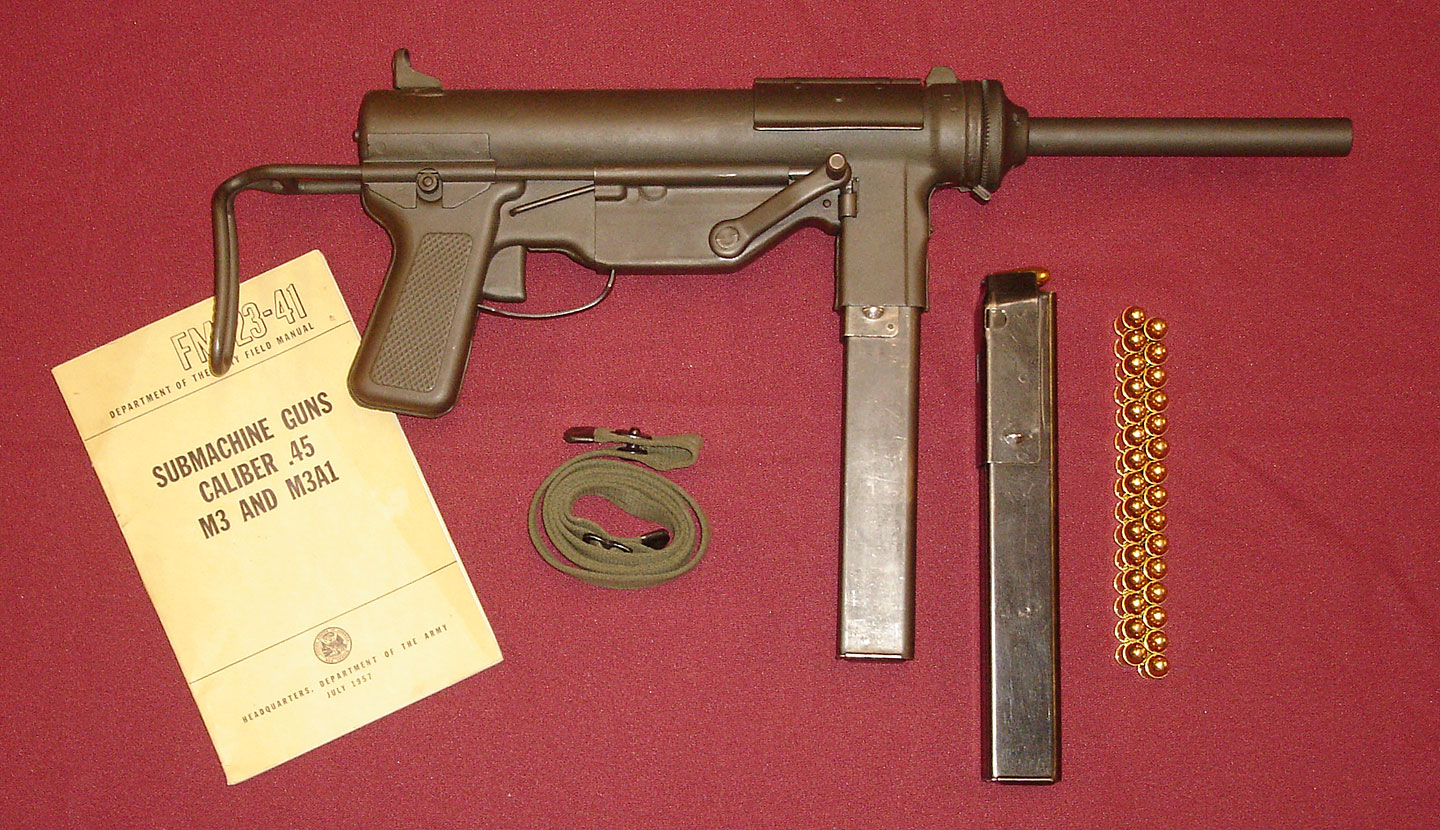
The M3 is an American .45-caliber submachine gun adopted by the U.S. Army on 12 December 1942, as the United States Submachine Gun, Cal. .45, M3. The M3 was chambered for the same .45 ACP round fired by the Thompson submachine gun, but was cheaper to mass produce and lighter, at the expense of accuracy. The M3 was commonly referred to as the "Grease Gun" or simply "the Greaser", owing to its visual similarity to the mechanic's tool.
The M3 was intended as a replacement for the Thompson, and began to enter frontline service in mid-1944. By late 1944, the M3A1 variant was introduced, which also saw use in the Korean War and later conflicts.
The M14 rifle, adopted in 1959, was intended to replace the M3A1 (as well as the M1 Garand, M1918 Browning Automatic Rifle and the M1 carbine) but the recoil of the M14's 7.62×51mm NATO cartridge proved too powerful for the submachine gun role. The M14 was in turn replaced by the M16 rifle in 1964, and this weapon and its subsequent shorter iterations (XM-177, firing the intermediate 5.56×45mm NATO cartridge) was a better replacement for the M3A1. M3A1 submachine guns were retired from U.S. frontline service after 1959, but continued to be issued, for example as backup weapons for armored vehicle crews as late as the Gulf War (1990–1991). Many overseas US military bases continued to issue these for certain crews into the mid to late 1990s.
In 1941, the U.S. Army Ordnance Board observed the effectiveness of submachine guns employed in Western Europe, particularly the German 9×19mm MP 40 and British Sten submachine gun and initiated a study to develop its own "Sten" type submachine gun in October 1942. The Ordnance Department requested the Army submit a list of requirements for the new weapon, and Ordnance in turn received a separate list of requirements from both the Infantry and Cavalry branches for a shoulder-fired weapon with full or semiautomatic fire capability in caliber .45 ACP or .30 Carbine.
The two lists of requirements received by Ordnance were then reviewed and amended by officials at Aberdeen Proving Ground (APG). The amended requirement called for a weapon of all-sheet metal construction in .45 ACP, designed for fast and inexpensive production with a minimum of machining and featuring both fully automatic and semi-automatic fire capabilities, a heavy bolt to keep the cyclic rate of fire under 500 rounds per minute and the ability to place 90% of shots fired from a standing position in full automatic mode on a 6x6 feet target at a range of 50 yards. The benchmark for testing the M3's performance would be the M1928A1 Thompson.
George Hyde of General Motors' Inland Division was given the task of designing the new weapon, while Frederick Sampson, Inland Division's chief engineer, was responsible for preparing and organizing tooling for production. The original T15 specifications of 8 October 1942 were altered to remove the semi-automatic fire function, as well as to permit installation of a kit to convert the weapon's original .45 caliber to that of 9 mm Parabellum. The new designation for the 9 mm/.45 full-automatic-only weapon was the T20.
Five prototype models of the .45 T20 and five 9 mm conversion kits were built by General Motors for testing. At the initial military trials, the T20 successfully completed its accuracy trials with a score of 97 out of 100. In the endurance test, the test weapon fired more than 5,000 rounds of brass-case ammunition, with only two failures to feed. Four army test boards composed of multiple army service branches independently tested and reviewed the T20 prototype weapons including the Airborne Command, the Amphibious Warfare Board, the Infantry Board, and the Armored Force Board. All four branches reported malfunctions caused by the magazine, mostly attributed to defective or jammed magazine followers.
The T20 was formally approved by U.S. Army Ordnance for production at GM's Guide Lamp Division in Anderson, Indiana, in December 1942 as the U.S. Submachine Gun, Caliber .45, M3. Guide Lamp produced 606,694 of the M3 variant submachine gun between 1943 and 1945. Although reports of malfunctions caused by the single-feed magazine design appeared during the initial firing trials, no changes were made to the M3 magazine.
Hub AI
M3 submachine gun AI simulator
(@M3 submachine gun_simulator)
M3 submachine gun
The M3 is an American .45-caliber submachine gun adopted by the U.S. Army on 12 December 1942, as the United States Submachine Gun, Cal. .45, M3. The M3 was chambered for the same .45 ACP round fired by the Thompson submachine gun, but was cheaper to mass produce and lighter, at the expense of accuracy. The M3 was commonly referred to as the "Grease Gun" or simply "the Greaser", owing to its visual similarity to the mechanic's tool.
The M3 was intended as a replacement for the Thompson, and began to enter frontline service in mid-1944. By late 1944, the M3A1 variant was introduced, which also saw use in the Korean War and later conflicts.
The M14 rifle, adopted in 1959, was intended to replace the M3A1 (as well as the M1 Garand, M1918 Browning Automatic Rifle and the M1 carbine) but the recoil of the M14's 7.62×51mm NATO cartridge proved too powerful for the submachine gun role. The M14 was in turn replaced by the M16 rifle in 1964, and this weapon and its subsequent shorter iterations (XM-177, firing the intermediate 5.56×45mm NATO cartridge) was a better replacement for the M3A1. M3A1 submachine guns were retired from U.S. frontline service after 1959, but continued to be issued, for example as backup weapons for armored vehicle crews as late as the Gulf War (1990–1991). Many overseas US military bases continued to issue these for certain crews into the mid to late 1990s.
In 1941, the U.S. Army Ordnance Board observed the effectiveness of submachine guns employed in Western Europe, particularly the German 9×19mm MP 40 and British Sten submachine gun and initiated a study to develop its own "Sten" type submachine gun in October 1942. The Ordnance Department requested the Army submit a list of requirements for the new weapon, and Ordnance in turn received a separate list of requirements from both the Infantry and Cavalry branches for a shoulder-fired weapon with full or semiautomatic fire capability in caliber .45 ACP or .30 Carbine.
The two lists of requirements received by Ordnance were then reviewed and amended by officials at Aberdeen Proving Ground (APG). The amended requirement called for a weapon of all-sheet metal construction in .45 ACP, designed for fast and inexpensive production with a minimum of machining and featuring both fully automatic and semi-automatic fire capabilities, a heavy bolt to keep the cyclic rate of fire under 500 rounds per minute and the ability to place 90% of shots fired from a standing position in full automatic mode on a 6x6 feet target at a range of 50 yards. The benchmark for testing the M3's performance would be the M1928A1 Thompson.
George Hyde of General Motors' Inland Division was given the task of designing the new weapon, while Frederick Sampson, Inland Division's chief engineer, was responsible for preparing and organizing tooling for production. The original T15 specifications of 8 October 1942 were altered to remove the semi-automatic fire function, as well as to permit installation of a kit to convert the weapon's original .45 caliber to that of 9 mm Parabellum. The new designation for the 9 mm/.45 full-automatic-only weapon was the T20.
Five prototype models of the .45 T20 and five 9 mm conversion kits were built by General Motors for testing. At the initial military trials, the T20 successfully completed its accuracy trials with a score of 97 out of 100. In the endurance test, the test weapon fired more than 5,000 rounds of brass-case ammunition, with only two failures to feed. Four army test boards composed of multiple army service branches independently tested and reviewed the T20 prototype weapons including the Airborne Command, the Amphibious Warfare Board, the Infantry Board, and the Armored Force Board. All four branches reported malfunctions caused by the magazine, mostly attributed to defective or jammed magazine followers.
The T20 was formally approved by U.S. Army Ordnance for production at GM's Guide Lamp Division in Anderson, Indiana, in December 1942 as the U.S. Submachine Gun, Caliber .45, M3. Guide Lamp produced 606,694 of the M3 variant submachine gun between 1943 and 1945. Although reports of malfunctions caused by the single-feed magazine design appeared during the initial firing trials, no changes were made to the M3 magazine.
Recent media