
Recent from talks
M50 Reising
Knowledge base stats:
Talk channels stats:
Members stats:
M50 Reising
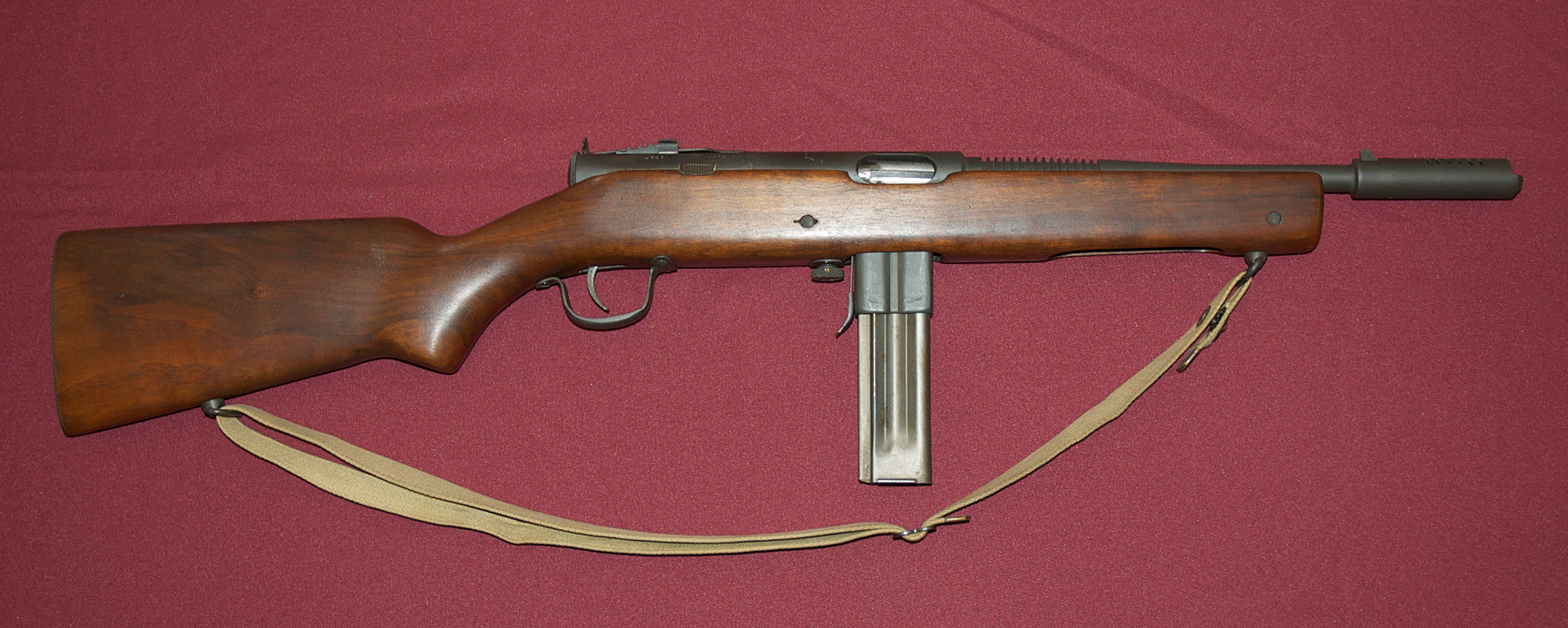
The .45 Reising submachine gun was manufactured by Harrington & Richardson (H&R) Arms Company in Worcester, Massachusetts, USA, and was designed and patented by Eugene Reising in 1940. The three versions of the weapon were the Model 50, the folding stock Model 55, and the semiautomatic Model 60 rifle. Over 100,000 Reisings were ordered during World War II, and were initially used by the United States Navy, Marine Corps, and the United States Coast Guard, though some were shipped to Canadian, Soviet, and other allied forces to fight the Axis powers.
Reising was an assistant to firearm inventor John M. Browning. In this role, Reising contributed to the final design of the US .45 ACP M1911 pistol. Reising then designed a number of commercial rifles and pistols on his own, when in 1938, he turned his attention to designing a submachine gun as threats of war rapidly grew in Europe.
Two years later he submitted his completed design to the Harrington & Richardson Arms Company (H&R) in Worcester, Massachusetts. It was accepted, and in March 1941, H&R started manufacturing the Model 50 submachine gun. Months later, production began on the Model 55, which was identical to the Model 50 other than having a folding wire buttstock, no compensator, and a 10.5 in (270 mm) barrel; and the Model 60 semiautomatic rifle that also resembled a Model 50, but had an 18.75 in (476 mm) barrel without cooling fins or a compensator.
H&R promoted the submachine guns for police and military use, and the Model 60 for security guards. After the Japanese attack on Pearl Harbor in December 1941 the US was suddenly in desperate need of thousands of modern automatic weapons. Reising's only competitor was the .45 ACP Thompson submachine gun.
The US Army first tested the Reising in November 1941 at Fort Benning, Georgia. During this test, several parts failed due to poor construction. Once this was corrected, a second test was made in 1942 at Aberdeen Proving Ground, Maryland. In that test, 3,500 rounds were fired, resulting in two malfunctions: one from the ammunition, the other from a bolt malfunction. As a result, the Army did not adopt the Reising, but the Navy and Marines did, due to insufficient supply of Thompsons.
The Reising submachine gun was innovative for its time. In comparison to its main rival, the famous Thompson, it possessed similar firepower, better accuracy, excellent balance, a lighter weight, a much lower cost, and greater ease of manufacture. Despite these achievements, the poor combat performance of the Reising—contrasted with favorable combat and law enforcement use of the Thompson—mired the weapon in controversy.
The Reising was far less costly ($62) compared to the Thompson ($200). It was much lighter (seven vs. eleven pounds). The Model 55 was also more compact (about twenty-two vs. thirty-three inches in length).
The Reising cost less than the Thompson because its metal components were mostly stampings instead of machined parts. This also allowed it to be lighter, as did its firing mechanism [clarification needed]. Like the 1928A1 Thompson, its operating principle was delayed blowback, but the Thompson's Blish lock system was far less mechanically effective and so, like a simple blowback weapon, the Thompson was dependent on high bolt mass or more specifically bolt inertia to provide an acceptably low rate of fire. That is, a lighter bolt, as used in earlier models of the Thompson, would have reciprocated faster and produced too great a firing speed. This in turn meant that the Thompson could not be radically lightened without a deterioration in its controllability, as a heavy gun was necessary in automatic fire, to counteract and stabilize the effects on control and accuracy of its heavy bolt moving back and forwards. The Reising's bolt is much lighter due to its delayed blowback mechanism being the main determinant of the automatic rate of fire; and consequently the whole gun could be correspondingly light without detracting from accuracy and controllability.
Hub AI
M50 Reising AI simulator
(@M50 Reising_simulator)
M50 Reising
The .45 Reising submachine gun was manufactured by Harrington & Richardson (H&R) Arms Company in Worcester, Massachusetts, USA, and was designed and patented by Eugene Reising in 1940. The three versions of the weapon were the Model 50, the folding stock Model 55, and the semiautomatic Model 60 rifle. Over 100,000 Reisings were ordered during World War II, and were initially used by the United States Navy, Marine Corps, and the United States Coast Guard, though some were shipped to Canadian, Soviet, and other allied forces to fight the Axis powers.
Reising was an assistant to firearm inventor John M. Browning. In this role, Reising contributed to the final design of the US .45 ACP M1911 pistol. Reising then designed a number of commercial rifles and pistols on his own, when in 1938, he turned his attention to designing a submachine gun as threats of war rapidly grew in Europe.
Two years later he submitted his completed design to the Harrington & Richardson Arms Company (H&R) in Worcester, Massachusetts. It was accepted, and in March 1941, H&R started manufacturing the Model 50 submachine gun. Months later, production began on the Model 55, which was identical to the Model 50 other than having a folding wire buttstock, no compensator, and a 10.5 in (270 mm) barrel; and the Model 60 semiautomatic rifle that also resembled a Model 50, but had an 18.75 in (476 mm) barrel without cooling fins or a compensator.
H&R promoted the submachine guns for police and military use, and the Model 60 for security guards. After the Japanese attack on Pearl Harbor in December 1941 the US was suddenly in desperate need of thousands of modern automatic weapons. Reising's only competitor was the .45 ACP Thompson submachine gun.
The US Army first tested the Reising in November 1941 at Fort Benning, Georgia. During this test, several parts failed due to poor construction. Once this was corrected, a second test was made in 1942 at Aberdeen Proving Ground, Maryland. In that test, 3,500 rounds were fired, resulting in two malfunctions: one from the ammunition, the other from a bolt malfunction. As a result, the Army did not adopt the Reising, but the Navy and Marines did, due to insufficient supply of Thompsons.
The Reising submachine gun was innovative for its time. In comparison to its main rival, the famous Thompson, it possessed similar firepower, better accuracy, excellent balance, a lighter weight, a much lower cost, and greater ease of manufacture. Despite these achievements, the poor combat performance of the Reising—contrasted with favorable combat and law enforcement use of the Thompson—mired the weapon in controversy.
The Reising was far less costly ($62) compared to the Thompson ($200). It was much lighter (seven vs. eleven pounds). The Model 55 was also more compact (about twenty-two vs. thirty-three inches in length).
The Reising cost less than the Thompson because its metal components were mostly stampings instead of machined parts. This also allowed it to be lighter, as did its firing mechanism [clarification needed]. Like the 1928A1 Thompson, its operating principle was delayed blowback, but the Thompson's Blish lock system was far less mechanically effective and so, like a simple blowback weapon, the Thompson was dependent on high bolt mass or more specifically bolt inertia to provide an acceptably low rate of fire. That is, a lighter bolt, as used in earlier models of the Thompson, would have reciprocated faster and produced too great a firing speed. This in turn meant that the Thompson could not be radically lightened without a deterioration in its controllability, as a heavy gun was necessary in automatic fire, to counteract and stabilize the effects on control and accuracy of its heavy bolt moving back and forwards. The Reising's bolt is much lighter due to its delayed blowback mechanism being the main determinant of the automatic rate of fire; and consequently the whole gun could be correspondingly light without detracting from accuracy and controllability.
Recent media