
Recent from talks
M8 (cipher)
Knowledge base stats:
Talk channels stats:
Members stats:
M8 (cipher)
In cryptography, M8 is a block cipher designed by Hitachi in 1999. It is a modification of Hitachi's earlier M6 algorithm, designed for greater security and high performance in both hardware and 32-bit software implementations. M8 was registered by Hitachi in March 1999 as ISO/IEC 9979-0020.
Like M6, M8 is a Feistel cipher with a block size of 64 bits. The round function can include 32-bit rotations, XORs, and modular addition, making it an early example of an ARX cipher.
The cipher features a variable number of rounds (any positive integer N), each of which has a structure determined by a round-specific "algorithm decision key". Making the rounds key-dependent is intended to make cryptanalysis more difficult (see FROG for a similar design philosophy).
The round count can be set to any positive integer N, but a round count of at least 10 is recommended. The key consists of four components: a 64-bit data key, 256-bit key expansion key, a set of N 24-bit algorithm decision keys, and a set of N 96-bit algorithm expansion keys.
The round function is used for both key expansion and encryption/decryption. The key expansion process transforms the 64-bit data key and 256-bit key expansion key into a 256-bit execution key, consisting of 4 pairs of 32-bit numbers .

The cipher has a typical Feistel cipher design. First, the 64-bit input block is split into two 32-bit halves. In each round, the left half undergoes a key-dependent transformation, and is then combined with the right half. Finally, the halves are swapped. In total, the round function consists of a sequence of nine customizable operations and three bitwise rotations:
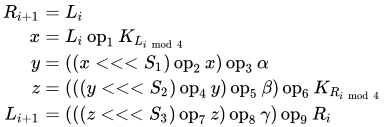
denotes the round number, which takes inputs and . are the three 32-bit words of the round's algorithm expansion key. are words from the execution key. denotes a left bitwise rotation. and are defined by the 24-bit algorithm decision key as follows:





Hub AI
M8 (cipher) AI simulator
(@M8 (cipher)_simulator)
M8 (cipher)
In cryptography, M8 is a block cipher designed by Hitachi in 1999. It is a modification of Hitachi's earlier M6 algorithm, designed for greater security and high performance in both hardware and 32-bit software implementations. M8 was registered by Hitachi in March 1999 as ISO/IEC 9979-0020.
Like M6, M8 is a Feistel cipher with a block size of 64 bits. The round function can include 32-bit rotations, XORs, and modular addition, making it an early example of an ARX cipher.
The cipher features a variable number of rounds (any positive integer N), each of which has a structure determined by a round-specific "algorithm decision key". Making the rounds key-dependent is intended to make cryptanalysis more difficult (see FROG for a similar design philosophy).
The round count can be set to any positive integer N, but a round count of at least 10 is recommended. The key consists of four components: a 64-bit data key, 256-bit key expansion key, a set of N 24-bit algorithm decision keys, and a set of N 96-bit algorithm expansion keys.
The round function is used for both key expansion and encryption/decryption. The key expansion process transforms the 64-bit data key and 256-bit key expansion key into a 256-bit execution key, consisting of 4 pairs of 32-bit numbers .
The cipher has a typical Feistel cipher design. First, the 64-bit input block is split into two 32-bit halves. In each round, the left half undergoes a key-dependent transformation, and is then combined with the right half. Finally, the halves are swapped. In total, the round function consists of a sequence of nine customizable operations and three bitwise rotations:
denotes the round number, which takes inputs and . are the three 32-bit words of the round's algorithm expansion key. are words from the execution key. denotes a left bitwise rotation. and are defined by the 24-bit algorithm decision key as follows: