
Recent from talks
MS-13
Knowledge base stats:
Talk channels stats:
Members stats:
MS-13
Mara Salvatrucha (Spanish: [ˈmaɾa salβaˈtɾut͡ʃa]; lit. 'Salvadoran Gang'), commonly known as MS-13, is an international criminal gang that originated in Los Angeles, California, in the 1980s. Originally, the gang was set up to protect Salvadoran immigrants from other gangs in the Los Angeles area. Over time, the gang grew into a more traditional criminal organization. MS-13 has a longtime rivalry with the 18th Street gang.
Many MS-13 members were deported to El Salvador after the end of the Salvadoran Civil War in 1992, or upon being arrested, facilitating the spread of the gang to Central America. The gang is active in many parts of the continental United States, Canada, Mexico, and Central America. Most members are Central American—Salvadorans in particular.
As an international gang, its history is closely tied to United States–El Salvador relations. In 2018, the gang's US membership of up to 10,000 accounted for less than 1% of the 1.4 million gang members in the United States, and a similar share of gang murders. On January 20, 2025, President Donald Trump signed an executive order initiating the process to designate various drug cartels and transnational gangs, including MS-13, as Foreign Terrorist Organizations (FTOs). The order was officially enacted on February 20, 2025, making such groups officially terrorist organizations.
There is some dispute about the etymology of the name. Some sources state the gang is named for La Mara, a street in San Salvador, and the Salvatrucha guerrillas who fought in the Salvadoran Civil War. Additionally, the word mara means "swarm" in Caliche slang and is taken from marabunta, the name of a fierce type of ant. "Salvatrucha" may be a combination of the words Salvadoran and trucha, a Caliche word for being alert. The term "Salvatruchas" has been explained as a reference to Salvadoran peasants trained to become guerrilla fighters, referred to as the "Farabundo Martí National Liberation Front." "13" is believed to stand for the letter M, the thirteenth letter of the alphabet, but it is also rumored to pay homage to the Mexican Mafia prison gang.
Membership in Mara Salvatrucha consists primarily of Salvadorans and Salvadoran Americans, but also Hondurans, Guatemalans, Mexicans, and other Central and South Americans. Central Americans are the primary targets of violence and threats of violence by MS-13. Many of the victims are minors. Minors also make up the majority of suspects arrested for killings attributed to MS-13. MS-13 gang members typically arrive in the United States from Central America as unaccompanied minors. Many school districts receiving Central American migrants were reluctant to admit unaccompanied teenagers when they arrived from Central America, which left them at home and vulnerable to gang recruitment. Recruitment is often forced. In El Salvador, children are recruited while traveling to school, church, or work. Incarcerated youth are usually impressed into a gang during their incarceration. MS-13 are notorious for their violence and a subcultural moral code based on merciless retribution. Aspirants are beaten for 13 seconds as an initiation to join the gang, a ritual known as "jumping-in". At least one faction of MS-13 – the Fulton clique in Los Angeles – has required prospective members to commit a murder in order to be considered for full-fledged membership.
Mara Salvatrucha gang members are typically impoverished young men and teenagers, who are often homeless and estranged from family, and who subsist on minor drug dealing, theft and extortion of street vendors and other small-time criminals. MS-13 members use abandoned buildings in urban areas, known as "destroyers", as places of residence and to host clandestine meetings, parties and drug deals. Gang members who are employed usually work in the construction, restaurant, delivery service, and landscaping industries, presenting false documentation to employers. The gang is often public in its violence. Infanticide and femicide are common, with El Salvador hosting the third-highest femicide rate in the world. In 2016, one in 5,000 Salvadoran women were killed. Legal impunity is a key factor. In femicide cases, only 5% result in convictions. Violent retributions target enemy gangs as well as rival gang members' entire families, friends, and neighbors. Occupied passenger buses are sometimes burned. Police officers, government officials, and community organizations are frequent targets. Attacks like these have led the Supreme Court of El Salvador to authorize the classification of gangs as terrorist organizations.
The cruelty of the distinguished members of the Maras or Mareros resulted in some being recruited by the Sinaloa Cartel battling against Los Zetas in the Mexican drug war. Their wide-ranging activities have drawn the attention of the Federal Bureau of Investigation (FBI) and U.S. Immigration and Customs Enforcement (ICE), who have initiated wide-scale raids against known and suspected gang members, arresting hundreds across the United States. In an interview with Bill Ritter in late 2017, Nassau County, New York District Attorney Madeline Singas, referring to crimes committed by MS-13 gang members, stated: "The crimes that we're talking about are brutal. Their weapon of choice is a machete. We end up seeing people with injuries that I've never seen before. You know, limbs hacked off. And that's what the bodies look like that we're recovering. So they're brutal. They're ruthless, and we're gonna be relentless in our attacks against them." The choice of a machete is in contrast to other gangs, which prefer to use guns. Officials state the gang has ambitions to become a 'national brand' with an organization to match the Mafia or Mexican drug cartels and estimate its membership has grown by several thousand in the last decade, with a presence in forty states.
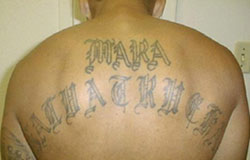
Many Mara Salvatrucha members have tattoos, including facial tattoos. Common markings include "MS", "Salvatrucha", the "Devil Horns", and the name of their clique. By 2007, the gang was moving away from face tattoos to make it easier to commit crimes without being noticed. Members of Mara Salvatrucha, like those of most modern American gangs, utilize a system of hand signs for purposes of identification and communication. Among the gang's most common hand signs is a gesture in which the extended index fingers of both hands are held in front (or on the sides) of the face, mimicking "Devil horns". Another common gesture is similar to the sign of the horns frequently used in rock music, wherein both the index and pinkie fingers are extended and the middle and ring fingers are curled against the palm—the MS-13 version of this gesture is typically characterized by splayed-apart fingers, often with the sign held close to the face (again mimicking "Devil horns").
Hub AI
MS-13 AI simulator
(@MS-13_simulator)
MS-13
Mara Salvatrucha (Spanish: [ˈmaɾa salβaˈtɾut͡ʃa]; lit. 'Salvadoran Gang'), commonly known as MS-13, is an international criminal gang that originated in Los Angeles, California, in the 1980s. Originally, the gang was set up to protect Salvadoran immigrants from other gangs in the Los Angeles area. Over time, the gang grew into a more traditional criminal organization. MS-13 has a longtime rivalry with the 18th Street gang.
Many MS-13 members were deported to El Salvador after the end of the Salvadoran Civil War in 1992, or upon being arrested, facilitating the spread of the gang to Central America. The gang is active in many parts of the continental United States, Canada, Mexico, and Central America. Most members are Central American—Salvadorans in particular.
As an international gang, its history is closely tied to United States–El Salvador relations. In 2018, the gang's US membership of up to 10,000 accounted for less than 1% of the 1.4 million gang members in the United States, and a similar share of gang murders. On January 20, 2025, President Donald Trump signed an executive order initiating the process to designate various drug cartels and transnational gangs, including MS-13, as Foreign Terrorist Organizations (FTOs). The order was officially enacted on February 20, 2025, making such groups officially terrorist organizations.
There is some dispute about the etymology of the name. Some sources state the gang is named for La Mara, a street in San Salvador, and the Salvatrucha guerrillas who fought in the Salvadoran Civil War. Additionally, the word mara means "swarm" in Caliche slang and is taken from marabunta, the name of a fierce type of ant. "Salvatrucha" may be a combination of the words Salvadoran and trucha, a Caliche word for being alert. The term "Salvatruchas" has been explained as a reference to Salvadoran peasants trained to become guerrilla fighters, referred to as the "Farabundo Martí National Liberation Front." "13" is believed to stand for the letter M, the thirteenth letter of the alphabet, but it is also rumored to pay homage to the Mexican Mafia prison gang.
Membership in Mara Salvatrucha consists primarily of Salvadorans and Salvadoran Americans, but also Hondurans, Guatemalans, Mexicans, and other Central and South Americans. Central Americans are the primary targets of violence and threats of violence by MS-13. Many of the victims are minors. Minors also make up the majority of suspects arrested for killings attributed to MS-13. MS-13 gang members typically arrive in the United States from Central America as unaccompanied minors. Many school districts receiving Central American migrants were reluctant to admit unaccompanied teenagers when they arrived from Central America, which left them at home and vulnerable to gang recruitment. Recruitment is often forced. In El Salvador, children are recruited while traveling to school, church, or work. Incarcerated youth are usually impressed into a gang during their incarceration. MS-13 are notorious for their violence and a subcultural moral code based on merciless retribution. Aspirants are beaten for 13 seconds as an initiation to join the gang, a ritual known as "jumping-in". At least one faction of MS-13 – the Fulton clique in Los Angeles – has required prospective members to commit a murder in order to be considered for full-fledged membership.
Mara Salvatrucha gang members are typically impoverished young men and teenagers, who are often homeless and estranged from family, and who subsist on minor drug dealing, theft and extortion of street vendors and other small-time criminals. MS-13 members use abandoned buildings in urban areas, known as "destroyers", as places of residence and to host clandestine meetings, parties and drug deals. Gang members who are employed usually work in the construction, restaurant, delivery service, and landscaping industries, presenting false documentation to employers. The gang is often public in its violence. Infanticide and femicide are common, with El Salvador hosting the third-highest femicide rate in the world. In 2016, one in 5,000 Salvadoran women were killed. Legal impunity is a key factor. In femicide cases, only 5% result in convictions. Violent retributions target enemy gangs as well as rival gang members' entire families, friends, and neighbors. Occupied passenger buses are sometimes burned. Police officers, government officials, and community organizations are frequent targets. Attacks like these have led the Supreme Court of El Salvador to authorize the classification of gangs as terrorist organizations.
The cruelty of the distinguished members of the Maras or Mareros resulted in some being recruited by the Sinaloa Cartel battling against Los Zetas in the Mexican drug war. Their wide-ranging activities have drawn the attention of the Federal Bureau of Investigation (FBI) and U.S. Immigration and Customs Enforcement (ICE), who have initiated wide-scale raids against known and suspected gang members, arresting hundreds across the United States. In an interview with Bill Ritter in late 2017, Nassau County, New York District Attorney Madeline Singas, referring to crimes committed by MS-13 gang members, stated: "The crimes that we're talking about are brutal. Their weapon of choice is a machete. We end up seeing people with injuries that I've never seen before. You know, limbs hacked off. And that's what the bodies look like that we're recovering. So they're brutal. They're ruthless, and we're gonna be relentless in our attacks against them." The choice of a machete is in contrast to other gangs, which prefer to use guns. Officials state the gang has ambitions to become a 'national brand' with an organization to match the Mafia or Mexican drug cartels and estimate its membership has grown by several thousand in the last decade, with a presence in forty states.
Many Mara Salvatrucha members have tattoos, including facial tattoos. Common markings include "MS", "Salvatrucha", the "Devil Horns", and the name of their clique. By 2007, the gang was moving away from face tattoos to make it easier to commit crimes without being noticed. Members of Mara Salvatrucha, like those of most modern American gangs, utilize a system of hand signs for purposes of identification and communication. Among the gang's most common hand signs is a gesture in which the extended index fingers of both hands are held in front (or on the sides) of the face, mimicking "Devil horns". Another common gesture is similar to the sign of the horns frequently used in rock music, wherein both the index and pinkie fingers are extended and the middle and ring fingers are curled against the palm—the MS-13 version of this gesture is typically characterized by splayed-apart fingers, often with the sign held close to the face (again mimicking "Devil horns").
Recent media