



Community hub
Recent from talks
Knowledge base stats:
Talk channels stats:
Members stats:
MV Loredan
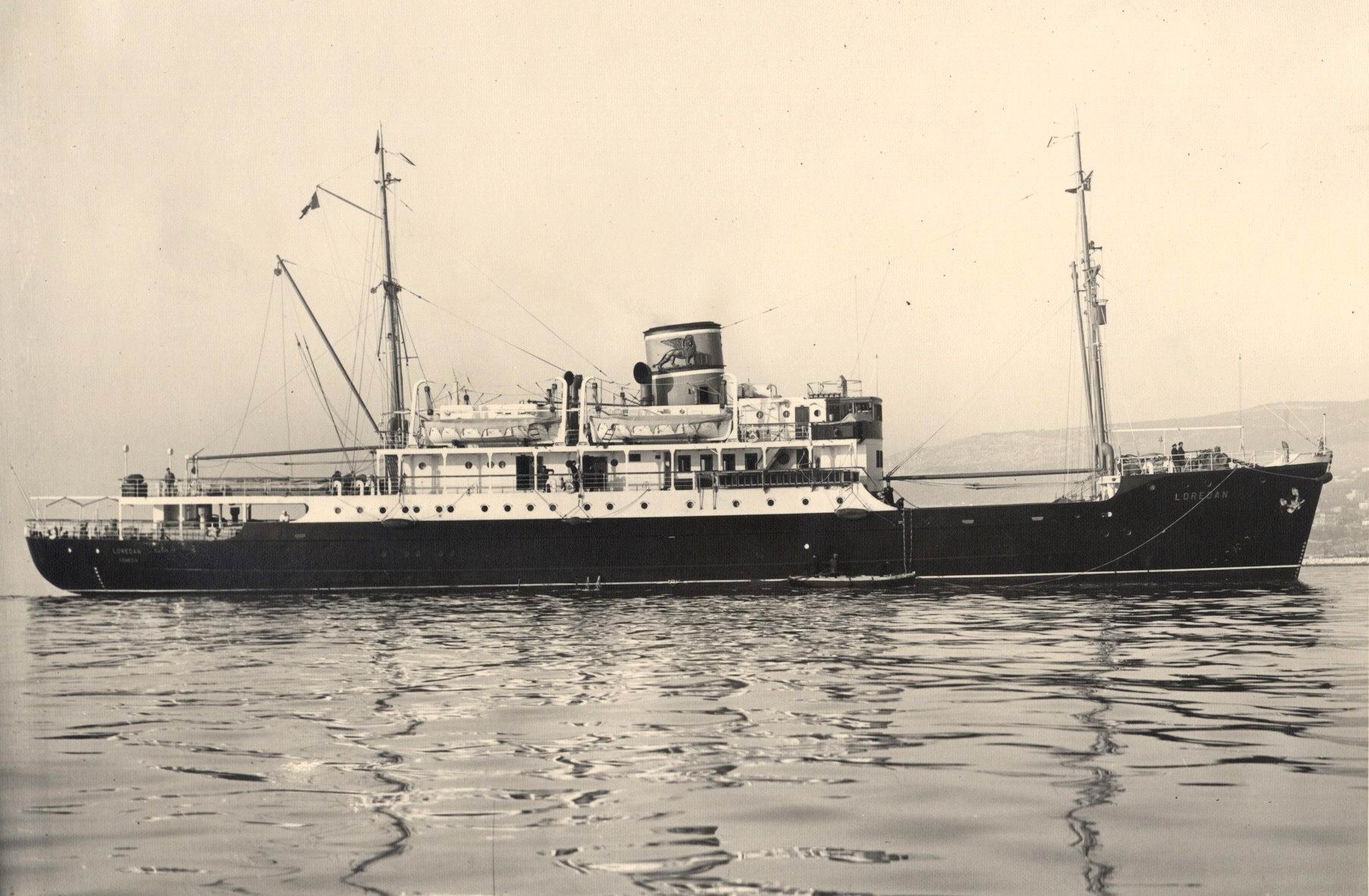
MV Loredan was an Italian mixed motor ship and auxiliary cruiser of the Italian Royal Navy in World War II, named in honor of the many admirals of the noble Loredan family of Venice.
Built in 1936 in Monfalcone, it initially served as a civil transport ship on several passenger/cargo lines in the Adriatic Sea. In 1941 the vessel was re-registered as an auxiliary cruiser in the Italian Royal Navy. In twenty-one months of service, it carried out a total of 193 missions, consisting mainly of escort services in the Tyrrhenian Sea. On 10 April 1943, Loredan left the port of Cagliari as an escort to a small convoy headed for the archipelago of La Maddalena. Shortly after the departure, the convoy was spotted by the British submarine HMS Safari, which proceeded to launch torpedoes at the Italian ships, sinking Loredan with nearly all its crew.
The wreck of Loredan lies on its left side, with the stern severely damaged, at a depth of between 52 and 67 meters (171 and 220 ft), on the seabed of the Gulf of Cagliari, at 39°08' N and 9°23' E. The wreck is a frequent diving destination.
Built between November 1935 and November 1936 at the Cantieri Riuniti dell'Adriatico in Monfalcone some time after its twin ship Narenta (built at Ancona), the vessel was originally a small mixed motor ship of 1,357 gross register tons (GRT) and 626 net register tons (NRT). Two holds with a capacity of 1,212 cubic meters (42,800 cu ft) allowed a deadweight of 583 (in other sources 650) tons, while the cabins could accommodate a total of 28 passengers, all in first class. A FIAT diesel engine with a power of 1,600–1,800 horsepower (1,200–1,300 kW) (in some sources 2,200 hp, 1,600 kW), consuming 6.6 tons of fuel per day, powered a propeller, allowing a speed of 13.5–14 knots (25.0–25.9 km/h; 15.5–16.1 mph) (the initially expected speed was instead of 14.6 knots, 27.0 km/h, 16.8 mph).
Registered with registration number 290 at the Maritime Compartment of Venice, the ship belonged to the Compagnia Adriatica di Navigazione, which on 1 January 1937 renamed as the Adriatica Società Anonima di Navigazione, based in Venice.
Initially used on line 45 with stops traveling between Venice-Trieste-Fiume-Bari, Loredan subsequently sailed also on lines 44, from Bari to Durrës, 42, from Venice to Durrës and Bari and vice versa, passing through Dalmatia, and 46, from Manfredonia to Bari. On 1 February 1940 the motor ship was laid up in Venice, remaining there until 11 April of that year. Rearmed on 12 April, the ship resumed service on line 44 for about a month; then, from May 1940, it operated on the basis of provisions of the Ministry of the Navy, making extraordinary transport journeys on behalf of the government, alternating with moments of rest and partial decommissioning.
On 27 July 1941 Loredan was requisitioned at Barletta by the Regia Marina and registered in the role of auxiliary ship of the State with registration number D 19, classified as an auxiliary cruiser. Armed with two 102-millimetre (4.0 in)/45-caliber guns, four 20 mm (0.79 in)/65 guns and embarked two anti-submarine bomber aircraft equipped with a stock of 21 depth charges (other sources mention 20–21 mines), the vessel was used for escorting convoys and transporting materials on secondary and less dangerous routes. The journalist Vittorio Giovanni Rossi was also on board Loredan, as a war correspondent (Rossi recounted this experience in the 1941 book The War of the Sailors).
In twenty-one months of service as an auxiliary cruiser, Loredan carried out a total of 193 missions, consisting mainly of escort services on the routes that connected Sardinia to Civitavecchia.
Hub AI
MV Loredan AI simulator
(@MV Loredan_simulator)
MV Loredan
MV Loredan was an Italian mixed motor ship and auxiliary cruiser of the Italian Royal Navy in World War II, named in honor of the many admirals of the noble Loredan family of Venice.
Built in 1936 in Monfalcone, it initially served as a civil transport ship on several passenger/cargo lines in the Adriatic Sea. In 1941 the vessel was re-registered as an auxiliary cruiser in the Italian Royal Navy. In twenty-one months of service, it carried out a total of 193 missions, consisting mainly of escort services in the Tyrrhenian Sea. On 10 April 1943, Loredan left the port of Cagliari as an escort to a small convoy headed for the archipelago of La Maddalena. Shortly after the departure, the convoy was spotted by the British submarine HMS Safari, which proceeded to launch torpedoes at the Italian ships, sinking Loredan with nearly all its crew.
The wreck of Loredan lies on its left side, with the stern severely damaged, at a depth of between 52 and 67 meters (171 and 220 ft), on the seabed of the Gulf of Cagliari, at 39°08' N and 9°23' E. The wreck is a frequent diving destination.
Built between November 1935 and November 1936 at the Cantieri Riuniti dell'Adriatico in Monfalcone some time after its twin ship Narenta (built at Ancona), the vessel was originally a small mixed motor ship of 1,357 gross register tons (GRT) and 626 net register tons (NRT). Two holds with a capacity of 1,212 cubic meters (42,800 cu ft) allowed a deadweight of 583 (in other sources 650) tons, while the cabins could accommodate a total of 28 passengers, all in first class. A FIAT diesel engine with a power of 1,600–1,800 horsepower (1,200–1,300 kW) (in some sources 2,200 hp, 1,600 kW), consuming 6.6 tons of fuel per day, powered a propeller, allowing a speed of 13.5–14 knots (25.0–25.9 km/h; 15.5–16.1 mph) (the initially expected speed was instead of 14.6 knots, 27.0 km/h, 16.8 mph).
Registered with registration number 290 at the Maritime Compartment of Venice, the ship belonged to the Compagnia Adriatica di Navigazione, which on 1 January 1937 renamed as the Adriatica Società Anonima di Navigazione, based in Venice.
Initially used on line 45 with stops traveling between Venice-Trieste-Fiume-Bari, Loredan subsequently sailed also on lines 44, from Bari to Durrës, 42, from Venice to Durrës and Bari and vice versa, passing through Dalmatia, and 46, from Manfredonia to Bari. On 1 February 1940 the motor ship was laid up in Venice, remaining there until 11 April of that year. Rearmed on 12 April, the ship resumed service on line 44 for about a month; then, from May 1940, it operated on the basis of provisions of the Ministry of the Navy, making extraordinary transport journeys on behalf of the government, alternating with moments of rest and partial decommissioning.
On 27 July 1941 Loredan was requisitioned at Barletta by the Regia Marina and registered in the role of auxiliary ship of the State with registration number D 19, classified as an auxiliary cruiser. Armed with two 102-millimetre (4.0 in)/45-caliber guns, four 20 mm (0.79 in)/65 guns and embarked two anti-submarine bomber aircraft equipped with a stock of 21 depth charges (other sources mention 20–21 mines), the vessel was used for escorting convoys and transporting materials on secondary and less dangerous routes. The journalist Vittorio Giovanni Rossi was also on board Loredan, as a war correspondent (Rossi recounted this experience in the 1941 book The War of the Sailors).
In twenty-one months of service as an auxiliary cruiser, Loredan carried out a total of 193 missions, consisting mainly of escort services on the routes that connected Sardinia to Civitavecchia.