


Community hub
Recent from talks
Contribute something
Nothing was collected or created yet.
Rijeka
View on Wikipedia
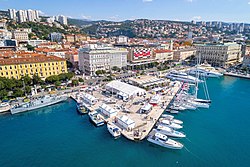
Rijeka (Croatian: [rijěːka] ⓘ[a]; Fiume [ˈfjuːme] in Italian and Fiuman Venetian) is the principal seaport and the third-largest city in Croatia. It is located in Primorje-Gorski Kotar County on Kvarner Bay, an inlet of the Adriatic Sea and in 2021 had a population of 107,964 inhabitants.[5] Historically, because of its strategic position and its excellent deep-water port, the city was fiercely contested, especially between the Holy Roman Empire, Venice, Italy and Yugoslavia, changing rulers and demographics many times over centuries. According to the 2021 census data, 85% of its citizens are Croats, along with small numbers of Serbs, Bosniaks and Italians.
Key Information


.jpg)
.jpg)


Rijeka is the main city and county seat of the Primorje-Gorski Kotar County. The city's economy largely depends on shipbuilding (shipyards 3. Maj and Viktor Lenac Shipyard) and maritime transport. Rijeka hosts the Croatian National Theatre Ivan pl. Zajc, first built in 1765, as well as the University of Rijeka.
Linguistically, apart from Croatian and Italian, the city is home to its own unique dialect of the Venetian language, Fiuman, with an estimated 20,000 speakers among the local Italians, Croats and other minorities.[citation needed] Historically, Fiuman served as the main lingua franca among the many ethnicities inhabiting the multi-ethnic port city. In certain suburbs of the modern extended municipality the autochthonous (native) population still speaks Chakavian, a dialect of Croatian.
In 2016, Rijeka was selected as the European Capital of Culture for 2020, alongside Galway, Ireland.[6]
Name
[edit]Historically, Rijeka was called Tharsatica, Vitopolis (lit. 'City of [Saint] Vitus'), or Flumen (lit. 'River') in Latin. The city is called Rijeka in Croatian, Reka in Slovene. In the local dialects of the Chakavian language it is called Reka or Rika.[7] It is called Fiume ([ˈfjuːme] ⓘ) in Italian and in Fiuman Venetian. All these names mean 'river' in their respective languages.[8][9] Meanwhile, in German the city has been called Sankt Veit am Flaum/Pflaum (lit. 'St. Vitus on the Flaum/Pflaum', with the name of the river being derived from Latin flumen).
Today, the name Fiume is not used for official purposes for legal reasons.[10] Beginning in 2018 there was an attempt on the initiative of the city's Italian community[11] to install a number of signs, including a route confirmation sign, featuring both names on the west entrance to the city among other places,[12] but as of 2021 no such signs have been installed due to technical difficulties.[13][14]
Geography
[edit]

Rijeka is located in western Croatia, 131 kilometres (81 miles) south-west of the capital, Zagreb, on the coast of Kvarner Gulf, in the northern part of the Adriatic Sea. Geographically, Rijeka is roughly equidistant from Milan (485 km [301 mi]), Budapest (502 km [312 mi]), Munich (516 km [321 mi]), Vienna (516 km [321 mi]) and Belgrade (550 km [340 mi]). Other major regional centers such as Trieste (76 km [47 mi]), Venice (240 km [150 mi]) and Ljubljana (115 km [71 mi]) are all relatively close and easily accessible. The Bay of Rijeka, which is bordered by Vela Vrata (between Istria and the island of Cres), Srednja Vrata (between Cres and Krk Island) and Mala Vrata (between Krk and the mainland) is connected to the Kvarner Gulf and is deep enough (about fifty metres or 160 feet) to accommodate large commercial ships.
The City of Rijeka lies at the mouth of the river Rječina and in the Vinodol micro-region of the Croatian coast. From three sides Rijeka is surrounded by mountains. To the west, the 1,396-metre (4,580 ft) Učka range is prominent. To the north/north-east are the Snežnik plateau and the 1,528 m (5,013 ft) Risnjak massif with its national park. To the east/south-east is the 1,533-metre (5,030 ft) Velika Kapela range. This type of terrain configuration prevented Rijeka from developing further inland (to the north) and the city mostly lies on a long and relatively narrow strip along the coast. Two important inland transport routes start in Rijeka. The first route runs north-east to the Pannonian Basin. This route takes advantage of Rijeka's location close to the point where the Dinaric Alps are the narrowest (about fifty kilometres or 31 miles) and easiest to traverse, making it the optimal route from the Hungarian plain to the sea. It also makes Rijeka the natural harbour for the Pannonian Basin (especially Hungary). The other route runs north-west across the Postojna Gate connecting Rijeka with Slovenia and further through the Ljubljana Gap with Austria and beyond. A third more coastal route runs east-west connecting Rijeka (and, by extension, the Adriatic coastal cities to the south) with Trieste and northern Italy.
History
[edit]Historical affiliations
Kingdom of Croatia pre-1102.
Kingdom of Croatia-Kingdom of Hungary:1102–1466
Holy Roman Empire (Habsburg monarchy), 1466–1809
First French Empire, 1809–1814
Austrian Empire, 1814–1867
Transleithania), 1867–1918
Italian Regency of Carnaro, 1919–1920
Free State of Fiume, 1920–1924
Kingdom of Italy, 1924–1943
OZAK, 1943–1945
Yugoslavia (
SR Croatia), 1945–1991
Croatia, 1991–present


Ancient and Medieval times
[edit]
Though traces of Neolithic settlements can be found in the region, the earliest modern settlements on the site were Celtic Tharsatica (modern Trsat, now part of Rijeka) on the hill, and the tribe of mariners, the Liburni, in the natural harbour below. The city long retained its dual character. Rijeka was first mentioned in the 1st century AD by Pliny the Elder as Tarsatica in his Natural History (iii.140).[15] Rijeka (Tarsatica) is again mentioned around AD 150 by the Greek geographer and astronomer Ptolemy in his Geography when describing the "Location of Illyria or Liburnia, and of Dalmatia" (Fifth Map of Europe).[16] In the time of Augustus, the Romans rebuilt Tarsatica as a municipium Flumen (MacMullen 2000), situated on the right bank of the small river Rječina (whose name means "the big river"). It became a city within the Roman Province of Dalmatia until the 6th century. In this period the city was part of the Liburnia limes (system of walls and fortifications against raiding Barbarians). Remains of these walls are still visible in some places today.
After the 4th century Rijeka was rededicated to Saint Vitus, the city's patron saint, as Terra Fluminis sancti Sancti Viti or in German Sankt Veit am Pflaum. From the 5th century onwards, the town was ruled successively by the Ostrogoths, the Byzantines, the Lombards, and the Avars. The city was burned down in 452 by the troops of Attila the Hun as part of their Aquileia campaign.[17] Croats settled the city starting in the 7th century giving it the Croatian name, Rika svetoga Vida ("the river of Saint Vitus"). At the time, Rijeka was a feudal stronghold surrounded by a wall. At the center of the city, its highest point, was a fortress.
.jpg)
In 799 Rijeka was attacked by the Frankish troops of Charlemagne. Their Siege of Trsat was at first repulsed, during which the Frankish commander Duke Eric of Friuli was killed. However, the Frankish forces finally occupied and devastated the castle, while the Duchy of Croatia passed under the overlordship of the Carolingian Empire. From about 925, the town was part of the Kingdom of Croatia, from 1102 in personal union with Hungary. Trsat Castle and the town were rebuilt under the rule of the House of Frankopan. In 1288 the Rijeka citizens signed the Law codex of Vinodol, one of the oldest codes of law in Europe.
From about 1300 to 1466 Rijeka was ruled by a number of noble families, the most prominent of which was the German Walsee family. Rijeka even rivalled Venice when in it was sold by Vitus Butinarius to the Habsburg emperor Frederick III, Archduke of Austria in 1466. It would remain under Austrian Habsburg rule for over 450 years (except for a brief period of French rule between 1809 and 1813) until the end of World War I in 1918 when it was occupied by Croatian and subsequently by Italian irregulars.[17]
Under Habsburg rule
[edit]Austrian presence on the Adriatic Sea was seen as a threat by the Republic of Venice and during the War of the League of Cambrai the Venetians raided and devastated the city with great loss of life in 1508 and again in 1509. However, the city did recover and remain under Austrian rule. For its fierce resistance to the Venetians it received the title of the "most loyal city" ("fidelissimum oppidium") as well as commercial privileges from the Austrian emperor Maximilian I in 1515.[18] While Ottoman forces attacked the town several times, they never occupied it. From the 16th century onwards, Rijeka's present Renaissance and Baroque style started to take shape. Emperor Charles VI declared the Port of Rijeka a free port (together with the Port of Trieste) in 1719 and had the trade route to Vienna expanded in 1725.

On November 28, 1750 Rijeka was hit by a large earthquake. The devastation was so widespread that the city had to be almost completely rebuilt. In 1753, the Austrian Empress Maria Theresa approved the funding for rebuilding Rijeka as a "new city" ("Civitas nova"). The rebuilt Rijeka was significantly different - it was transformed from a small medieval walled town into a larger commercial and maritime city centered around its port.[19]
By order of Maria Theresa in 1779, the city was annexed to the Kingdom of Hungary and governed as corpus separatum directly from Budapest by an appointed governor, as Hungary's only international port. From 1804, Rijeka was part of the Austrian Empire (Kingdom of Croatia-Slavonia after the Compromise of 1867), in the Croatia-Slavonia province.[20]
During the Napoleonic Wars, Rijeka was briefly captured by the French Empire and included in the Illyrian Provinces. During the French rule, between 1809 and 1813, the critically important Louisiana road was completed (named after Napoleon's wife Marie Louise). The road was the shortest route from Rijeka to the interior (Karlovac) and gave a strong impulse to the development of Rijeka's port. In 1813 the French rule came to an end when Rijeka was first bombarded by the Royal Navy and later re-captured by the Austrians under the command of the Irish general Laval Nugent von Westmeath.[21] The British bombardment has an interesting side story. The city was apparently saved from annihilation by a young lady named Karolina Belinić who - amid the chaos and destruction of the bombardment - went to the English fleet commander and convinced him that further bombardment of the city was unnecessary (the small French garrison was quickly defeated and left the city). The legend of Karolina is warmly remembered by the population even today. Karolina Riječka (Caroline of Rijeka) became a folk hero and has been celebrated in plays, movies and even in a rock opera.[22]
In the early 19th century, the most prominent economical and cultural leader of the city was Andrija Ljudevit Adamić.
Fiume also had a significant naval base, and in the mid-19th century it became the site of the Imperial and Royal Naval Academy (K.u.K. Marine-Akademie), where the Austro-Hungarian Navy trained its officer cadets.
Hungarian Crown
[edit]During the Hungarian revolution of 1848, when Hungary tried to gain independence from Austria, Rijeka was captured by the Croatian troops (loyal to Austria) commanded by Ban Josip Jelačić. The city was then annexed directly to Croatia, although it did keep a degree of autonomy.[23]
Giovanni de Ciotta (mayor from 1872 to 1896) proved to be an authoritative local political leader. Under his leadership, an impressive phase of expansion of the city started, marked by major port development, fuelled by the general expansion of international trade and the city's connection (1873) to the Austro-Hungarian railway network. Modern industrial and commercial enterprises such as the Royal Hungarian Sea Navigation Company "Adria", a rival shipping company the Ungaro-Croata (established in 1891) and the Smith and Meynier paper mill (which operated the first steam engine in south-east Europe), situated in the Rječina canyon, producing cigarette paper sold around the world.
The second half of the 19th century and the beginning of the 20th century (up to World War I) was a period of great prosperity, rapid economic growth and technological dynamism for Rijeka. Many authors and witnesses describe Rijeka of this time as a rich, tolerant, well-to-do town which offered a good standard of living, with endless possibilities for making one's fortune. The Pontifical Delegate Celso Costantini noted in his diary "the religious indifference and apathy of the town". The further industrial development of the city included the first industrial scale oil refinery in Europe in 1882[24] and the first torpedo factory in the world in 1866, after Robert Whitehead, manager of the "Stabilimento Tecnico Fiumano" (an Austrian engineering company engaged in providing engines for the Austro-Hungarian Navy), designed and successfully tested the world's first torpedo. In addition to the Whitehead Torpedo Works, which opened in 1874, the oil refinery (1882) and the paper mill, many other industrial and commercial enterprises were established or expanded in these years. These include a rice husking and starch factory (one of the largest in the world), a wood and furniture company, a wheat elevator and mill, the Ganz-Danubius shipbuilding industries, a cocoa and chocolate factory, a brick factory, a tobacco factory (the largest in the Monarchy), a cognac distillery, a pasta factory, the Ossoinack barrel and chest factory, a large tannery, five foundries and many others.[25] At the beginning of the 20th century more than half of the industrial capacity in Croatia (which was at that time mostly agrarian) was located in Rijeka.[26]
Rijeka's Austro-Hungarian Marine Academy became a pioneering centre for high-speed photography. The Austrian physicist Peter Salcher working in the Academy took the first photograph of a bullet flying at supersonic speed in 1886, devising a technique that was later used by Ernst Mach in his studies of supersonic motion.[27]
Rijeka's port underwent tremendous development fuelled by generous Hungarian investments, becoming the main maritime outlet for Hungary and the eastern part of the Austro-Hungarian Empire. By 1913–14, the port of Fiume became the tenth-busiest port in Europe.[25] The population grew rapidly from only 21,000 in 1880 to 50,000 in 1910. Major civic buildings constructed at this time include the Governor's Palace, designed by the Hungarian architect Alajos Hauszmann. There was an ongoing competition between Rijeka and Trieste, the main maritime outlet for Austria—reflecting the rivalry between the two components of the Dual Monarchy. The Austro-Hungarian Navy sought to keep the balance by ordering new warships from the shipyards of both cities.
During this period[when?] the city had an Italian majority.[dubious – discuss] According to the census of 1880, in Rijeka there were 9,076 Italians, 7,991 Croats, 895 Germans and 383 Hungarians.[28] Some historians claim that the city had a Slavic majority at the beginning of the 19th century, because the 1851 census reported a Croatian majority. However, this census is considered not very reliable by Italian historians.[29][better source needed] At the last Austro-Hungarian census in 1910, the corpus separatum had a population of 49,806 people and was composed of the following linguistic communities:[30]
| Languages in 1911 | 49,806 inhabitants | (100%) |
| Italian | 23,283 | (46.9%) |
| Croatian | 15,731 | (31.7%) |
| Slovenian | 3,937 | (7.9%) |
| Hungarian | 3,619 | (7.3%) |
| German | 2,476 | (5.0%) |
| English | 202 | (0.4%) |
| Czech | 183 | (0.3%) |
| Serbian | 70 | (0.14%) |
| French | 40 | (0.08%) |
| Polish | 36 | (0.07%) |
| Romanian | 29 | (0.06%) |
By religion, the census of 1910 indicates that - from the total of 49,806 inhabitants - there were 45,130 Catholics, 1,696 Jewish, 1,123 Calvinist, 995 Orthodox and 311 Lutheran. The Jewish population expanded rapidly, particularly in the 1870s-1880s, and built a large synagogue in 1907 (which would be destroyed in 1944, during the German occupation, concurrent with the murder of most of the city's Jewish residents). On the eve of WWI, there were 165 inns, 10 hotels with restaurants, 17 cafés, 17 jewellers, 37 barbers and 265 tailor shops in Rijeka.[25]
-
 Rijeka, Roman Arch in the Old City, c.1900
 -
 Rijeka Harbor, c.1900
 -
 Rijeka - Corso, c. 1900
 -
 Tram in Rijeka, L. Kossuth Street, c.1910


.jpg)
World War I
[edit]
World War I put an end to Rijeka's "golden era" of peace, stability and rapid economic growth. The city would never quite recover to the same level of prosperity. Initially there was a semblance of normalcy (the city was far from the frontlines), however - a growing part of the male population started to be mobilized by the army and the navy. The city's war-related industries continued to work at full steam and contributed significantly to the Austro-Hungarian war effort, especially to the navy. The shipyard Ganz-Danubius produced a number of warships and submarines like the U-27-class submarines, the Novara-class cruisers, the large battleship SMS Szent István and others. In total, between the early 1900s and 1918 the city's shipyards produced 1 battleship, 2 cruisers, 20 destroyers, 32 torpedo boats and 15 submarines for the navy.[31] Rijeka was also the main center for the production of torpedoes. However, a lot changed with the war becoming a protracted conflict and especially with the Italian declaration of war on Austria-Hungary in May 1915. This opened a frontline only 90 km from the city and caused a pervasive sense of anxiety among the large Italian population. Several hundred Italians, considered disloyal (enemy non-combatants) by the authorities, were deported to camps in Hungary (Tápiósüly and Kiskunhalas), where many died of malnutrition and diseases. The torpedo factory was attacked by the Italian airship "Città di Novara" in 1915 (later shot down by Austrian hydroplanes) and suffered damages. As a consequence - most of the torpedo production was moved to Sankt Pölten in Austria, further away from the frontlines. The city was again attacked by Italian airplanes in 1916 and suffered minor damage. The Naval Academy ceased its activities and was converted to a war hospital (the ex-naval academy buildings are still housing the city hospital to this day). On 10 February 1918 the Italian navy raided the nearby bay of Bakar causing little material damage but achieving a significant propaganda effect. As the war dragged on, the city's economy and the living standard of the population deteriorated rapidly. Due to a maritime blockade, the port traffic suffered a collapse - from 2,892.538 tons in 1913 (before the war) to only 330.313 tons in 1918. Many factories - lacking manpower and/or raw materials - reduced the production or simply closed. Shortages of food and other basic necessities became widespread. Even public safety became a problem with an increase in the number of thefts, violent incidents and war profiteering.[32] The crisis escalated on October 23, 1918, when the Croatian troops stationed in Rijeka (79th regiment) mutinied and temporarily took control of the city.[33][25][34] Amid growing chaos, the Austro-Hungarian empire dissolved a few weeks later, on November 12, 1918, starting a long period of instability and uncertainty for the city.
The "Fiume Question" and the Italian-Yugoslav dispute
[edit]Habsburg-ruled Austria-Hungary's disintegration in October 1918 during the closing weeks of World War I led to the establishment of rival Croatian-Serbian and Italian administrations in the city; both Italy and the founders of the new Kingdom of the Serbs, Croats and Slovenes (later the Kingdom of Yugoslavia) claimed sovereignty based on their "irredentist" ("unredeemed") ethnic populations.
After a brief military occupation by the Kingdom of Serbs, Croats and Slovenes, followed by the unilateral annexation of the former Corpus Separatum by Belgrade, an international force of British, Italian, French and American troops entered the city in November 1918. Its future became a major barrier to agreement during the Paris Peace Conference of 1919. The US president Wilson even proposed to make Rijeka a free city and the headquarters of the newly formed League of Nations.[35][36]
The main problem arose from the fact that Rijeka was not assigned either to Italy or to Croatia (now Yugoslavia) in the Treaty of London which defined the post-war borders in the area. It remained assigned to Austria-Hungary because - until the very end of WWI - it was assumed that the Austro-Hungarian empire would survive WWI in some form and Rijeka was to become its only seaport (Trieste was to be annexed by Italy). However, once the empire disintegrated, the status of the city became disputed. Italy based its claim on the fact that Italians comprised the largest single nationality within the city (46.9% of the total population). Croats made up most of the remainder and were a majority in the surrounding area.[37] Andrea Ossoinack, who had been the last delegate from Fiume to the Hungarian Parliament, was admitted to the conference as a representative of Fiume, and essentially supported the Italian claims. Nevertheless, at this point the city had had for years a strong and very active Autonomist Party seeking for Rijeka a special independent status among nations as a multicultural Adriatic city. This movement even had its delegate at the Paris peace conference - Ruggero Gotthardi.
Regency of Carnaro
[edit]
On 10 September 1919, the Treaty of Saint-Germain was signed, declaring the Austro-Hungarian monarchy dissolved. Negotiations over the future of the city were interrupted two days later when a force of Italian nationalist irregulars led by the poet Gabriele D'Annunzio captured the city.[39] Because the Italian government, wishing to respect its international obligations, did not want to annex Fiume, D'Annunzio and the intellectuals at his side eventually established an independent state, the Italian Regency of Carnaro, a unique social experiment for the age and a revolutionary cultural experience in which various international intellectuals of diverse walks of life took part (like Osbert Sitwell, Arturo Toscanini, Henry Furst, Filippo Tommaso Marinetti, Harukichi Shimoi, Guglielmo Marconi, Alceste De Ambris, Whitney Warren and Léon Kochnitzky).[40]
-10_Kronen_(1920).jpg)
Among the many political experiments that took place during this experience, D'Annunzio and his men undertook a first attempt to establish a movement of non-aligned nations in the so-called League of Fiume, an organisation antithetic to the Wilsonian League of Nations, which it saw as a means of perpetuating a corrupt and imperialist status quo. The organisation was aiming primarily at helping all oppressed nationalities in their struggle for political dignity and recognition, establishing links with many movements on various continents, but it never found the necessary external support and its main legacy remains today the Regency of Carnaro's recognition of Soviet Russia, the first state in the world to have done so.[41][42][43]
The Liberal Giovanni Giolitti became Premier of Italy again in June 1920; this signalled a hardening of official attitudes to D'Annunzio's coup. On 12 November, Italy and Yugoslavia concluded the Treaty of Rapallo, which envisaged Fiume becoming an independent state, the Free State of Fiume, under a government acceptable to both powers.[44] D'Annunzio's response was characteristically flamboyant and of doubtful judgment: his declaration of war against Italy invited the bombardment by Italian royal forces which led to his surrender of the city at the end of the year, after five days' resistance (known as Bloody Christmas). Italian troops freed the city from D'Annunzio's militias in the last days of December 1920. After a world war and additional two years of economic paralysis the city economy was nearing collapse and the population was exhausted.
Free State of Fiume
[edit]
In a subsequent democratic election the Fiuman electorate on 24 April 1921 approved the idea of a free state of Fiume-Rijeka with a Fiuman-Italo-Yugoslav consortium ownership structure for the port, giving an overwhelming victory to the independentist candidates of the Autonomist Party. Fiume became consequently a full-fledged member of the League of Nations and the ensuing election of Rijeka's first president, Riccardo Zanella, was met with official recognition and greetings from all major powers and countries worldwide. Despite many positive developments leading to the establishment of the new state's structures, the subsequent formation of a constituent assembly for the state did not put an end to strife within the city. A brief Italian nationalist seizure of power ended with the intervention of an Italian royal commissioner, and another short-lived peace was interrupted by a local Fascist putsch in March 1922 which ended with a third Italian intervention to restore the previous order. Seven months later the Kingdom of Italy itself fell under Fascist rule and Fiume's fate was therefore sealed, the Italian Fascist Party being among the strongest proponents of the annexation of Fiume to Italy. The Free State of Fiume thus was to officially become the first country victim of fascist expansionism.
The territory of Fiume part of the Kingdom of Italy
[edit]
The period of diplomatic acrimony was closed by the bilateral Treaty of Rome (27 January 1924), signed by Italy and Yugoslavia. With it the two neighbouring countries agreed to partition the territory of the small state. Most of the old Corpus Separatum territory became part of Italy, while a few Croatian/Slovenian-speaking villages to the north of the city were annexed by Yugoslavia.[45] The annexation happened de facto on 16 March 1924, and it inaugurated about twenty years of Italian government for the city proper, to the detriment of the Croatian minority, which fell victim of discrimination and targeted assimilation policies.


The city became the seat of the newly formed Province of Fiume. In this period Fiume lost its commercial hinterland and thus part of its economic potential as it became a border town with little strategic importance for the Kingdom of Italy. However, since it retained the Free Port status and its iconic image in the nation-building myth, it gained many economic concessions and subsidies from the government in Rome. These included a separate tax treatment from the rest of Italy and a continuous inflow of investments from the Italian state (although not as generous as previous Hungarian ones). The city regained a good level of economic prosperity and was much richer than the surrounding Yugoslav lands, but the economic and demographic growth slowed down if compared to the previous Austro-Hungarian period.
![Coat of Arms in use during the italian domain of the city, approved in 1935[42]](https://en.wikipedia.org/wiki/File:Fiume-Stemma_(1924-1945).svg)
![Varinate della Bandiera con lo stemma[2]](https://en.wikipedia.org/wiki/File:Flag_of_Fiume_(1924-1945,_Variant).svg)
World War II and the German Operational Zone
[edit]At the beginning of World War II Rijeka immediately found itself in an awkward position. The city's largest demographic was Italian followed by Croatian constituting most of the remainder, but its immediate surroundings and the city of Sušak, just across the Rječina river (today a part of Rijeka proper) were inhabited almost exclusively by Croatians and part of a potentially hostile power—Yugoslavia. Once the Axis powers invaded Yugoslavia in April 1941, the Croatian areas surrounding the city were occupied by the Italian military, setting the stage for an intense and bloody insurgency which would last until the end of the war. Partisan activity included guerrilla-style attacks on isolated positions or supply columns, sabotage and killings of civilians believed to be connected to the Italian and (later) German authorities. This, in turn, was met by stiff reprisals from the Italian and German military. On 14 July 1942, in reprisal for the killing of four civilians of Italian origin by Partisans, the Italian military killed 100 men from the suburban village of Podhum, resettling the remaining 800 people to concentration camps, in the Podhum massacre.[48]
After the surrender of Italy to the Allies in September 1943, Rijeka and the surrounding territories were occupied and annexed by Germany, becoming part of the Adriatic Littoral Zone. Partisan activity continued and intensified. On 30 April 1944, in the nearby village of Lipa, German troops killed 263 civilians in reprisal for the killing of several soldiers during a Partisan attack, in the Lipa massacre.[49]
The German and Italian occupiers and their local collaborators deported some 80 percent of the city's roughly 500 Jews to Auschwitz. A larger proportion of Rijeka's Jewish population was murdered in the Holocaust than that of any other city in Italian territory.[50][51]
_bombing_by_RAF_in_1944.jpg)
Because of its industries (oil refinery, torpedo factory, shipyards) and its port facilities, the city was also a target of more than 30 Anglo-American air attacks,[52] which caused widespread destruction and hundreds of civilian deaths. Some of the heaviest bombardments happened on 12 January 1944 (attack on the refinery, part of the oil campaign),[53] on 3–6 November 1944, when a series of attacks resulted in at least 125 deaths and between 15 and 25 February 1945 (200 dead, 300 wounded).[54]
The area of Rijeka was heavily fortified even before World War II (the remains of these fortifications can be seen today on the outskirts of the city). This was the fortified border between Italy and Yugoslavia which, at that time, cut across the city area and its surroundings. As Yugoslav troops approached the city in April 1945, one of the fiercest and largest battles in this area of Europe ensued. The 27,000 German and additional Italian RSI troops fought tenaciously from behind these fortifications (renamed "Ingridstellung"—Ingrid Line—by the Germans). Under the command of the German general Ludwig Kübler they inflicted thousands of casualties on the attacking Partisans, which were forced by their superiors to charge uphill against well-fortified positions to the north and east of the city. The Yugoslav commanders did not spare casualties to speed up the capture of the city, fearing a possible English landing in area which would prevent their advance towards Trieste before the war was over. After an extremely bloody battle and heavy losses on the attackers side, the Germans were forced to retreat. Before leaving the city the German troops destroyed much of the harbour area and other important infrastructure with explosive charges. However, the German attempt to break out of the encirclement north-west of the city was unsuccessful. Of the approximately 27,000 German and other troops retreating from the city, 11,000 were killed or executed after surrendering[citation needed], while the remaining 16,000 were taken as prisoners. Yugoslav troops entered Rijeka on 3 May 1945.[55][56] The city had suffered extensive damage in the war. The economic infrastructure was almost completely destroyed, and of the 5,400 buildings in the city at the time, 2,890 (53%) were either completely destroyed or damaged.[57]
Aftermath of World War II
[edit]
The city's fate was once again solved by a combination of force and diplomacy, despite insistent pledges by the Fiuman government in exile and its close collaboration with the partisan movement, and despite numerous calls to respect the city-state's internationally recognized sovereignty. During the war years, the Yugoslav communist had promised full independence restoration for Fiume initially, and later an extensive autonomy for the city-state (the locals being promised various degrees of autonomy at different moments during the war, most notably to be granted a federal state of the upcoming Republic of Yugoslavia), in order to ensure the support of the local Autonomists. As the war was coming to an end the city was outright occupied bt Tito's armies, and consequently unilaterally annexed by Yugoslavia, getting fully incorporated into the federal state of Croatia. All the many voices of dissent within the Fiuman population were violently silenced in the 12 months following the end of the war. The de-facto situation created by the Yugoslav forces on the ground was eventually formalized also de-jure in the 1947 Paris peace treaty between Italy and the Allies on the 10th of February 1947, despite public complaints and opposition by the last democratically elected government and its president-in-exile Riccardo Zanella, and all efforts by Italy's experienced foreign minister Carlo Sforza to finally uphold the implementation of the previous Wilsonian plans for a multicultural Free State solution, hosting a local headquarters for the newly created United Nations. Once the change to Yugoslav sovereignty was formalized, and in particular in the years leading to the Trieste Crisis of 1954, 58,000 of the city's 66,000 inhabitants were gradually pushed either to emigrate (they became known in Italian as esuli or the exiled ones from Istria, Fiume and Dalmatia) or to endure harsh oppression by the new Yugoslav Communist regime. The Yugoslav communist party opted for a markedly Stalinist approach in solving the local ethnic question, in particular after the Autonomist gained massive support in the first post-war local elections held between 1945 and 1946.

The discrimination and persecution that many inhabitants experienced at the hands of Yugoslav officials in the last days of World War II and the first years of peace, still remain painful memories for the locals and the esuli, and are somewhat of a taboo topic for Rijeka's political milieu, which is still largely denying the events.[58] Summary executions of alleged Fascists (often well-known anti-fascists or openly apolitical), aimed at hitting the local intellectual class, the Autonomists, the commercial classes, the former Italian public servants, the military officials and often also ordinary civilians (at least 650 executions of Italians took place after the end of the war[59]) eventually forced most Italophones (of various ethnicities) to leave Rijeka/Fiume in order to avoid becoming victims of a harsher retaliation. The removal was a meticulously planned operation, aimed at convincing the hardly assimilable Italian part of the autochthonous population to leave the country, as testified decades later by representatives of the Yugoslav leadership.[60]
The most notable victims of the political and ethnic repression of locals in this period was the Fiume Autonomists purge hitting all the autonomist figures still living in the city, and now associated in the Liburnian Autonomist Movement. The Autonomists actively helped the Yugoslav partisans in liberating the region from Fascist and Nazi occupation, and, despite receiving various promises of large political autonomy for the city, they were eventually all assassinated by the Yugoslav secret police OZNA in the days leading up to the Yugoslav army's victorious march into city and its aftermath.

In subsequent years, the Yugoslav authorities joined the municipalities of Fiume and Sušak and, after 1954, less than one third of the original population of the now united municipalities (mostly what was previously the Croat minority in Fiume and the majority in Sušak) remained in the city, because the old municipality of Fiume lost in these years more than 85% of the original population. The Yugoslav plans for a more obedient demographic situation in Rijeka culminated in 1954 during the Trieste crisis, when the Yugoslav Communist Party rallied many local members to ruin or destroy the most notable vestiges of the Italian/Venetian language and all bilingual inscriptions in the city (which had been legally granted a fully bilingual status after the occupation in 1945), eventually also 'de facto' (but not 'de jure') deleting bilinguilism, except in a handful of selected bilingual schools and inside the Italian Community's own building. After the war the local ethnic Italians of Rijeka left Yugoslavia for Italy (Istrian-Dalmatian exodus).[61]

The city was then resettled by immigrants from various parts of Yugoslavia, once more changing heavily the city's demographics and its linguistic composition. These years coincided also with a period of general reconstruction and new program of industrialization after the destruction of the war. During the period of the Yugoslav Communist administration between the 1950s and the 1980s, the city became the main port of the Federal Republic and started to grow once again, both demographically and economically, taking advantage of the newly re-established hinterland that had been lacking during the Italian period, as well as the rebuilding after the war of its traditional manufacturing industries, its maritime economy and its port potential. This, paired with its rich commercial history, allowed the city to soon become the second richest (GDP per capita) district within Yugoslavia. However, many of these industries and companies, being based on a socialist planned economic model were not able to survive the move to a market-oriented economy in the early 1990s.
As Yugoslavia broke up in 1991, the former Federal State of Croatia became independent and, in the Croatian War of Independence that ensued, Rijeka became part of the newly independent Croatia. Since then, the city has stagnated economically and its demography has plunged. Some of its largest industries and employers have gone out of business, the most prominent among them being the Jugolinija shipping company, the torpedo factory, the paper mill and many other small or medium manufacturing and commercial companies. Other companies have struggled to remain economically viable (like the city's landmark 3. Maj shipyard). The number of people working in manufacturing dropped from more than 80,000 in 1990 to only 5,000 two decades later[citation needed]. Privatization scandals and the large scale corruption which marked Croatia's transition from socialism to capitalism as well as several years of war economy played a significant role in the collapse of the city's economy during the 1990s and early 2000s. A difficult and uncertain transition of the city's economy away from manufacturing and towards an economy based on services and tourism is still in progress.
On 27 November 2019, a waterspout of intensity IF1 made landfall in the city of Rijeka, causing tree, roof and car damage along a narrow path.[62][63]
In 2020, Rijeka was voted the European Capital of Culture alongside Galway,[64] with a planned program including more than 600 events of cultural and social importance.
Rijeka's International Carnival
[edit]
The Rijeka Carnival (Croatian: Riječki karneval) is held each year before Lent (between late January and early March) in Rijeka, Croatia. Established in 1982, it has become the biggest carnival in Croatia. Every year there are numerous events preceding the carnival itself. First the mayor of Rijeka gives the symbolic key of the city to Meštar Toni, who is "the maestro" of the carnival, and he becomes the mayor of the city during the carnival, although this is only figuratively. On the same day, the carnival queen is elected. As all the cities around Rijeka have their own events during the carnival time, Queen and Meštar Toni are attending most of them.
Also, every year the Carnival charity ball is held in the Governor's palace in Rijeka. It is attended by politicians, people from sport and media life, as well as a number of ambassadors.
The weekend before the main event there are two other events held. One is Rally Paris–Bakar (after the Dakar Rally). The start is a part of Rijeka called Paris after the restaurant located there, and the end is in city of Bakar, located about 20 kilometres (12 miles) south-east. All of the participants of the rally wear masks, and the cars are mostly modified old cars. The other event is the children's carnival, held, like the main one, on Rijeka's main walkway Korzo. The groups that participate are mostly from kindergartens and elementary schools, including groups from other parts of Croatia and neighboring countries. In 1982 there were only three masked groups on Rijeka's main walkway Korzo. In recent years, the international carnival has attracted around 15,000 participants from all over the world organized in over 200 carnival groups, with crowds of over 100,000.[65]
Climate
[edit]

Rijeka has a humid subtropical climate (Cfa by the Köppen climate classification) with warm summers and relatively mild and rainy winters.[66] The terrain configuration, with mountains rising steeply just a few kilometres inland from the shores of the Adriatic, provides for some striking climatic and landscape contrasts within a small geographic area. Beaches can be enjoyed throughout summer in a typically Mediterranean setting along the coastal areas of the city to the east (Pećine, Kostrena) and west (Kantrida, Preluk). At the same time, the ski resort of Platak, located only about 10 kilometres (6.2 mi) from the city, offers alpine skiing and abundant snow during winter months (at times until early May). The Kvarner Bay and its islands are visible from the ski slopes.[67][68] Unlike typical mediterranean locations, Rijeka does generally not see a summer drought. Snow is rare (usually three days per year, almost always occurring in patches). There are 20 days a year with a maximum of 30 °C (86 °F) or higher, while on one day a year the temperature does not exceed 0 °C (32 °F).[69] Fog appears in about four days per year, mainly in winter.[69] The climate is also characterized by frequent rainfall. Cold (bora) winds are common in wintertime.
Since records began in 1948, the highest temperature recorded at the local weather station at an elevation of 120 metres (390 ft) was 40.0 °C (104.0 °F), on 19 July 2007.[70] The coldest temperature was −12.8 °C (9.0 °F), on 10 February 1956.[71]
| Climate data for Rijeka (1971–2000, extremes 1948–present) | |||||||||||||
|---|---|---|---|---|---|---|---|---|---|---|---|---|---|
| Month | Jan | Feb | Mar | Apr | May | Jun | Jul | Aug | Sep | Oct | Nov | Dec | Year |
| Record high °C (°F) | 20.0 (68.0) |
21.4 (70.5) |
24.0 (75.2) |
29.0 (84.2) |
33.7 (92.7) |
36.8 (98.2) |
40.0 (104.0) |
39.2 (102.6) |
34.8 (94.6) |
28.8 (83.8) |
25.5 (77.9) |
20.4 (68.7) |
40.0 (104.0) |
| Mean daily maximum °C (°F) | 9.1 (48.4) |
9.9 (49.8) |
12.6 (54.7) |
15.9 (60.6) |
21.1 (70.0) |
24.6 (76.3) |
27.9 (82.2) |
28.1 (82.6) |
23.5 (74.3) |
18.5 (65.3) |
13.2 (55.8) |
10.1 (50.2) |
17.9 (64.2) |
| Daily mean °C (°F) | 5.8 (42.4) |
6.3 (43.3) |
8.8 (47.8) |
12.0 (53.6) |
16.8 (62.2) |
20.3 (68.5) |
23.1 (73.6) |
23.1 (73.6) |
18.8 (65.8) |
14.2 (57.6) |
9.6 (49.3) |
6.8 (44.2) |
13.8 (56.8) |
| Mean daily minimum °C (°F) | 2.9 (37.2) |
3.2 (37.8) |
5.5 (41.9) |
8.4 (47.1) |
12.8 (55.0) |
16.0 (60.8) |
18.6 (65.5) |
18.6 (65.5) |
14.9 (58.8) |
10.9 (51.6) |
6.6 (43.9) |
4.0 (39.2) |
10.2 (50.4) |
| Record low °C (°F) | −11.4 (11.5) |
−12.8 (9.0) |
−7.7 (18.1) |
−0.2 (31.6) |
2.1 (35.8) |
7.4 (45.3) |
10.4 (50.7) |
9.1 (48.4) |
4.8 (40.6) |
−1.2 (29.8) |
−4.5 (23.9) |
−8.9 (16.0) |
−12.8 (9.0) |
| Average precipitation mm (inches) | 128.7 (5.07) |
104.1 (4.10) |
113.0 (4.45) |
113.8 (4.48) |
103.3 (4.07) |
119.9 (4.72) |
70.1 (2.76) |
101.5 (4.00) |
156.5 (6.16) |
203.9 (8.03) |
181.9 (7.16) |
155.6 (6.13) |
1,552.4 (61.12) |
| Average precipitation days (≥ 0.1 mm) | 10.7 | 8.5 | 10.3 | 12.6 | 12.5 | 12.3 | 8.8 | 9.0 | 10.6 | 12.1 | 11.7 | 11.2 | 130.1 |
| Average snowy days (≥ 1.0 cm) | 0.8 | 0.3 | 0.2 | 0.0 | 0.0 | 0.0 | 0.0 | 0.0 | 0.0 | 0.0 | 0.0 | 0.1 | 1.4 |
| Average relative humidity (%) | 65.1 | 60.3 | 60.4 | 62.6 | 63.7 | 62.4 | 56.4 | 56.0 | 63.7 | 67.4 | 67.3 | 66.4 | 62.7 |
| Mean monthly sunshine hours | 111.6 | 135.6 | 155.0 | 171.0 | 232.5 | 249.0 | 297.6 | 279.0 | 201.0 | 161.2 | 111.0 | 99.2 | 2,203.7 |
| Mean daily daylight hours | 9.2 | 10.4 | 12 | 13.6 | 14.9 | 15.6 | 15.3 | 14 | 12.5 | 10.9 | 9.5 | 8.8 | 12.2 |
| Percentage possible sunshine | 41 | 50 | 47 | 47 | 57 | 61 | 71 | 71 | 58 | 51 | 42 | 40 | 55 |
| Average ultraviolet index | 1 | 2 | 3 | 5 | 7 | 8 | 8 | 7 | 5 | 3 | 2 | 1 | 4 |
| Source 1: Croatian Meteorological and Hydrological Service[69][72] | |||||||||||||
| Source 2: Weather Atlas(Daylight-UV)[73] | |||||||||||||
| Climate data for Rijeka | |||||||||||||
|---|---|---|---|---|---|---|---|---|---|---|---|---|---|
| Month | Jan | Feb | Mar | Apr | May | Jun | Jul | Aug | Sep | Oct | Nov | Dec | Year |
| Average sea temperature °C (°F) | 11.4 (52.6) |
10.7 (51.2) |
11.3 (52.3) |
13.7 (56.6) |
18.0 (64.3) |
22.6 (72.7) |
24.8 (76.5) |
24.9 (76.8) |
23.4 (74.1) |
19.5 (67.1) |
16.8 (62.2) |
14.3 (57.7) |
17.6 (63.6) |
| Source: Weather Atlas[73] | |||||||||||||


Demographics
[edit]| Year | Pop. | ±% |
|---|---|---|
| 1880 | 37,904 | — |
| 1890 | 48,959 | +29.2% |
| 1900 | 61,419 | +25.4% |
| 1910 | 76,042 | +23.8% |
| 1921 | 61,157 | −19.6% |
| 1931 | 72,111 | +17.9% |
| 1948 | 67,088 | −7.0% |
| 1953 | 73,718 | +9.9% |
| 1961 | 98,759 | +34.0% |
| 1971 | 129,173 | +30.8% |
| 1981 | 158,226 | +22.5% |
| 1991 | 165,904 | +4.9% |
| 2001 | 144,043 | −13.2% |
| 2011 | 128,624 | −10.7% |
| 2021 | 107,964 | −16.1% |
| Source: Naselja i stanovništvo Republike Hrvatske 1857–2021, DZS, Zagreb | ||
According to the 2021 census, the city proper had a population of 107,964,[5] which included:[2]
| Croats | 92,075 | (85.28%) |
| Serbs | 5,537 | (5.13%) |
| Bosniaks | 1,696 | (1.57%) |
| Italians | 1,569 | (1.45%) |
Other groups, including Slovenes and Hungarians, formed less than 1% each. The Croatian census recognized two settlements within the City of Rijeka - the city itself with a population of 128,384, and "Bakar" with a population of 240,[74] which is the village of Sveti Kuzam, separate from the neighboring town of Bakar. On 27 February 2014, Rijeka city council passed a decision to annex the settlement (named "Bakar-dio (Sv. Kuzam")) to the settlement of Rijeka.[75]
| population | 18597 | 23880 | 27904 | 38959 | 51419 | 66042 | 61157 | 72111 | 67088 | 73718 | 98759 | 129173 | 158226 | 165904 | 144043 | 128624 | 107964 |
| 1857 | 1869 | 1880 | 1890 | 1900 | 1910 | 1921 | 1931 | 1948 | 1953 | 1961 | 1971 | 1981 | 1991 | 2001 | 2011 | 2021 |
There are 34 units of local administration called mjesni odbor in Rijeka:[76]
- Banderovo
- Belveder
- Brajda-Dolac
- Brašćine-Pulac
- Bulevard
- Centar-Sušak
- Draga
- Drenova
- Gornja Vežica
- Gornji Zamet
- Grad Trsat
- Grbci
- Kantrida
- Kozala
- Krimeja
- Luka
- Mlaka
- Orehovica
- Pašac
- Pećine
- Pehlin
- Podmurvice
- Podvežica
- Potok
- Srdoči
- Sveti Kuzam
- Sveti Nikola
- Svilno
- Školjić-Stari grad
- Škurinje
- Škurinjska Draga
- Turnić
- Vojak
- Zamet
In 1911 the linguistic division of the city of Rijeka (excluding Sušak) was:[77]
| Total inhabitants (in 1911) | 49,608 | % |
| Italians | 23,283 | 46.9% |
| Croats | 15,731 | 31.7% |
| Slovenians | 3,937 | 7.9% |
| Hungarians | 3,619 | 7.3% |
| Germans | 2,476 | 5.0% |
| English | 202 | 0.4% |
| Czechs | 183 | 0.3% |
| Serbs | 70 | 0.14% |
| French | 40 | 0.08% |
| Poles | 36 | 0.07% |
| Romanians | 29 | 0.06% |
The number of Italians in Rijeka decreased drastically following the Istrian-Dalmatian exodus, which occurred from 1943 to 1960.
Boundaries of Rijeka are sometimes extended into the adjoining areas. The former municipality of Rijeka (20th century) consists of other towns and municipalities outside Rijeka city proper, which used to be part of an official union of adjacent settlements (disbanded in 1995). It includes towns and municipalities of Kastav, Viškovo, Klana, Kostrena, Čavle, Jelenje, Bakar and Kraljevica.
The urban agglomeration of Rijeka includes the former municipality along with the towns and municipalities of Opatija, Lovran, Mošćenička Draga and Matulji.[78]
The metro area of Rijeka is the territory of consolidated expansion. It includes towns and municipalities of Crikvenica, Novi Vinodolski, Vinodolska, Lokve, Fužine, Delnice and Omišalj, which all gravitate towards the City of Rijeka.
The following tables list the city's population, along with the population of ex-municipality (disbanded in 1995), the urban and the metropolitan area.[citation needed]
| Year | City proper | Ex-municipality | Urban | Metro |
|---|---|---|---|---|
| 1981 | 158,226 | 193,044 | 222,318 | 251,768 |
| 1991 | 165,904 | 206,229 | 236,028 | 268,016 |
| 2001 | 144,043 | 191,647 | 220,538 | 252,933 |
| 2011 | 128,624 | 185,125 | 213,666 | 245,054 |
| 2021 | 107,964 | 165,008 | 191,293 | 219,325 |
| Population | Area (km2) | Density | |
| City proper | 107,964 | 44 | 2,469 |
| Ex-municipality | 56,386 | 473 | 119 |
| Subtotal | 165,008 | 517 | 319 |
| Urban agglomeration | 26,285 | 308 | 85 |
| Subtotal | 191,293 | 825 | 232 |
| Metro area | 28,032 | 840 | 33 |
| Total | 219,325 | 1,665 | 132 |
Architecture of Rijeka
[edit]

.jpg)
After the Austro-Hungarian Compromise of 1869, and the Croatian-Hungarian Compromise of 1869, the city of Rijeka came under the administration of the central Hungarian government as a separate political body - Corpus Separatum. The Hungarians sought to turn the temporary political situation into a permanent one and achieve their goal - the creation of a Hungarian littoral (Magyar tenger) with Rijeka as its capital. Architecture in Rijeka was heavily influenced by the architecture of Vienna and Budapest, where the Art Nouveau expression began to take shape in the late 1890s. The Hungarians wanted to build their only seaport like other important cities in the Austro-Hungarian Monarchy, especially like the competing Austrian port - Trieste. In 1873, the then mayor Giovanni Ciotte announced a public competition for the urban expansion of the city and his entire campaign was to turn Rijeka into a European metropolis. The construction of Rijeka took place intensively on three levels, and so they began to build the Hungarian Royal State Railway and the railway connecting Budapest with the Adriatic Sea. They also built numerous administrations, office and residential buildings, and shipyards.[79]
At the end of the 19th century, Rijeka became an international center for port and railway traffic due to its rapid industrialization. Such extensive construction of all types of architecture gave rise to the development of historicism in Rijeka, and today Rijeka's architecture represents the history of Austro-Hungarian influence. Facade decorations are most often borrowed from the repertoire of the Renaissance and Baroque for companies that want a luxurious facade and want to emphasize their economic power. The first locations of business palaces in the city were built on the Korzo, the Palace of the Maritime Governor (today's Port of Rijeka administration), the Palace of the Adria Shipping Company (today's county building on the Riva), the Governor's Palace, the Palace of the Hungarian Customs Administration (today's Brodokomerc). This type of Rijeka architecture includes multi-storey palaces built for office and business purposes, the Main Post Office Palace, the Rijeka Municipal Savings Bank Palace (built in 1883, today's Palace Modello), the Royal Railway Palace, the Governor's Palace (built in 1892, today's Maritime and Historical Museum of the Croatian coast), the Pension Fund Palace (built in 1894, a business and residential building), and the Adria Palace of the Hungarian Shipbuilding Society (built in 1894, today's headquarters of Jadrolinija).[80]
Monuments and sights
[edit]

.jpg)
The Croatian National Theatre Ivan Zajc is located on a park-like square. The building by architects Fellner and Helmer preserves a long theatrical tradition. Officially opened in October 1885, the grand theatre building includes work by the famous Venetian sculptor August Benvenuti and ceiling artist Franz Matsch, who collaborated with Ernst and Gustav Klimt, who painted the interior.
Among the residential buildings, there is a building called the Turkish House (Casa turca), built in the neo-Moorish style for Nikolaides, the Turkish diplomatic representative in Spain, and then the consul in Rijeka from 1898.
Tvornica "Torpedo" (the Torpedo factory). The first European prototypes of a self-propelled torpedo, created by Giovanni Luppis, a retired naval engineer from Rijeka. The remains of this factory still exist, including a well-preserved launch ramp used for testing self-propelled torpedoes on which in 1866 the first torpedo was tested.
Old gate or Roman arch. At first it was thought that this was a Roman Triumphal Arch built by the Roman Emperor Claudius Gothicus but later it was discovered to be just a portal to the pretorium, the army command in late antiquity.
Rijeka Cathedral, the cathedral of the Rijeka Archdiocese. It was built as a monastery church of the Rijeka Jesuits, on the site of a demolished church dedicated to the patron saint of Rijeka, Saint Vitus.
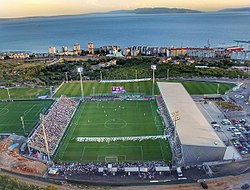
Stadion Kantrida, was included on CNN's list of the world's most iconic and unusual football stadiums in 2011.[81]
Art installation "Masters", a site-specific art installation by Czech artist Pavel Mrkus was permanently placed beneath the high ceiling vault on the inner balconies of Rijeka's fish market. The installation consists of a video segment - a projection of Mrkus's video recorded on the DIMI fishing trawler while fishing in the Kvarnerić waters – and it is accompanied by an audio segment of the sounds of the sea and a fishing boat that can only be heard in the fish market gallery. It is a story that pays homage to those who are never seen here, but without whom there would be no fish on the tables.[82]
Art installation "Balthazartown Beach", a site-specific art installation found its place on the Grčevo beach, more commonly known as Pajol or Šestica, located at the very end of Pećine near the Viktor Lenac Shipyard. Under the mentorship of artist Igor Eškinja, students of the Academy of Applied Arts of the University of Rijeka designed a steel sculpture that changes the observer's experience of the environment and they created 15 inscriptions on a concrete plateau that encourage everyone to play and are visible only when in contact with water. The artistic process is inspired by the theme of Professor Balthazar, the world-famous and award-winning animated series, in which the scenographer used Rijeka as the primary inspiration in the creation of Balthazartown Beach.[83]
Riječki neboder, (Palazzo Arbori) is the oldest skyscraper in Rijeka, named after the war Riječki to distinguish it from its contemporary counterpart in Sušak. It is located on Jadranski trg in the city center. The Arbori Palace, or the Rijeka Skyscraper, has become one of the recognizable symbols of Rijeka, and with its spatial organization and the design of its simple but monumental brick facade, it is considered one of the most significant works of modern architecture in today's Croatia.
Trsat
[edit]Svetište Majke Božje Trsatske – the Sanctuary of Our Lady of Trsat. Built 135 m (443 ft) above sea level on the Trsat hill during the late Middle Ages, it represents the Guardian of Travellers, especially seamen, who bring offerings to her so she will guard them or help them in time of trouble or illness. It is home to the Gothic sculpture of the Madonna of Slunj and to works by the Baroque painter C. Tasce. Trsat Castle, a 13th-century fortress, which offers magnificent vistas from its bastions and ramparts, looking down the Rječina river valley to the docks and the Kvarner Gulf. Petar Kružić staircase (or Trsat stairway), which links downtown Rijeka to Trsat. The stairway consists of 561 stone steps and was built for the pilgrims as the way to reach the Sanctuary of Our Lady of Trsat.
Transport
[edit]


The Port of Rijeka is the largest port in Croatia, with a cargo throughput in 2017 of 12.6 million tonnes, mostly crude oil and refined petroleum products, general cargo and bulk cargo, and 260,337 twenty-foot equivalent units (TEUs).[84] The port is managed by the Port of Rijeka Authority. The first record of a port in Rijeka date back to 1281, and in 1719, the Port of Rijeka was granted a charter as a free port. There are ferry connections between Rijeka and the surrounding islands and cities, but no direct international passenger ship connections. There are coastal lines to Split and onward to Dubrovnik, which operate twice weekly and have international connections.
The city is difficult to get to by air outside of the tourist season. The city's own international airport, Rijeka Airport is located on the nearby island of Krk across the Krk Bridge. Buses, with a journey time of approximately 45 minutes, operate from Rijeka city center and nearby Opatija, with a schedule based on the planned arrival and departure times of flights. Handling 200,841 passengers in 2019, the facility is more of a charter airport than a serious transport hub, although various scheduled airlines have begun to service it with a comparatively large number of flights coming from airports in Germany. Most of these flights only operate during the tourist season between approximately May and October. Alternative nearby airports include Pula (around 90 minutes drive from Rijeka), Trieste (around 90 minutes), Ljubljana (around 2 hours), Zagreb (around 2 hours) and Venice (around 3 hours).
Rijeka has efficient road connections to other parts of Croatia and neighbouring countries. The A6 motorway connects Rijeka to Zagreb via the A1, while the A7 motorway, completed in 2004, links Rijeka with Ljubljana, Slovenia, via Ilirska Bistrica and with Trieste, Italy. The A7 acts as the Rijeka bypass motorway and facilitates access to the A8 motorway of the Istrian Y network starting with the Učka Tunnel, and linking Rijeka with Istria. As of August 2011, the bypass is being extended eastwards to the Krk Bridge area and new feeder roads are under construction.
Rijeka is integrated into the Croatian railway network and international rail lines. A fully electrified railway connects Rijeka to Zagreb and beyond towards Koprivnica and the Hungarian border as part of Pan-European corridor Vb. Rijeka is also connected to Trieste and Ljubljana by a separate electrified line that extends northwards from the city. Rijeka has direct connections by daily/night trains to Prague, München, Salzburg, Ljubljana, Bratislava and Brno. Construction of a new high performance railway between Rijeka and Zagreb, extending to Budapest is planned, as well as rail links connecting Rijeka to the island of Krk and between Rijeka and Pula.
Bus connections
[edit]Rijeka Bus Station is connected by regular bus lines with all major Croatian cities such as Zagreb, Osijek, Slavonski Brod, Đakovo, Nova Gradiška, Požega, Vukovar, Gospić, Karlovac, Zadar, Šibenik, Split, Makarska and Dubrovnik. Departures are frequent in the direction of Istria, the islands of Cres, Lošinj, Krk, Rab and Pag and the towns around Crikvenica, Novi Vinodolski and Senj. From international lines, there are regular departures in the direction of Germany, Switzerland, Italy, Bosnia and Herzegovina and Serbia.[85]
KD Autotrolej d.o.o. is a carrier of passengers in the area of the City of Rijeka and cities / towns in the suburbs (the so-called Rijeka ring).[citation needed]
Sports
[edit]The history of Rijeka's organised sports started between 1885 and 1888 with the foundation of the Club Alpino Fiumano in 1885, the Young American Cycle Club in 1887 (the first club of this American league to be founded in a foreign land), and the Nautico Sport Club Quarnero in 1888 by the Hungarian minority of the city. Even earlier, in 1873, following an initiative by the English industrialist Robert Whitehead, the first football match to be disputed in today's Republic of Croatia territory was played in Rijeka: the Hungarian Railways team and the English engineers-led team of the Stabilimento Tecnico di Fiume (later Torpedo Factory of Fiume).[86] The first football club in Fiume was founded under the name of Fiumei Atletikai Club.
Today, HNK Rijeka is the city's main football team, which competes in the Croatian Football League. HNK Rijeka were Croatian champions in 2016–17 and 2024–25, as well as 7 times Croatian Football Cup winners and 2 times Yugoslav Cup winners. Until July 2015, HNK Rijeka was based at the iconic Stadion Kantrida. With Kantrida awaiting reconstruction, they are based at the newly built Stadion Rujevica, their temporary home in the club's new training camp. Additionally, HNK Orijent is based in Sušak and plays in the First Football League (second tier).
Rijeka's other notable sports clubs include RK Zamet and ŽRK Zamet (handball), VK Primorje EB (water polo), KK Kvarner (basketball) and ŽOK Rijeka (women's volleyball).
Between 1969 and 1990, Rijeka hosted the Yugoslav motorcycle Grand Prix that was part of the Grand Prix motorcycle racing. Rijeka also hosted the 2008 European Short Course Swimming Championships. In over 80 years, LEN had never seen so many records as the number set at Bazeni Kantrida (Kantrida Swimming Complex). A total of 14 European records were set, of which 10 were world records, and even 7 were world-best times. This championship also presented a record in the number of participating countries. There were more than 600 top athletes from some 50 European countries. Swimmers from 21 nations won medals, and 40 of the 51 national member Federations of LEN were present in Rijeka.
-
 Bazeni Kantrida, site of the 2008 European Short Course Swimming Championships
 -

-
-


Education
[edit]The University of Rijeka is the main institution of higher education in the city. It was formally founded in 1973 but with roots dating back to 1632 and the local Jesuit School of Theology.[87]
The secondary education in the city includes a variety of schools, including:
International relations
[edit]


Panoramas
[edit]


Notable people
[edit]Scientists, professors and inventors
[edit]- Archduke Joseph Karl of Austria, Archduke of the Austro-Hungarian Empire, Romani language philologist and Romani ethnographer, member of the Hungarian Academy of Sciences
- Robert Bartini, Fiuman-Soviet aircraft designer and scientist, creator of the Bartini A-57 and Bartini Beriev VVA-14
- Mihaly Csikszentmihalyi, Fiuman-Hungarian Psychology Professor at Claremont Graduate University, known as the architect of the notion of flow
- Umberto D'Ancona, Fiuman-Italian Biology Professor and founder of the Hydro-biological Station in Chioggia
- Aladár Fest, Fiuman-Hungarian pioneer pedagogue, historian that wrote his works in Hungarian, German and Italian.
- Antonio Grossich, Fiuman-Italian doctor, professor of surgery and inventor of the Tincture of iodine, senator and irredentist politician
- William Klinger, historian of Fiuman, Croatian and Yugoslav history
- Giovanni Kobler, Fiuman historian whose work is considered the major milestone in the Rijeka historiography
- Giovanni Luppis, Fiuman officer of the Austro-Hungarian Navy, lead inventor of the first self-propelled torpedo
- Paul Neményi, Fiuman-Hungarian mathematician and physicist, and the probable father of former World Chess Champion Bobby Fischer
- Sándor Alexander Riegler, Hungarian professor of chemistry and physics
- Peter Salcher, Fiuman-Austrian physicist of the Fiume Academy, pioneer of ultrafast photography and aerodynamic studies
- Petar Strčić, Croatian historian
- Danilo Klen, Croatian historian whose main focus of work were Rijeka and Istria
Arts and culture
[edit]- Oretta Fiume, Fiuman-Italian cinema star of the 1930s and 1940s, with her final role in Fellini's La Dolce Vita
- Irma Gramatica, Fiuman-Italian stage and film actress
- Janko Polić Kamov, Croatian writer and poet from Sušak
- Marija Krucifiksa Kozulić, Catholic nun, founder of the order of the Sisters of the Sacred Heart of Jesus
- Aldo Lado, Italian film director
- Geronimo Meynier, Fiuman-Italian teen film actor
- Osvaldo Ramous, Fiuman poet and writer that signed the town's 20th-century literature and cultural life
- Janni Sabucco, Italian writer and author of Si Chiamava Fiume (1952).
- Romolo Venucci, Fiuman-Italian cubist painter and sculptor
- Ödön von Horváth, Austro-Hungarian playwright, author of the play Geschichten aus dem Wiener Wald, winner of the Kleist Prize in 1931
- Heinrich von Littrow, Czech and Austrian poet, writer and cartographer
- Leo von Littrow, Fiuman Impressionist artist, a major exponent of the artistic movement in Southern Europe
Politics and institutions
[edit]- Mario Blasich, Fiuman politician and physician, victim of the Fiume Autonomists purge of 1945.
- Giovanni de Ciotta, Fiuman-Italian entrepreneur and politician
- Kolinda Grabar-Kitarović, Croatia's 4th and first female president from 2015 to 2020
- János Kádár, Chairman of the Central Committee of the Hungarian Communist Party, served for more than 30 years as the leader of Hungary
- Michele Maylender, Fiuman politician during the Hungarian Crown's dependency, founder of the Autonomist Party of Fiume
- Andrea Ossoinack, businessman and politician, among the founders of the Free State of Fiume and founder of the Autonomist League of Fiume
- Giovanni Palatucci, last Italian superintendent of Fiume and Righteous Among The Nations
- Leo Valiani, Fiuman-Italian historian, politician and journalist, a prominent dissident during the Italian fascist regime
- Miklós Vásárhelyi, Fiuman-Hungarian dissident and writer, famous for his decades-long fight against the Hungarian communist party headed by János Kádár
- Nino Host Venturi, Fiuman-Italian fascist leader, politician and historian
- Alexander von Hoyos, Fiuman-Hungarian diplomat who played a major role during the July Crisis while serving as chef de cabinet of the Foreign Minister at the outbreak of World War I in 1914
- Sebő Vukovics (Sava Vuković), Hungarian Minister of Justice in 1849 during the Hungarian Revolution of 1848
- Riccardo Zanella, Fiuman politician, first and only elected president of the Free State of Fiume
Economists and entrepreneurs
[edit]- Andrea Lodovico Adamich, Aristocratic trader from Fiume, builder, and one of the most prominent supporters of the economical and cultural development of the city
- Luigi Ossoinack, serial entrepreneur and businessman, was one of the main drivers of Fiume's economic boom during the second half of the 19th century
- Robert Whitehead, English serial entrepreneur, known for developing the first effective self-propelled torpedo, in collaboration with Giovanni Luppis in Fiume
Sportspeople
[edit]- Ivana Dojkić, Croatian basketball player, 2024 WNBA champion
- Mirza Džomba, Croatian handball player, world champion and Olympic champion
- Iva Grbas, Croatian professional basketball player
- Ezio Loik, Italian footballer, member of the Grande Torino team which won 5 consecutive Serie A titles in the 1940s and the Italian national team
- Abdon Pamich, Fiuman-Italian race walker, gold medalist at the 1964 Tokyo Summer Olympics
- Ulderico Sergo, Fiuman-Italian professional boxer, gold medalist at the 1936 Summer Olympics in Berlin
- Orlando Sirola, Fiuman-Italian tennis player
- Luciano Sušanj, Fiuman-Croatian politician, European athletic champion
- Mario Varglien, Italian footballer, Juventus player with record appearances and world champion in 1934
- Oscarre Vicich, footballer
- Rodolfo Volk, footballer and member of the AS Roma Hall of Fame
- Stefano Vukov, tennis coach known for coaching Wimbledon champion Elena Rybakina
- Vladimir Vujasinović, Serbian water polo player, World and European champion, Olympic silver and bronze medalist
Musicians
[edit]- Dino Ciani, Fiuman-Italian pianist
- Damir Urban, Croatian musician and singer-songwriter, former member of the band Laufer
- Ivan Zajc, Fiuman-Croatian composer, conductor, director and teacher
- Marko Purišić, Music Artist, achieved 2nd place in the Eurovision Song Contest in 2024 and known as Baby Lasagna
Others
[edit]- Agathe Whitehead, Fiuman-born English heiress and mother of the Trapp Family singers
- Hedviga Golik, a former nurse whose death story was picked up by several media outlets around the world.
In popular culture
[edit]The German western Winnetou movies from the 1960s, based on Karl May novels, were in part filmed on location in the outskirts of Rijeka.[91]
Marvel's villain Purple Man originates from this city, and Rijeka has been present in many of the character's stories.
The setting of the 1970s cartoon series Professor Balthazar was inspired by Rijeka.[92]
The 1980s American TV series The Winds of War was in part filmed in Rijeka and the surrounding areas.[93]
A stylised version of Fiume during the 1920s was one of the main settings in the 1992 movie Porco Rosso by world acclaimed Japanese director Hayao Miyazaki, as the town in front of which the fantastical "Hotel Adriano" is found and to which it is connected by a boat service taken by the protagonist.[94]
Bruce Sterling's November 2016 novel, written in collaboration with Warren Ellis, Pirate Utopia,[95] a dieselpunk alternative history, is set in Fiume (now Rijeka) in 1920 during the short-lived Italian Regency of Carnaro.[96]
The TV series Novine (The Paper),[97][98] which has been streaming on Netflix since April 2018, is based in Rijeka and the city was used as the main filming location.[99]
In 2019 the movie The Hitman's Wife's Bodyguard with was in part filmed in Rijeka.[100]
Recently Rijeka - with its historic industrial sites, unusual hilly setting, sweeping views and retro architecture - has become a popular location for the filming of TV-advertisements. Examples include advertisements for the Belgian internet provider Telenet, Japanese tire manufacturer Bridgestone, German retail chain DM, Japanese Honda Civic Type R cars, Ukrainian seafood restaurant chain Flagman, Slovenian soft drink brand Cockta, German car manufacturer Mercedes and others.[101][102]
See also
[edit]- Quotes about Rijeka
- Čavle
- Charter of Carnaro was the constitution of the Italian Regency of Carnaro, a short-lived government in Fiume (Rijeka)
- Crikvenica
- Drenova, Rijeka
- Fiume (disambiguation)
- Geography of Croatia
- Ilario Carposio
- Kastav
- Kostrena
- Kvarner Gulf
- List of governors and heads of state of Fiume
- Primorje-Gorski Kotar County
- Robert Whitehead
- Rječina
- Sušak
- Trsat
- Fužine
Notes
[edit]- ^ /riˈɛkə, riˈeɪkə/ ree-EK-ə, ree-AY-kə, US also /riˈjɛkə/ ree-YEK-ə,;[3][4] local Chakavian: Reka, Rika
References
[edit]Bibliography
[edit]- Cresswell, Peterjon; Atkins, Ismay; Dunn, Lily (10 July 2006). Time Out Croatia (First ed.). London, Berkeley & Toronto: Time Out Group Ltd & Ebury Publishing, Random House Ltd. 20 Vauxhall Bridge Road, London SV1V 2SA. ISBN 978-1-904978-70-1. Retrieved 10 March 2010.
- Reill, Dominique Kirchner. The Fiume Crisis: Life in the Wake of the Habsburg Empire (2020) online review[dead link]
Notes
[edit]- ^ Register of spatial units of the State Geodetic Administration of the Republic of Croatia. Wikidata Q119585703.
- ^ a b "Population by Age and Sex, by Settlements" (xlsx). Census of Population, Households and Dwellings in 2021. Zagreb: Croatian Bureau of Statistics. 2022.
- ^ Wells, John C. (2008). Longman Pronunciation Dictionary (3rd ed.). Longman. ISBN 978-1-4058-8118-0.
- ^ Roach, Peter (2011). Cambridge English Pronouncing Dictionary (18th ed.). Cambridge: Cambridge University Press. ISBN 978-0-521-15253-2.
- ^ a b "Stanovništvo u najvećim gradovima, općinama i naseljima" [Population in major towns, municipalities and settlements] (xlsx). Census of Population, Households and Dwellings in 2021. Zagreb: Croatian Bureau of Statistics. 2022.
- ^ "Croatian city Rijeka wins European Capital of Culture in 2020". Shanghai Daily. Archived from the original on 8 April 2016. Retrieved 25 March 2016.
- ^ Patrioti (30 April 2014). "Rika ili Reka - Čakavski rječnik kvarnerskog kraja". Lokalpatrioti Rijeka - Mjesto za sve ljubitelje grada Rijeke (in Croatian). Archived from the original on 5 December 2021. Retrieved 5 December 2021.
- ^ "Dubrovnik and Croatia Dictionary and pronunciation of Croatian language". Dubrovnik-online.net. Archived from the original on 8 April 2012. Retrieved 7 April 2012.
- ^ "English Translations of Italian word "fiume"". Word Reference online dictionaries. Archived from the original on 5 September 2012. Retrieved 5 January 2013.
- ^ Pavlović, Mirna (29 September 2018). "Zapisnik 11. sjednice Gradskog vijeća Grada Rijeke održane 27. i 29. rujna 2018. godine" (PDF). Grad Rijeka (in Croatian). Archived (PDF) from the original on 30 April 2025.
- ^ "Fiume "torna" italiana: arriva la segnaletica bilingue per Rijeka". ilGiornale.it (in Italian). Archived from the original on 10 October 2018. Retrieved 9 October 2018.
- ^ N., P. (26 September 2018). "Ostvarenje velike želje brojnih Fiumana: Ploča Rijeka-Fiume uskoro na ulazu u grad". Novi list (in Croatian). ISSN 2584-5985. Archived from the original on 30 April 2025.
- ^ "Pitanje vijećnika Gradskog vijeća Grada Rijeke" (PDF). 24 October 2024.
- ^ NL (4 September 2021). "Riješeno je, po Rijeci se postavljaju ploče "Rijeka – Fiume": "Sve je dogovoreno, bit će savršene"". Novi list. ISSN 2584-5985. Archived from the original on 4 September 2021.
- ^ "Pliny the Elder: the Natural History, Liber III". University of Chicago. Archived from the original on 23 September 2023. Retrieved 12 July 2019.
- ^ "The Geography of Claudius Ptolemy, Book II, Chapter 15". University of Chicago. Archived from the original on 23 September 2023. Retrieved 15 February 2020.
- ^ a b "Riječki Ljetopis (Rijeka Chronicle) - in Croatian". Matica Hrvatska. Archived from the original on 17 January 2020. Retrieved 15 February 2020.
- ^ "Danilo Klen: Stoljeće I Pol Prilika I Neprilika U Rijeci. I Oko Nje (1465-1627) - Croatian". Historijski zbornik, god. XLI (1), str. 17-26 (1988) Izvorni znanstveni članak UDK 949.713 «14/16. 13 April 2016. Archived from the original on 18 December 2021. Retrieved 12 February 2021.
- ^ "Goran Moravček: Potres 1750. promijenio lice Rijeke - Croatian". fluminensia.org. 28 November 2012. Archived from the original on 22 January 2021. Retrieved 12 February 2021.
- ^ Handbook of Austria and Lombardy-Venetia Cancellations on the Postage Stamp Issues 1850–1864, by Edwin Mueller, 1961.
- ^ Antoljak, Stjepan. "Prekosavska Hrvatska i pitanje njene reinkorporacije (1813 - 1822)", in Stjepan Antoljak, Stjepan. 1994. Hrvati u povijesti, Split, Književni krug, 1992. (in Croatian)
- ^ "Caroline, the Woman Who Saved Rijeka". croatia.hr. Archived from the original on 29 October 2020. Retrieved 12 February 2021.
- ^ "Ban Josip Jelačić postao guvernerom Rijeke (1848.)". December 2021. Archived from the original on 24 January 2021. Retrieved 12 February 2021.
- ^ "Rafinerija nafte Rijeka – europski pionir u preradi crnog zlata". Hrčak. p. 116. Archived from the original on 31 July 2021. Retrieved 12 February 2021.
- ^ a b c d Fried, Fiona (2020). "'Out to Sea, Hungarians!' History, Myth, Memories. Fiume 1868–1945". Spiegelungen. Zeitschrift für deutsche Kultur und Geschichte Südosteuropas. 15 (1): 99–109.
- ^ "Rafinerija nafte Rijeka – europski pionir u preradi crnog zlata, page 114". Hrčak. Archived from the original on 31 July 2021. Retrieved 12 February 2021.
- ^ Peter Salcher und Ernst Mach, Schlierenfotografie von Überschall-Projektilen Archived 6 January 2012 at the Wayback Machine, W. Gerhard Pohl, Universität Wien, Plus Lucis 2/2002 – 1/2003, ISSN 1606-3015 (in German)
- ^ Guerrino Perselli, I censimenti della popolazione dell'Istria, con Fiume e Trieste e di alcune città della Dalmazia tra il 1850 e il 1936, Centro di Ricerche Storiche - Rovigno, Unione Italiana - Fiume, Università Popolare di Trieste, Trieste-Rovigno, 1993, pp. 429
- ^ O.Mileta Mattiuz, Popolazioni dell'Istria, Fiume, Zara e Dalmazia (1850-2002). Ipotesi di quantificazione demografica, Trieste, ADES 2005 pp. 118 ss.; A.Depoli, Una statistica sorprendente, in Fiume, n. 3-4, 1957, p. 180
- ^ "Magyar statisztikai közlemények (1–116. kötet) - in Hungarian". Hungarian Central Statistical Office. Archived from the original on 9 March 2021. Retrieved 8 March 2021.
- ^ "Usponi i padovi 3. maja: Nekad je bio 16. na svijetu, s prihodom od 110 milijuna dolara - Croatian". vecernji.hr. Archived from the original on 2 June 2021. Retrieved 28 May 2021.
- ^ "Markus Leideck:Crna kronika" (Kriminalfalle) in der Tageszeitung "Riečki novi list" Jahrgang 1914/1915 - German, Croatian". Hrčak. Archived from the original on 31 July 2021. Retrieved 16 February 2021.
- ^ Patafta, Daniel (25 July 2005). "Daniel Patafta:Economical Situation in Rijeka From 1918 to 1924 - Croatian". Ekonomska i Ekohistorija: Časopis za Gospodarsku Povijest i Povijest Okoliša. 1 (1): 115–137. Archived from the original on 31 July 2021. Retrieved 12 February 2021 – via Hrčak.
- ^ Manfried Rauchensteiner:Prvi Svjetski Rat i Kraj Habsburške Monarhije 1914-1918 - in Croatian, Matica Hrvatska, Zagreb 2019, ISBN 978-953-341-102-6, page 903-904
- ^ Stanislav Krakov, Dolazak srpske vojske na Rijeku i severni Jadran, Beograd: Jadranska Straza,1928/29; The Arrival of the Serbian Army in Fiume and the Northern Adriatic
- ^ "Gerthrude Slaughter: The Significance of Fiume". The North American Review. 210 (768): 614–621. November 1919. JSTOR 25120377.
- ^ A. J. P. Taylor: The Habsburg Monarchy, 1809–1918, University of Chicago Press, Paperback edition, 1976, ISBN 0-226-79145-9, page 269
- ^ "Fiume question". Encyclopædia Britannica. Retrieved 8 May 2025.
- ^ Ledeen, Michael A. 1977. The First Duce. D'Annunzio at Fiume, Baltimore and London: The Johns Hopkins University Press.
- ^ Ferdinando Gerra, L'impresa di Fiume, Longanesi, Milano, 1974
- ^ Claudia Salaris, Alla festa della rivoluzione. Artisti e libertari con D'Annunzio a Fiume, Il Mulino, Bologna
- ^ Renzo De Felice, D'Annunzio politico (1918–1928), Roma-Bari, Giuseppe Laterza e figli, 1978
- ^ Enrico Galmozzi, "Il soggetto senza limite. Interpretazione del dannunzianesimo", Milano, 1994
- ^ Federzoni, Luigi. Il Trattato di Rapallo, Bologna, Zanichelli, 1921.
- ^ Benedetti, Giulio. La pace di Fiume, Bologna, Zanichelli, 1924.
- ^ "Fiume all'Italia (1924-1925) - Società di Studi Fiumani - Archivio Museo Storico di Fiume". www.webdeveloping.it. Archived from the original on 2 December 2022. Retrieved 18 June 2023.
- ^ "Croazia città1". www.rbvex.it. Archived from the original on 18 August 2022. Retrieved 18 June 2023.
- ^ Jozo Tomasevich: War and Revolution in Yugoslavia, Stanford University Press, 2001, ISBN 0-8047-3615-4, page 134
- ^ "Tajna Rupe: Kako je nestalo 11.000 vojnika" (in Croatian). 30 April 2006. Archived from the original on 1 February 2010. Retrieved 28 July 2020.
- ^ "Italian Praised for Saving Jews Is Now Seen as Nazi Collaborator". The New York Times. 13 June 2013. Archived from the original on 31 October 2021. Retrieved 31 October 2021.
- ^ "World War II Researchers Say 'Italian Schindler' Was A Myth". National Public Radio. 5 August 2013. Archived from the original on 31 October 2021. Retrieved 31 October 2021.
- ^ Gianfranco Miksa (30 April 2010). "Fiume 1945, piovono i ricordi – Le conseguenze dei trenta bombardamenti e la difficile ricostruzione". La Voce del Popolo. Archived from the original on 21 July 2011. Retrieved 21 April 2011.
- ^ "317th Bomb Squadron Roster". B17pbemgame.com. Archived from the original on 22 February 2012. Retrieved 7 April 2012.
- ^ Kako Je Potopljen Kiebitz?, Slavko Suzic, Susacka Revija 54/55, 2007, see [1] (in Croatian)
- ^ "Rajko Samueli Kacic: Rijecka Bitka, SUŠACKA REVIJA, br. 49, 2005". Klub-susacana.hr. Archived from the original on 20 March 2012. Retrieved 7 April 2012.
- ^ "Rijeka operation". Vojska.net. 7 May 1945. Archived from the original on 20 March 2012. Retrieved 7 April 2012.
- ^ Yugoslav communist authorities, as mentioned in the 1947 government documentary about the reconstruction of the city, see Video on YouTube (in Croatian)
- ^ "Dorić: Tito je bio čelnik totalitarnog režima i ne zaslužuje riječki trg". Novi list. 30 August 2013. Archived from the original on 29 October 2013.
- ^ Società di Studi Fiumani – Roma – Hrvatski Institut za Povijest – Zagreb,Le vittime di nazionalita italiana a Fiume e dintorni (1943–1947),Žrtve talijanske nacionalnosti u Rijeci i okolici (1939.-1947 .), Rome 2002 Archived 31 October 2008 at the Wayback Machine ISBN 88-7125-239-X. Tablica ubijenima od 2. svibnja 1945. do 31. prosinca 1947: "Statistički podaci", stranice 206 i 207.
- ^ Marino Micich. "L'esodo dall'Istria, Fiume e Zara (1943–1958) e l'accoglienza in Italia" (PDF). Archived (PDF) from the original on 14 January 2017. Retrieved 10 August 2018.
- ^ "L'esodo degli italiani dall'Istria e l'insediamento dei profughi nella provincia di Modena". Archived from the original on 29 June 2021. Retrieved 29 June 2021.
- ^ Tomljanović, Meri (28 November 2019). "Pijavica je demolirala 3. maj: 'Prvo smo mislili da je potres!'". 24sata (in Croatian). ISSN 1845-4267. Archived from the original on 29 November 2019.
- ^ Sekulić, Mario; Laskowski, Igor (27 November 2019). "Tornado: Rijeka". European Severe Weather Database.
- ^ "Rijeka 2020 – Europska prijestolnica kulture". rijeka2020.eu (in Croatian). Archived from the original on 9 October 2018. Retrieved 9 October 2018.
- ^ d.o.o., Multilink. "Riječki karneval - Maškare i mesopust u Rijeci". www.rijecki-karneval.hr. Archived from the original on 8 August 2018. Retrieved 10 August 2018.
- ^ "Kvarner Climate". climate-data.org. Retrieved 17 January 2020.[permanent dead link]
- ^ "platak.hr" (in Croatian). Archived from the original on 17 January 2021. Retrieved 11 February 2021.
- ^ "Aktivnosti". kvarner.hr (in Croatian). Archived from the original on 29 November 2014. Retrieved 14 November 2014.
- ^ a b c "Rijeka Climate Normals" (PDF). Croatian Meteorological and Hydrological Service. Archived (PDF) from the original on 4 March 2016. Retrieved 2 December 2015.
- ^ DHMZ (19 July 2022). "Najviše izmjerene temperature zraka u Hrvatskoj za razdoblje od kada postoje mjerenja". Državni hidrometeorološki zavod.
- ^ DHMZ (21 January 2022). "Najniže izmjerene temperature zraka u Hrvatskoj za razdoblje od kada postoje mjerenja". Državni hidrometeorološki zavod.
- ^ "Mjesečne vrijednosti za Rijeka u razdoblju1948−2014" (in Croatian). Croatian Meteorological and Hydrological Service. Archived from the original on 8 December 2015. Retrieved 3 December 2015.
- ^ a b "Rijeka, Croatia - Climate data". Weather Atlas. Archived from the original on 5 April 2017. Retrieved 4 April 2017.
- ^ "Population by Age and Sex, by Settlements, 2011 Census: Rijeka". Census of Population, Households and Dwellings 2011. Zagreb: Croatian Bureau of Statistics. December 2012.
- ^ "Odluka o promjeni imena naselja u gradu Rijeci u Registru prostornih jedinica Republike Hrvatske" [Decision on changing the name of a settlement in the City of Rijeka in the Register of Spatial Units of the Republic of Croatia]. Službene novine Grada Rijeke (in Croatian). City council of Rijeka. 3 May 2014. Archived from the original on 28 July 2021. Retrieved 18 August 2021.
- ^ "Mjesna samouprava". Official website of the City of Rijeka (in Croatian). City of Rijeka. Retrieved 8 October 2024.
- ^ A.J.P. Taylor, The Habsburg Monarchy 1809–1918, University of Chicago Press, Paperback edition, 1976, ISBN 0-226-79145-9, p. 269.
- ^ "Urbana aglomeracija - Grad Rijeka" (in Croatian). Grad Rijeka.
- ^ Glavocic, Daina. "Arhitektura historicizma u Rijeci" (PDF). cpu.hr. Retrieved 3 September 2025.
- ^ Glavocic, Daina. "Arhitektura historicizma u Rijeci" (PDF). cpu.hr. Retrieved 3 September 2025.
- ^ "World's most unusual football stadiums". CNN. CNN. 9 November 2011. Archived from the original on 9 January 2015. Retrieved 4 December 2011.
- ^ "Lungomare Art Rijeka Fish Market - Masters - Pavel Mrkus (CZ) • Rijeka 2020". Rijeka 2020. Archived from the original on 22 April 2021. Retrieved 26 April 2021.
- ^ "Lungomare Art Grčevo - Balthazartown Beach - Igor Eškinja (HR) and students of the Academy of Applied Arts • Rijeka 2020". Rijeka 2020. Archived from the original on 22 April 2021. Retrieved 26 April 2021.
- ^ "Portauthority.hr" (PDF). Archived from the original (PDF) on 4 November 2016. Retrieved 2 November 2016.
- ^ "Autobusni Kolodvor Rijeka, kontakt, vozni red i radno vrijeme | Arriva Hrvatska". www.arriva.com.hr. Archived from the original on 2 July 2022. Retrieved 10 June 2022.
- ^ "SPOMEN PLOČA PRVOJ NOGOMETNOJ UTAKMICI". Retrieved 2 August 2025.
- ^ "From The Beginning..." University of Rijeka. Archived from the original on 19 November 2015. Retrieved 11 September 2015.
- ^ "City of Rijeka, Sister Cities". City of Rijeka. Archived from the original on 16 May 2021. Retrieved 16 May 2021.
- ^ "Medmestno in mednarodno sodelovanje". Mestna občina Ljubljana (Ljubljana City) (in Slovenian). Archived from the original on 26 June 2013. Retrieved 27 July 2013.
- ^ a b "Sister City and Friendly City Relations of the City of Rijeka". Official website of the City of Rijeka. Archived from the original on 19 April 2015. Retrieved 31 December 2014.
- ^ "Kroatien Winnetou Drehorte". YouTube (in German). Archived from the original on 12 December 2021.
- ^ "Rijeka Baltazar Grad" (in Croatian). Archived from the original on 28 September 2018. Retrieved 28 September 2018.
- ^ "ABC-TV, Paramount Studio go with 'Winds of War'". The Town Talk from Alexandria, Louisiana. 5 February 1983. p. 30. Archived from the original on 22 August 2018. Retrieved 28 September 2018.
- ^ "Hayao Miyazaki's Croatian Hideout - Croatia Times". 27 June 2014. Archived from the original on 17 August 2018. Retrieved 10 August 2018.
- ^ "Pirate Utopia". Archived from the original on 12 April 2018. Retrieved 12 April 2018.
- ^ Mitrovich, Matt (15 November 2016). "Book Review: Pirate Utopia by Bruce Sterling". Archived from the original on 12 April 2018. Retrieved 12 April 2018.
- ^ The Paper[permanent dead link], netflix.com.
- ^ The Paper Archived 7 April 2018 at the Wayback Machine, imdb.com.
- ^ Črnjar Ivančan, Iva (3 April 2018). "Uz bok najvećoj svjetskoj produkciji: Netflix otkupio seriju "Novine"". Radio Rijeka (in Croatian). Archived from the original on 4 April 2018. Retrieved 12 April 2018.
- ^ "Hitman's Wife's Bodyguard (2021) - IMDb". IMDb. Archived from the original on 9 May 2022. Retrieved 28 August 2020.
- ^ "Rijeka je totalni hit za snimanje stranih reklama" (in Croatian). Archived from the original on 26 February 2021. Retrieved 28 August 2020.
- ^ "U reklami za Mercedes The Weeknd se vozi ulicama – Rijeke!" (in Croatian). 22 July 2020. Archived from the original on 24 July 2020. Retrieved 28 August 2020.
External links
[edit]
 Rijeka travel guide from Wikivoyage
- Official website
- Rijeka Tourist Board
- Port of Rijeka Authority
- Old Postcards of Fiume
- Rijeka detailed map
- Chisholm, Hugh, ed. (1911). . Encyclopædia Britannica. Vol. 10 (11th ed.). Cambridge University Press. pp. 449, 450.

| Geography | |
|---|---|
| Districts | |
| History |
|
| Places of worship | |
| Landmarks | |
| Culture and music | |
| Events | |
| Local media | |
| Sports venues | |
| Sports clubs |
|
| Sport events |
|
| Education | |
| Transportation | |
| Industry | |
| People | |

| 100,000+ |  | |
|---|---|---|
| 50,000+ | ||
| 30,000+ | ||
| 15,000+ | ||
| 10,000+ | ||
Subdivisions of Primorje-Gorski Kotar County | ||
|---|---|---|
| Cities and towns |  | |
| Municipalities | ||
| International | |
|---|---|
| National | |
| Geographic | |
| Other | |


Rijeka
View on GrokipediaName and Etymology
Origins and Linguistic Roots
The name Rijeka derives from the South Slavic term for "river," directly referencing the Rječina River, which flows through the city and empties into the Adriatic Sea at its core. This linguistic association underscores the settlement's foundational reliance on the waterway for access, trade, and sustenance, with the Rječina itself bearing a name interpreted as "the flowing one" or augmented form denoting a significant stream in regional dialects.[7][8] The Proto-Slavic root rěka, ancestral to modern Croatian rijeka, stems from a Proto-Indo-European base linked to motion and flow, such as *h₃reyH- or extensions thereof, reflecting a shared Indo-European conceptual framework for designating watercourses across ancient Eurasian languages. Prior to Slavic linguistic influence, the area hosted pre-Roman Illyrian populations, particularly the Liburnians, whose coastal settlements exploited the Rječina's estuary for maritime activities. The earliest known toponym for the locale, Tarsatica, appears in classical records, potentially tied to Liburnian or Celtic substrates denoting the river (Tarsa in local usage) or adjacent terrain, though exact etymological reconstruction remains elusive due to sparse attestation.[9][10] This name surfaces in Ptolemy's Geography (circa 150 AD), cataloging it among Illyrian sites near the Adriatic, marking one of the first geographic fixations of the position without implying urban scale.[11] In contrast, the Italian exonym Fiume, emergent in medieval Latin documentation from the 13th century onward, transparently adapts the classical Latin flumen ("river"), prioritizing descriptive universality over indigenous specificity and aligning with Romance linguistic evolution in the region.[7] This divergence highlights how parallel Indo-European branches—Slavic via flow-motion roots and Latin via fluvial nomenclature—converged on hydrographic descriptors, independent of direct borrowing.[12]Historical Names and Political Usage
The name Fiume, derived from Italian and Venetian dialects meaning "river," gained prominence during periods of Venetian influence in the Adriatic from the late medieval era onward, reflecting the linguistic dominance of Italian-speaking merchants and administrators in the port's trade networks.[13] Under Habsburg rule from the early 16th century, official Latin designations such as Flumen Sancti Viti (River of Saint Vitus) or Vitopolis emphasized the city's ecclesiastical ties to Saint Vitus, while German speakers referred to it as Sankt Veit am Fluss.[14] Hungarian administration, following the 1868 Croatian-Hungarian Compromise, retained the Italianate Fiume for administrative purposes, underscoring the name's persistence across non-Slavic empires despite the city's corpus separatum status within the Austro-Hungarian framework.[4] In the 19th and early 20th centuries, bilingual usage of Fiume and Rijeka—the latter from Croatian, also meaning "river"—appeared in official censuses, mirroring the city's mixed demographics rather than uniform ethnic allegiance. The 1910 Austro-Hungarian census recorded approximately 48.6% Italian speakers among residents, compared to 25.9% Croatian speakers, indicating a plurality preference for Italian linguistic norms and, by extension, the Fiume nomenclature in daily and commercial contexts.[13] This data, collected under Habsburg oversight, highlighted Fiume's role as a cosmopolitan entrepôt where language choice often aligned with economic ties to Italy and Central Europe over Slavic hinterlands. Post-World War I, the name became a flashpoint in irredentist disputes, with Italian nationalists under Gabriele D'Annunzio insisting on Fiume during the 1919-1920 occupation, framing it as an ethnic and cultural imperative against Yugoslav claims favoring Rijeka to assert South Slavic sovereignty.[15] The short-lived Free State of Fiume (1920-1924) enshrined Fiume in its governance and symbolism, yet the 1924 Rapallo Treaty ceded it to Italy, where the Italian name prevailed until 1947 amid demographic shifts from wartime expulsions.[15] Under Yugoslav control from 1945 to 1991, Rijeka was imposed as the sole official name, coinciding with the exodus of much of the Italian population—reducing Italian speakers to a minority—and aligning nomenclature with communist federal policies prioritizing Slavic unity over prewar multilingualism.[13] Croatia's 1991 independence standardized Rijeka, reflecting consolidated national identity post-Yugoslav dissolution, though Fiume persists in Italian expatriate narratives and historical references, illustrating how nomenclature has historically mirrored controlling powers' geopolitical agendas more than immutable ethnic demographics.[16]Geography
Location and Topography
Rijeka occupies the northern shore of Kvarner Bay, a gulf in the northern Adriatic Sea bounded by the Istrian Peninsula to the west and the Croatian mainland to the east. The city's central coordinates are approximately 45°19′N 14°26′E, placing it at the bay's innermost inlet where the coastline indents sharply, providing a naturally sheltered harbor position conducive to maritime access.[17] This topographic configuration, with depths in the bay facilitating vessel entry, underscores the site's longstanding suitability as a port location.[18] To the north and east, Rijeka rises from the coastal plain into the foothills of the Učka mountain range, part of the Dinaric Alps, where elevations culminate at Vojak peak, 1,401 meters above sea level.[19] The terrain transitions from narrow littoral strips to steeper karstic highlands characterized by limestone formations, sinkholes, and poljes, which influence drainage patterns and slope stability in the hinterland.[20] The Rječina River, originating inland and traversing a 23 km² valley before debouching into the bay at Rijeka's core, has carved a canyon that delineates the urban morphology, channeling settlement along its lower reaches and constraining eastward expansion.[21] This fluvial feature, amid karst-dominated geology, contributes to hydrological variability and landslide susceptibility in the valley flanks.[22] Seismic activity poses inherent risks due to the region's position along the northwest External Dinarides thrust front, with the 1750 earthquake generating intensities up to VIII through local soil amplification on unconsolidated deposits.[23] The harbor basin, naturally deepened by the bay's funneling geometry, supports drafts up to 16.5 meters after seabed maintenance, enhancing its capacity for deep-water operations.[24] The contiguous urban zone spans about 44 km², incorporating adjacent districts like Sušak to the east across the river.[25]Climate and Environmental Factors
Rijeka features a humid subtropical climate with warm, humid summers and mild, rainy winters, marked by significant seasonal variability. The annual mean temperature averages 14°C, with monthly highs reaching 25–27°C in July and August, and lows dipping to 4–6°C in January. Precipitation totals approximately 1,530 mm yearly, concentrated in autumn and winter, often exceeding 150 mm per month from October to February, while summers remain relatively dry with under 100 mm.[26][27] The bora, a fierce katabatic wind originating from the continental highlands, frequently sweeps through in winter, generating gusts over 150 km/h and abrupt temperature plunges of up to 20°C within hours.[26] Extreme weather records underscore this variability: the lowest temperature on record stands at -13°C, measured in February 1956, with another notable drop to -11.5°C in January 1985 amid bora episodes. Mild winter averages have bolstered tourism extension into off-seasons, yet intense rainfall events heighten flood vulnerability, particularly along the Rječina River, which has triggered recurrent urban inundations and associated landslides, as documented in 2016 analyses of valley-wide events linked to heavy precipitation.[26][28][22] Urban environmental pressures compound climatic challenges, including localized heat islands that amplify summer highs by 2–3°C in built-up areas and air quality degradation from shipping emissions at the port, which handles over 10 million tons of cargo annually. Post-2020, Croatia's EU-aligned National Energy and Climate Plan has allocated funds for green adaptations in Rijeka, targeting urban heat mitigation through greening projects and pollution controls, alongside broader efforts to enhance resilience against flooding and thermal pollution from industrial sources.[29][30]History
Ancient Foundations and Medieval Development
Archaeological evidence indicates human presence in the Rijeka region during the Neolithic period, with finds confirming settlement continuity from prehistoric times.[31] The area served as a natural harbor for the Liburnian tribes, an Illyrian people known for their naval capabilities, facilitating trade along the Adriatic coast prior to Roman conquest.[10] In the 1st century AD, the Romans established the colony of Tarsatica on the site's right bank of the Rječina River (ancient Eneo), developing it into a municipium with urban features including fortified walls, dwellings, thermal baths, and a portal gate.[32] [4] Remnants of a Roman aqueduct and the Old Gate (Arco Romano), dating to the 1st century, underscore Tarsatica's role as a key port and military outpost, with artifacts spanning the 1st to 5th centuries AD attesting to its economic and defensive significance.[33] [34] Following the decline of Roman authority in the 5th century, the region fell under Byzantine influence amid broader Dalmatian transitions.[32] Slavic migrations in the 7th century introduced early Croats, who expanded under local dukes, integrating with existing settlements while establishing control over inland fortifications like Trsat hillfort.[35] In 799, Croatian Duke Višeslav successfully repelled a Frankish invasion led by Duke Eric during the Siege of Trsat, preserving autonomy against Carolingian expansion and highlighting the site's strategic defensiveness.[35] This period marked the overlay of Slavic elements on Roman-Byzantine substrates, with Trsat evolving into an early medieval stronghold preserving features of fortified town construction.[36] By the medieval era, Rijeka's trade hub status persisted amid conflicts, with Trsat Castle serving as a bulwark against incursions, its 8th-century foundations expanded for defense.[36] The influx of Slavs fostered cultural synthesis, but the area faced pressures from neighboring powers, including Venetian maritime ambitions that threatened Adriatic ports through the 13th century, necessitating ongoing fortifications.[37] Under Croatian dukes and later nobility like the Frankopans, who held sway until the late 15th century, the settlement maintained economic vitality through port activities while prioritizing military resilience against raids and territorial disputes.[38]Habsburg Rule and Economic Prosperity
Rijeka came under Habsburg control in 1466 following its sale to Emperor Frederick III, marking the beginning of a long period of Austrian administration that laid the foundations for later economic expansion.[10] The city's strategic position as a Adriatic outlet facilitated gradual trade recovery, though significant prosperity emerged in the 18th century amid Habsburg efforts to counter Venetian dominance. Emperor Charles VI's declaration of Rijeka as a free port in 1719, alongside Trieste, eliminated customs duties and spurred commercial activity by attracting merchants from across the empire and beyond.[39] [4] This policy directly linked to demographic and economic booms, as tariff-free access to inland markets via expanded routes to Vienna encouraged immigration and investment.[40] The free port status catalyzed a surge in maritime trade, with Rijeka's population growing from approximately 3,000 in the early 18th century to over 11,000 by 1847, reflecting influxes of Italian, Croatian, German, and other traders.[10] By 1880, the figure reached around 21,000, driven by port revenues that funded urban development and attracted labor for emerging industries.[41] Habsburg reforms under Maria Theresa and Joseph II further dismantled feudal remnants, such as manorial obligations that had stifled local initiative prior to the 1780s, enabling freer labor mobility and private enterprise.[42] Trade volumes in grain, timber, and salt peaked, with causal evidence from port records showing doubled shipments post-1719 compared to Venetian-era stagnation.[39] Infrastructure investments underscored this prosperity: the Rijeka gasworks, established to modernize lighting, enabled public illumination by August 1852 with 226 lamps, enhancing nighttime commerce and safety.[43] The railway connection in 1873 linked Rijeka to Vienna and Zagreb, slashing transport times for exports and integrating the city into the empire's industrial network; lines to Pivka and Zidani Most facilitated coal and ore inflows.[39] Shipbuilding thrived, with 12 yards employing 700 workers by 1862, producing vessels exported empire-wide and positioning the region as a top producer.[44] Tobacco processing emerged as a monopoly-driven sector, with the factory operational from 1851 in repurposed sugar refinery buildings, processing imperial leaf imports and employing hundreds in sorting and manufacturing.[45] [46] Administration reflected Rijeka's multicultural fabric, with Italian serving as the primary lingua franca for commerce among Italian, Croatian, Slovene, and German residents, fostering efficient port operations without uniform ethnic policies.[47] The 1848 revolutions prompted Croatian Ban Josip Jelačić's occupation, leading to temporary Croatian governance (1849–1868) that introduced Croatian-language schools to promote literacy among Slavic populations, though Italian retained dominance in official and trade spheres.[48] This era's reforms abolished serfdom remnants, but pre-1848 feudal holdovers had delayed equitable growth, as noted in contemporary critiques of uneven land access.[42] Overall, Habsburg policies correlated with sustained output increases, evidenced by port throughput rising threefold from mid-18th to late 19th century.[10]Hungarian Administration and Pre-WWI Tensions
Following the Austro-Hungarian Compromise of 1867, Fiume was designated a corpus separatum directly under the Hungarian Holy Crown, separating it administratively from the Kingdom of Croatia-Slavonia while maintaining its status as a free port to facilitate Hungarian maritime trade independent of Austrian or Croatian control.[16] Hungarian authorities invested in infrastructure to bolster economic ties, including rail connections to Budapest and port modernization, which elevated Fiume's cargo throughput to 2.1 million tons by 1913, positioning it as a key export hub for Hungarian grain, timber, and bauxite.[49] This growth sustained economic continuity from Habsburg times, with the port ranking among Europe's top ten by volume, though plans for a Hungarian-language university in Fiume faced local resistance and were ultimately unrealized amid competing cultural priorities.[16] The 1910 Hungarian census revealed a population of 49,806, with Italian speakers comprising 48.6%, Croatian speakers 25.9%, and Hungarian speakers 13%, underscoring Italian cultural and linguistic dominance despite formal Hungarian sovereignty.[16][13] This composition reflected Fiume's role as a cosmopolitan port, where bilingual Italian-Croatian education in schools and the emergence of hybrid dialects like Fiuman—a Venetian-influenced vernacular blending Italian and Croatian elements—fostered a pragmatic multicultural identity among residents, though official Hungarian remained limited in daily use.[50] Such linguistic fluidity mitigated some administrative frictions but highlighted the city's detachment from Hungarian assimilation efforts. Pre-WWI tensions escalated as Italian irredentist groups, organized through cultural clubs like the Dante Alighieri Society, agitated for annexation to Italy, portraying Fiume as an ethnically Italian enclave unjustly severed from the peninsula.[51] Concurrently, the Croatian Sabor asserted claims to Fiume as historically Croatian territory, demanding its reintegration into Croatia-Slavonia to secure Adriatic access, which clashed with Hungarian separation and fueled petitions to Vienna.[52] These rival nationalisms, amplified by press campaigns and electoral disputes, strained the corpus separatum's viability without disrupting port operations, as economic pragmatism tempered overt conflict until external pressures mounted.[16]World War I Aftermath and the Fiume Crisis
Following the Armistice of Villa Giusti on November 3, 1918, which ended hostilities between Italy and Austria-Hungary, Italian troops occupied Fiume on November 17, 1918, as part of broader advances along the eastern Adriatic coast.[53] Italy asserted claims to the city based on ethnic self-determination, citing its Italian-speaking plurality—approximately 24,000 Italian-speakers out of a total population of around 50,000 in the 1910 census—while irredentist nationalists invoked the 1915 Secret Treaty of London, which had promised Italy territorial gains in the region for entering the war, though Fiume itself was a Hungarian-administered corpus separatum not explicitly included.[54] The Kingdom of Serbs, Croats, and Slovenes (SHS, later Yugoslavia) countered with demands for territorial integrity, arguing Fiume provided essential sea access for inland Croatian regions and rejecting Italian expansion as a violation of Slavic unity post-Habsburg collapse.[54] U.S. President Woodrow Wilson opposed Italian acquisition of Fiume, prioritizing his Fourteen Points' emphasis on self-determination and public diplomacy over secret wartime pacts like the Treaty of London, which he viewed as morally invalid and contrary to open covenants.[55] The Paris Peace Conference of 1919 failed to arbitrate the dispute, with Allied proposals for international administration or condominium stalling amid Italian walkouts and Yugoslav intransigence, leaving the city under provisional Italian military control.[54] Frustrated by Prime Minister Francesco Saverio Nitti's reluctance to annex Fiume outright, Italian nationalist poet and war hero Gabriele d'Annunzio led about 2,500 arditi volunteers in seizing the city on September 12, 1919, in the "Impresa di Fiume," defying government orders and proclaiming Italian annexation.[56] D'Annunzio established the Italian Regency of Carnaro, issuing the Charter of Carnaro in September 1920 as a corporatist framework dividing society into guilds (corporazioni) for labor, production, and culture, emphasizing national renewal, anti-Bolshevik resistance to communist expansion, and rejection of liberal parliamentary democracy in favor of heroic vitalism.[54] The regency's experiment attracted legionaries and futurists but faced naval bombardment during "Bloody Christmas" on December 24, 1920, forcing surrender after Italian government intervention.[56] The November 12, 1920, Treaty of Rapallo between Italy and the SHS resolved the crisis by demilitarizing Fiume, establishing it as the independent Free State of Fiume with safeguards for Italian cultural rights, while ceding surrounding territories to Italy and granting Yugoslavia economic concessions including port usage.[57]Interwar Autonomy and Italian Annexation
The Free State of Fiume, formalized after the Treaty of Rapallo on November 12, 1920, functioned as an autonomous entity from 1921 until its dissolution, with residents approving its independent status via referendum on April 24, 1921.[54] Governed initially under the lingering influence of Gabriele d'Annunzio's 1919–1920 occupation, which introduced the Charter of Carnaro—a document blending corporatist guilds, syndicalist labor organization, and cultural mandates like mandatory choral societies—it shifted toward pragmatic multi-ethnic administration under President Riccardo Zanella, incorporating flexible citizenship laws and even divorce provisions uncommon in contemporary Italy or Yugoslavia.[58] [59] An Italo-Fiuman-Yugoslav consortium oversaw port operations, preserving Fiume's role as a free port and enabling continued trade flows that built on its prewar status as one of Europe's busiest harbors, though exact interwar cargo volumes remain sparsely documented beyond general continuity of export activities in timber, grain, and manufactures.[54] [16] This period saw cultural effervescence, with d'Annunzio's Regency of Carnaro fostering avant-garde experiments in art, theater, and social norms—described by participants as a hub of libertarian impulses including free expression and communal festivals—contrasting the era's broader authoritarian trends, though internal instability persisted amid economic strains from blockades and political factions.[60] Fascist elements, styling themselves the National Legion, staged a coup attempt in March 1922, culminating in Zanella's forced resignation on September 17, 1923, under pressure from Benito Mussolini's regime.[61] The Treaty of Rome, signed January 27, 1924, between Italy and the Kingdom of Serbs, Croats, and Slovenes, annexed Fiume to Italy as the Province of Carnaro (later Fiume), ending its sovereignty and integrating it into the Kingdom's Venezia Giulia region.[54] [59] Under fascist rule from 1924 to 1941, infrastructure advanced with port dredging, road networks linking to Trieste and Abbazia (Opatija), and hydroelectric electrification drawing from regional plants, sustaining initial trade prosperity—evidenced by Fiume's handling of Adriatic commerce rivaling nearby ports—before 1930s militarization redirected resources toward naval facilities for the Regia Marina.[10] Assimilation policies enforced Italian as the sole administrative language, shuttered Croatian schools and cultural societies, and incentivized Italian settlers via land grants and jobs, prompting Croatian emigration; the Italian share of the population, around 49% in 1910, rose to over 60% by the late 1930s through such influxes, while Croats fell from 26% amid suppression of irredentist activities.[62] [13] These measures, framed by Italian authorities as cultural unification, prioritized ethnic homogenization over the Free State's prior pluralism, yielding modernization gains but at the cost of minority alienation.[59]World War II Occupation and Destruction
Following Italy's entry into World War II and the Axis invasion of Yugoslavia on April 6, 1941, Rijeka remained under direct Italian administration as part of the Kingdom of Italy's Province of Carnaro, with expanded Italian control over surrounding Yugoslav territories incorporated into the Governorate of Dalmatia.[63] After Italy signed an armistice with the Allies on September 8, 1943, German forces swiftly occupied Rijeka on September 10, annexing it into the Operational Zone of the Adriatic Littoral (German: Operationszone Adriatisches Küstenland, OZAK), a de facto German administrative district encompassing former Italian Adriatic territories including Trieste, Istria, and coastal Slovenia. German occupation, enforced by Wehrmacht units and SS elements under Higher SS and Police Leader Odilo Globocnik until late 1943 and subsequently others, prioritized port exploitation for Axis logistics and suppression of dissent, amid local divisions between collaborationist elements aligned with the occupiers and anti-fascist resistance networks.[64] Resistance in Rijeka during the German phase involved multi-ethnic groups, including Italian autonomists seeking local independence, Croatian nationalists loosely tied to the Ustaše movement in adjacent areas, and predominantly communist-led Yugoslav Partisans conducting sabotage and guerrilla actions against Axis supply lines.[4] Partisan units, operating from surrounding hills and coordinating with the National Liberation Movement, targeted German garrisons and infrastructure, though internal rivalries and reprisals by occupation forces fragmented efforts; collaborationists, often from Italian fascist remnants or local opportunists, provided intelligence and labor support to the Germans.[65] Allied bombing campaigns intensified from late 1943, focusing on Rijeka's strategic port, shipyards, oil refinery, and torpedo factories to disrupt German Adriatic operations, with approximately 30 Anglo-American air raids recorded by April 19, 1945.[10] Key strikes included the U.S. 15th Air Force attack on the oil refinery on January 12, 1944, as part of the broader Oil Campaign; RAF Baltimore bomber raids on harbor and rail facilities in 1944; a series of assaults from November 3–6, 1944, killing at least 125 civilians; and February 15–25, 1945, operations against shipyards that caused 200 deaths and 300 injuries.[66] These raids, alongside deliberate sabotage by retreating German troops in early May 1945, resulted in roughly 80% destruction of the port and industrial zones, hundreds of civilian fatalities overall, and widespread urban devastation that left much of the city center in ruins.[10][66] German forces withdrew amid advancing Partisan units, leading to the city's liberation by Yugoslav forces on May 3, 1945, accompanied by immediate post-combat reprisals against suspected collaborators that exacerbated local ethnic tensions.[4]Yugoslav Era: Suppression and Economic Stagnation
Following World War II, Rijeka came under Yugoslav military administration as part of Zone B in the Free Territory of Trieste, established by the 1947 Paris Peace Treaty and persisting until the 1954 London Memorandum formally ceded the area to Yugoslavia.[67] [68] This period involved direct control by Yugoslav forces, prioritizing Slovene and Croatian settlers while marginalizing remaining Italian residents through policies of demographic engineering.[69] The administration enforced collectivization and resource extraction, with local autonomy limited by Belgrade's oversight, fostering resentment among the pre-war cosmopolitan population. A massive exodus of ethnic Italians ensued, with estimates indicating 20,000 departures from Rijeka by 1947 alone, escalating to nearly 50,000 by the mid-1950s as Yugoslav authorities pressured optants under the 1946 peace treaty provisions.[70] [69] This Istrian-Dalmatian exodus, driven by foibe reprisals, property expropriations, and coerced citizenship choices, reduced the Italian share from over 80% pre-war to negligible levels, replaced by migrants from inland Yugoslavia who altered the city's ethnic fabric toward Slovene-Croatian dominance.[71] Titoist policies causally linked suppression—via arrests, forced labor, and cultural demotion—to this outflow, as empirical records show targeted harassment of Italian intellectuals and professionals, eroding skilled labor pools essential for urban vitality.[70] From 1954 onward, Rijeka integrated into the Socialist Federal Republic of Yugoslavia, with Tito's regime channeling investment into heavy industry, including expansion of the 3. Maj shipyard (established 1948) for vessel construction and the pre-existing oil refinery, which reached 4.5 million tons annual throughput by the 1970s.[72] Yet, centralized planning under self-management socialism bred inefficiencies: chronic material shortages plagued operations, as factories prioritized output quotas over quality or supply chains, leading to frequent halts and black-market dependencies reflective of broader Yugoslav systemic failures. Industrial mismanagement, evident in overcapacity without technological upgrades, contributed to stagnation; regional GDP proxies show Kvarner area's growth lagging national averages by the 1980s, exacerbated by hyperinflation and debt servicing that diverted funds from maintenance. Cultural suppression intensified post-1954, with Italian-language schools shuttered by the late 1950s and bilingual signage eradicated, enforcing monolingual Serbo-Croatian toponymy changes—e.g., "Corso" to "Korale"—as tools of ideological homogenization.[73] [74] Despite official narratives of voluntary assimilation, underground Italian cultural associations persisted, preserving literature and dialects amid surveillance, though empirical data on participation remains sparse due to repression.[73] This erasure, rooted in partisan vendettas against perceived fascist collaborators, causally undermined social cohesion, correlating with accelerated brain drain: Rijeka served as an emigration hub, with thousands of educated youth fleeing for Western Europe by the 1970s-1980s amid uncompetitive wages and ideological conformity demands.[75] Population inflows from rural Yugoslavia offset some losses but imported underqualified labor, perpetuating low productivity cycles under Titoist egalitarianism that stifled innovation.[75]Post-Yugoslav Independence and Croatian Integration
Following Croatia's declaration of independence from Yugoslavia on June 25, 1991, Rijeka transitioned into the newly sovereign state with minimal direct involvement in the ensuing Croatian War of Independence (1991–1995), as fighting concentrated in eastern and southern regions rather than the Kvarner Bay area.[76] The city's strategic western position and naval assets spared it from major sieges or infrastructure devastation seen elsewhere, though the broader economic contraction affected local industries like shipbuilding.[76] Privatization efforts in the 1990s and early 2000s targeted state-owned enterprises, including the 3. Maj shipyard, transferring ownership to private entities such as Pontifex in 2013 to foster efficiency amid post-communist reforms.[77] However, these processes drew scrutiny for mismanagement and corruption allegations, contributing to operational declines and job losses in Rijeka's maritime sector.[77] Croatia's accession to the European Union on July 1, 2013, enhanced Rijeka's integration by opening access to the single market, which boosted port throughput and exports through reduced trade barriers and EU funding for logistics.[78] The Port of Rijeka, handling over 13 million tons of cargo annually by the mid-2010s, benefited from €25 million in EU Connecting Europe Facility grants for rail and quay upgrades, strengthening links to Central Europe.[79] Designation as a European Capital of Culture for 2020 (with events extended into 2021 due to the COVID-19 pandemic) spurred over €40 million in infrastructure investments, including renovated cultural venues and public spaces, yielding long-term tourism gains despite elevated municipal debt from the €60 million total program cost.[80][81] Recent port developments underscore stability, with the €380 million Rijeka Gateway terminal commencing operations in September 2025, adding capacity for 650,000 TEU annually in its initial phase to accommodate larger vessels and intermodal traffic.[82] A new multimodal terminal on the port's western side, set for full operation by late 2025, further supports rail-integrated logistics with over 1 million TEU potential throughput.[83] Amid these advances, identity frictions persist from Rijeka's multicultural legacy—marked by Italian, Croatian, and Slavic influences—complicating full alignment with Zagreb-centric national narratives, as local sentiments emphasize regional autonomy and historical frontier dynamics over uniform Croatianization.[69] Shipyard woes, including 3. Maj's post-privatization inefficiencies, highlight ongoing governance challenges, with anti-corruption probes revealing executive irregularities tied to debt accumulation.[77]Economy
Port Infrastructure and Maritime Trade
The Port of Rijeka serves as Croatia's primary maritime gateway, handling the majority of the country's seaborne trade with specialized facilities for bulk, liquid, and general cargo alongside a dedicated container terminal. Its infrastructure includes over 12 kilometers of quays, oil terminals capable of processing refined products and crude, and the Adriatic Gate Container Terminal (AGCT) at Brajdica, which supports modern vessel operations up to 14 meters draft. In 2023, the port managed approximately 386,000 TEUs at AGCT, reflecting steady growth in containerized traffic driven by regional supply chain demands.[84] Historically, the port reached its zenith during the late Yugoslav period, with a record 20.2 million tons of cargo in 1980, predominantly liquid bulk like oil comprising 13.1 million tons, underscoring its role as a key exporter for socialist-era heavy industry. Under Habsburg administration from the mid-19th century, following the 1873 opening of the Zagreb-Rijeka railway, it emerged as Hungary's principal outlet to the Adriatic, facilitating grain, timber, and coal exports that boosted throughput into the millions of tons annually by the early 20th century. Italian control after 1924 sustained this momentum through interwar expansions, positioning Rijeka (as Fiume) as a vital node for Central European trade until wartime disruptions.[85] Post-1991, the port experienced sharp decline amid the Yugoslav wars, UN sanctions, and severed ties to former hinterlands, with volumes stagnating below 10 million tons through the 1990s as traffic shifted to rivals like Koper. Recovery ensued via infrastructure modernization, including AGCT's 2004 establishment under International Container Terminal Services Inc. (ICTSI) and subsequent private concessions, elevating throughput to around 13-14 million tons by the early 2020s through diversified cargoes like bauxite, coal, and petroleum.[86] Despite initial interest from Chinese firms in a major container expansion—ultimately blocked by EU and U.S. security concerns in 2021—growth has relied on Western-led investments, such as APM Terminals' €380 million Rijeka Gateway project.[87] Rijeka's strategic perch on the northern Adriatic, with direct rail links to Central Europe via the Rijeka-Zagreb corridor, underpins its competition with Trieste and Koper for Austrian, Hungarian, and Slovenian markets, though it lags in TEU volumes (Koper exceeds 1 million annually) due to shallower drafts and less intermodal integration. Bulk cargoes remain dominant, comprising over 70% of traffic, while container expansion aims to capture more short-sea feeder routes amid broader Adriatic rivalries.[88][89]Industrial Base and Service Sector
Rijeka's industrial base has historically centered on heavy manufacturing, particularly shipbuilding at the 3. Maj Brodogradiliste yard, which employed thousands but entered bankruptcy proceedings in May 2025 following financial distress and failed creditor sales in prior years.[90][91] The yard, a legacy of Yugoslav-era state ownership, faced repeated restructuring attempts, including government-approved privatization launches in 2025 to attract investors and revive operations.[92] Other sectors include pharmaceuticals, bolstered by JGL's Pharma Valley complex established in 2015, focusing on automated production of eye care products and generics.[93] The city's oil refinery, operated by INA-Industrija nafte, underwent modernization with investments in units like delayed coking since 2014, contributing to refined petroleum output amid Croatia's partial privatization of energy assets post-1990s. These industries represent diversification efforts from port-dependent activities, though shipbuilding's collapse highlights vulnerabilities in legacy manufacturing. The service sector forms the backbone of Rijeka's economy, with small enterprises comprising 99% of businesses and employing 53% of the workforce, per municipal data emphasizing retail, professional services, and local commerce.[94] In Primorje-Gorski Kotar County, which includes Rijeka, services account for the majority of registered employment, aligning with national trends where services employ 67.9% of workers as of 2023.[3][95] This shift underscores attempts to pivot from socialist-era state industries toward a mixed economy, though data indicate persistent challenges in scaling mid-sized service firms. Post-Yugoslav privatizations have yielded mixed outcomes in Rijeka's industrial restructuring, with efficiency gains in the refinery through foreign investment and upgrades contrasting shipyard failures tied to mismanagement and market shifts.[96] Unemployment in Croatia averaged 5.0% in 2024, but Rijeka experiences elevated youth rates around 17%, fueling emigration to countries like Ireland and Germany amid limited local opportunities in diversified sectors.[97][98] This exodus, part of broader Croatian depopulation losing 20% of its population since independence, reflects structural hurdles in transitioning from heavy industry despite privatization reforms.[99]Recent Infrastructure Projects and Tourism Growth
The Rijeka Gateway container terminal, developed as a €380 million joint venture between APM Terminals and ENNA Group, began operations on September 10, 2025, with an initial annual handling capacity of 650,000 twenty-foot equivalent units (TEU) and expansion potential exceeding one million TEU.[82] Featuring a 400-meter quay at 20-meter depth, automated cranes, and renewable energy integration, the facility prioritizes efficiency through private sector automation and logistics enhancements.[100] In July 2024, Hrvatski Telekom installed a standalone 5G network slice for the terminal, supporting remote operation of electric quay vehicles, real-time data analytics, and IoT-enabled security to reduce emissions and operational delays.[101][102] Tourism infrastructure has expanded via market-led nautical projects, including the ACI Marina Rijeka, which repurposes the former Porto Baroš industrial port into a luxury facility with over 230 berths across 106,000 square meters, incorporating digital booking systems and sustainable design for superyachts up to 100 meters.[103] Set for partial opening in the 2025 season, this €100 million-plus initiative—Croatia's largest in nautical tourism—aims to create over 130 direct jobs and attract high-value yachting traffic.[104] Complementing this, Rijeka's cruise sector projects nearly 40 ship calls in 2026, up from prior years, driven by enhanced port access and promotional efforts targeting luxury lines for Adriatic itineraries.[105] Supporting these developments, EU cohesion funds financed the D-403 access road, completed in 2025 to link the Gateway terminal directly to Rijeka's ring road, alleviating congestion for container traffic and enabling smoother integration with regional highways.[106] This infrastructure has underpinned tourism recovery, with Rijeka recording a 66% rise in arrivals by 2022 relative to pre-2020 baselines, sustained through 2025 via diversified offerings like cruise excursions and marina amenities.[80] Parallel service-sector growth includes a 6.5% expansion in Rijeka's startup ecosystem in 2025, with 38 ventures focusing on logistics tech and tourism apps, fostering innovation in visitor experiences.[107]Challenges: Emigration, Unemployment, and Structural Issues
Rijeka's population fell from 165,904 in 1991 to 107,964 as recorded in the 2021 Croatian census, reflecting a decline of over 35% amid broader post-independence emigration trends.[108][109] This depopulation stems primarily from net outward migration, with Croatia losing an estimated 60,000 citizens annually—mostly young and educated individuals—since EU accession in 2013, as domestic wage stagnation and limited career advancement push talent toward Western Europe.[110] In Rijeka, the brain drain has hollowed out skilled sectors like engineering and maritime trades, once bolstered by the city's shipyards, reducing the local labor pool and perpetuating a cycle of economic contraction.[111] Youth emigration rates compound this issue, with national surveys from 2014 showing 75-85% of Croatian youth expressing intent to leave due to high unemployment and insufficient opportunities, a sentiment echoed in Rijeka's coastal industrial base where post-Yugoslav restructuring failed to replace lost jobs.[112] Structural unemployment persists despite Croatia's national rate dropping to 4.5% by early 2025, as Rijeka grapples with deindustrialization effects from the 1990s onward, including the collapse of state-supported heavy industries like shipbuilding, which employed tens of thousands during the socialist era but shed workers amid inefficient privatization and global competition.[113][114] Corruption scandals, such as the 2017 Agrokor crisis—a conglomerate collapse exposing crony ties between business elites and political figures—rippled through supply chains, eroding investor confidence and delaying recovery in dependent regions like Primorje-Gorski Kotar County, home to Rijeka.[115] Housing shortages exacerbate these pressures, with Rijeka facing rising prices amid scarce affordable supply, as foreign investment drives up coastal real estate while domestic construction lags due to regulatory hurdles and underinvestment.[116][117] This contrasts sharply with the Habsburg era (late 19th to early 20th century), when targeted infrastructure incentives and trade liberalization spurred population growth from 21,000 in 1880 to 50,000 by 1910 through organic port expansion and labor attraction, unhindered by the centralized planning and subsidy distortions that characterized Yugoslavia's later stagnation and Croatia's transition missteps.[14] Post-socialist state interventions, often favoring politically connected firms over market reforms, have thus sustained structural rigidities, hindering Rijeka's adaptation to service-oriented economies seen in comparable ports like Trieste.[118]Demographics
Historical Population Shifts
The population of Rijeka expanded markedly from the late 18th to early 20th century under Habsburg administration, driven by its designation as a corpus separatum and free port status, which attracted trade, migration, and urbanization. Records indicate approximately 3,000 inhabitants by the late 16th century, growing to 11,867 by 1847 amid infrastructure improvements like road connections to the mainland.[10] By 1880, the figure reached about 21,000, surging to roughly 50,000 by 1910 as port activities and industrial development drew diverse ethnic groups, including Italians, Croats, Slovenes, and Hungarians.[14] [39] Post-World War I autonomy and Italian rule preserved much of this growth, but World War II and subsequent Yugoslav policies triggered abrupt shifts through military occupations, aerial bombings, and targeted expulsions. The Italian-identifying population, which constituted around 47% in the 1910 Austro-Hungarian census, faced coerced departures after the 1945 Yugoslav Partisan takeover, with many locals opting for repatriation to Italy amid reprisals and citizenship policies; estimates place the exodus at tens of thousands from the city and environs, effectively halving the Italian demographic presence. [119] This vacuum was rapidly filled by inflows of Croats, Slovenes, and others from inland Yugoslavia, alongside the administrative merger with the adjacent Croatian-majority Sušak suburb, expanding the urban area and integrating its roughly 30,000 residents into Rijeka's framework by 1948.[69] The 1948 Yugoslav census reflected this reconfiguration, with Croats and Slovenes comprising approximately 82% of the population.[10]| Year | Population | Notes |
|---|---|---|
| 1847 | 11,867 | Habsburg growth phase[10] |
| 1910 | ~50,000 | Peak pre-WWI, multi-ethnic[39] |
| 1948 | ~70,000 (post-merger est.) | Post-exodus and Sušak integration, shifted ethnic majority |
Current Ethnic and Linguistic Composition
According to the 2021 census conducted by the Croatian Bureau of Statistics, Rijeka's population of 107,964 is ethnically composed of approximately 85% Croats (92,075 individuals), 5% Serbs (5,537 individuals), and smaller groups including Bosniaks, Montenegrins, and Italians totaling around 6%.[122] National minorities overall account for 11.2% of residents (12,104 people), with self-declared Croats forming the overwhelming majority amid post-independence trends favoring Croatian identification. This contrasts sharply with pre-1945 demographics, when Italians constituted the majority, though current declarations reflect assimilation and emigration rather than cultural erasure alone. The Italian minority, numbering fewer than 2% (down by about one-third from 2011 levels), benefits from constitutional protections under Croatia's 2002 Constitutional Law on the Rights of National Minorities, including rights to bilingual education, public signage, and representation in local councils where they exceed thresholds like 15% in specific areas.[123] [124] Organizations such as the Italian Society of Fiume advocate for these groups, maintaining cultural institutions like the Matteo Benussi Italian School, which provides bilingual Italian-Croatian instruction.[125] However, debates persist over declared versus cultural affiliations, with critics arguing that self-identification underreports Italian heritage due to historical stigma and incentives for integration. Linguistically, Croatian is the mother tongue for over 95% of Rijeka's residents, aligning with national patterns, while Italian usage is confined to the minority community and specific protected contexts.[126] Bilingualism remains low outside tourism-driven English proficiency or formal minority settings, despite historical Venetian-influenced dialects like Fiumano persisting informally among some families. Yugoslav-era censuses exhibited self-identification biases, as state policies promoted supranational "Yugoslav" or Serbo-Croatian identities, suppressing distinct ethnic-linguistic declarations; post-1991 shifts amplified Croatian majorities through freer but still pressured self-reporting.[126]Urbanization and Migration Patterns
Rijeka's urbanization historically relied on internal migration from its rural hinterland, particularly during the Yugoslav period when industrial development drew workers to the city, fostering population growth and urban expansion.[127] This inflow supported suburban development in peripheral areas like Drenova and Kostrena, addressing housing demands amid rapid industrialization. However, migration patterns reversed in recent decades, yielding net population losses; from 2011 to 2021, Rijeka's resident population fell from 128,624 to 107,964, a decline exceeding 16%, outpacing national averages in coastal regions.[128][129] Post-2013 EU accession intensified outflows via enhanced labor mobility, with young adults emigrating to Western Europe for better prospects, contributing to Croatia's overall negative net migration and local depopulation in urban centers like Rijeka.[99] Estimates indicate thousands departed from the Primorje-Gorski Kotar area since accession, amplifying suburbanization trends as remaining residents relocated to affordable outskirts for housing stability, driven by urban core constraints such as high costs and limited space.[130] Internal migration networks reveal reciprocity between city and suburbs, but net urban loss persists, with reciprocity favoring peripheral gains over central retention.[131] These patterns compound demographic pressures, including an aging populace with a median age of 45.4 years and fertility rates near 1.4 children per woman, yielding low birth rates of about 7.4 per 1,000 inhabitants.[132][133] Refugee inflows from 1990s Balkan conflicts, primarily Serbs displaced during wartime, saw limited long-term integration in Rijeka due to minimal returns—fewer than 5% of the 200,000+ who fled Krajina and other areas repatriated sustainably—failing to offset outflows.[134] Overall, net migration remains negative, hindering urban vitality despite sporadic hinterland inflows.[135]Culture and Identity
Multicultural Heritage and Italian Influences
Rijeka's multicultural heritage stems from its role as a strategic Adriatic port, fostering interactions among Croats, Italians, Hungarians, and other groups under Habsburg rule from the 16th to 20th centuries. By the late 19th century, the city's population reflected this diversity, with Italians comprising 48.6%, Croats 25.9%, and Hungarians 13%, driving commerce through trade links with Italian cities established as early as the 12th to 14th centuries.[16][31] Italian influences are evident in architecture, such as the Governor's Palace, constructed between 1892 and 1896 in a style modeled on the Italian Renaissance, featuring a two-storey structure with surrounding open spaces despite its design by Hungarian architect Alajos Hauszmann. Pre-1945, Italian cultural institutions thrived, including schools staffed by teachers from the Italian peninsula to preserve linguistic ties, and theaters reflecting the city's Italian-speaking majority.[136][47][137] The Fiumean dialect, a Venetian variant with Croatian, German, Hungarian, and Slovenian admixtures, persists among an estimated 20,000 speakers, underscoring enduring Italian linguistic legacies despite post-World War II shifts. Following the 1945 incorporation into Yugoslavia, Italian-language use faced suppression, including the 1953 abolition of official bilingualism (Croatian-Italian signage and titles) and an exodus of Italian residents, often accompanied by property seizures that disrupted cultural continuity.[138][10] Complementing these Italian elements, Croatian contributions include the Glagolitic script tradition in the Croatian Littoral, with Rijeka hosting exhibitions of 127 artifacts tracing its 9th-century origins and north Adriatic usage until the 19th century, as preserved in local libraries and churches. While Italian commerce propelled economic growth, Croatian Glagolitic literacy reinforced religious and cultural identity in the region.[139][140]Rijeka Carnival and Festivals
The Rijeka Carnival, or Riječki karneval, draws from medieval Catholic pre-Lenten traditions of feasting and masked revelry, blending Venetian and Austrian influences with ancient Slavic and pagan customs aimed at warding off winter's ills.[141][142] These practices, once vibrant in the early 20th century and attracting European elites, were suppressed under Yugoslav rule from the 1950s onward to curb satirical critiques of authorities, leading to a formal revival in 1982 as a restored international event.[143][144] Central to the carnival are elaborate handmade masks, satirical floats, and parades emphasizing creativity, humor, and thematic groups, with key events including the Children's Carnival Parade, Queen selection, and the climactic International Carnival Parade on city streets.[145] The 2025 edition, spanning late January to early March, drew over 100,000 spectators to the main parade alone, featuring approximately 11,000 costumed participants across 100 groups, underscoring its scale as Croatia's largest such gathering.[146][147] Economically, the carnival drives tourism revenue through heightened hotel occupancy, dining, and retail activity, with 2016 data showing marked upticks in service sector turnover; its inclusion in European Carnival Cities networks since 1995 further amplifies Rijeka's appeal to international visitors year-round.[148][149] Beyond the carnival, Rijeka hosts seasonal festivals like Rijeka Summer Nights, an outdoor series of theater, music, and film from June to September, alongside Advent celebrations with markets and performances, contributing to the city's cultural calendar without overlapping the carnival's winter focus.[150][151]Architectural Landmarks and Preservation Debates
Rijeka's architectural landmarks reflect its layered history under Habsburg, Italian, and Yugoslav influences, with prominent sites including the Korzo promenade, Trsat Castle, and the City Clock Tower. The Korzo, established after the demolition of medieval city walls in 1780 under Austrian Emperor Joseph II, evolved into a 19th-century neoclassical artery lined with palaces and cafes, serving as the city's central pedestrian spine.[152] Trsat Castle, originating in the 13th century on a site with Roman precedents, functioned as a strategic fortress overlooking the Rječina River and Kvarner Bay, with significant 19th-century reconstructions including neo-Gothic elements.[153] The City Clock Tower, built as a medieval town gate possibly on ancient Roman foundations, received its clock and upper structure in the 17th century, marking the transition from port access to symbolic civic architecture.[154][155] Post-World War II development introduced brutalist structures amid Yugoslavia's socialist modernization, often critiqued for utilitarian aesthetics and construction flaws leading to safety hazards, such as facade detachments in high-rises dubbed the "Skyscraper of Death."[156] These contrasts with pre-war Italianate and neoclassical facades, characterized by ornate detailing from Habsburg-era expansions, fueling preservation debates centered on cost-benefit trade-offs: restoring historical cores boosts tourism revenue—evidenced by Rijeka's 2020 European Capital of Culture status drawing over 1 million visitors—while demolishing or retrofitting socialist-era blocks addresses decay but risks erasing 20th-century heritage.[157][158] In the 2020s, EU funding has prioritized classical preservation, with €35.6 million allocated to revitalize the Rikard Benčić industrial complex into cultural spaces, emphasizing adaptive reuse over wholesale demolition to balance economic viability and authenticity.[159] Post-1991 independence spurred demolitions of substandard socialist structures to reclaim Italianate urban fabric, yet experts argue for selective retention of modernist examples for their ideological documentation, weighing maintenance costs against intangible historical value.[158] This pragmatic approach favors verifiable benefits like enhanced structural integrity and visitor appeal over ideological preservation, as evidenced by ongoing restorations of sites like the Croatian National Theatre, originally erected in 1765.[160]Linguistic and Identity Controversies
The post-World War II exodus of ethnic Italians from Rijeka (historically known as Fiume to Italian speakers) formed a pivotal demographic shift, contributing to the broader Istrian-Dalmatian exodus that displaced an estimated 250,000 Italians from Yugoslav-controlled territories between 1945 and the mid-1950s, driven by violence, forced expulsions, and policies under Yugoslav Partisan administration.[161] [162] In Rijeka specifically, the Italian population, which comprised about 48.6% of residents before World War I, plummeted following these events, leading to the abrupt abolition of official Croatian-Italian bilingualism in 1953 amid the resettlement of Slavic populations and assimilation pressures.[13] During the Tito era in socialist Yugoslavia, census data for Rijeka and adjacent areas revealed inconsistencies, with pre-exodus records indicating Italian majorities in urban centers like Rijeka, but subsequent counts underreported Italian self-identification due to coerced declarations as "Yugoslav" or incentives for assimilation, exacerbating identity suppression and contributing to further emigration.[163] This period entrenched Croatian nationalist perspectives that framed residual Italian cultural elements as relics of foreign occupation, contrasting with autonomist sentiments among remaining Italian communities who preserved dialects like Fiumano—a Venetian-influenced idiom unique to Rijeka—and advocated for recognition of historical multilingualism.[164] In contemporary Croatia, the Italian minority, numbering around 2% of Rijeka's population per 2011 census data, has pursued enhanced linguistic rights, including proposals for visual bilingual signage and expanded public use of Italian, as advanced by groups like Lista per Fiume in 2017; however, these have faced resistance from local authorities prioritizing Croatian as the sole official language, despite constitutional provisions and EU minority protections mandating bilingualism where minorities exceed thresholds (typically 15-20% in affected units).[165] [137] Since 2016, limited rights allow Italian usage in public administration and education, yet full co-official status remains unrealized, fueling debates where Croatian nationalists invoke post-exodus sovereignty to counter autonomist claims rooted in pre-1945 demographics, while Italian advocates cite EU Framework Convention obligations for cultural preservation. [166] No binding referenda on bilingualism have been held in Rijeka, distinguishing it from more accommodated practices in Istria County, where Italian enjoys broader signage and schooling.[138]Transportation and Connectivity
Port and Maritime Access
The Port of Rijeka provides deep-water access with drafts exceeding 16 meters, enabling berthing for large container ships and other vessels up to 18 meters draft.[167] It functions as Croatia's primary gateway for international maritime cargo, handling containerized goods via regular liner services to Mediterranean destinations including Italy, Greece, Malta, and Egypt, with feeder connections extending to the Far East and Red Sea.[168] Major operators such as Mediterranean Shipping Company (MSC), Maersk, CMA CGM, and COSCO maintain scheduled routes, supporting regional trade flows.[169][170] In September 2025, the Rijeka Gateway container terminal commenced operations following a €380 million investment, marking a significant enhancement to container handling capacity.[82] Phase one features a 400-meter quay with 20-meter depth, accommodating vessels up to 20,000 TEU and delivering an initial annual throughput of 650,000 TEUs.[171] Integrated into the Maersk-Hapag-Lloyd Gemini alliance, the terminal facilitates direct routes from East Asia to the Adriatic, positioning Rijeka as a regional logistics hub with planned expansion to 680 meters of quay and over 1 million TEUs capacity.[172] Container traffic at the port rose 13% in tonnage during the first quarter of 2025 compared to the prior year, driven by these developments.[173] Passenger maritime services include Jadrolinija-operated ferries connecting Rijeka to Adriatic islands such as Cres, Lošinj, and Rab, as well as coastal routes southward.[174] These domestic lines, part of Jadrolinija's northern district network, accommodate vehicles and foot passengers with multiple daily sailings in peak seasons.[175] International ferry options link to Italian ports like Ancona and Bari.[174] The cruise terminal, expanded in 2020, supports growing tourism traffic with facilities for simultaneous berthing of large vessels.[176] It handled approximately 27,000 passengers in 2024, reflecting sustained post-expansion demand amid Croatia's national passenger traffic increase of 1.7% in the first half of 2025.[176][177]Road, Rail, and Urban Transit
Rijeka is connected to the national motorway network via the A6, which links the city eastward to Bosiljevo and onward to Zagreb, and the A7, extending northward to the Slovenian border at Rupa. These routes, managed by the Autocesta Rijeka-Zagreb concessionaire, encompass approximately 187 kilometers including segments approaching the city, facilitating high-volume freight and passenger traffic to the port and beyond.[178] The A7 extension serves as a key bypass for Rijeka, addressing prior congestion on approach roads, with recorded traffic growth rates among the highest in Croatia due to its role in diverting port-related heavy vehicles.[179] Completion of the full Rijeka ring road infrastructure, enhancing circumferential capacity, remains targeted within the 2020s amid ongoing upgrades like the 2023 Trinajstići interchange on the A7.[180] Rail connectivity centers on the M202 line, spanning 229 kilometers from Rijeka to Zagreb via Ogulin, with daily InterCity services operated by Croatian Railways averaging 4-5 hours travel time.[181] The M203 branch extends northward from Rijeka through Šapjane to the Slovenian network, enabling cross-border links to Ljubljana, though frequencies remain limited to a few daily trains coordinated with Slovenian Railways.[182] Electrification at 25 kV AC supports modern tilting trains on these routes, but capacity constraints persist due to single-track sections and mountainous terrain, prompting plans for a full Zagreb-Rijeka overhaul by 2026 including new viaducts and stations.[183] Urban transit relies on Autotrolej d.d., which operates a fleet of 172 buses across local and regional lines, serving approximately 20 million passengers annually pre-pandemic but facing declining demand amid rising car usage.[184] Congestion in central Rijeka, exacerbated by narrow streets and port proximity, results in average delays of 20-30% during peak hours, with parking shortages compounding urban mobility challenges.[185] To mitigate this, a Park & Ride system launched on April 7, 2025, offering integrated bus-motorway access at peripheral lots, with fares starting at 2 EUR for one passenger; initial trials through April 14 attracted around 100 users, indicating early adoption hurdles tied to awareness and integration.[186][187]Sports and Recreation
Major Clubs and Achievements
HNK Rijeka, the city's premier football club founded in 1912, holds the distinction of being Croatia's third-most successful team in terms of domestic honors, with two Croatian First League titles secured in the 2016–17 and 2024–25 seasons.[188][189] The club has also claimed seven Croatian Cup victories and participated extensively in European competitions, including 24 UEFA tournaments.[190] Its supporters' group, Armada, plays a central role in community cohesion by promoting local identity and youth involvement, though it has faced criticism for episodes of fan violence, such as the 2024 Europa Conference League play-off suspension against Olimpija Ljubljana, where flares disrupted play and led to police evacuations, resulting in a €100,000 UEFA fine and a three-match away fan ban.[191][192] In handball, RK Zamet, established in 1957, competes in the Croatian Premier Handball League without major national titles but has significantly influenced Croatia's international success by developing talent for the national team, including four Olympic gold medalists: goalkeeper Valter Matošević (1996), Alvaro Načinović (1996), Valner Franković (1996), and winger Mirza Džomba (2004).[193] These players contributed to Croatia's handball dominance, with the team earning multiple world and European medals alongside their Olympic triumphs. Zamet's role extends to fostering regional pride, though like football ultras, its fanbase has occasionally been linked to broader Croatian sports hooliganism patterns. Rijeka's sports landscape also features Olympic achievers in water polo, such as Samir Barać, who won silver medals in 2004, 2008, and 2012 while representing clubs tied to the city's aquatic tradition.[194] HNK Rijeka's home matches at Stadion Rujevica, with a capacity of 8,279, underscore the club's competitive infrastructure supporting these records.[195] Overall, these clubs enhance social integration in Rijeka's diverse population but contend with hooliganism challenges that have prompted UEFA sanctions and calls for stricter fan management.[196]Facilities and Community Impact
The reconstruction of Kantrida Stadium, home to HNK Rijeka's football operations, represents a major upgrade to the city's sports infrastructure, with plans unveiled in December 2023 for a multi-purpose venue featuring an elliptical design and capacity for 12,000 to 14,000 spectators.[197][198] Construction is slated to begin by late 2025, with completion targeted no later than four years thereafter, incorporating coastal integration and enhanced accessibility to foster broader community engagement beyond elite sports.[197] This project, designed by firms GAUARENA and ZDL Arhitekti, aims to replace the aging facility—temporarily vacated for Stadium Rujevica—while addressing seismic vulnerabilities and expanding recreational uses, potentially increasing local physical activity through integrated public spaces.[199] Rijeka's network of sports facilities extends to venues like the Zamet Sports Centre, Kantrida Athletic Hall, and Kantrida swimming pools, which support diverse activities including athletics, aquatics, and team sports for residents of all ages.[200] The Kantrida Athletic Hall, in particular, serves as a multi-purpose hub for both competitive training and general recreation, promoting year-round access to fitness amid the city's variable climate.[201] These installations contribute to social cohesion by facilitating integration programs, such as those for refugees and persons with disabilities, where sport enhances self-confidence and psychophysical health through organized events and inclusive training.[202][203] Empirical data on physical activity in Rijeka and broader Croatia indicate tangible health benefits from such infrastructure, including reduced risks of obesity and cardiovascular issues via increased moderate-to-vigorous exercise, though urban green-integrated facilities amplify mental well-being effects like stress reduction.[204] Participation rates, however, reveal persistent gender disparities: Croatian adolescent girls engage in organized sports and physical activity at lower levels than boys, correlating with diminished motor skills and fitness outcomes, a pattern evident in Rijeka's university student cohorts where females report less overall activity and exhibit postural differences like pronounced lordosis.[205][206] These gaps, potentially exacerbated by cultural and access barriers rather than facility shortages, underscore the need for targeted interventions to equalize community-wide health gains from Rijeka's sports amenities.[207]Education and Innovation
Universities and Research Institutions
The University of Rijeka, established on May 17, 1973, functions as the principal institution of higher education in Rijeka, enrolling approximately 18,000 students across 11 faculties and academies.[208][209] Its academic scope includes disciplines aligned with the city's maritime and industrial heritage, notably through faculties emphasizing medicine, engineering, economics, and maritime studies, which collectively drive regional knowledge production and workforce development.[208] The Faculty of Engineering (RITEH) concentrates on technical fields such as mechanical engineering, naval architecture, electrical engineering, and computer engineering, offering undergraduate, graduate, and doctoral programs that integrate practical applications for shipbuilding and energy sectors.[210] RITEH supports research initiatives, including participation in European Union-funded projects on topics like blockchain security and industrial applications, enhancing technological innovation in northwestern Croatia.[211][212] The Faculty of Medicine (MEDRI), founded in 1955 as the university's earliest constituent, maintains active research groups in areas including human reproductive genetics, viral pathogenesis, and T-cell immunology, contributing to clinical and biomedical advancements.[213][214] Complementing these are interdisciplinary units like the Center for Advanced Studies of Southeastern Europe (CAS SEE), which focuses on social sciences research and fellowships within the university framework.[215] Overall, these entities position Rijeka as a hub for applied research, with the university securing EU grants to sustain projects extending beyond national borders.[212]Vocational Training and Economic Role
The Polytechnic of Rijeka provides professional higher education programs emphasizing practical skills in fields such as engineering, informatics, and civil engineering, aligning training with regional workforce demands in logistics and manufacturing.[216] These short-cycle undergraduate studies, typical of Croatian polytechnics, prepare graduates for immediate employment by integrating hands-on experience and applied research, with a focus on sectors like mechanical engineering that support Rijeka's industrial base.[217] Vocational training in Rijeka ties directly to the city's port economy and tourism sector through specialized programs in shipping and hospitality operations. Maritime training centers, such as Adria Libar in Rijeka, deliver STCW-compliant certifications for seafaring roles, including safety, tanker operations, and ECDIS navigation, supplying skilled personnel to the Port of Rijeka, Croatia's largest cargo handler with annual throughput exceeding 13 million tons as of 2023.[218] Similarly, polytechnic modules in tourism management address seasonal workforce needs, though enrollment remains modest compared to secondary vocational schools offering polyvalent programs in commerce and administration.[217] Port development initiatives have amplified demand for such training, generating ancillary jobs in logistics and supply chains.[219] Apprenticeships form a component of initial vocational education and training (IVET) in Croatia, with about 10% of learners enrolled in three-year journeyman programs culminating in practical exams, though Rijeka-specific uptake mirrors national trends limited by demographic decline.[217] These pathways, often in metalworking or electrical trades via institutions like the Department of Polytechnics Rijeka, bridge education to employment but face low participation due to preferences for academic tracks.[220] Despite these efforts, Croatia experiences STEM skill shortages, particularly in mechanical engineering and ICT, exacerbated by high emigration rates among tertiary-educated youth—over 20% of recent graduates depart annually for better opportunities abroad, draining Rijeka's talent pool and hindering port-related innovation.[221][111] This outflow, driven by wage disparities and perceived limited prospects, undermines the economic multiplier effects of vocational outputs, as local industries like shipping report persistent vacancies despite training investments.[222]International Relations
Twin Cities and Partnerships
Rijeka has established formal twinning agreements with over 20 cities across Europe, Asia, and beyond, primarily to promote mutual cooperation in economic development, cultural exchanges, tourism, sports, education, and port-related trade activities. These partnerships often involve student and professional exchange programs, joint cultural events, and economic pacts aimed at enhancing bilateral trade and innovation sharing, particularly leveraging Rijeka's status as a major Adriatic port.[223] Key partnerships include those with Italian cities such as Trieste (signed 2011), emphasizing cross-border trade and cultural ties due to historical proximity; Genova (2005), focusing on maritime and economic collaboration; Este (2004), supporting community and educational exchanges; and Faenza (1983), centered on cultural and artistic initiatives.[223] In Central and Eastern Europe, Rijeka twins with Ljubljana, Slovenia (1979, renewed multiple times), facilitating regional cultural and educational programs; Novi Sad, Serbia (2011); Burgas, Bulgaria (2008); Gdansk and Gdynia, Poland (both 2015); and Tuzla, Bosnia and Herzegovina (2022), with emphases on economic recovery, tourism promotion, and youth exchanges.[223] Further afield, agreements exist with Kawasaki, Japan (1977, the longest-standing), promoting industrial and technological exchanges; Qingdao and Ningbo, China (1998 and 2010, respectively), targeting port logistics and trade pacts; and Dalian, China (2006). German partners include Rostock (1974), Neuss (1990), and Karlsruhe (cooperation in health, welfare, and economy). Other ties encompass Csepel, Hungary (1997); Gomel, Belarus (2016); Bitola, North Macedonia (2009); and Cetinje, Montenegro (2010), often yielding joint sports events and university collaborations.[223]| City | Country | Initiation Year |
|---|---|---|
| Kawasaki | Japan | 1977 |
| Rostock | Germany | 1974 |
| Faenza | Italy | 1983 |
| Ljubljana | Slovenia | 1979 |
| Neuss | Germany | 1990 |
| Csepel | Hungary | 1997 |
| Qingdao | China | 1998 |
| Este | Italy | 2004 |
| Genova | Italy | 2005 |
| Dalian | China | 2006 |
| Burgas | Bulgaria | 2008 |
| Bitola | North Macedonia | 2009 |
| Ningbo | China | 2010 |
| Cetinje | Montenegro | 2010 |
| Novi Sad | Serbia | 2011 |
| Trieste | Italy | 2011 |
| Gdansk | Poland | 2015 |
| Gdynia | Poland | 2015 |
| Gomel | Belarus | 2016 |
| Tuzla | Bosnia and Herzegovina | 2022 |