
Recent from talks
Madison Square Garden (1925)
Knowledge base stats:
Talk channels stats:
Members stats:
Madison Square Garden (1925)
Madison Square Garden (MSG III) was an indoor arena in New York City, the third bearing that name. Built in 1925 and closed in 1968, it was located on the west side of Eighth Avenue between 49th and 50th streets in Manhattan, on the site of the city's trolley-car barns. It was the first Garden that was not located near Madison Square. MSG III was the home of the New York Rangers of the National Hockey League and the New York Knicks of the National Basketball Association, and also hosted numerous boxing matches, the Millrose Games, the National Invitation Tournament, Ringling Bros. and Barnum & Bailey, concerts, and other events. In 1968 it was demolished and its role and name passed to the fourth Madison Square Garden, which stands at the site of the original Penn Station. One Worldwide Plaza was built on the arena's former 50th Street location.
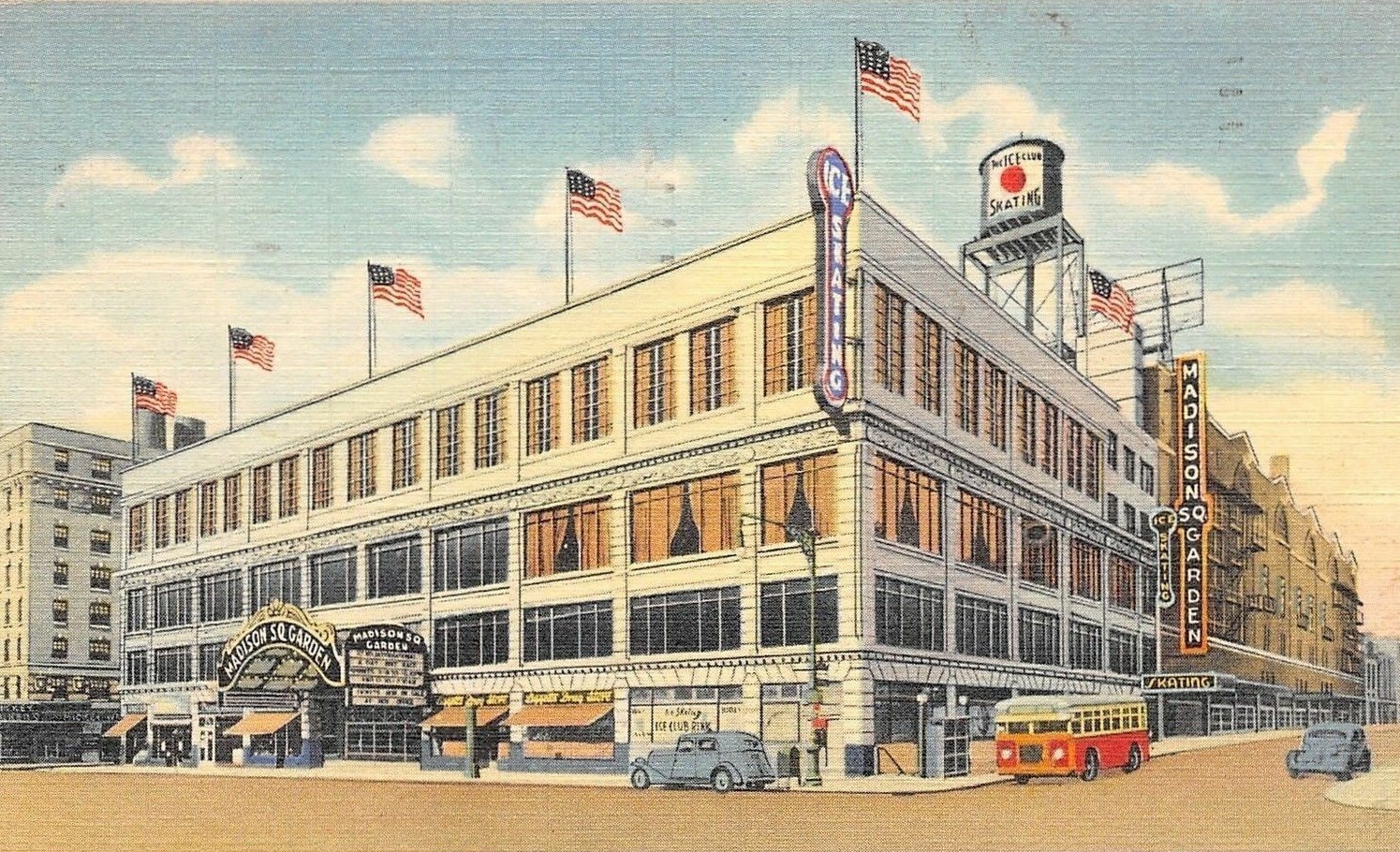
Groundbreaking on the third Madison Square Garden took place on January 9, 1925. Designed by the theater architect Thomas W. Lamb, it was built at the cost of $4.75 million in 349 days by boxing promoter Tex Rickard, who assembled backers he called his "600 millionaires" to fund the project. The new arena was dubbed "The House That Tex Built." In contrast to the ornate towers of Stanford White's second Garden, the exterior of MSG III was a simple box. Its most distinctive feature was the ornate marquee above the main entrance, with seemingly endless abbreviations (Tomw., V/S, Rgrs, Tonite, Thru, etc.) Even the name of the arena was abbreviated, to "Madison Sq. Garden".
The arena, which opened on December 15, 1925, was 200 feet (61 m) by 375 feet (114 m), with seating on three levels, and a maximum capacity of 18,496 spectators for boxing. It had poor sight lines, especially for hockey, and fans sitting virtually anywhere behind the first row of the side balcony could count on having some portion of the ice obstructed. The poor ventilation and allowed smoking often caused haze in the upper portions of the Garden.
Madison Square Garden III was managed by Rickard, John S. Hammond, William F. Carey, General John Reed Kilpatrick, Ned Irish and Irving Mitchell Felt. It was eventually replaced by the fourth Madison Square Garden.
Boxing was Madison Square Garden III's principal claim to fame. The first bout took place on December 11, 1925, a week before its official opening, as world light heavyweight champion Paul Berlenbach defended his title against challenger Jack Delaney before more than 22,000 fans.
On January 17, 1941, 23,190 people witnessed Fritzie Zivic's successful welterweight title defense against Henry Armstrong, still the largest crowd at any of the Gardens.
The New York Rangers, owned by the Garden's owner Tex Rickard, got their name from a play on words involving his name: Tex's Rangers. However, the Rangers were not the first NHL team to play at the Garden; the New York Americans had begun play in 1925 – and officially opened the Garden in front of 17,000 by losing to the Montreal Canadiens, 3-1 – Shorty Green of the Americans was the first player to score a goal in the arena. The Americans were so tremendously successful that Rickard wanted his own team. The Rangers were founded in 1926 and played their first game in the Garden on November 16, 1926. Both teams played at the Garden until the Americans suspended operations in 1942 due to World War II. In the meantime, the Rangers had usurped the Americans with their own success, winning three Stanley Cups between 1928 and 1940. The refusal of the Garden's management to allow the postwar resurrection of the Americans team was one popular theory underlying the Curse of 1940, which supposedly prevented the Rangers from winning another Stanley Cup until 1994. Another alleged cause of "The Curse" stemmed from manager Kilpatrick burning the Garden's mortgage papers in the bowl of the Stanley Cup, made possible by receipts from the 1940 Cup run. Hockey purists believed that the trophy had been "defiled", leading to the Rangers' woes.
The New York Rovers, a farm team of the Rangers, played in the Garden on Sunday afternoons, while the Rangers played on Wednesday and Sunday nights. Tommy Lockhart managed the Rovers games and introduced on-ice promotions such as racing model aircraft and bicycles around the arena, figure skating acts Shipstads & Johnson Ice Follies and Sonja Henie, and a skating grizzly bear. The fourth floor of the Garden had a second sheet of ice, used for public skating, recreational hockey, and as the Rangers' practice facility.
Hub AI
Madison Square Garden (1925) AI simulator
(@Madison Square Garden (1925)_simulator)
Madison Square Garden (1925)
Madison Square Garden (MSG III) was an indoor arena in New York City, the third bearing that name. Built in 1925 and closed in 1968, it was located on the west side of Eighth Avenue between 49th and 50th streets in Manhattan, on the site of the city's trolley-car barns. It was the first Garden that was not located near Madison Square. MSG III was the home of the New York Rangers of the National Hockey League and the New York Knicks of the National Basketball Association, and also hosted numerous boxing matches, the Millrose Games, the National Invitation Tournament, Ringling Bros. and Barnum & Bailey, concerts, and other events. In 1968 it was demolished and its role and name passed to the fourth Madison Square Garden, which stands at the site of the original Penn Station. One Worldwide Plaza was built on the arena's former 50th Street location.
Groundbreaking on the third Madison Square Garden took place on January 9, 1925. Designed by the theater architect Thomas W. Lamb, it was built at the cost of $4.75 million in 349 days by boxing promoter Tex Rickard, who assembled backers he called his "600 millionaires" to fund the project. The new arena was dubbed "The House That Tex Built." In contrast to the ornate towers of Stanford White's second Garden, the exterior of MSG III was a simple box. Its most distinctive feature was the ornate marquee above the main entrance, with seemingly endless abbreviations (Tomw., V/S, Rgrs, Tonite, Thru, etc.) Even the name of the arena was abbreviated, to "Madison Sq. Garden".
The arena, which opened on December 15, 1925, was 200 feet (61 m) by 375 feet (114 m), with seating on three levels, and a maximum capacity of 18,496 spectators for boxing. It had poor sight lines, especially for hockey, and fans sitting virtually anywhere behind the first row of the side balcony could count on having some portion of the ice obstructed. The poor ventilation and allowed smoking often caused haze in the upper portions of the Garden.
Madison Square Garden III was managed by Rickard, John S. Hammond, William F. Carey, General John Reed Kilpatrick, Ned Irish and Irving Mitchell Felt. It was eventually replaced by the fourth Madison Square Garden.
Boxing was Madison Square Garden III's principal claim to fame. The first bout took place on December 11, 1925, a week before its official opening, as world light heavyweight champion Paul Berlenbach defended his title against challenger Jack Delaney before more than 22,000 fans.
On January 17, 1941, 23,190 people witnessed Fritzie Zivic's successful welterweight title defense against Henry Armstrong, still the largest crowd at any of the Gardens.
The New York Rangers, owned by the Garden's owner Tex Rickard, got their name from a play on words involving his name: Tex's Rangers. However, the Rangers were not the first NHL team to play at the Garden; the New York Americans had begun play in 1925 – and officially opened the Garden in front of 17,000 by losing to the Montreal Canadiens, 3-1 – Shorty Green of the Americans was the first player to score a goal in the arena. The Americans were so tremendously successful that Rickard wanted his own team. The Rangers were founded in 1926 and played their first game in the Garden on November 16, 1926. Both teams played at the Garden until the Americans suspended operations in 1942 due to World War II. In the meantime, the Rangers had usurped the Americans with their own success, winning three Stanley Cups between 1928 and 1940. The refusal of the Garden's management to allow the postwar resurrection of the Americans team was one popular theory underlying the Curse of 1940, which supposedly prevented the Rangers from winning another Stanley Cup until 1994. Another alleged cause of "The Curse" stemmed from manager Kilpatrick burning the Garden's mortgage papers in the bowl of the Stanley Cup, made possible by receipts from the 1940 Cup run. Hockey purists believed that the trophy had been "defiled", leading to the Rangers' woes.
The New York Rovers, a farm team of the Rangers, played in the Garden on Sunday afternoons, while the Rangers played on Wednesday and Sunday nights. Tommy Lockhart managed the Rovers games and introduced on-ice promotions such as racing model aircraft and bicycles around the arena, figure skating acts Shipstads & Johnson Ice Follies and Sonja Henie, and a skating grizzly bear. The fourth floor of the Garden had a second sheet of ice, used for public skating, recreational hockey, and as the Rangers' practice facility.
Recent media