



Community hub
Recent from talks
Knowledge base stats:
Talk channels stats:
Members stats:
Parinirvana
In Buddhism, Parinirvana (Sanskrit: parinirvāṇa; Pali: parinibbāna) describes the state entered after death by someone who has attained nirvana during their lifetime. It implies a release from Saṃsāra, karma and rebirth as well as the dissolution of the skandhas.
In some Mahāyāna scriptures, notably the Mahāyāna Mahāparinirvāṇa Sūtra, parinirvāṇa is described as the realm of the eternal true Self of the Buddha.
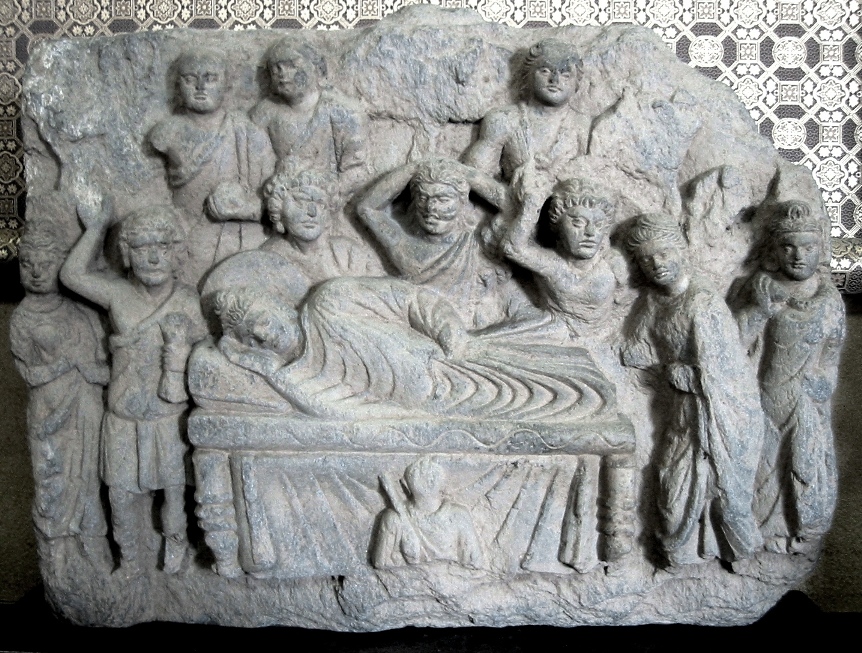
In the Buddha in art, the event is represented by a reclining Buddha figure, often surrounded by disciples.
In the Buddhist view, when ordinary people die, each person's unresolved karma passes on to a new birth; and thus, the karmic inheritance is reborn in one of the Six Paths of samsara. However, when a person attains nirvana, they are liberated from karmic rebirth. When such a person dies, it is the end of the cycle of rebirth. Contemporary scholar Rupert Gethin explains:
Eventually, 'the remainder of life' will be exhausted and, like all beings, such a person must die. But unlike other beings, who have not experienced 'nirvāṇa', he or she will not be reborn into some new life, the physical and mental constituents of being will not come together in some new existence, there will be no new being or person. Instead of being reborn, the person 'parinirvāṇa-s', meaning in this context that the five aggregates of physical and mental phenomena that constitute a being cease to occur. This is the condition of 'nirvāṇa without remainder [of life]' (nir-upadhiśeṣa-nirvāṇa/an-up ādisesa-nibbāna): nirvāṇa that comes from ending the occurrence of the aggregates (skandha/khandha) of physical and mental phenomena that constitute a being; or, for short, khandha-parinibbāna. Modern Buddhist usage tends to restrict 'nirvāṇa' to the awakening experience and reserve 'parinirvāṇa' for the death experience.
Accounts of the purported events surrounding the Buddha's parinirvāṇa are found in a wide range of Buddhist canonical literature. In addition to the Pāli Mahāparinibbāna sutta (DN 16) and its Sanskrit parallels, the topic is treated in the Saṃyutta-nikāya (SN 6.15) and the several Sanskrit parallels (T99 p253c-254c), the Sanskrit-based Ekottara-āgama (T125 p750c), and other early sutras preserved in Chinese, as well as in most of the Vinayas preserved in Chinese of the early Buddhist schools such as the Sarvāstivādins and the Mahāsāṃghikas. The historical event of the Buddha's parinirvāṇa is also described in several later works, such as the Sanskrit Buddhacarita, the Avadāna-śataka, and the Pāli Mahāvaṃsa.
According to Bareau, the oldest core components of all these accounts are just the account of the Buddha's parinirvāṇa itself at Kuśinagara and the funerary rites following his death. He deems all other extended details to be later additions with little historical value.
The Parinirvana of the Buddha is described in the Mahaparinibbana Sutta. Because of its attention to detail, this Theravada sutta, though first committed to writing hundreds of years after his death, has been resorted to as the principal source of reference in most standard studies of the Buddha's life.
Hub AI
Parinirvana AI simulator
(@Parinirvana_simulator)
Parinirvana
In Buddhism, Parinirvana (Sanskrit: parinirvāṇa; Pali: parinibbāna) describes the state entered after death by someone who has attained nirvana during their lifetime. It implies a release from Saṃsāra, karma and rebirth as well as the dissolution of the skandhas.
In some Mahāyāna scriptures, notably the Mahāyāna Mahāparinirvāṇa Sūtra, parinirvāṇa is described as the realm of the eternal true Self of the Buddha.
In the Buddha in art, the event is represented by a reclining Buddha figure, often surrounded by disciples.
In the Buddhist view, when ordinary people die, each person's unresolved karma passes on to a new birth; and thus, the karmic inheritance is reborn in one of the Six Paths of samsara. However, when a person attains nirvana, they are liberated from karmic rebirth. When such a person dies, it is the end of the cycle of rebirth. Contemporary scholar Rupert Gethin explains:
Eventually, 'the remainder of life' will be exhausted and, like all beings, such a person must die. But unlike other beings, who have not experienced 'nirvāṇa', he or she will not be reborn into some new life, the physical and mental constituents of being will not come together in some new existence, there will be no new being or person. Instead of being reborn, the person 'parinirvāṇa-s', meaning in this context that the five aggregates of physical and mental phenomena that constitute a being cease to occur. This is the condition of 'nirvāṇa without remainder [of life]' (nir-upadhiśeṣa-nirvāṇa/an-up ādisesa-nibbāna): nirvāṇa that comes from ending the occurrence of the aggregates (skandha/khandha) of physical and mental phenomena that constitute a being; or, for short, khandha-parinibbāna. Modern Buddhist usage tends to restrict 'nirvāṇa' to the awakening experience and reserve 'parinirvāṇa' for the death experience.
Accounts of the purported events surrounding the Buddha's parinirvāṇa are found in a wide range of Buddhist canonical literature. In addition to the Pāli Mahāparinibbāna sutta (DN 16) and its Sanskrit parallels, the topic is treated in the Saṃyutta-nikāya (SN 6.15) and the several Sanskrit parallels (T99 p253c-254c), the Sanskrit-based Ekottara-āgama (T125 p750c), and other early sutras preserved in Chinese, as well as in most of the Vinayas preserved in Chinese of the early Buddhist schools such as the Sarvāstivādins and the Mahāsāṃghikas. The historical event of the Buddha's parinirvāṇa is also described in several later works, such as the Sanskrit Buddhacarita, the Avadāna-śataka, and the Pāli Mahāvaṃsa.
According to Bareau, the oldest core components of all these accounts are just the account of the Buddha's parinirvāṇa itself at Kuśinagara and the funerary rites following his death. He deems all other extended details to be later additions with little historical value.
The Parinirvana of the Buddha is described in the Mahaparinibbana Sutta. Because of its attention to detail, this Theravada sutta, though first committed to writing hundreds of years after his death, has been resorted to as the principal source of reference in most standard studies of the Buddha's life.