Hubbry Logo
ParinirvanaParinirvanaMain
Open search
Parinirvana
Community hub
Parinirvana
logo
8 pages, 0 posts
0 subscribers
Be the first to start a discussion here.
Parinirvana
Parinirvana
from Wikipedia

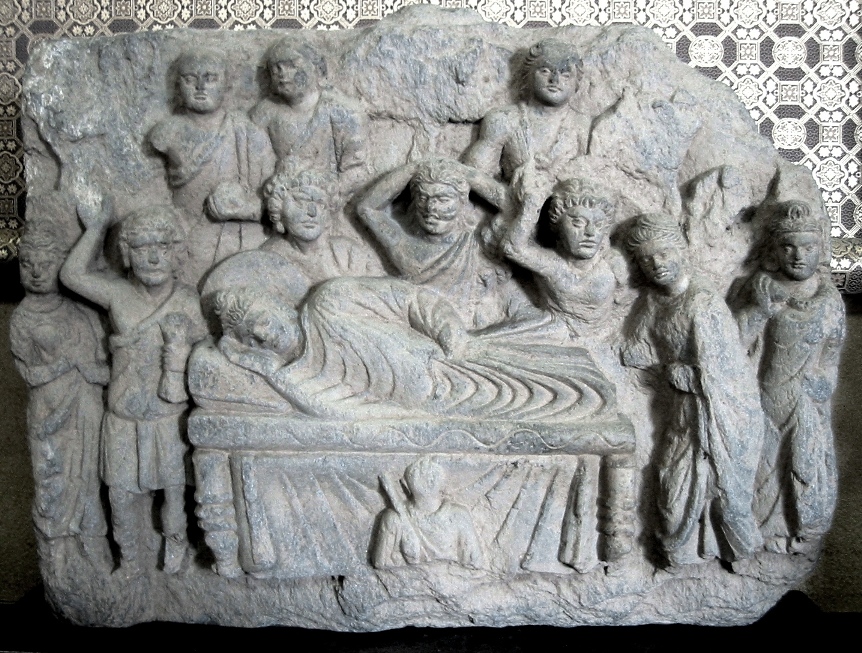
The death of the Buddha, or Mahaparinirvana, Gandhara 2–3rd century
Translations of
Parinirvana
EnglishNirvana after death,
Nirvana without remainder,
Nirvana without residue
Sanskritपरिनिर्वाण
(IAST: parinirvāṇa)
Paliparinibbāna
Burmeseပရိနိဗ္ဗာန်
(MLCTS: pa.ri.nibban)
Chinese般涅槃
(Pinyin: bōnièpán)
Indonesianparinirwana
Japanese般涅槃
(Rōmaji: hatsunehan)
Khmerបរិនិព្វាន
(UNGEGN: bârĭnĭpvéan)
Korean반열반
(RR: banyeolban)
Laoປະລິນິພພານ
(palinipphan)
Sinhalaපරිනිර්වාණය
(parinirvāṇaya)
Tibetanམྱང་འདས།
(myang 'das)
Tagalogpawinilbana
Thaiปรินิพพาน
(RTGS: parinipphan)
Glossary of Buddhism

In Buddhism, Parinirvana (Sanskrit: parinirvāṇa; Pali: parinibbāna) describes the state entered after death by someone who has attained nirvana during their lifetime. It implies a release from Saṃsāra, karma and rebirth as well as the dissolution of the skandhas.

In some Mahāyāna scriptures, notably the Mahāyāna Mahāparinirvāṇa Sūtra, parinirvāṇa is described as the realm of the eternal true Self of the Buddha.

In the Buddha in art, the event is represented by a reclining Buddha figure, often surrounded by disciples.

Final nirvana at death

[edit]

In the Buddhist view, when ordinary people die, each person's unresolved karma passes on to a new birth; and thus, the karmic inheritance is reborn in one of the Six Paths of samsara. However, when a person attains nirvana, they are liberated from karmic rebirth. When such a person dies, it is the end of the cycle of rebirth.[1] Contemporary scholar Rupert Gethin explains:[1]

Eventually, 'the remainder of life' will be exhausted and, like all beings, such a person must die. But unlike other beings, who have not experienced 'nirvāṇa', he or she will not be reborn into some new life, the physical and mental constituents of being will not come together in some new existence, there will be no new being or person. Instead of being reborn, the person 'parinirvāṇa-s', meaning in this context that the five aggregates of physical and mental phenomena that constitute a being cease to occur. This is the condition of 'nirvāṇa without remainder [of life]' (nir-upadhiśeṣa-nirvāṇa/an-up ādisesa-nibbāna): nirvāṇa that comes from ending the occurrence of the aggregates (skandha/khandha) of physical and mental phenomena that constitute a being; or, for short, khandha-parinibbāna. Modern Buddhist usage tends to restrict 'nirvāṇa' to the awakening experience and reserve 'parinirvāṇa' for the death experience.

Parinirvana of Buddha Shakyamuni

[edit]
Buddha attaining Parinirvana – Depicted in cave 26 of Ajanta Caves – India

Accounts of the purported events surrounding the Buddha's parinirvāṇa are found in a wide range of Buddhist canonical literature. In addition to the Pāli Mahāparinibbāna sutta (DN 16) and its Sanskrit parallels, the topic is treated in the Saṃyutta-nikāya (SN 6.15) and the several Sanskrit parallels (T99 p253c-254c), the Sanskrit-based Ekottara-āgama (T125 p750c), and other early sutras preserved in Chinese, as well as in most of the Vinayas preserved in Chinese of the early Buddhist schools such as the Sarvāstivādins and the Mahāsāṃghikas. The historical event of the Buddha's parinirvāṇa is also described in several later works, such as the Sanskrit Buddhacarita, the Avadāna-śataka, and the Pāli Mahāvaṃsa.

According to Bareau, the oldest core components of all these accounts are just the account of the Buddha's parinirvāṇa itself at Kuśinagara and the funerary rites following his death.[2] He deems all other extended details to be later additions with little historical value.

Within the Mahaparinibbana Sutta (Pali)

[edit]

The Parinirvana of the Buddha is described in the Mahaparinibbana Sutta. Because of its attention to detail, this Theravada sutta, though first committed to writing hundreds of years after his death, has been resorted to as the principal source of reference in most standard studies of the Buddha's life.[3]

Within the Mahāyāna Mahāparinirvāṇa sūtra

[edit]
Attendants to the Parinirvana, Gandhara, Victoria and Albert museum

In contrast to these works which deal with the Buddha's parinirvāṇa as a biographical event, the Mahāyāna Mahāparinirvāṇa sūtra was written hundreds of years later.[4] The Nirvana Sutra does not give details of the historical event of the day of the parinirvāṇa itself, except the Buddha's illness and Cunda's meal-offering, nor any of the other preceding or subsequent incidents, instead using the event as merely a convenient springboard for the expression of standard Mahayana ideals such as the Tathagata-Garbha/Buddha-Dhatu doctrine, the eternality of the Buddha, and the soteriological fate of the Icchantikas and so forth.[5]

Location of Gautama Buddha's death and parinirvana

[edit]

It has been suggested by Waddell that the site of the death and parinirvana of Gautama Buddha was in the region of Rampurva: "I believe that Kusīnagara, where the Buddha died may be ultimately found to the North of Bettiah, and in the line of the Aśōka pillars which lead hither from Patna (Pāțaliputra)"[6] in Bihar. It still awaits proper archaeological excavation.

In Mahayana literature

[edit]
Buddha's Parinirvana (Death of Sakyamuni), Kamakura period, 13th century, wood - Tokyo National Museum
Parinirvana Shrine, Miyajima, Japan

According to the Mahāyāna Mahāparinirvāṇa Sūtra (also called the Nirvana Sutra), the Buddha taught that parinirvāṇa is the realm of the Eternal, Bliss, the Self, and the Pure. Dr. Paul Williams states that it depicts the Buddha using the term "Self" to win over non-Buddhist ascetics.[7] However, the Mahaparinirvana Sutra is a long and highly composite Mahayana scripture,[8] and the part of the sutra upon which Williams is basing his statement is a portion of the Nirvana Sutra of secondary Central Asian provenance - other parts of the sutra were written in India.[9]

Guang Xing speaks of how the Mahayanists of the Nirvana Sutra understand the mahaparinirvana to be the liberated Self of the eternal Buddha:[10]

One of the main themes of the MMPS [Mahayana Mahaparinirvana Sutra] is that the Buddha is eternal ... The Mahayanists assert the eternity of the Buddha in two ways in the MMPS. They state that the Buddha is the dharmakaya, and hence eternal. Next, they reinterpret the liberation of the Buddha as mahaparinirvana possessing four attributes: eternity, happiness, self and purity.

Only in Mahaparinirvana is this True Self held to be fully discernible and accessible.[11]

Kosho Yamamoto cites a passage in which the Buddha admonishes his monks not to dwell inordinately on the idea of the non-self but to meditate on the Self. Yamamoto writes:[12]

Having dwelt upon the nature of nirvana, the Buddha now explains its positive aspect and says that nirvana has the four attributes of the Eternal, Bliss, the Self, and the Pure ... the Buddha says: "O you bhiksus [monks]! Do not abide in the thought of the non-eternal, sorrowful, non-Self, and the not-pure and have things as in the case of those people who take the stones, wooden pieces, and gravel for the true gem [of the true Dharma] ... In every situation, constantly meditate upon the idea of the Self, the idea of the Eternal, Bliss, and the Pure ... Those who, desirous of attaining Reality meditatively cultivate these ideas, namely, the ideas of the Self [atman], the Eternal, Bliss, and the Pure, will skilfully bring forth the jewel, just like the wise person."

Michael Zimmermann, in his study of the Tathagatagarbha Sutra, reveals that not only the Mahaparinirvana Sutra but also the Tathagatagarbha Sutra and the Lankavatara Sutra speak affirmatively of the Self. Zimmermann observes:[13]

The existence of an eternal, imperishable self, that is, Buddhahood, is the basic point of the TGS [Tathagatagarbha Sutra] ... the Mahaparinirvanasutra and the Lankavatarasutra characterize the tathagatagarbha explicitly as atman [Self].

See also

[edit]

Notes

[edit]

Sources

[edit]
  • Gethin, Rupert (1998), Foundations of Buddhism, Oxford University Press
  • Goldstein, Joseph (2011), One Dharma: The Emerging Western Buddhism, HarperCollins, Kindle Edition
  • Goleman, Daniel (2008), Destructive Emotions: A Scientific Dialogue with the Dalai Lama, Bantam, Kindle Edition
  • Harvey, Peter (1990), Introduction to Buddhism, Cambridge University Press
  • Harvey, Peter (1995), The Selfless Mind: Personality, Consciousness and Nirvāṇa in Early Buddhism, Routledge, ISBN 0-7007-0338-1
  • Keown, Damien (2000), Buddhism: A Very Short Introduction, Oxford University Press, Kindle Edition
  • Lama Surya Das (1997), Awakening the Buddha Within, Broadway Books, Kindle Edition
  • Lopez, Donald S. (2001), The Story of Buddhism, HarperCollins
  • Traleg Kyabgon (2001), The Essence of Buddhism, Shambhala
  • Williams, Paul (2002), Buddhist Thought, Taylor & Francis, Kindle Edition
  • Walpola Rahula (2007), What the Buddha Taught, Grove Press, Kindle Edition
[edit]
Revisions and contributorsEdit on WikipediaRead on Wikipedia
from Grokipedia
Parinirvana (: parinirvāṇa; Pāli: parinibbāna), meaning "complete" or "final nirvana," refers to the ultimate state of liberation attained by an enlightened being upon their physical death, signifying the total cessation of the cycle of birth, death, and rebirth known as samsara. In , it specifically denotes the death of the historical Buddha, Siddhartha Gautama (also known as Shakyamuni), who entered parinirvana at the age of 80 in (modern-day Kasia, , ), around the 5th century BCE, after having achieved initial enlightenment at age 35. This event, detailed in canonical texts such as the of the Pāli Canon, marks the Buddha's complete release from all karmic influences and suffering, leaving no remainder of conditioned existence. Doctrinally, parinirvana differs from nirvana (nibbāna in Pāli), which an enlightened individual—such as an arahant in Theravada Buddhism—can attain during life, extinguishing the "three poisons" of greed, hatred, and delusion while still bound by residual karma and the physical body. Parinirvana represents "nirvana without remainder," occurring at death when all aggregates (skandhas) dissolve, ensuring no further rebirth and embodying the ultimate goal of the Buddhist path: the end of dukkha (suffering) through insight into the Four Noble Truths and the Eightfold Path. In Mahayana traditions, this state is similarly viewed as the final passing of a Buddha or bodhisattva, though some bodhisattvas delay it to aid sentient beings. The Buddha's parinirvana underscores his role as both a spiritual teacher and a cakravartin (universal monarch), justifying the veneration of his relics to perpetuate the dharma (teachings). The event of the Buddha's parinirvana profoundly influenced , ritual, and , particularly in early representations from the Gandharan region during the Kushan period (1st–3rd centuries CE). Narrative reliefs, often carved in , depict the Buddha reclining on his right side between two sal trees, surrounded by grieving disciples and deities, as described in texts like the Buddhacarita and Mahāparinirvāṇa Sūtra. These scenes, part of a seven-episode cycle including the , relic division into eight portions, and their enshrinement in stupas, blend Buddhist with Hellenistic and local Gandharan styles, reflecting cultural exchanges along ancient trade routes. Following the Buddha's , his relics () were distributed to promote merit-making and darśan (auspicious viewing), a practice amplified by Emperor in the 3rd century BCE through the construction of numerous stupas. Today, parinirvana is commemorated annually as (or Nirvana Day) in many Buddhist traditions, typically on the full moon of the second month (around February or March), serving as a time for reflection on impermanence and enlightenment.

Definition and Terminology

Etymology and Core Meaning

The term parinirvāṇa derives from , combining the prefix pari- (meaning "complete," "full," or "around") with nirvāṇa (from niḥ "out" + the verbal root √vā "to blow," denoting "" or "blowing out," as of a fire). This yields a of "complete " or "nirvana without remainder," emphasizing finality. In , the canonical language of , the equivalent is parinibbāna, sharing the same etymological roots and structure. At its core, parinirvāṇa refers to the state attained upon the physical death of an enlightened being—such as an or —who has already realized nirvāṇa during life, marking the irreversible cessation of saṃsāra (cyclic ), karma, and all conditioned phenomena. This complete blowing out of the "fires" of , hatred, and ends any possibility of rebirth, achieving unconditioned beyond all aggregates of . Unlike nirvāṇa experienced in life, which coexists with a physical body, parinirvāṇa signifies the ultimate dissolution without remainder. The term first appears in early Buddhist suttas, such as the , with scholarly estimates placing its composition between the 4th and 3rd centuries BCE, reflecting oral traditions shortly after the Buddha's time. Linguistically, its roots are in verbal elements predating , but the term nirvāṇa as a soteriological concept of extinction was developed in early Buddhist thought, redefining ideas of liberation as a non-theistic cessation emphasizing impermanence and no-self (), without reliance on an eternal soul.

Relation to Nirvana

In early Buddhist doctrine, nirvana, also termed "nirvana with remainder" (Pāli: sa-upādisesa-nibbāna; Sanskrit: sopadhiśeṣa-nirvāṇa), refers to the liberation from craving, , and the cycle of rebirth achieved during life by an or , where mental defilements cease but the physical body and the five aggregates (skandhas)—form, sensation, perception, mental formations, and consciousness—persist as a residual substrate of past karma. This state marks the initial realization of the unconditioned, yet the practitioner continues to exist in the conditioned world until . Parinirvana, or "nirvana without remainder" (anupādisesa-nibbāna; nirupadhiśeṣa-nirvāṇa), occurs at the moment of for such an enlightened being, when the aggregates fully dissolve, eliminating any possibility of further rebirth or conditioned existence. Philosophically, both nirvana and parinirvana are described as unconditioned (asaṅkhata) dharmas, beyond arising, ceasing, or conceptual description, characterized as "unborn, unoriginated, unmade, unformed." While nirvana extinguishes the "fires" of , , and —analogous to a flame going out, leaving no fuel for further burning—parinirvana completes this process by removing even the residual "embers" of the physical form, ensuring absolute freedom from karmic continuity. This distinction underscores parinirvana as the ultimate realization of nirvana, where no trace of the conditioned realm remains, as formulated in early suttas that extend nirvana's attributes to its final, post-mortem fulfillment.

Accounts in Early Buddhist Texts

Depiction in the Mahāparinibbāna Sutta

The (DN 16) constitutes the longest discourse in the , the first collection of the within the Pāli Canon, spanning six chapters and detailing the Buddha's final journey, teachings, and entry into parinirvāṇa at the age of eighty. This narrative recounts events from Rājagaha to Kuśinārā over his last year, emphasizing his physical decline and deliberate decision to relinquish his remaining lifespan after a meal offered by the smith Cunda, which precipitates a severe illness. The sutta's compilation reflects early oral traditions, with its kernel likely originating within decades of the Buddha's death around 480 BCE and a final circa the 3rd century BCE, predating the Aśokan era. Key doctrinal elements woven into the narrative underscore impermanence (anicca) as a central theme, with the Buddha repeatedly instructing his followers on the transience of all conditioned phenomena, culminating in his final exhortation: "All compounded things are subject to vanish—strive on untiringly." He establishes four sites of pilgrimage—Lumbinī (birthplace), Bodh Gayā (enlightenment), Sarnath (first sermon), and Kuśinārā (parinirvāṇa)—to inspire future devotees with a sense of urgency (saṃvega) toward liberation. Provisions for the Saṅgha's future include reliance on the Dhamma-Vinaya as the enduring teacher, permission to abrogate minor disciplinary rules if consensus arises, and the four great references for verifying doctrinal authenticity; relics from his cremation are to be distributed equally among eight claimants, including kings and Brahmins, to foster communal veneration. The parinirvāṇa itself is portrayed as a conscious meditative attainment between twin sāla trees in Kuśinārā's Mallas' grove, where , having announced his intent, progressively enters the nine successive abodes—from the first absorption through the immaterial spheres to cessation—before extinguishing his vital forces from the fourth absorption. Supernatural signs accompany the event, including six earth tremors, the sāla trees blooming out of season, and the Buddha's body emitting sixfold rays of light that illuminate the , symbolizing his transcendence. These elements highlight parinirvāṇa not as mere but as the ultimate cessation of rebirth for an enlightened being. Scholarly analysis attributes the sutta to layered composition from early oral recitations, with André Bareau identifying a core narrative of the Buddha's last hours, final instructions, and parinirvāṇa as the oldest stratum, dating to around the 5th century BCE, while later interpolations—such as the four pilgrimage sites, relic distribution protocols, and debates on minor rules—emerged between the 2nd and 1st centuries BCE to address evolving monastic concerns like community and . This stratification reflects the text's to institutional needs while preserving foundational accounts of impermanence and liberation.

Key Events of the Buddha's Final Days

The Buddha's final journey began in Rājagaha, where he set out with a large company of monks toward Vesālī, stopping at several locations including Ambalaṭṭhikā, Nālandā, Pāṭaligama, Koṭigama, and Nādikā along the way. During this period, he delivered teachings to monks and lay followers, emphasizing impermanence and the value of the Dhamma. Upon arriving in Vesālī, he resided in the Great Forest and addressed a severe illness with and exertion, subduing it to continue his instructions. As the Buddha departed Vesālī, he and his followers crossed the by psychic power, vanishing on the near shore and reappearing on the far shore, demonstrating his spiritual attainments. Continuing westward, he reached , where the blacksmith Cunda offered him his final meal of sukara-maddava, a dish variously interpreted as , truffles, or . Shortly after, the Buddha was stricken with severe and pain, though the texts debate whether this resulted from food poisoning, intentional tainting, or natural causes related to his advanced age. He instructed Cunda to bury the remaining food under strict conditions and later consoled him, stating that the meal had created great merit. Pressing on despite his weakened state, the Buddha arrived in Kusinārā (modern Kushinagar) and rested between two sāla trees in the Upavattana Shrine of the Mallas, near the Hiraṇṇavatī River. There, he engaged in final dialogues, refusing Ananda's plea to extend his life for the benefit of the world, citing his prior opportunities to do so and emphasizing the impermanence of all conditioned things. He predicted schisms in the Saṅgha within a century, advising adherence to the Dhamma and Vinaya as the true guides after his passing, and famously urged his followers: "Therefore, Ānanda, be islands unto yourselves, refuges unto yourselves, seeking no external refuge; with the Dhamma as your island, the Dhamma as your refuge, seeking no other refuge." In a key instructional moment, he rejected any notion of divine kingship or prolonged earthly rule, reinforcing self-reliance and the sufficiency of his teachings. On the full moon night of Vesākha, at the age of eighty, the Buddha entered progressive meditative absorptions and attained parinirvana between the twin sāla trees, with his body in a lion's posture facing north. Following his passing, the Mallas of Kusinārā prepared his body with royal honors, cremating it after seven days amid extraordinary signs like a great earthquake. The relics, consisting of bones and ashes, were divided equally among eight clans—the Mallas of Kusinārā, the Mallas of Pāvā, the Sakyas, the Licchavis, the Bulis of Allakappa, the Kolis of Rāmagrāma, the brahmin of Veṭṭhapura, and Ajātasattu of Magadha—under the mediation of the brahmin Doṇa to prevent conflict. Each recipient constructed a stupa to enshrine their share, establishing sites of veneration, while Doṇa received the urn for an additional stupa.

Theravada Interpretations

Philosophical Understanding

In Theravada doctrine, parinirvana represents the ultimate cessation of through the complete eradication of (avijjā) and the mental defilements (kilesas), such as , , and , ensuring no further arising of consciousness or rebirth. This state is attained upon the of an enlightened being, marking the final extinguishing of the aggregates (khandhas) without residue, distinct from the provisional nirvana realized during life. It is not viewed as annihilation (ucchedavāda), which the Buddha explicitly rejected as a wrong view implying the destruction of an eternal self, but rather as a transcendence beyond the dualities of existence and non-existence. For practitioners, parinirvana is attainable by arhats, who have fully uprooted the defilements through insight into the —impermanence, suffering, and non-self ()—thus ending the cycle of dependent origination at their demise. Following parinirvana, the Buddha's personal agency ceases entirely, yet his influence endures through the Dhamma (teachings) and (discipline), which serve as the guiding refuge for future generations, as emphasized in the Buddha's final instructions. Commentaries like the describe parinirvana as "unthinkable" (acintiya) and beyond sensory analogies or conceptual grasp, attainable only through direct realization rather than intellectual speculation. Theravada philosophy rejects both eternalism (sassatavāda), which posits a permanent surviving death, and (natthikavāda), which denies any continuity or ethical efficacy, positioning parinirvana instead as the "unborn, unbecome, unmade, unconditioned" realm that allows escape from the conditioned world. This aligns with the doctrine of , where the of (suññatā) reveals no inherent entity to be annihilated or preserved, but rather the dissolution of clinging and the arising of unshakeable peace.

Site of the Buddha's Parinirvana

The traditional site of the Buddha's parinirvana is identified as in modern , , corresponding to the ancient city of Kusinara in the Malla republic. According to and pilgrim accounts, passed away between two sala trees in a grove near the Hiranyavati River, with his head oriented northward. The primary monuments marking this location are the Parinirvana Temple, housing a colossal statue symbolizing his final moments, and the adjacent , believed to cover the spot of his death; approximately 1.5 kilometers east lies the Ramabhar Stupa, the site of his cremation. Archaeological excavations conducted by the (ASI) since the late 19th century have substantiated Kushinagar's antiquity as a Buddhist center dating to the 5th century BCE. Initial explorations in 1861 by A.A. Cunningham identified the site using Chinese pilgrim records, followed by major digs in 1876 by A.C.L. Carlleyle, who unearthed the brick and the 6-meter-long statue from the 5th century CE, along with surrounding monastic ruins and terracotta plaques depicting the parinirvana scene. Further ASI work between 1904 and 1912 by J.P. Vogel and others revealed (NBPW) pottery shards from the 5th–4th centuries BCE, terracotta figurines, and structural remains of viharas (monasteries) and chaityas (prayer halls), indicating continuous occupation from the Mauryan period onward. Seals inscribed with "mahaparinirvana vihar arya bhikshu " and similar phrases found during these excavations confirm the site's association with the parinirvana event. Accounts from Chinese pilgrims provide early historical corroboration. (Faxien), visiting around 405 CE, described Kusinara as a sparsely populated area with existing s and monasteries at the parinirvana site, noting a tope marking the spot where lay between the sala trees, and emphasizing the relic division that followed. (Hsüan-tsang), traveling in 637 CE, reported the city in ruins with overgrown vegetation but identifiable monuments, including two proximate Ashokan pillars—one at the parinirvana grove and another at the relic distribution site—along with a vihara housing a image. Although an intact Ashokan pillar has not been located in modern excavations, fragments and inscriptions from the BCE align with these descriptions, supporting Emperor Ashoka's patronage of the site through construction and relic veneration. Alternative theories have occasionally challenged Kushinagar's identification. In 1893, L.A. Waddell proposed Rampurva in Bihar (near the Nepal border) as Kusinara based on its proximity to described geographical features in texts and the presence of Ashokan pillars with edicts, suggesting it better matched the relic division narrative; however, this hypothesis remains unexcavated for parinirvana-specific structures and is not widely accepted by scholars. In historical context, Kushinagar played a central role in the division of the Buddha's relics into eight portions among regional clans and kings, as recounted in texts like the Mahaparinibbana Sutta, with the Parinirvana Stupa erected over one share by the Mallas, forming part of the original eight major stupas commemorating his life events. Today, the site holds immense pilgrimage significance, attracting millions annually, and is included on UNESCO's Tentative List as part of the "Silk Road Sites in India" for its cultural and spiritual heritage spanning over 2,000 years. Recent ASI efforts, including conservation as of 2023, have enhanced accessibility for pilgrims.

Mahayana Developments

In the Mahāparinirvāṇa Sūtra

The Mahāparinirvāṇa Sūtra (also known as the Nirvāṇa Sūtra), a foundational Mahāyāna text, was likely composed in stages from the 1st century CE, with its core elements originating around 50 CE in southern India (Andhra region)—possibly linked to the reign of Gautamīputra Sātakarṇi—and undergoing expansion during transmission through Central Asia up to around 130 CE. Unlike the biographical focus of earlier accounts such as the Pāli Mahāparinibbāna Sutta, this sutra prioritizes extensive doctrinal discourses delivered by the Buddha during his final illness in Kuśinagarī, framing parinirvāṇa as a pivotal moment for revealing ultimate truths rather than a mere endpoint. Extant versions include two Tibetan translations (from the 8th–9th centuries CE) and multiple Chinese renditions, with the earliest being Faxian and Buddhabhadra's six-fascicle edition (Taishō 376, ca. 416–418 CE) and a more comprehensive one by Dharmakṣema (Taishō 374, ca. 421 CE). Sanskrit fragments discovered in Central Asian sites, such as Khādaliq near Khotan, attest to its dissemination along trade routes. Central to the sutra's narrative are dialogues between the ailing and figures like Kāśyapa and Mañjuśrī, which expand on parinirvāṇa by asserting the eternity (nitya and śāśvata) of the 's , or law-body, as an indestructible, supramundane reality beyond birth and . This portrayal reframes the 's physical demise as a voluntary, docetic manifestation—an intentional "show" to inspire practitioners—rather than a true annihilation, thereby refuting non-Buddhist eternalist views and certain early Buddhist emphases on impermanence. The text counters misconceptions by affirming the 's permanence, bliss, purity, and self-like quality, integrating these with teachings on the buddhadhātu (Buddha-element) inherent in all beings. Structured in 36 chapters across its southern Chinese edition (Taishō 375, 5th century CE), the systematically addresses (śīla), (samādhi), and (prajñā), weaving parinirvāṇa into eschatological prophecies and ethical exhortations for bodhisattvas. Scholars attribute the to the Tathāgatagarbha , viewing it as a key scriptural source for doctrines that invert classical Buddhist no-self (anātman) teachings while harmonizing with Mahāyāna ideals of universal enlightenment potential. Dharmakṣema's expansive 40-fascicle translation, which incorporated additional Central Asian and Kashmiri materials, profoundly influenced , serving as the basis for commentaries by figures like and shaping Chan and Pure Land schools; later editions, such as the 36-chapter version, refined this for southern Chinese audiences. These developments highlight the sutra's role in evolving Mahāyāna , emphasizing parinirvāṇa as an eternal, inclusive liberation accessible to all.

Eternal Aspects and Buddha-Nature

In Mahāyāna Buddhism, the doctrines of and Tathāgatagarbha reinterpret parinirvāṇa not as the annihilation or dissolution of the Buddha's form, but as the consummate manifestation of the eternal —the unchanging, blissful, and ultimate true nature of enlightenment. This , synonymous with the absolute (dharmadhātu), is described as immutable and penetrating all , transcending the cycles of birth and death while serving as the foundational essence of the Buddha's being. Influenced by 's emphasis on the purified mind as the basis for ultimate truth and Tathāgatagarbha's affirmation of inherent purity, parinirvāṇa thus reveals an abiding, non-contingent rather than an end to . In , the sūtra's teachings on the eternal and have been extensively commented upon, influencing doctrines across sects such as the school's emphasis on universal enlightenment potential. Central to this perspective is the concept of buddha-nature (tathāgatagarbha), which asserts that every sentient being harbors an eternal, pure essence capable of realization through parinirvāṇa. This buddha-nature is portrayed as inherently luminous and unobscured by adventitious defilements, akin to a treasure concealed within impurities, and it constitutes the potential for full Buddhahood in all beings without exception. In Tathāgatagarbha texts, it is endowed with qualities such as permanence (nitya), supreme joy (sukha), a non-substantial "self" (ātman, understood as the perfection of non-self or anātman-pāramitā), and intrinsic purity (amala), distinguishing it from samsaric conditioning. These eternal aspects carry profound soteriological implications, redirecting Buddhist practice from mere cessation of to the awakening of universal enlightenment potential, thereby countering perceived "nihilistic" tendencies in Theravāda views that prioritize impermanence (anicca) and no- (anattā) without affirming an underlying affirmative ground. By equating parinirvāṇa with the four perfections—, bliss, , and purity—the tradition underscores its positive, vibrant character, as exemplified in sūtra descriptions where nirvāṇa is "permanent, blissful, the and pure," and the is eternally abiding and unchanging. This framework fosters an optimistic cosmology, where parinirvāṇa embodies the joyful liberation inherent to all reality.

Iconography and Commemoration

Artistic Representations

Artistic representations of 's parinirvana typically feature the Buddha reclining on his right side with his head resting on his right hand, positioned between twin sala trees, and surrounded by grieving disciples, deities, and animals. This iconographic convention, symbolizing the final liberation, first appears in anthropomorphic form in n reliefs from the 2nd–3rd century CE, such as a gray panel depicting the event with mourners in Hellenistic-influenced attire. Earlier , prior to the CE, employed aniconic symbols like empty thrones or footprints to evoke the parinirvana, reflecting doctrinal emphasis on the Buddha's absence after death; the shift to anthropomorphic depictions in marked a profound evolution, blending Greco-Roman styles with Indian narratives to humanize the transcendent event. In Indian stupa carvings, parinirvana scenes appear in narrative reliefs at sites like Sanchi and from the 1st–3rd centuries CE, where the Buddha's form is integrated into panels showing processions and symbolic motifs amid , emphasizing communal mourning and relic veneration. Regional variations emerged as spread: in Chinese and Japanese traditions, 14th-century hanging scrolls, such as the Yale Parinirvana attributed to Myōson, portray the reclining Buddha on a jeweled with gold accents on silk, highlighting serene acceptance amid tearful figures like Maya descending from heaven and calm devotees like , underscoring emotional contrast and spiritual poise. Tibetan thangkas extend this with cosmic elements, incorporating mandalas, elemental symbols (e.g., lotuses for purity, mountains for stability), and surrounding deities to frame the parinirvana within a universal order of enlightenment. The reclining posture and right-hand mudra under the head signify restful liberation, evoking the Buddha's peaceful transition from samsara's cycle to nirvana's eternal state, as seen in Gandharan prototypes that influenced global veneration icons. These depictions, inspired by the Mahāparinibbāna Sutta's account of , use entourages to contrast impermanence with the dharma's enduring presence through relics.

Rituals and Observances

In Buddhist traditions, is observed on the 15th day of the second lunar month, typically falling around February 15 in the , commemorating the Buddha's entry into final nirvana. In , this event is known as Nehan-e, where temples hold special services involving the recitation of sutras, sessions, and the veneration of relics to honor the Buddha's passing. Devotees engage in chanting and contemplative practices to reflect on the impermanence of life, often displaying images or scrolls depicting the parinirvana scene during these gatherings. In traditions, the Buddha's parinirvana is commemorated as part of , observed on the full moon of the month of Vesakha (usually May), which also marks his birth and enlightenment. Celebrations in countries like include readings from the , communal , and the offering of alms to monks, emphasizing the Buddha's final teachings on impermanence and non-attachment. A key practice involves pilgrimages to sites like in , the traditional location of the parinirvana, where pilgrims perform circumambulation around the and engage in devotional chants from the sutta to invoke blessings and contemplate mortality. Cultural adaptations vary across regions; in East Asian Mahayana communities, observances may include symbolic rituals such as arranging floral offerings around Buddha statues to represent purity and transience, though bathing statues is more commonly associated with the Buddha's birthday. In Tibetan Buddhism, parinirvana commemorations align with the lunar calendar's second month, often integrated into broader seasonal rituals without a direct tie to Losar (Tibetan New Year). Modern diaspora communities worldwide, from to , adapt these practices through temple services, online meditations, and discussions focused on reflecting on impermanence to foster personal spiritual growth amid contemporary life.

References

Add your contribution
Related Hubs
User Avatar
No comments yet.