Recent from talks
Nothing was collected or created yet.
Majayjay
View on WikipediaThis article has multiple issues. Please help improve it or discuss these issues on the talk page. (Learn how and when to remove these messages)
|
Majayjay (Tagalog: [mɐhaɪ̯ˈhaɪ̯]), officially as the Municipality of Majayjay (Tagalog: Bayan ng Majayjay), is a municipality in the province of Laguna, Philippines. According to the 2024 census, it has a population of 28,504 people.[5]
Key Information
History
[edit]Precolonial town
[edit]Majayjay was founded at the foot of a mountain, which gave it an abundant supply of fresh spring water. Four rivers flowed through the town: Initian, Oobi, Olla, and Balanac (from the falls of Botocan) where all the rivers meet. Botocan Falls and the town's scenery were uniquely famous, attracting wealthy citizens from other towns to become guests at Majayjay. By 1571, Majayjay was one of the most populated towns around Laguna de Bay and near the capital of the Kingdom of Luzon in Manila.
The road to Majayjay was considered to be tough. Guests often had to be ferried from Manila through the Pasig River to Laguna de Bay.
In 1571, Spanish warriors with Cebuano Visayan reinforcements moved towards the town from Liliw after having sacked Nagcarlan. Upon reaching the river Olla, they retreated upon the sight of Majayjay’s defenders. They went through Panglan instead. They attacked before dawn with guns and drums. The citizens fled, leaving only a man named Liraw and a pregnant woman nearing labor whom the Spaniards captured. The town was then held by the Spanish.
Spanish rule
[edit]
The popularity of the town grew during Spanish rule.[citation needed] Botocan Falls went on to lead European travellers, besides wealthy Filipinos, to also frequently visit the town. Land travel also started being aided by horses.
After the conversion of the citizens of Majayjay, the Spanish priests ordered the building of a provisional church near May-it River,[citation needed] but it was destroyed by a fire in 1578.[citation needed] A new church made of bamboo and cogon thatch was built; however, another fire destroyed it again. A stone church was then built, which was also burned down.[citation needed] Despite the fires, the image of their patron saint, San Gregorio Papa Magno survived.[citation needed]
Through the efforts of the Spanish priest Padre José de Puertollano, contributions enforced by parishioners, and forced labor of Filipinos, a new church was built in 1730[citation needed], with its construction taking 19 years.[citation needed]

Geography
[edit]Majayjay is situated in the southernmost part of Laguna. It nestles at the foot of Mt. Banahaw, and due to its higher altitude at some 2,700+ ft above sea level, the town makes for a popular vacation destination during summer in the Philippines. It was once branded as the 'Summer Capital of the Philippines' 300–400 years ago during the Spanish era, when most of the prominent names in the Spanish colonial Philippines visited the area. Other sights along the streets include the remnants of the said era of Spanish-inspired houses that still stand at periodic key locations, mostly in the town square. Affluent families still have their ancestral houses maintained.[citation needed]
Majayjay is situated at the base of Mount Banahaw; approximately 1,000 feet (300 meters) above sea level. It is 62 kilometers (39 mi) from Santa Cruz, 107 kilometers (66 mi) from Manila, and 12 kilometers (7.5 mi) from Lucban. It shares borders with Magdalena on the northwest, Lucban in Quezon to the southeast, Luisiana to the northeast, and Liliw to the west.
Climate
[edit]Majayjay is classified as Am in the Köppen–Geiger climate classification, which refers to a tropical monsoon climate. There is significant rainfall in most months of the year, with the annual rainfall averaging 2,571 mm, and the precipitation between the driest month and the wettest month differing by 332 mm. The short dry season has little effect on the overall climate. The temperature here averages 25.8 °C, and during the year, the average temperatures vary by 3.2 °C. The warmest month of the year is May, with an average temperature of 27.4 °C. January has the lowest average temperature of the year, which is 24.2 °C.
| Climate data for Majayjay, Laguna | |||||||||||||
|---|---|---|---|---|---|---|---|---|---|---|---|---|---|
| Month | Jan | Feb | Mar | Apr | May | Jun | Jul | Aug | Sep | Oct | Nov | Dec | Year |
| Mean daily maximum °C (°F) | 25 (77) |
26 (79) |
28 (82) |
30 (86) |
30 (86) |
29 (84) |
28 (82) |
27 (81) |
27 (81) |
27 (81) |
26 (79) |
25 (77) |
27 (81) |
| Mean daily minimum °C (°F) | 19 (66) |
19 (66) |
19 (66) |
20 (68) |
22 (72) |
23 (73) |
22 (72) |
22 (72) |
22 (72) |
21 (70) |
21 (70) |
20 (68) |
21 (70) |
| Average precipitation mm (inches) | 52 (2.0) |
35 (1.4) |
27 (1.1) |
27 (1.1) |
82 (3.2) |
124 (4.9) |
163 (6.4) |
144 (5.7) |
145 (5.7) |
141 (5.6) |
100 (3.9) |
102 (4.0) |
1,142 (45) |
| Average rainy days | 12.0 | 8.1 | 8.8 | 9.7 | 17.9 | 22.6 | 26.2 | 24.5 | 24.6 | 22.0 | 16.7 | 14.9 | 208 |
| Source: Meteoblue[6] | |||||||||||||
Barangays
[edit]Majayjay is politically subdivided into 40 barangays[7] - as indicated in the matrix below - which is the smallest administrative division in the Philippines. Each barangay consists of puroks, or unofficial divisions within a barangay, and some barangays also have sitios, which are also unofficial divisions in a barangay.
| Barangay Name | Barangay Chairman[8] | Philippine Standard Geographic Codes Code |
Urban/Rural | Population (2020 Census) |
|---|---|---|---|---|
| Amonoy | Onofre O. Barba | 043416001 | Rural | 150 |
| Bakia | Carlos P. Evanoso Jr. | 043416002 | Rural | 512 |
| Balanac | Digna R. Breganza | 043416004 | Rural | 51 |
| Balayong | Ryan Emmanuel C. Conejos | 043416005 | Rural | 73 |
| Banilad | Ricarte O. Solison | 043416007 | Rural | 204 |
| Banti | Matias M. Palentinos | 043416008 | Rural | 82 |
| Bitaoy | Federico R. Borines | 043416010 | Rural | 196 |
| Botocan | Roman T. Bojabe | 043416011 | Rural | 931 |
| Bukal | Nestor J. Cube | 043416003 | Rural | 745 |
| Burgos | Genaro A. Villaraza | 043416012 | Rural | 147 |
| Burol | Ariel M. Argañosa | 043416013 | Rural | 43 |
| Coralao | Mauro V. Bravante | 043416014 | Rural | 495 |
| Gagalot | Crisostomo U. Mercurio | 043416015 | Rural | 923 |
| Ibabang Banga | Rosana C. Marquez | 043416016 | Rural | 835 |
| Ibabang Bayucain | Orlando S. Patron | 043416017 | Rural | 172 |
| Ilayang Banga | Suela Josephine A. Mauricio | 043416018 | Rural | 1,187 |
| Ilayang Bayucain | Alan G. Expression | 043416019 | Rural | 84 |
| Isabang | Mylyn R. Comendador | 043416020 | Rural | 150 |
| Malinao | Beny P. Trovela | 043416021 | Rural | 752 |
| May-It | Crispin F. Rivera | 043416022 | Rural | 159 |
| Munting Kawayan | Nicanor T. Esteba | 043416023 | Rural | 744 |
| Olla | Dindo B. Arasa | 043416025 | Rural | 1,009 |
| Oobi | Leonida P. Gripo | 043416024 | Rural | 730 |
| Origuel (Poblacion) | Quennie Grace N. Macam | 043416026 | Urban | 1,446 |
| Panalaban | Francisca G. Mirano | 043416027 | Rural | 67 |
| Pangil | Jeffrey E. Zornosa | 043416029 | Rural | 817 |
| Panglan | Eladio J. Codera | 043416028 | Rural | 441 |
| Piit | Marianito T. Rondilla | 043416030 | Rural | 700 |
| Pook | Romeo G. Gripo | 043416031 | Rural | 121 |
| Rizal | Juan V. Borines | 043416032 | Rural | 301 |
| San Francisco (Poblacion) | Juliana E. Oates | 043416033 | Urban | 2,899 |
| San Isidro | Joel S. Bomuel | 043416034 | Rural | 613 |
| San Miguel (Poblacion) | Guillermo T. Valderrama | 043416035 | Urban | 4,132 |
| San Roque | Ritche B. Garcia | 043416036 | Rural | 110 |
| Santa Catalina (Poblacion) | Onofre G. Andaya | 043416037 | Urban | 2,042 |
| Suba | Yolando U. Lagon | 043416038 | Rural | 2,099 |
| Talortor | Arcadio A. Ernieta | 043416041 | Rural | 1,105 |
| Tanawan | Celso R. Rubiales | 043416039 | Rural | 85 |
| Taytay | Bonifacio R. Consebido | 043416040 | Rural | 415 |
| Villa Nogales | Mario Arnildo M. Sobreviñas | 043416042 | Rural | 126 |
Demographics
[edit]| Year | Pop. | ±% p.a. |
|---|---|---|
| 1903 | 5,800 | — |
| 1918 | 6,410 | +0.67% |
| 1939 | 7,543 | +0.78% |
| 1948 | 7,753 | +0.31% |
| 1960 | 9,906 | +2.06% |
| 1970 | 12,316 | +2.20% |
| 1975 | 13,182 | +1.37% |
| 1980 | 13,699 | +0.77% |
| 1990 | 15,875 | +1.49% |
| 1995 | 18,989 | +3.41% |
| 2000 | 22,159 | +3.36% |
| 2007 | 23,681 | +0.92% |
| 2010 | 26,547 | +4.25% |
| 2015 | 27,792 | +0.88% |
| 2020 | 27,893 | +0.08% |
| 2024 | 28,504 | +0.52% |
| Source: Philippine Statistics Authority[9][10][11][12][13] | ||
In the 2020 census, the population of Majayjay was 27,893 people,[14] with a density of 400 inhabitants per square kilometer or 1,000 inhabitants per square mile.
Economy
[edit]Poverty incidence of Majayjay
5
10
15
20
25
30
2000
27.27 2003
24.69 2006
24.40 2009
13.43 2012
15.23 2015
8.40 2018
3.12 2021
12.13 Source: Philippine Statistics Authority[15][16][17][18][19][20][21][22] |
The town boasts a line of shanties of budding small enterprises mostly selling indigenous farm crops along its main road.
Tourism
[edit]
- Minor Basilica and Parish of Saint Gregory the Great: Majayjay is home to one of the oldest Roman Catholic churches in the Philippines, the Minor Basilica and Parish of Saint Gregory the Great. It was built in 1575 through forced labor by the town folks. Inside the church are antique statues of saints brought by the Spaniards in the early era of propagating Christianity. The church underwent fire incidents in 1576, 1606, and 1660, but later underwent reconstructions and rehabilitation works. A view of Laguna de Bay can be seen atop the roof of the church. On January 25, 2025, Pope Francis designated it as a minor basilica, which stemmed from a petition letter of the Bishop of San Pablo, Marcelino Antonio Maralit, on December 6, 2024; it is the first in the said diocese to grant such designation.

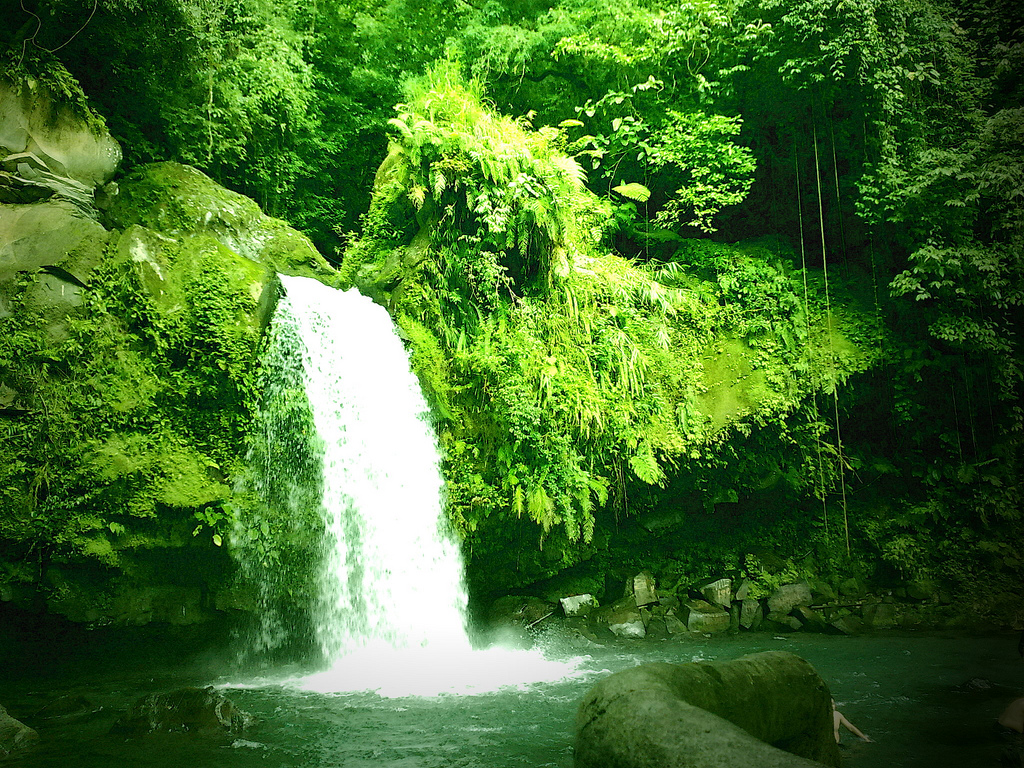
- Taytay Falls: Also known as Majayjay Falls or even Imelda Falls because ex-First Lady Imelda Marcos financed the promotion of tourism in this place. It is a two-story high fall located in a forested area.
- Puente de Capriccio: In José Rizal's El Filibusterismo, he spoke of an old Spanish bridge made of stone in the year 1851. It was a one-arch bridge since it was not finished, early natives put a bamboo footbridge to connect the opposite sides to make it accessible. Puente de Capriccio was initiated by Spanish Franciscan priest Victoriano del Moral. The priest was cruel and autocratic, anyone who did not labour in the construction would be later punished by whipping the buttocks. The workers were reportedly not paid a single centavo. Because of his cruelty, the workers campaigned against him, thus, the bridge's construction never resumed since 1851. The bridge is still standing firm today crossing the Olla River. It is called Tulay ng Pige (Bridge of Buttocks) by residents. The bridge now symbolizes the defiance of Filipino workers against the oppressive Spanish colonialists during the colonial period.
- Mount Banahaw: Majayjay is located at the foot of this mountain. In the early Spanish era, Mount Banahaw was called Monte de Majayjay, because it was the town the only way to travel to the mountain. Many European elites visited the town for Mount Banahaw.
- Bukal Falls: Popular to most tourists as the Enchanted Falls
- Botocan Hydroelectric Power Plant and Dam: It is the first hydroelectric power plant constructed in the Philippines in the 20th century (1930). It is now owned by the CBK Power Company Limited.
- Ermita Church: Then, a tribunal. This holy place houses the image of Nuestra Señora de la Portería.
- Our Lady of the Gate Grotto: Situated along the Olla riverbank is a sacred place where masses at times are being held. It is a small tourist destination for religious excursionists.
Culture
[edit]Festivals
[edit]Majayjay Day is celebrated every year on October 2 as part of the celebration of the founding anniversary of the town. It brags off-farm and agricultural products produced primarily from the 40 barangays composing it. This day has been given a new life and breathing in its new brand name AniLinang Festival. The 1st AniLinang Festival was held on October 2, 2016, as an initiative of the local government to promote the town's laid-back, and peaceful way of life seen in its agricultural produce as well as in its indigenous cuisines.
SaGreMa Festival (San Gregorio Magno Majayjay), is a parochial festivity celebrated on September 3, the day when Saint Gregory, the town's patron saint, became a pope, and March 12, the day he died. In the festival, Majayjayenos honor the saint for the fortunes of their town.
Transportation
[edit]
The town can be accessed by four entry points: Magdalena-Majayajay Road to the north, Liliw-Majayjay Road to the west, Luisiana-Majayjay Road to the east, and Lucban-Majayjay Road to the south. Public utility vehicles such local jeepneys and tricycles are modes of public transportation in the municipality.
Jeepney Routes
[edit]Infrastructure
[edit]Communication
[edit]The town of Majayjay possesses different communication lines including PLDT, and cellular communications such as Globe, Smart, and DITO.
Education
[edit]The Majayjay Schools District Office governs all educational institutions within the municipality. It oversees the management and operations of all private and public, from primary to secondary schools.[23]
Primary and elementary schools
[edit]- Bakia-Botocan Elementary School
- Bucal Elementary School
- Liceo de Majayjay
- Majayjay Elementary School
- Munting Kawayan Elementary School
- Paaralang Elementarya ng Gagalot
- Sta Catalina Elementary School
- Suba Elementary School
Secondary schools
[edit]- Liceo de Majayjay
- Sta Catalina Integrated National High School
- Suba National High School
Government
[edit]
Elected officials
[edit]| Majayjay Municipal Official (2025–2028) | ||||||
|---|---|---|---|---|---|---|
| Name | Party | Term of office | ||||
| Start | End | |||||
| Municipal Mayor | ||||||
| Romeo P. Amorado | Lakas–CMD | 30 June 2025 |
30 June 2028 | |||
| Municipal Vice Mayor | ||||||
| Juan Ariel A. Argañosa Jr. | Lakas–CMD | 30 June 2025 |
30 June 2028 | |||
| Member of the Municipal Council | ||||||
| Felix U. Arnuco | Lakas–CMD | 30 June 2025 |
30 June 2028 | |||
| Edison S. Reyes | AKAY | 30 June 2025 |
30 June 2028 | |||
| Gabriel A. Mentilla | NUP | 30 June 2025 |
30 June 2028 | |||
| Ma. Esperanza Z. Bravante | Lakas–CMD | 30 June 2025 |
30 June 2028 | |||
| Ma. Fe B. Cabonce | Lakas–CMD | 30 June 2025 |
30 June 2028 | |||
| Elfredo A. Bicomong | Lakas–CMD | 30 June 2025 |
30 June 2028 | |||
| Dandred O. Eriga | Lakas–CMD | 30 June 2025 |
30 June 2028 | |||
| Jauncho M. Andaya | Lakas–CMD | 30 June 2025 |
30 June 2028 | |||
| ABC Federation President | ||||||
| Margarito P. Gripo | Nonpartisan (Oobi) |
15 December 2023 |
||||
| SK Federation President | ||||||
| Brian E. Fresco | Nonpartisan (Oobi) |
14 November 2023 |
||||
Notable people
[edit]- Gustavo Tobler (1834-1875), merchant and coffee planter from Switzerland
References
[edit]- ^ Municipality of Majayjay | (DILG)
- ^ "2015 Census of Population, Report No. 3 – Population, Land Area, and Population Density" (PDF). Philippine Statistics Authority. Quezon City, Philippines. August 2016. ISSN 0117-1453. Archived (PDF) from the original on May 25, 2021. Retrieved July 16, 2021.
- ^ "2024 Census of Population (POPCEN) Population Counts Declared Official by the President". Philippine Statistics Authority. 17 July 2025. Retrieved 18 July 2025.
- ^ "PSA Releases the 2021 City and Municipal Level Poverty Estimates". Philippine Statistics Authority. 2 April 2024. Retrieved 28 April 2024.
- ^ "2024 Census of Population (POPCEN) Population Counts Declared Official by the President". Philippine Statistics Authority. 17 July 2025. Retrieved 18 July 2025.
- ^ "Majayjay: Average Temperatures and Rainfall". Meteoblue. Retrieved 11 May 2020.
- ^ "Philippine Standard Geographic Code (PSGC) | Philippine Statistics Authority".
- ^ "Official COMELEC Website :: Commission on Elections".
- ^ "2024 Census of Population (POPCEN) Population Counts Declared Official by the President". Philippine Statistics Authority. 17 July 2025. Retrieved 18 July 2025.
- ^ Census of Population (2015). "Region IV-A (Calabarzon)". Total Population by Province, City, Municipality and Barangay. Philippine Statistics Authority. Retrieved 20 June 2016.
- ^ Census of Population and Housing (2010). "Region IV-A (Calabarzon)" (PDF). Total Population by Province, City, Municipality and Barangay. National Statistics Office. Retrieved 29 June 2016.
- ^ Censuses of Population (1903–2007). "Region IV-A (Calabarzon)". Table 1. Population Enumerated in Various Censuses by Province/Highly Urbanized City: 1903 to 2007. National Statistics Office.
- ^ "Province of". Municipality Population Data. Local Water Utilities Administration Research Division. Retrieved 17 December 2016.
- ^ "2024 Census of Population (POPCEN) Population Counts Declared Official by the President". Philippine Statistics Authority. 17 July 2025. Retrieved 18 July 2025.
- ^ "Poverty incidence (PI):". Philippine Statistics Authority. Retrieved December 28, 2020.
- ^ "Estimation of Local Poverty in the Philippines" (PDF). Philippine Statistics Authority. 29 November 2005.
- ^ "2003 City and Municipal Level Poverty Estimates" (PDF). Philippine Statistics Authority. 23 March 2009.
- ^ "City and Municipal Level Poverty Estimates; 2006 and 2009" (PDF). Philippine Statistics Authority. 3 August 2012.
- ^ "2012 Municipal and City Level Poverty Estimates" (PDF). Philippine Statistics Authority. 31 May 2016.
- ^ "Municipal and City Level Small Area Poverty Estimates; 2009, 2012 and 2015". Philippine Statistics Authority. 10 July 2019.
- ^ "PSA Releases the 2018 Municipal and City Level Poverty Estimates". Philippine Statistics Authority. 15 December 2021. Retrieved 22 January 2022.
- ^ "PSA Releases the 2021 City and Municipal Level Poverty Estimates". Philippine Statistics Authority. 2 April 2024. Retrieved 28 April 2024.
- ^ "Masterlist of Schools" (PDF). Department of Education. January 15, 2021. Retrieved October 9, 2025.
External links
[edit]Majayjay
View on GrokipediaMajayjay, officially the Municipality of Majayjay, is a 4th-class landlocked municipality in the province of Laguna, Calabarzon region, Philippines.[1] As of the 2020 census by the Philippine Statistics Authority, it has a population of 27,893 distributed across 40 barangays.[1] Covering 69.58 square kilometers at coordinates 14°9′N 121°28′E and an elevation of 289 meters, Majayjay lies at the base of Mount Banahaw, bordered by Liliw, Luisiana, Nagcarlan, Magdalena, and Rizal in Laguna, and Lucban in Quezon.[1] Established in 1576 during early Spanish colonization, the municipality holds historical significance as one of Laguna's oldest settlements, with its cool climate historically attracting elites as a summer retreat.[2] Its defining landmark is the San Gregorio Magno Parish Church, constructed by Franciscans in the early 18th century and designated a minor basilica by Pope Francis in 2025, reflecting its enduring religious and architectural heritage.[3][4] Today, Majayjay draws visitors to natural sites like Taytay Falls and preserved colonial structures, supporting a local economy centered on agriculture and tourism, with annual revenues indicating modest fiscal capacity.[1]
History
Pre-colonial and early settlement
The region encompassing present-day Majayjay featured pre-colonial settlements of Tagalog barangays situated at the foothills of Mount Banahaw, where communities relied on the mountain's perennial springs for water and its volcanic soils for agriculture, including rice cultivation and possibly other crops like root vegetables and fruits.[5] These indigenous groups participated in regional trade networks linked to Laguna de Bay, exchanging goods such as abaca, forest products, and foodstuffs with coastal and lakeside polities, a pattern common in pre-Hispanic southern Luzon.[6] The elevated terrain offered defensive advantages against inter-barangay conflicts or external threats, fostering relatively stable habitation patterns sustained by the area's biodiversity and hydrological resources.[7] Spanish contact began in the mid-16th century as expeditions from Manila ventured into the Laguna interior following the 1570 conquest of nearby areas, with missionaries identifying Majayjay's site around 1571 for its accessibility via riverine and overland paths from Laguna de Bay.[5] Initial pacification efforts, involving Franciscan friars who arrived in the Philippines in 1578, integrated local datus through alliances and Christianization, transitioning the settlement from autonomous barangays to a visita administered under the nearby pueblo of Bay by circa 1580.[8] This early subordination reflected Spanish priorities for centralized control and resource extraction, leveraging Majayjay's position for missionary outposts amid the mountain's terrain, which provided refuge from lowland heat and facilitated oversight of upland indigenous populations.[9] By 1594, Majayjay achieved status as an independent pueblo, marking the consolidation of Spanish authority through fortified visita structures and tribute systems, driven by the site's defensibility and proximity to timber, water, and labor sources essential for colonial expansion into the Banahaw range.[10] This permanence stemmed from pragmatic factors, including the terrain's role in deterring resistance and supporting agricultural tribute, rather than solely evangelistic motives, as evidenced by the rapid incorporation of local elites into the colonial framework.[11]Spanish colonial era
Majayjay emerged as a significant missionary center during the Spanish colonial period, with the establishment of the Saint Gregory the Great Parish Church (San Gregorio Magno) facilitating widespread Catholic evangelization among local indigenous groups. The initial chapel, constructed around 1575 using bamboo and nipa, burned down in 1576, prompting reconstruction efforts by Franciscan and Augustinian orders.[12][13] The enduring stone structure, begun in 1616 and completed by 1649, became a focal point for religious instruction and community organization, embedding Spanish cultural and administrative control while serving as Laguna's largest parish.[2] This infrastructure not only centralized worship but also supported the collection of tributes and labor under the encomienda system, fostering economic dependence on agricultural production for colonial exports like abaca and rice. Infrastructure developments underscored Spanish priorities for connectivity and resource extraction. In 1851, Franciscan friar Victorino del Moral oversaw the construction of Puente del Capricho, locally known as Tulay ng Pigi or "Bridge of the Buttocks," a stone arch bridge spanning the Talao River to enhance trade routes linking Majayjay to Manila and surrounding haciendas.[14] Local lore attributes the bridge's name to the friar's reputed anger over construction delays, manifesting in a whimsical design element, though historical accounts emphasize its engineering as a practical response to flooding and isolation, enabling efficient transport of goods and reinforcing colonial economic integration.[15] Such projects relied on indigenous labor, often coerced, which strained local societies but stabilized population centers around fortified ecclesiastical hubs. Colonial policies in Majayjay prioritized missionary consolidation over aggressive militarization, resulting in relative social stability without major recorded uprisings, unlike broader Laguna revolts in the late 19th century. The town's elevated, cooler climate positioned it as a preferred retreat for Spanish officials and clergy, earning it the moniker "summer capital of the Philippines," which spurred temporary economic activity through provisioning services but perpetuated inequalities via tribute obligations and land grants to friars. Church records, while not yielding precise demographic figures, reflect a gradual integration of converts, with the parish's expansion indicating sustained population adherence to colonial religious norms by the early 1800s.[2]American period and independence
Following the Spanish-American War, American forces occupied Majayjay as part of the broader transition in Laguna province, with civil government established in the Philippines by 1901 under the Philippine Organic Act. In Majayjay, administrative reforms included the introduction of public education systems, with a public school building constructed starting in 1920 under municipal president Simeon Ordoñez. Infrastructure improvements were prioritized, notably a road from Santa Cruz to Majayjay ordered by Civil Governor William Howard Taft after his 1903 visit, during which he stayed at the home of local resident Pedro Ordoñez and expressed admiration for Botocan Falls. Further developments encompassed a cadastral survey from 1923 to 1925 under Law No. 2259, enabling Torrens land titles, and the establishment of a Meralco hydroelectric plant in Barrio Botocan in 1928, which elevated Majayjay's status to a second-class municipality by harnessing local water resources for electricity generation.[16][17] The Japanese occupation from 1941 to 1945 brought severe disruptions to Majayjay, marked by guerrilla conflicts that resulted in few direct casualties but significant property losses from looting during civilian evacuations. Japanese forces liquidated several prominent locals suspected of guerrilla affiliations, including Mayor Felix Solisa, Pedro Rosalda, Patrocinio Fresco, Salvador Monteseña, and Ceferino Estella. Liberation occurred in 1945 as Allied forces reclaimed Laguna, with Majayjay experiencing postwar recovery amid national efforts to restore order.[16] Philippine independence on July 4, 1946, ushered in municipal autonomy for Majayjay, with initial milestones including compensation for war damages and backpay or pensions for USAFFE veterans, recognized guerrillas, and their widows. Rehabilitation efforts featured U.S. aid for repairing school buildings, supplying desks and books, and implementing an economic mobilization program to revive agriculture and infrastructure damaged during the occupation. These measures supported local recovery without specific land reform initiatives documented for the municipality in the immediate postwar years.[16]Post-war and modern developments
Following World War II, Majayjay implemented rehabilitation measures, including the payment of war damage claims to all eligible recipients, which supported local recovery efforts focused on restoring agricultural productivity and basic infrastructure damaged during the conflict.[16] Agricultural revival in the 1950s and 1960s leveraged the municipality's fertile slopes near Laguna de Bay, contributing to Laguna province's broader post-war economic expansion driven by proximity to Manila and improved rice and crop yields.[18] Road networks saw gradual enhancements through the 1970s, facilitating better connectivity to regional markets, though Majayjay retained its rural character amid Laguna's uneven industrialization spillover from Metro Manila.[19] Population growth remained modest from the late 20th century onward, rising from 15,875 in 1990 to 27,893 by the 2020 census, reflecting a combination of natural increase and limited net migration influenced by the pull of Mount Banahaw's cultural and spiritual allure offsetting outflows to urban centers.[1] [20] This slow urbanization pressure, exacerbated by Manila's expansion, has strained land use but preserved Majayjay's agrarian base, with out-migration for employment balanced by returnees seeking lower living costs and eco-tourism opportunities. Tourism gained momentum in the late 20th century, with former First Lady Imelda Marcos funding promotions for Taytay Falls (also known as Majayjay or Imelda Falls) to highlight natural attractions, efforts that continued into the 2000s through local initiatives emphasizing organic agri-eco-cultural sites.[21] Into the 2020s, preservation of Spanish-era heritage, including the San Gregorio Magno Church declared a national treasure, has been prioritized via municipal tourism offices to counter development pressures while fostering sustainable visitor economies.[22] Mount Banahaw's dormant status poses ongoing risks, with Majayjay's position at its base exposing communities to potential lahars, pyroclastic flows, and ashfall; recent hazard mappings classify lahar zones as moderate to high uncertainty, prompting community disaster resilience assessments since the 2010s to mitigate flood-prone vulnerabilities from heavy rains or seismic triggers.[23] [24] These efforts underscore causal factors like topographic funneling of debris flows, informing land-use planning amid climate variability.[25]Geography
Location and topography
Majayjay occupies the southern portion of Laguna province in the Philippines, positioned along the western slopes of Mount Banahaw, a dormant stratovolcano reaching 2,170 meters in elevation. The municipality spans 69.58 square kilometers of land, featuring undulating terrain that rises from river valleys to steeper mountain inclines. Its boundaries adjoin Liliw and Magdalena to the north, Nagcarlan to the northwest, Luisiana to the northeast, and Lucban in Quezon province to the southeast, isolating it somewhat due to the encircling topography.[1] Elevations within Majayjay vary significantly, with the poblacion at approximately 300 meters (1,000 feet) above sea level and higher reaches extending toward Mount Banahaw's flanks up to over 800 meters in some areas. This topography includes dissected plateaus, narrow valleys carved by rivers such as the Majayjay and Lucban, and residual forests totaling 972 hectares of natural cover as of 2020. Volcanic soils, enriched by ash deposits from ancestral eruptions of Mount Banahaw, predominate, fostering fertile conditions for cultivation while heightening vulnerability to lahar flows during heavy rains or potential reactivation.[26][27][28]Climate and environmental features
Majayjay experiences a tropical monsoon climate (Köppen classification Am), marked by distinct wet and dry seasons influenced by the southwest and northeast monsoons.[29] Average annual precipitation totals approximately 1,700 mm, with the heaviest rainfall occurring from June to December, peaking in November at around 279 mm.[30] Temperatures vary seasonally between a low of about 21°C in the cooler months and highs reaching 31°C during the dry period from January to May, moderated somewhat by the municipality's elevation of roughly 240 meters above sea level.[29] Relative humidity remains high year-round, often exceeding 80%, contributing to muggy conditions.[31] ![Taytay Falls in Majayjay][float-right] The surrounding environment features fertile volcanic soils derived from Mount Banahaw, a dormant stratovolcano adjacent to Majayjay, which supports agricultural productivity in rice, vegetables, and fruit cultivation. The Mounts Banahaw-San Cristobal Protected Landscape, encompassing parts of Majayjay, hosts significant biodiversity, including over 578 animal species with approximately 20% endemics such as land snails, butterflies, and small mammals adapted to forested montane habitats. Studies document diverse land snail populations on the Majayjay slopes, with local ecological knowledge highlighting sustainable harvesting practices amid habitat pressures.[32] Forested areas provide watershed functions, feeding rivers and waterfalls like Taytay Falls, which originate from Banahaw's springs. Environmental hazards include recurrent flooding from rivers such as the Sta. Cruz and Pagsanjan, exacerbated by intense monsoon rains; LiDAR-based flood mapping identifies inundation risks in low-lying barangays during 5-year return period events, affecting agricultural lands and infrastructure.[33] [34] Geological assessments note potential for lahar flows and ashfall from Banahaw's reactivation, though the volcano has been dormant since the 18th century, with monitoring by the Philippine Institute of Volcanology and Seismology indicating low current activity. These risks underscore the need for integrated disaster preparedness in the region's hazard-prone topography.Administrative divisions
Majayjay is administratively subdivided into 40 barangays, comprising a core of urban areas in the Poblacion and predominantly rural extensions into upland and lowland terrains.[1] The Poblacion barangays, including Burol, Origuel, and Santa Catalina, function as the central administrative nucleus, housing key governance infrastructure such as the municipal hall and facilitating coordinated local policy implementation.[35] Upland rural barangays, situated toward Mount Banahaw, manage community-level administration for dispersed settlements, while lowland ones along river systems support governance linkages to adjacent municipalities.[35] No recent boundary adjustments or mergers among barangays have been documented in municipal records.[35] The barangays, listed alphabetically, are:- Amonoy
- Bakia
- Balanac
- Balayong
- Banilad
- Banti
- Bitaoy
- Botocan
- Bukal
- Burgos
- Burol
- Coralao
- Gagalot
- Ibabang Banga
- Ibabang Bayucain
- Ilayang Banga
- Ilayang Bayucain
- Isabang
- Malinao
- May-it
- Munting Kawayan
- Olla
- Oobi
- Origuel
- Panalaban
- Pangil
- Panglan
- Piit
- Pook
- Rizal
- San Francisco
- San Isidro
- San Miguel
- San Roque
- Santa Catalina
- Suba
- Talortor
- Tanawan
- Taytay
- Villa Nogales[1]
Demographics
Population dynamics
The population of Majayjay increased from 5,800 residents in 1903 to 27,893 in the 2020 census, reflecting steady long-term expansion driven primarily by natural increase rather than rapid influx.[1] This equates to an average annual compound growth rate of approximately 1.6% over 117 years, though decadal variations occurred, with slower rates in recent periods such as 0.08% annualized from 27,792 in 2015 to 27,893 in 2020.[1] Such modest recent growth underscores rural demographic stability, countering narratives of unchecked urbanization in peripheral Laguna municipalities, as evidenced by the absence of explosive doublings seen in nearby metro-adjacent areas. At 463 persons per square kilometer across 60.26 km² of land area, Majayjay's density aligns with rural Philippine patterns, far below urban thresholds exceeding 1,000/km² and indicating dispersed settlement tied to agricultural and topographic constraints rather than concentrated development.[20] The 2020 age distribution reveals a broad-based pyramid, with the largest cohorts in the 20-29 age group (4,566 persons), followed by 10-19 (approximately 4,200 combined) and 30-39 (3,531), signaling a productive working-age majority and family-centric reproduction rates sustaining local numbers without heavy reliance on immigration.[20] Average household size stood at 4.2 persons in 2015, consistent with national rural averages emphasizing extended family units, though updated 2020 figures suggest persistence amid slowing overall growth.[36] Projections from Philippine Statistics Authority trends imply continued low-to-moderate increases, potentially reaching 28,500-29,000 by 2030 barring major disruptions, as out-migration to Metro Manila—common in Laguna's inland areas for employment—offsets births without eroding core rural fabric.Cultural and social composition
The residents of Majayjay are predominantly of Tagalog ethnicity, reflecting the ethnolinguistic dominance of this group in inland Laguna province, where Tagalogs form the overwhelming majority of the population. This composition stems from historical settlement patterns in the Tagalog heartland, with minimal influx from other groups such as Bicolanos or Ilocanos, which constitute less than 1% regionally.[37] Tagalog serves as the primary language spoken by nearly all inhabitants, serving as the vernacular for daily communication, education, and local governance, with Filipino (standardized Tagalog) as the national medium and English used in formal contexts.[38] This linguistic homogeneity aligns with broader patterns in rural Calabarzon, where over 85% of households report Tagalog as their mother tongue. Religiously, the municipality exhibits strong Roman Catholic adherence, exceeding 90% of the population, consistent with Laguna province's 88.2% Catholic affiliation in the 2020 census and amplified by Majayjay's status as an early mission site since the 16th century. Protestant denominations and other Christian groups represent minor shares, under 5%, while non-Christian faiths or unaffiliated individuals are negligible, underscoring resistance to diversification seen in urban Philippine areas. Socially, community life revolves around extended family networks, typical of rural Tagalog households, where multiple generations often co-reside and share responsibilities, fostering interdependence and mutual support.[39] This structure emphasizes kinship ties and communal cooperation, such as the bayanihan tradition of collective labor, which reinforces social cohesion amid agricultural lifestyles, as observed in ethnographic studies of Tagalog rural families.[40]Economy
Agricultural and primary industries
Agriculture in Majayjay primarily revolves around crop production suited to the municipality's hilly terrain and fertile soils derived from volcanic activity near Mount Banahaw, enabling diversified farming on approximately 7,340 hectares of agricultural land. Coconut remains the dominant crop, occupying 2,086.27 hectares or 28.41% of arable area, primarily for copra production, which has historically supported local livelihoods through export-oriented processing. Rice cultivation covers 975.97 hectares (13.29%), focusing on irrigated paddies in lower elevations, contributing to staple food security amid Laguna province's broader rice challenges like fluctuating yields and input costs.[23][41] Other key crops include vegetables such as leafy greens, root crops like ginger, and fruit-bearing plants including saba bananas, calamansi, and native chili, often grown on smaller plots with emphasis on organic methods to leverage soil fertility for higher-value outputs. Livestock rearing, though secondary, integrates with crop systems through integrated farming models, featuring poultry (chicken, duck), swine, and aquaculture like tilapia, as demonstrated in certified organic operations that apply effective microorganism (EM) technology for soil health and waste management. Historically, the area relied on coconut for copra and potentially abaca fiber in Laguna's colonial-era exports, but post-independence shifts toward sustainable practices, including organic certification, have reduced chemical dependency and promoted agritourism hybrids without diminishing primary output.[41][42][43] These activities underpin local self-sufficiency in food production, with coconut and rice forming the backbone of primary industry value, though exact GDP shares for Majayjay remain undocumented at the municipal level; provincial data indicate agriculture's role in buffering industrial dominance amid environmental pressures like erosion on slopes. Efforts in diversified, low-input farming enhance resilience to climate variability, linking topography's elevation gradients to crop zoning—upland vegetables versus lowland grains—while minimizing deforestation risks in watershed areas.[44]Tourism and service sector
Majayjay's tourism sector centers on its historical and natural attractions, including the San Gregorio Magno Parish Church, constructed around 1606 by Franciscan friars and recognized as one of the oldest stone churches in the Philippines.[45] This structure, featuring a three-tiered facade and elevated position on a hill, draws visitors interested in colonial-era architecture and religious heritage.[46] Adjacent sites like the unfinished Puente de Capricho, a Spanish-era stone bridge initiated in 1851 over the Olla River, add to the appeal with its historical narrative tied to local folklore and literature, such as José Rizal's El Filibusterismo.[14] Natural features, particularly Taytay Falls in Barangay Gagalot, serve as a primary draw for eco-tourists, with the 12-meter cascade accessible via short hikes through lush terrain near Mount Banahaw's foothills.[47] The site attracts crowds, especially during summer weekends, where reports indicate up to 1,000 visitors on peak days, supported by modest entrance fees of 20 Philippine pesos per person and facilities like tent rentals.[48][49] Hiking trails in the Mount Banahaw area further promote ecotourism, emphasizing the region's biodiversity and spiritual significance, though access remains informal and tied to local guides.[50] Visitor inflows peak during Holy Week, when the church hosts processions and serves as a pilgrimage site, amplified by the municipality's tourism office efforts to highlight cultural events. Local government initiatives since the mid-2010s, including the 2016 AniLinang Festival, have aimed to boost the service economy through homestays and guided tours, with external support like World Bank sponsorship for falls promotion enhancing accessibility.[51][52] These efforts contribute to revenue from lodging and local vendors, though the sector remains small-scale compared to Laguna's urban destinations.Economic challenges and growth
Majayjay's economy grapples with structural challenges rooted in its upland, remote topography, which limits access to broader markets and exacerbates vulnerability to natural disasters such as typhoons and landslides associated with nearby Mount Banahaw. These factors contribute to persistent infrastructure gaps, including inadequate road networks and limited electrification in peripheral barangays, constraining commercial activity and employment diversification. As a fourth-class municipality with annual revenues around PHP 147 million as of recent assessments, fiscal constraints further impede investment in resilient infrastructure, perpetuating a cycle of low productivity in agriculture-dependent livelihoods.[53] Poverty incidence in rural Laguna municipalities like Majayjay remains elevated relative to the province's urban hubs, influenced by seasonal agricultural disruptions and outmigration, though exact municipal figures post-2000 (when it stood at 27.27%) are scarce in public data. Causal drivers include hazard-prone terrain that damages crops and erodes soil fertility, alongside skills mismatches that drive youth emigration, reducing local labor pools for value-added enterprises. Regional analyses highlight underemployment rates in CALABARZON exceeding 15% in rural zones, underscoring Majayjay's lag behind the area's industrial growth.[54][55] Efforts to address these include targeted irrigation developments, such as the 2021 Majayjay Communal Irrigation System and Piit Small Irrigation Project, which have expanded irrigable land and stabilized yields for rice and vegetable farmers through improved diversion works and canal linings. These initiatives, supported by the National Irrigation Administration, demonstrate potential for productivity gains without heavy reliance on subsidies, fostering self-sustaining agribusiness. Complementing this, remittances from overseas Filipino workers—integral to rural household incomes across Laguna—buffer against local shocks, though they incentivize temporary migration over permanent investment.[56][57][58] Realistic growth hinges on leveraging CALABARZON's robust regional expansion, which posted 7.6% GDP growth in 2021, by prioritizing local entrepreneurship in niche processing and eco-compatible ventures rather than aid dependency. Projections under the 2023-2028 Regional Development Plan emphasize infrastructure resilience and skills training to integrate Majayjay into supply chains, potentially yielding modest 2-4% annual local output increases if hazard mitigation aligns with private initiative. This approach counters aid traps by building on empirical gains from irrigation, where serviced areas have seen yield uplifts of up to 20% in similar Laguna projects.[55][59]Government and administration
Local governance structure
Majayjay functions as a fourth-class municipality pursuant to Republic Act No. 7160, the Local Government Code of 1991, which establishes the framework for local governance in the Philippines.[60] The executive authority is vested in the municipal mayor, elected for a three-year term, who exercises general supervision over administrative operations, enforces ordinances, and manages public services within the municipality's jurisdiction.[60]
The legislative powers reside in the Sangguniang Bayan, comprising the vice-mayor as presiding officer, eight regular members elected at large, and ex-officio members including the president of the municipal league of barangays, the president of the federation of sangguniang kabataan, and sectoral representatives from agriculture or other industries.[60] This body enacts ordinances, approves budgets, and oversees development planning, with elections synchronized nationally every three years to align with the code's term limits.[60]
At the grassroots level, Majayjay encompasses 40 barangays, each administered by a barangay council headed by a captain elected every three years, handling local disputes, basic services, and community initiatives under the oversight of the municipal government.[1] While RA 7160 grants fiscal autonomy through powers to generate local revenues via taxes, fees, and charges, fourth-class municipalities like Majayjay remain dependent on the Internal Revenue Allotment from national taxes, limiting independent funding for large-scale projects.[60]
Accountability mechanisms include requirements for open sessions of the Sangguniang Bayan, public hearings on proposed ordinances, and access to financial records, ensuring transparency in decision-making and resource allocation as stipulated in the code.[60] The Department of the Interior and Local Government provides regulatory oversight, with provisions for audits and sanctions to prevent abuse of authority.[60]
Elected officials and political events
Romeo Amorado of Lakas–CMD was elected mayor of Majayjay in the May 12, 2025, local elections, securing 10,264 votes out of the votes cast among approximately 21,000 registered voters.[61] Ariel Argañosa, also of Lakas–CMD, won the vice mayoral position with 9,100 votes, indicating strong support for the party's platform in this rural municipality.[61] Both officials assumed office for the 2025–2028 term, focusing local governance on agriculture, infrastructure, and community welfare without reported major shifts from prior administrations. Election patterns in Majayjay demonstrate consistent backing for Lakas–CMD candidates, a center-right party aligned with national pro-development policies, underscoring the area's conservative rural electorate preferences over opposition groups.[61] Voter participation remains typical of Philippine local polls, though specific turnout figures for Majayjay in 2025 are not detailed in official tallies beyond the vote counts for top positions. Notable political events include a 2017 armed clash between New People's Army rebels and Philippine Army troops in Barangay Ibabang Banga, which prompted advisories to avoid the area ahead of a local festival and heightened security concerns during that period.[62] Earlier, in 2007, Majayjay was among seven Laguna towns designated as election hot spots due to NPA presence, reflecting intermittent insurgent influences on local polling.[63] No significant recent corruption probes or governance disputes specific to elected officials have been documented. Historically, the folklore surrounding the Tulay ng Pigi (Buttocks Bridge) originates from 19th-century colonial administration under Fray Victorino del Moral, who enforced compulsory labor for its construction, leading to whippings for non-compliance and local resentment that inspired the derogatory name tied to laborers' pained postures.[64] Spanish authorities in Manila mockingly termed it Puente de Capricho, highlighting tensions between ecclesiastical oversight and community burdens in early governance.[15]Infrastructure
Transportation networks
Majayjay is primarily accessed from Metro Manila via a 91-kilometer road route along national highways such as the Pan-Philippine Highway (AH26), with typical driving times of 1 hour and 27 minutes depending on traffic and weather conditions.[65] Public transit involves buses from Manila to San Pablo City, followed by jeepneys or tricycles covering the remaining distance through towns like Liliw or Nagcarlan, though service frequency diminishes in off-peak hours due to the area's rural character.[66] [67] Intra-municipal transport centers on a jeepney terminal located near the public market, a short walk from the municipal hall, serving local routes to barangays and connecting to neighboring municipalities including Liliw, Rizal, Nagcarlan, Magdalena, Luisiana, Santa Cruz, and Lucban.[68] Tricycles provide last-mile connectivity within the poblacion and to remote areas, while fares remain regulated at low levels to support accessibility for residents. Jeepneys often traverse narrow, winding roads shaped by the proximity to Mount Banahaw, which imposes limitations on larger vehicles and public transit expansion.[17] [69] Key historical infrastructure includes the Puente de Capricho, an unfinished stone arch bridge over the Olya River initiated in 1851 under Spanish friar Victorino del Moral as a shortcut to Majayjay, but abandoned due to structural challenges and funding shortfalls; it remains a pedestrian link rather than a primary vehicular route.[15] Recent improvements encompass road widening and concreting along the Liliw-Majayjay corridor, as well as the Majayjay Diversion Road in Barangays Pangil and Ilayang Banga under the Department of Public Works and Highways' network development program, aimed at easing congestion and enhancing connectivity.[70] [71] Additional local projects, such as the concreting of the Tanawan-Banilad Road, have improved farm-to-market access but face ongoing maintenance issues from heavy rains and terrain erosion.[72] The municipality's mountainous topography continues to constrain broader public transit options, with narrow paths and steep gradients restricting bus services beyond jeepneys and leading to reliance on private vehicles or habal-habal motorcycles for upland barangays; no rail or major airport links exist, underscoring persistent mobility gaps despite incremental paving efforts.[17][66]Utilities and communication
Majayjay's water supply is primarily managed by the local Majayjay Waterworks System, drawing from rivers, springs, and groundwater sources, though residents frequently encounter intermittent service, low pressure, and discoloration issues.[73] Ongoing infrastructure improvements include the Department of Agriculture's Philippine Rural Development Project, which approved rehabilitation of Level II potable water systems to enhance reliability and access for residents.[74] In early 2025, eight upland barangays received upgraded supply systems, addressing gaps in remote areas through piped distribution from protected sources.[75] Electricity distribution occurs via the national grid operated by Manila Electric Company (Meralco), achieving widespread household coverage in this peri-urban setting.[76] Targeted interventions, such as One Meralco Foundation's Household Electrification Program, connected 86 low-income homes in barangays Panglan, Pangil, and Gagalot in February 2025, reducing reliance on informal submetering and supporting productivity.[77] These efforts align with national pushes for universal access, with Meralco's franchise ensuring stable supply despite occasional rural extensions.[78] Telecommunications infrastructure has advanced since the 2010s, with mobile coverage from major providers like Globe Telecom extending LTE signals across Laguna's 25 municipalities by March 2021, including Majayjay.[79] Broadband options, such as Converge ICT's fiber plans offering speeds up to 800 Mbps, serve residential and business users, though occasional outages require provider maintenance.[80] Provincial initiatives like the Department of Information and Communications Technology's "Wi-Fi for All" program provide free public hotspots, boosting internet penetration amid growing demand.[81] Solid waste management relies on municipal collection and disposal, enforced through ordinances prohibiting river dumping since April 2018, particularly targeting agricultural effluents from hog farms that have historically polluted waterways. From May 2025, stricter rules apply to tourist sites like Taytay Falls, mandating segregation and fines for non-compliance to curb littering.[70] Laguna-wide developments include new sanitary landfills equipped for leachate control and methane capture, aiding Majayjay's compliance with ecological standards amid rising waste volumes.[82] Sanitation coverage emphasizes basic household latrines, with rural challenges tied to topography and enforcement gaps.[83]Public services and facilities
Majayjay's primary public health facilities include the Majayjay Rural Health Unit, a government-operated center in Plaza Street that delivers free medical check-ups, vaccinations, family planning, and targeted programs for tuberculosis, dengue prevention, and maternal care.[84][85] The Majayjay District Hospital, part of the Laguna Provincial Hospital system, provides emergency room services, inpatient admissions, nursing care, and outpatient billing, with a new ambulance acquired in May 2025 to improve transport during medical emergencies.[86][87] Public safety is managed by the Majayjay Municipal Police Station in Poblacion, adjacent to the municipal hall and public market, which conducts routine patrolling, traffic assistance, and community outreach to maintain order and respond to incidents.[88][89] Disaster preparedness efforts address local vulnerabilities such as floods, landslides, and seismic activity near Mount Banahaw, informed by a 2022 climate and disaster risk assessment that evaluates vulnerability and supports mitigation planning at the barangay level.[23] Community welfare services fall under the Municipal Social Welfare and Development Office, which administers support for seniors and persons with disabilities, alongside national programs like the Pantawid Pamilyang Pilipino Program; in August 2025, 292 local 4Ps beneficiaries completed livelihood training to promote self-sufficiency.[90][91] A public market in Poblacion facilitates daily access to fresh goods and supports small vendors, integrating with broader food security initiatives.[88]Education
Educational institutions
Majayjay's public elementary schools, managed by the Department of Education, include Majayjay Elementary School on P. Zamora Street in the poblacion and Bakia-Botocan Elementary School serving rural areas.[92][93] Additional public primaries such as Bukal Elementary School and Gagalot-Taytay Elementary School support basic education across the municipality's 25 barangays.[94][95] Secondary education is primarily provided by Sta. Catalina Integrated National High School in Barangay Sta. Catalina, offering junior and senior high programs.[96] Suba National High School maintains an annex in Gagalot, facilitating access for students in peripheral zones.[97] Private schools include Liceo de Majayjay, a Catholic institution established as the municipality's first such facility, providing elementary through senior high school curricula with a focus on holistic formation.[98][99] Other private options, such as Great Strides Christian School, offer alternative elementary and secondary instruction.[100] Public schooling in Majayjay traces its origins to the American colonial era (1898–1940s), when the U.S. administration established formalized systems emphasizing universal access and infrastructure development.[5] Literacy outcomes reflect strong basic education penetration, aligning with the national rate of 97.0% for individuals aged five and over per the 2020 Census of Population and Housing; Laguna province sustains near-universal levels, supporting agricultural and tourism-related skills development.[101] No local tertiary institutions operate within Majayjay, with residents typically pursuing higher education in nearby urban centers like Santa Cruz or San Pablo City.[102]Literacy and development initiatives
The Municipality of Majayjay participates in provincial scholarship programs administered by the Laguna provincial government, such as the Iskolar ng Laguna initiative, which provides financial assistance to eligible college students from resident municipalities, including requirements for residency, voter registration, and academic performance.[103] Local efforts complement these through targeted educational support, with the Caliraya-Botocan-Kalayaan (CBK) Social Development Program delivering education benefits to Majayjay as a host community, encompassing public education components aimed at youth and adults since the program's inception over two decades ago.[104] A notable adult education initiative is the "Hanep Gulay" TV School-on-the-Air program, a distance learning effort focused on vegetable processing and farming skills, enrolling 47 participants—primarily mothers—in Majayjay in 2017, with content delivered via eight episodes broadcast on local cable, including quizzes to reinforce learning.[105] This non-formal program enhances functional literacy in practical agricultural knowledge, aligning with broader Department of Agriculture-supported open distance learning models.[106] Development initiatives tie education to economic needs, particularly eco-tourism and organic agriculture. Costales Nature Farms in Majayjay offers hands-on training courses in organic farming techniques, enabling participants to acquire skills for sustainable livelihoods that support the area's tourism attractions like Taytay Falls.[107] Such programs address local demands for workforce development in agri-eco-tourism, where practical training fosters income generation through farm-based enterprises.[108] Outcomes reflect participation in regional efforts, with Laguna's functional literacy rate at 72.2% as of recent surveys, indicating room for targeted interventions like those in Majayjay to bridge gaps in applied skills.[109] The "Hanep Gulay" evaluation showed variable retention and adoption of farming information among completers, underscoring the value of interactive distance formats for rural adult learners despite challenges in full implementation.[105]Culture and heritage
Religious traditions and festivals
Roman Catholicism dominates religious practices in Majayjay, with the San Gregorio Magno Parish Church serving as the focal point for communal worship and spiritual observances. Daily life integrates faith through regular masses, novenas, and sacramental rites, fostering a strong sense of devotion among residents.[110] Holy Week processions form a cornerstone of local traditions, held annually during Lent on Holy Wednesday and Good Friday. These events feature devotees carrying antique religious statues of Christ, the Virgin Mary, and saints through the streets, accompanied by Latin chants and prayers, reflecting centuries-old Catholic penitential practices prevalent in Laguna province. Majayjay's processions, alongside those in nearby Pakil and Paete, attract participants emphasizing solemnity and communal piety.[111][112] The SaGreMa Festival (San Gregorio Magno Majayjay) celebrates the parish patron saint with parochial festivities on September 3 and March 12, dates linked to Saint Gregory the Great's liturgical commemorations. Activities include masses, processions, and community gatherings that highlight the saint's legacy of pastoral care and doctrinal contributions.[110] The Anilinang Festival, observed around October 2 to coincide with Majayjay's founding anniversary, blends Catholic thanksgiving with agrarian rituals, featuring street dances, harvest exhibits, and displays of local produce to honor abundance. Established as an annual event, its 8th iteration in 2023 ran from September 30 to October 2, incorporating faith-based elements like prayers for bountiful yields rooted in pre-colonial indigenous reverence for nature, though fully framed within Catholic liturgy.[113][51] The Feast of Saint Gregory the Great on April 9 further reinforces patronal devotion, with special masses and minor processions drawing local participation to venerate the pope-saint's intercession for guidance and protection.[114]Historical landmarks and folklore
The Minor Basilica and Parish of Saint Gregory the Great, originally constructed between 1616 and 1649 using stone and brick in Romanesque style, serves as Majayjay's foremost historical landmark and was designated a National Cultural Treasure (Level 1) by the National Museum of the Philippines for its architectural and historical significance.[2][12] The structure replaced earlier wooden edifices dating to 1573 that succumbed to fire, enduring subsequent damages from typhoons and earthquakes through multiple repairs while retaining core colonial features like its facade and retablo.[115] Elevated to minor basilica status by Pope Francis in January 2025, it underscores the site's role in early Franciscan evangelization efforts in Laguna, with the adjacent Ermita Chapel of Nuestra Señora de la Soledad adding to the preserved complex.[116][117] The Puente del Capricho, an unfinished stone arch bridge commenced in 1851 over the Olya River, constitutes another key landmark, engineered as a shortcut linking Majayjay to neighboring areas but abandoned mid-construction, leaving a single prominent arch intact amid jungle overgrowth.[118] Supervised by Franciscan friar Victorino del Moral, the project exemplified ambitious 19th-century infrastructure amid challenging terrain at Mount Banahaw's foothills, with its elegant design evoking Spanish engineering prowess despite incompletion likely due to funding shortages or logistical hurdles rather than mere whim.[14] Referenced in José Rizal's El Filibusterismo as a symbol of colonial folly, the bridge—locally dubbed Tulay ng Pige (Bridge of Buttocks)—preserves evidentiary value for studying Spanish-era public works, though no formal National Cultural Treasure status has been conferred.[14][119] Local folklore envelops the Puente del Capricho with tales of an irascible friar halting work in rage, possibly over laborers' defiance or hygiene lapses, a narrative transmitted orally across generations and potentially embedding kernels of historical truth such as exploitative labor practices or clerical overreach prevalent in mid-19th-century Philippines.[118] These stories, while unverified by primary documents, mirror broader colonial tensions documented in ecclesiastical records, contrasting with the church's enduring legacy of institutional continuity. Preservation efforts for both sites emphasize structural maintenance against natural decay, with the church benefiting from diocesan oversight and the bridge from incidental protection via its remote location, though archaeological surveys of surrounding pre-colonial settlements remain underexplored despite potential for uncovering indigenous artifacts predating Spanish arrival.[119]Notable people
Prominent figures from Majayjay
Majayjay, a small municipality in Laguna province, has not produced figures of national prominence in fields such as politics, arts, or science, consistent with patterns in rural Philippine communities where emigration and local focus predominate.[120] Local contributions include artistic documentation of the town's heritage by Wilfredo "Yeye" Calderon, a Laguna artist whose watercolor and coffee paintings of Majayjay's landmarks, such as its churches and bridges, have been featured in exhibits to support parish restoration efforts as of 2023.[121][122] Residents have also sustained traditions of resilience, with families like the Villarazas establishing ancestral homes and professional legacies in medicine during the American era, though without broader recognition.[123] In governance, figures such as recent mayors have managed local development, emphasizing the town's emphasis on community stewardship over individual fame.[120]References
- https://en.wikivoyage.org/wiki/Laguna
- https://www.wikidata.org/wiki/Q75888

