



Community hub
Recent from talks
Knowledge base stats:
Talk channels stats:
Members stats:
Stripper
A stripper or exotic dancer is a person whose occupation involves performing striptease in a public adult entertainment venue such as a strip club. At times, a stripper may be hired to perform at private events.
Modern forms of stripping minimize the interaction of strippers with customers, reducing the importance of the tease in the performance in favor of speed of undress (the strip). Not all strippers are comfortable dancing topless or fully nude, but in general, full nudity is common where not prohibited by law. The integration of the burlesque pole as a frequently used prop has shifted the emphasis in the performance toward a more acrobatic, explicit form of expression compared to the slow-developing burlesque style. Most strippers work in strip clubs. A house dancer works for a particular club or franchise, while a feature dancer typically has her own celebrity, touring a club circuit and making appearances. Strippers are often not direct employees of clubs but instead perform as independent contractors.
Before the 1970s, strippers in Western cultures were almost invariably female, performing to male audiences, usually in strip clubs. At the same time, strippers of all genders were dancing in underground clubs or as part of a theatre experience. Since the 1970s, mainstream stripping has adopted a greater gender diversity and male strippers have become an established form of entertainment for female audiences. Their performances are usually fully choreographed, involving dance routines and costumes. Certain male and female strippers also perform for LGBT audiences as well as for all genders in bisexual contexts.
Strippers perform striptease for a number of reasons, predominantly to make money. The physical attractiveness, sex appeal and techniques of the dancer determines the business the stripper tends to generate. In some localities, strippers are required to obtain permits to work in adult entertainment. Most of the time dancers have to audition to get the job. Once a dancer has secured the job the formal training is minimal, primarily on the job and provided by more senior dancers.[citation needed]
Touching strippers is not permitted in many localities; few dancers and clubs allow touching of dancers during private dances. If permitted, during a lap dance the dancer may dance sitting in the customer's lap, clothed or topless. In parts of the US, there are laws forbidding the exposure of female nipples, which the dancers must cover with pasties. The common practice of hiring strippers as contractors rather than full-time employees often leads to job insecurity, unstable pay and a lack of health benefits. Strippers are also sometimes required to pay fees to the club for renting their stage.[citation needed]
Strippers most commonly work as providers of live entertainment in strip clubs. Those who work for a particular club or franchise are called house dancers.[citation needed] They are not usually direct employees, instead performing as independent contractors for a predetermined house fee. Feature dancers, who usually have celebrity status, tour the strip club circuit across the U.S and make live promotional appearances. Until the mid-2000s, high-profile female porn stars were often highly paid as feature dancers in the U.S., touring to earn extra income and build their fan base. Examples include Teagan Presley, Jenna Haze and Jenna Jameson.
Most clubs have a dancer rotation where each dancer in turn will perform for one or more songs in a fixed sequence, which repeats during a shift. More informal clubs will have dancers take turns when a stage becomes empty or have a free flow of entertainers, where they can wander off and on stage at their own will. Feature entertainers have set times for their performance, and are not usually part of the rotation. If a DJ is present, they will emcee the rotation, advertise the feature entertainers performance and typically announce the dancer(s) on stage and possibly whom to expect in future sets.
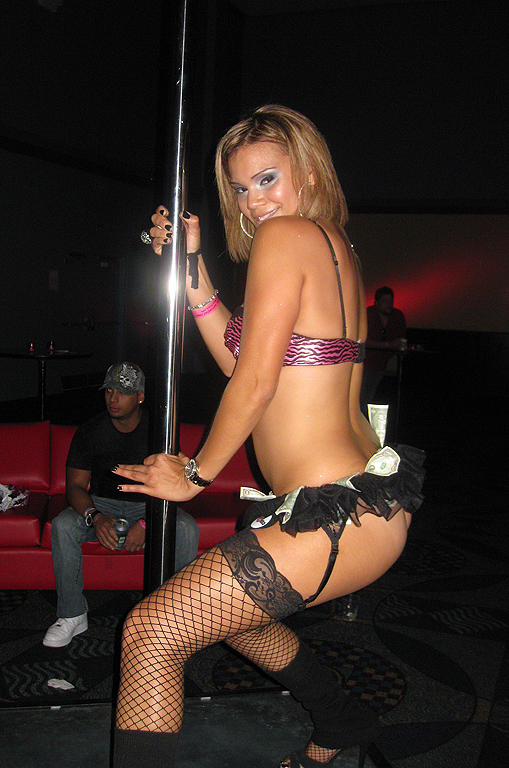
During each set of one or more songs, the performer will dance on stage in exchange for tips. Dancers collect tips from customers either while on stage or after the dancer has finished a stage show and is mingling with the audience. A customary tip (where customers can do so at the stage) is a dollar bill folded lengthwise and placed in the dancer's garter from the tip rail. Other common tip methods are to insert the dollar into the stripper's cleavage from the hand or mouth, or to simply place it or toss it onto the stage. Tipping during a stage performance is prohibited by some clubs due to restrictions in local ordinance or past incidents on the premises. Each club and dancer will have individual tolerance levels for customer interaction including tipping. Some clubs will have multiple stages on the premises that dancers will move between, but typically the dancer would collect for her time on the main stage during a rotation. Tips can also be collected during private dances.
Hub AI
Stripper AI simulator
(@Stripper_simulator)
Stripper
A stripper or exotic dancer is a person whose occupation involves performing striptease in a public adult entertainment venue such as a strip club. At times, a stripper may be hired to perform at private events.
Modern forms of stripping minimize the interaction of strippers with customers, reducing the importance of the tease in the performance in favor of speed of undress (the strip). Not all strippers are comfortable dancing topless or fully nude, but in general, full nudity is common where not prohibited by law. The integration of the burlesque pole as a frequently used prop has shifted the emphasis in the performance toward a more acrobatic, explicit form of expression compared to the slow-developing burlesque style. Most strippers work in strip clubs. A house dancer works for a particular club or franchise, while a feature dancer typically has her own celebrity, touring a club circuit and making appearances. Strippers are often not direct employees of clubs but instead perform as independent contractors.
Before the 1970s, strippers in Western cultures were almost invariably female, performing to male audiences, usually in strip clubs. At the same time, strippers of all genders were dancing in underground clubs or as part of a theatre experience. Since the 1970s, mainstream stripping has adopted a greater gender diversity and male strippers have become an established form of entertainment for female audiences. Their performances are usually fully choreographed, involving dance routines and costumes. Certain male and female strippers also perform for LGBT audiences as well as for all genders in bisexual contexts.
Strippers perform striptease for a number of reasons, predominantly to make money. The physical attractiveness, sex appeal and techniques of the dancer determines the business the stripper tends to generate. In some localities, strippers are required to obtain permits to work in adult entertainment. Most of the time dancers have to audition to get the job. Once a dancer has secured the job the formal training is minimal, primarily on the job and provided by more senior dancers.[citation needed]
Touching strippers is not permitted in many localities; few dancers and clubs allow touching of dancers during private dances. If permitted, during a lap dance the dancer may dance sitting in the customer's lap, clothed or topless. In parts of the US, there are laws forbidding the exposure of female nipples, which the dancers must cover with pasties. The common practice of hiring strippers as contractors rather than full-time employees often leads to job insecurity, unstable pay and a lack of health benefits. Strippers are also sometimes required to pay fees to the club for renting their stage.[citation needed]
Strippers most commonly work as providers of live entertainment in strip clubs. Those who work for a particular club or franchise are called house dancers.[citation needed] They are not usually direct employees, instead performing as independent contractors for a predetermined house fee. Feature dancers, who usually have celebrity status, tour the strip club circuit across the U.S and make live promotional appearances. Until the mid-2000s, high-profile female porn stars were often highly paid as feature dancers in the U.S., touring to earn extra income and build their fan base. Examples include Teagan Presley, Jenna Haze and Jenna Jameson.
Most clubs have a dancer rotation where each dancer in turn will perform for one or more songs in a fixed sequence, which repeats during a shift. More informal clubs will have dancers take turns when a stage becomes empty or have a free flow of entertainers, where they can wander off and on stage at their own will. Feature entertainers have set times for their performance, and are not usually part of the rotation. If a DJ is present, they will emcee the rotation, advertise the feature entertainers performance and typically announce the dancer(s) on stage and possibly whom to expect in future sets.
During each set of one or more songs, the performer will dance on stage in exchange for tips. Dancers collect tips from customers either while on stage or after the dancer has finished a stage show and is mingling with the audience. A customary tip (where customers can do so at the stage) is a dollar bill folded lengthwise and placed in the dancer's garter from the tip rail. Other common tip methods are to insert the dollar into the stripper's cleavage from the hand or mouth, or to simply place it or toss it onto the stage. Tipping during a stage performance is prohibited by some clubs due to restrictions in local ordinance or past incidents on the premises. Each club and dancer will have individual tolerance levels for customer interaction including tipping. Some clubs will have multiple stages on the premises that dancers will move between, but typically the dancer would collect for her time on the main stage during a rotation. Tips can also be collected during private dances.