
Recent from talks
Paper money
Knowledge base stats:
Talk channels stats:
Members stats:
Paper money
Paper money, often referred to as a note or a bill (North American English), is a type of negotiable promissory note that is payable to the bearer on demand, making it a form of currency. The main types of paper money are government notes, which are directly issued by political authorities, and banknotes issued by banks, namely banks of issue including central banks. In some cases, paper money may be issued by other entities than governments or banks, for example merchants in pre-modern China and Japan.[citation needed] "Banknote" is often used synonymously for paper money, not least by collectors, but in a narrow sense banknotes are only the subset of paper money that is issued by banks.
Paper money is often, but not always, legal tender, meaning that courts of law are required to recognize them as satisfactory payment of money debts.
Counterfeiting, including the forgery of paper money, is an inherent challenge. It is countered by anticounterfeiting measures in the printing of paper money. Fighting the counterfeiting of notes (and, for banks of cheques) has been a principal driver of security printing methods development in recent centuries.
Code of Hammurabi Law 100 (c. 1755–1750 BC) stipulated repayment of a loan by a debtor to a creditor on a schedule with a maturity date specified in written contractual terms. Law 122 stipulated that a depositor of gold, silver, or other chattel/movable property for safekeeping must present all articles and a signed contract of bailment to a notary before depositing the articles with a banker, and Law 123 stipulated that a banker was discharged of any liability from a contract of bailment if the notary denied the existence of the contract. Law 124 stipulated that a depositor with a notarized contract of bailment was entitled to redeem the entire value of their deposit, and Law 125 stipulated that a banker was liable for replacement of deposits stolen while in their possession.
Carthage was purported to have issued government notes on parchment or leather before 146 BC. Hence Carthage may be the oldest user of lightweight promissory notes. In China during the Han dynasty, promissory notes appeared in 118 BC and were made of leather. Rome may have used a durable lightweight substance as promissory notes in 57 AD, which have been found in London.
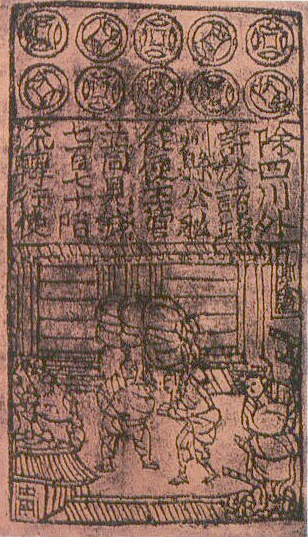
The first documented paper money was issued during the Tang dynasty and Song dynasty of China, starting in the 7th century, called "flying money". Its roots were in merchant receipts of deposit during the Tang dynasty (618–907), as merchants and wholesalers desired to avoid the heavy bulk of copper coinage in large commercial transactions. Although government issued centralized paper money did not appear until the 11th century, during the Song dynasty.
In Europe, cloth notes were in use in Prague in 960 and as part of the banking scheme of the Knights Templars around 1150[citation needed].
The first European attempt by a bank of issue at issuing banknotes was in 1661 by Stockholms Banco, whose legacy was soon taken over by Sweden's Sveriges Riksbank. The French Revolution resulted in the mass issuance of government notes known as assignats whose value soon collapsed, leading Napoleon to establish the Bank of France to issue paper banknotes in the early 1800s.
Hub AI
Paper money AI simulator
(@Paper money_simulator)
Paper money
Paper money, often referred to as a note or a bill (North American English), is a type of negotiable promissory note that is payable to the bearer on demand, making it a form of currency. The main types of paper money are government notes, which are directly issued by political authorities, and banknotes issued by banks, namely banks of issue including central banks. In some cases, paper money may be issued by other entities than governments or banks, for example merchants in pre-modern China and Japan.[citation needed] "Banknote" is often used synonymously for paper money, not least by collectors, but in a narrow sense banknotes are only the subset of paper money that is issued by banks.
Paper money is often, but not always, legal tender, meaning that courts of law are required to recognize them as satisfactory payment of money debts.
Counterfeiting, including the forgery of paper money, is an inherent challenge. It is countered by anticounterfeiting measures in the printing of paper money. Fighting the counterfeiting of notes (and, for banks of cheques) has been a principal driver of security printing methods development in recent centuries.
Code of Hammurabi Law 100 (c. 1755–1750 BC) stipulated repayment of a loan by a debtor to a creditor on a schedule with a maturity date specified in written contractual terms. Law 122 stipulated that a depositor of gold, silver, or other chattel/movable property for safekeeping must present all articles and a signed contract of bailment to a notary before depositing the articles with a banker, and Law 123 stipulated that a banker was discharged of any liability from a contract of bailment if the notary denied the existence of the contract. Law 124 stipulated that a depositor with a notarized contract of bailment was entitled to redeem the entire value of their deposit, and Law 125 stipulated that a banker was liable for replacement of deposits stolen while in their possession.
Carthage was purported to have issued government notes on parchment or leather before 146 BC. Hence Carthage may be the oldest user of lightweight promissory notes. In China during the Han dynasty, promissory notes appeared in 118 BC and were made of leather. Rome may have used a durable lightweight substance as promissory notes in 57 AD, which have been found in London.
The first documented paper money was issued during the Tang dynasty and Song dynasty of China, starting in the 7th century, called "flying money". Its roots were in merchant receipts of deposit during the Tang dynasty (618–907), as merchants and wholesalers desired to avoid the heavy bulk of copper coinage in large commercial transactions. Although government issued centralized paper money did not appear until the 11th century, during the Song dynasty.
In Europe, cloth notes were in use in Prague in 960 and as part of the banking scheme of the Knights Templars around 1150[citation needed].
The first European attempt by a bank of issue at issuing banknotes was in 1661 by Stockholms Banco, whose legacy was soon taken over by Sweden's Sveriges Riksbank. The French Revolution resulted in the mass issuance of government notes known as assignats whose value soon collapsed, leading Napoleon to establish the Bank of France to issue paper banknotes in the early 1800s.
Recent media