Recent from talks
Nothing was collected or created yet.
Stripper
View on WikipediaThis article has multiple issues. Please help improve it or discuss these issues on the talk page. (Learn how and when to remove these messages)
|
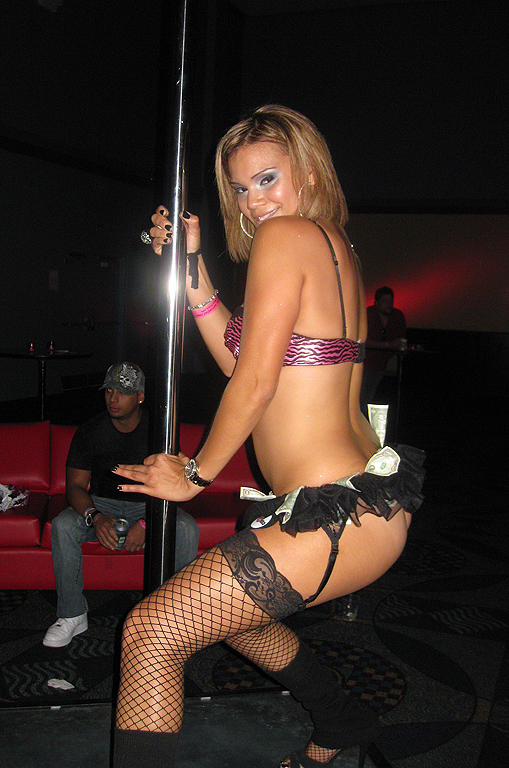
A stripper performing with tips she has received (Miami, 2009) | |
| Occupation | |
|---|---|
| Names | Exotic dancer, erotic dancer, dancer |
Occupation type | Performing arts, sex industry |
Activity sectors | Strip clubs, exhibitions, festivals, competitions, busking |
| Description | |
| Competencies | Striptease, pole dancing, cage dancing, lap dancing |
Fields of employment | Adult entertainment |
Related jobs | Nude modeling, pornography |
A stripper or exotic dancer is a person whose occupation involves performing striptease in a public adult entertainment venue such as a strip club. At times, a stripper may be hired to perform at private events.
Modern forms of stripping minimize the interaction of strippers with customers, reducing the importance of the tease in the performance in favor of speed of undress (the strip).[1] Not all strippers are comfortable dancing topless or fully nude,[2] but in general, full nudity is common where not prohibited by law. The integration of the burlesque pole as a frequently used prop has shifted the emphasis in the performance toward a more acrobatic, explicit form of expression compared to the slow-developing burlesque style. Most strippers work in strip clubs. A house dancer works for a particular club or franchise, while a feature dancer typically has her own celebrity, touring a club circuit and making appearances. Strippers are often not direct employees of clubs but instead perform as independent contractors.
Before the 1970s, strippers in Western cultures were almost invariably female, performing to male audiences, usually in strip clubs. At the same time, strippers of all genders were dancing in underground clubs or as part of a theatre experience. Since the 1970s, mainstream stripping has adopted a greater gender diversity and male strippers have become an established form of entertainment for female audiences. Their performances are usually fully choreographed, involving dance routines and costumes. Certain male and female strippers also perform for LGBT audiences as well as for all genders in bisexual contexts.[3][4]
Work environment
[edit]Strippers perform striptease for a number of reasons, predominantly to make money. The physical attractiveness, sex appeal and techniques of the dancer determines the business the stripper tends to generate. In some localities, strippers are required to obtain permits to work in adult entertainment.[5] Most of the time dancers have to audition to get the job.[6] Once a dancer has secured the job the formal training is minimal, primarily on the job and provided by more senior dancers.[citation needed]
Touching strippers is not permitted in many localities; few dancers and clubs allow touching of dancers during private dances. If permitted, during a lap dance the dancer may dance sitting in the customer's lap, clothed or topless.[7] In parts of the US, there are laws forbidding the exposure of female nipples, which the dancers must cover with pasties.[8] The common practice of hiring strippers as contractors rather than full-time employees often leads to job insecurity, unstable pay and a lack of health benefits. Strippers are also sometimes required to pay fees to the club for renting their stage.[citation needed]
In strip clubs
[edit]Strippers most commonly work as providers of live entertainment in strip clubs. Those who work for a particular club or franchise are called house dancers.[citation needed] They are not usually direct employees, instead performing as independent contractors for a predetermined house fee.[9] Feature dancers, who usually have celebrity status, tour the strip club circuit across the U.S and make live promotional appearances. Until the mid-2000s, high-profile female porn stars were often highly paid as feature dancers in the U.S., touring to earn extra income and build their fan base.[10] Examples include Teagan Presley, Jenna Haze[11] and Jenna Jameson.[12]
Stage performance
[edit]Most clubs have a dancer rotation where each dancer in turn will perform for one or more songs in a fixed sequence, which repeats during a shift. More informal clubs will have dancers take turns when a stage becomes empty or have a free flow of entertainers, where they can wander off and on stage at their own will. Feature entertainers have set times for their performance, and are not usually part of the rotation. If a DJ is present, they will emcee the rotation, advertise the feature entertainers performance and typically announce the dancer(s) on stage and possibly whom to expect in future sets.[13]
Tip collection
[edit]During each set of one or more songs, the performer will dance on stage in exchange for tips. Dancers collect tips from customers either while on stage or after the dancer has finished a stage show and is mingling with the audience. A customary tip (where customers can do so at the stage) is a dollar bill folded lengthwise and placed in the dancer's garter from the tip rail. Other common tip methods are to insert the dollar into the stripper's cleavage from the hand or mouth, or to simply place it or toss it onto the stage. Tipping during a stage performance is prohibited by some clubs due to restrictions in local ordinance or past incidents on the premises. Each club and dancer will have individual tolerance levels for customer interaction including tipping. Some clubs will have multiple stages on the premises that dancers will move between, but typically the dancer would collect for her time on the main stage during a rotation. Tips can also be collected during private dances.[14]
Private dance
[edit]Where legal (or legal restrictions are ignored), dancers may offer additional services, such as a lap dance or a set amount of time in the champagne room, for a set fee rather than a tip. Private dances in the main club areas mostly take the form of table dances, lap and couch dances, and bed dances. Air dances are private dances with little to no contact between the dancer and customer, and they sometimes occur when other forms of dance are expected and paid for.[citation needed]
Table dances are performed where the customer is seated on the main floor. Table dances also refer to a form of minimal touch private dance where the performer is physically located on a small table in front of the customer(s). Table dances should not be confused with table stages, where the stripper is at or above eye level on a platform surrounded by chairs and usually enough table surface for customers to place drinks and tip money. These stages are configured for close viewing of the striptease and are known for dancers lowering themselves from the stage onto customers during their set.[citation needed]
Lap dances usually take place among the customer seating, but may occur publicly on stage with one or more dancers if events such as bachelor parties or birthdays are being celebrated. Bed dances involve the customer lying down with the entertainer(s) positioned on top of them, and are the least common of the three. This is because they are typically more expensive than lap dances due to the novelty and the increased level of contact between customer and dancer.[citation needed]
A champagne room (also called a champagne lounge or champagne court) is a specialized VIP Room service offered by gentleman's clubs where a customer can purchase time (usually in half-hour increments) with an exotic dancer in a private room on the premises. In more expensive clubs the room, which is away from the main club, is well decorated and usually has its own bar. Clubs sell champagne by the glass or by the bottle for both the dancer and the customer.[citation needed]
Other locations
[edit]Strippers can be contracted for performances outside the strip club environment. Some strippers will only strip for private engagements and do not have a regular affiliation with a strip club.[citation needed]
Adult industry trade shows often have strippers working, though many of them are affiliated with individual companies and not necessarily freelancers. There are also exhibitions, festivals, and competitions where independent strippers perform. Nudes-A-Poppin' was a popular erotic dance contest that took place annually in Indiana, US, from 1975 until 2019.[citation needed]
Bachelor and bachelorette parties
[edit]A bachelor party may involve activities beyond the usual party and social-gathering ingredients, such as going to a strip club or hiring a stripper to perform in a private setting like a home or hotel. In some traditions, there are hazing-like tests and pranks at the future groom's expense. These pranks can involve a stripper if the entertainer is willing. Some women also participate in a similar party to be held for the bride-to-be. This is known as a bachelorette party or Hen party.[citation needed]
Private parties
[edit]Private parties are popular events for which to hire strippers. There are many entertainment businesses that have strippers contracted for private performances. Some of these companies have a national presence, with strippers contracted in multiple states and some who work regionally over a multi-state area. Strippers will also do side work and handle their own agreements and payment arrangements. Written agreements are atypical in this type of transaction unless a formal, registered business is involved. They could also travel over significant (i.e. flight required) distances for private events and appointments, most of the time passing the cost of travel and accommodations onto the customer. Patrons at the clubs in which the strippers work are a primary source of customers for their work outside the club. Much like activities inside the club, different dancers have different comfort levels for services they will provide during a private party.[citation needed]
Performance
[edit]
While working, a stripper is not necessarily required to remove all of their clothing. Regardless of size, name, or location in the world, strip clubs can be full nude, topless or bikini.[15][16] For any type of strip club there are exceptions based on the individual dancer and management, and clubs are classified based on typical performances, zoning, and advertised services.[citation needed]
Style of dress
[edit]During a performance, both the breasts and the genitals typically remain covered by revealing clothes, while dancers provide services and entertainment. A female stripper whose upper body is exposed, but whose genitals remain covered during a performance, is said to be topless. Strippers who uncover the genital areas while removing the rest of their clothing during a performance are said to be dancing fully nude. The fully nude practice is banned in many jurisdictions,[16] but many dancers work around these constraints by selective uncovering of the vulva, anus, or both, for short periods of time, followed by immediate replacement of the clothing.[17][18]
In many clubs, entertainers will walk the floor in their revealing clothing. When a stripper performs personal services (such as lap or bed dances) they come into contact with a customer, and are required to remain in their revealing clothing in more restrictive club environments. Private dances in particular are scrutinized to ensure that no club policies or local ordinances are being violated during the performance. The additional clothing also acts as a deterrent to prevent a customer from exceeding the boundaries set by a particular dancer. On 19 June 1964, Carol Doda began go-go dancing topless at the Condor Club on Broadway and Columbus in the North Beach neighborhood of San Francisco.[19] She became the world's most famous go-go dancer, and a prototype for the modern stripper, while dancing at the Condor for 22 years.[20]
Topless
[edit]Women are at times employed in adult-only venues to perform or pose topless in forms of commercial erotic entertainment. Such venues can range from downmarket strip clubs to upmarket cabarets, such as the Moulin Rouge. Topless entertainment may also include competitions such as wet T-shirt contests in which women display their breasts through translucent wet fabric—and may end up removing their T-shirts before the audience. Strippers can engage in these alternate topless activities at sanctioned times inside the club or as independent contractors at outside venues. In areas where choice in formats exist, exotic dancers may profit more if they offer a greater degree of nudity in their performance.[citation needed]
Even the dancers that will go topless have been known to stay covered during a dance during slow periods in the club with few customers. This is particularly true if the customers do not appear to be engaged or actively tipping because they are not being compensated for their time on stage. The practice of topless dancing is banned in many jurisdictions, but strippers have been known to work around the constraints by selectively uncovering her breasts "peek-a-boo" style for short periods of time then replacing the clothing. For a male dancer, a bare chest is not considered in the same light and does not face the same legal restrictions. During a show where customer tipping is permitted, most strip clubs limit contact with a dancer's breasts to one way—from dancer to customer. Many clubs do not allow any breast contact, and some place markers on stage that a dancer is not permitted to cross while nude. This physical separation enforces compliance with the no-touch policy.[citation needed]
Full nudity
[edit]Strippers are banned from dancing fully nude in many jurisdictions, but many dancers will work around the regulations by selectively uncovering their vulva, anus, or both for short periods of time then replacing the clothing. For a male dancer, exposing the penis or anus is equivalent.[citation needed]
Not all strippers are comfortable dancing fully nude. If viewed as a continuum, fewer dancers will dance topless than go-go and fewer still would dance fully nude. It has been reported when in direct competition with more conservative offerings, fully nude formats are seen by customers as a superior enough substitute for them to switch clubs.[21] In areas where choice in formats exist, exotic dancers express concern that the more they offer in their performance (nudity included) the more they stand to profit. Still, strippers have been known to dance only at topless clubs because of their desire not to strip completely nude.[22] Some clubs permit both nude stage dancing and fully nude lap dances. Where nude private dances are allowed with contact, some dancers choose to place some type of barrier (cloth or occasionally plastic) over the customer's lap as a precautionary measure.[citation needed]
Customer interaction
[edit]Strippers are focused on making money from customers. Strippers are employed as independent contractors and expected to generate income themselves making the profession similar to a sales job. How dancers go about maximizing revenue varies. For customers they do not already know, dancers use factors such as clothing, shoes, age, and race to determine whom they wish to interact with. Dancers are the primary enablers to encourage potential patrons to spend time in strip clubs. The dancers continually interact with the customers in the club by walking around and attempting to solicit drinks and lap dances, usually scanning the floor of a club to find the most lucrative customer to target.[23]
While clubs can generate revenue through means such as cover charges and drink fees, dancers make most of their profit from giving lap dances or VIP dances where regulations allow. Otherwise, customer tips to dancers from a stage set are their primary form of payment per shift. The dancer qualifies a customer by sizing up their appearance and personal characteristics. Once the dancer identifies her mark, she approaches and attempts to create social relationship with her customer using tactical interactions and manipulations. Alternatively, customers can make the first move and engage the dancer directly. Strippers appeal to masculine desires, but they can adapt to fit the needs of female patrons to view them as customers. Adapting the experience to the customer is an integral part of exotic dancing.[23]
Mainstreaming
[edit]In the 21st century, as adult themes and work are becoming more commonplace, more of the population is attracted to this type of work.[24] For example, a University of Leeds study, published by the British Journal of Sociology of Education, revealed that as many as one third of "strip club dancers are students, with many using the cash earned to support themselves throughout their studies" and likely to come from middle class backgrounds.[25] The study also stated that "students were now a 'core supply group into the sex industries', with clubs even targeting freshers' week events with recruitment leaflets."[25] This is supported by a 2014 story in the New York Daily News regarding San Francisco strip clubs taking out recruitment ads in the university newspaper for the University of California at Berkeley, The Daily Californian.[26] One distinction made is that many view working as a strip club dancer as a short-term means to address financial needs, while others view it as a profession and go on to other types of sex work such as performing in adult films.[25]
Gender roles
[edit]

Male strippers
[edit]Until the 1970s, strippers in Western cultures were almost invariably female, performing to male audiences. Male and female strippers also perform for all types of adult audiences.
The modern male stripper show usually involves full nudity, although sometimes they may retain underwear, especially g-strings, bikini briefs or thongs throughout the show, or only remove all clothing for a brief time. Performances are usually fully choreographed, involve dance routines and a costume of some sort.[3][4] Prominent male strip groups include the Dreamboys in the UK & Chippendales in the US.[citation needed]
A male stripper will likely perform at club, bar, workplace or private home with private advanced bookings or ladies nights being prevalent over strip clubs which is the norm for female strippers.[27] This is different from the Chippendales scene that emerged to prominence in the 1980s with today's norm being one sole performer, or a series of individual performers rather than a group of strippers.[28]
The social psychologist Richard Tewksbury says that male strippers 'masculinise' the role; thus are not disempowered in the way that, he asserts, female strippers are.[29]
Sexuality and gender bias
[edit]Ethnographic research has observed that strippers, regardless of sexual orientation, have a tendency to treat female customers differently than males. Because of the non-physical motivations ascribed to female intimacy, dancers select women to approach who are smiling and sitting comfortably with open body language such as uncrossed arms, actively participating with the crowd, laughing and engaging with fellow customers, and applauding for dancers at the main stage also increase the likelihood they will be approached. Dancers tend to avoid women with unfriendly facial expressions or visibly hostile body language, again regardless of sexual orientation. In order to become approached, men must indicate financial potential through their appearance. Women must demonstrate their good attitude and willingness to participate in club activities. At that point, a woman's perceived profitability is also a factor in a dancer's decision to approach a female patron. The presence of male companionship has been cited in research as an indicator used by dancers to gauge the profitability of a female once she is perceived to be a customer.[23]
In popular culture
[edit]This section is written like a personal reflection, personal essay, or argumentative essay that states a Wikipedia editor's personal feelings or presents an original argument about a topic. (April 2015) |

The image of strippers has evolved through the late 1960s and 1970s in the U.S. and international cultures which embraced Americanized striptease. By the 1980s pole dancing had become popular in America, and the highly sexual imagery associated with the period's performers was widely accepted and frequently portrayed in film, television, and theater.[citation needed]
1980s–1990s
[edit]In addition to lesser-known videos, the 1980s also featured mainstream films involving strippers and their work as part of the central narrative. These included Flashdance (1983), which told the story of blue-collar worker Alexandra "Alex" Owens (Jennifer Beals), who works as an exotic dancer in a Pittsburgh bar at night and at a steel mill as a welder during the day. Blaze (1989) features Lolita Davidovitch as notorious stripper Blaze Starr. Starr herself appears in the film in a cameo role. Exotica (1994), directed by Atom Egoyan, is set in a Canadian lap-dance club, and portrays a man's (Bruce Greenwood) obsession with a schoolgirl stripper named Christina (Mia Kirshner). Showgirls (1995) was directed by Paul Verhoeven and starred Elizabeth Berkley and Gina Gershon. Striptease (1996), was an adaptation of the novel starring Demi Moore. The Players Club (1998) starred LisaRaye McCoy as a girl who becomes a stripper to earn enough money to enter college and study journalism.[citation needed]
In Jekyll and Hyde (1997), the character of Lucy Harris (originally portrayed by Linda Eder) works as a prostitute and stripper in a small London club called The Red Rat, where she meets a multi-dimension man named Doctor Henry Jekyll, who turns into his evil persona Mr. Edward Hyde. Lucy performs the song "Bring on the Men" during a show at The Red Rat (which was later replaced with "Good 'n' Evil" in the Broadway production, some claiming "Bring on the Men" was too "risqué"). In Neighbours (1985), the character of Daphne is originally a stripper at Des's bucks party, and eventually goes on to marry him. Married... with Children (1987–97) often featured Al Bundy, Jefferson D'Arcy, and the NO MA'AM crew spending a night at the Nudie Bar. In The Sopranos (1999–2007) business was often conducted at the Bada Bing strip club.[citation needed]
21st century
[edit]Dancing at the Blue Iguana (2000) is a feature film starring Sandra Oh and Daryl Hannah. The female cast of the film researched the film by dancing at strip clubs and created their parts and their storylines to be as realistic as possible. Stripsearch (2001–), an ongoing Australian reality television show which centers around the training of male strippers. The Hot Chick (2002) stars Rachel McAdams, in her film debut, as a high school cheerleader who, after switching bodies with a small time criminal (Rob Schneider), starts working at a strip club called Pole Cat. The Raymond Revuebar: The Art of Striptease (2002) is a documentary, directed by Simon Weitzman. Los Debutantes (2003) is a Chilean film set in a strip club in Santiago. In Closer (2004), Natalie Portman plays Alice Ayres aka Jane Jones, a young American stripper who arrives in London, England. Portman won the Golden Globe Award for Best Supporting Actress – Motion Picture for her performance. Rob Zombie's 2007 Halloween remake features Michael Myers' mother Deborah (played by Zombie's wife Sheri Moon Zombie), dancing to "Love Hurts" by Nazareth.[citation needed]
I Know Who Killed Me (2007) stars Lindsay Lohan as Dakota Moss, an alluring stripper involved in the machinations of a serial killer, and features a long striptease sequence at a strip club.[30] In Planet Terror (2007), Rose McGowan plays go-go dancer Cherry Darling who, after having her leg eaten by a zombie, uses an assault rifle as a prosthetic leg.[31][32] In the two-part season 6 finale of Degrassi: The Next Generation, Alex Nunez resorts to stripping after she and her mother do not have enough money to pay the rent on their apartment. Darren Aronofsky's 2008 drama film The Wrestler features Marisa Tomei playing a stripper and single mother who is romantically pursued by professional wrestler Randy "The Ram" Robinson (Mickey Rourke). Tomei received a nomination for the Academy Award for Best Supporting Actress for her performance. Zombie Strippers (2008) chronicles a zombie virus that makes its way to a strip club. Barely Phyllis is a play on Phyllis Dixey which was first staged at the Pomegranate Theatre, Chesterfield in 2009. The Hangover (2009) features Heather Graham as a Las Vegas stripper and escort who marries Stu (Ed Helms) despite his plan to propose to his controlling girlfriend (Rachael Harris).[33] She reprised her role in the sequel The Hangover III.[34]
The seventh episode of season 6 of the CBS crime drama Criminal Minds focuses on the BAU team tracking down a trio of young men, one of whom is revealed to be the son of the sheriff leading the investigation, who kidnap, rape, and murder several exotic dancers in Indiana. The 2012 film Magic Mike and 2015 sequel Magic Mike XXL are fictionalized stories of the lives of several male performers.[citation needed] In We're the Millers (2013), Jennifer Aniston plays a stripper who is hired by her drug dealer neighbor to pose as his wife in order to smuggle marijuana from Mexico into America.[35] Lap Dance (2014), which stars Briana Evigan and Carmen Electra, focuses on an aspiring actress who makes a pact with her husband to take a job as an exotic dancer so she can make money to care for her cancer-stricken father. It is based on the true story of the film's director Greg Carter. Dixieland (2015) involves Riley Keough as a stripper making money to support her sick mother and is also being abused by her manager.[36][37] In the TV series La que se avecina, Lola Reynolds (played by Macarena Gómez), changes her job and works as a stripper after know she will earn more money.[38]
Music and spoken word
[edit]Strippers have been the inspiration for a number of musical artists, with several of the songs resulting in hit singles. An instrumental, "The Stripper", was a No. 1 hit on the U.S. pop singles charts for David Rose and His Orchestra in 1962. That song pre-dated the opening of what is considered to be the first modern strip club, Condor Club on Broadway in the U.S. city of San Francisco, California. "Private Dancer" by Tina Turner was an international hit and her second highest-charting single reaching No. 7 on the U.S. Billboard Hot 100 chart. "Girls, Girls, Girls" by Mötley Crüe was also a Top 20 hit on the U.S. charts.[citation needed]
T-Pain had a No. 5 hit on the Billboard chats with "I'm 'n Luv (Wit a Stripper)" in 2006. Hip hop artist Flo Rida had two No. 1 hits in the U.S. in the 2000s with "Right Round" and "Low". For both hip-hop artists, the depictions of strippers and expressions of lust are far more explicit than in songs released in earlier music eras. This is not limited to hip-hop, with contemporary songs in other styles of music sharing similar traits. "Worked Up So Sexual" by The Faint is graphic in its depiction of dancer rivalry (older dancers gag at what new talent seems to mean, smaller tits and younger limbs) and customers longing to bed them.[citation needed]
Achille Lauro represented San Marino in the Eurovision Song Contest 2022 with the song "Stripper".[citation needed]
Video games
[edit]Duke Nukem 3D (1996) was the first video game to include strippers.[39] The Grand Theft Auto series has strippers and strip clubs in many of its games, starting with Grand Theft Auto: Vice City (2002).[40][41][42][43][44][45]
Legal issues
[edit]Laws and court cases
[edit]Many U.S. jurisdictions have specific laws on the books related to striptease, with more being added increasing both complexity of enforcement and impact. For example, the classification of dancers as independent contractors has been challenged in court, successfully in Massachusetts in 2009.[46] One of the more notorious local ordinances is San Diego Municipal Code 33.3610,[47] specific and strict in response to allegations of corruption among local officials[48] which included contacts in the nude entertainment industry. Among its provisions is the "six foot rule", copied by other municipalities in requiring that dancers maintain a six-foot distance while performing.[citation needed]
There are a limited amount of dancers and clubs that condone touching of dancers during private dances, and it is illegal in many U.S. states. In some locales, dancers may give a customer a "lap dance", whereby the dancer grinds against the customer's crotch while they are fully clothed. Other rules forbid "full nudity". In some parts of the US, there are laws forbidding the exposure of female nipples, which have thus to be covered by pasties by the dancer (though not applied to the exposure of male nipples). In early 2010, the U.S. city of Detroit, Michigan banned fully exposed breasts in its strip clubs, following the example of Houston, Texas who began enforcing a similar ordinance in 2008.[8] The Detroit city council has since softened the rules eliminating the requirement for pasties[49] but kept other restrictions. Both municipalities were reputed to have rampant occurrences of illicit activity including prostitution linked to its striptease establishments[50][51] within their city limits.
In 1930 the Windmill Theatre, opened in London, and began to present nude shows, British law prohibited performers moving whilst in a state of nudity.[52] To get around that rule, models appeared naked in stationary tableaux vivants. To keep within the law, sometimes devices were used which rotated the models without them moving themselves. Fan dances were another device used to keep performances within the law. These allowed a naked dancer's body to be concealed by her fans or those of her attendants, until the end of an act, when she posed naked for a brief interval whilst standing stock still, and the lights went out or the curtain dropped to allow her to leave the stage.[citation needed]
In 2010, Iceland outlawed striptease.[53] Jóhanna Sigurðardóttir, Iceland's prime minister, said: "The Nordic countries are leading the way on women's equality, recognizing women as equal citizens rather than commodities for sale."[54] The politician behind the bill, Kolbrún Halldórsdóttir, said: "It is not acceptable that women or people in general are a product to be sold."[54]
Collective bargaining
[edit]As the sex industry has grown and become a more established sector of national economies, sex workers—strippers included—have mobilized to negotiate or demand workplace rights. One means of collectivization pursued by strippers is the formation of labor unions, which involves formal membership. These strippers' unions have tended to focus on economic and workers' rights rather than civil rights, which constitutes a significant departure from the advocacy groups for prostitutes' rights that began in the 1970s and 1980s.[55] The stigma attached to sex work also creates another obstacle to organization because many strippers and other types of sex workers are uncomfortable with declaring their profession publicly, even in a movement to improve their work environment and benefits.[56]
One potential critique of the organization of strippers and sex workers of other types is that people in management positions in these industries, who are in a position to perpetuate the exploitation that sex workers face, can infiltrate these labor organizations and lobby for the maintenance of a status quo.[57]
Australia
[edit]The Striptease Artists of Australia formed in 2002. The SAA successfully negotiated an industrial award with the AIRC in 2006. Despite this establishment of an industry-wide minimum standard for labor rights, changes to employment legislature under a Conservative government enabled employers to utilize loopholes such as employing strippers as sub-contractors.[citation needed]
Another group, the Scarlet Alliance, has been involved in advocacy and projects geared towards improving the standing of sex workers since its inception in 1989. While labor rights are an important part of this group's agenda, it is not a labor union.[55]
Britain
[edit]The International Union of Sex Workers is a branch of the GMB, a major general union in Great Britain.[55]
Canada
[edit]In the 1980s, the Vancouver Exotic Dancers Alliance formed and was active for about a decade.[56] The Canadian Guild for Erotic Labour was established in 2003.[58]
United States
[edit]The Lusty Lady of San Francisco is a notable example of collectivization of strippers in the U.S. When the strippers of the establishment successfully unionized in 1996 through the Erotic Dancers' Alliance, the owners of the club closed it. In response, the strippers formed a cooperative in 2003 to run the club themselves, renamed the Looking Glass Collective.[55] The Lusty Lady closed in 2013.[59]
In 2023, strippers at the Star Garden Topless Dive Bar in North Hollywood, California voted to unionize and join the Actors' Equity Association, which made them the only group of unionized strippers in the United States.[59][60][61]
See also
[edit]References
[edit]- ^ Roach, Catherine M. (1 November 2007). Stripping, Sex, and Popular Culture. Berg. p. 37. ISBN 9781845201289 – via Google Books.
- ^ Barton, Bernadette (2006). Stripped: inside the lives of exotic dancers. New York: New York University Press. ISBN 9780814799338. Details.
- ^ a b Carrier, Brandon. "What does a male stripper do? (blog)". articleonlinedirectory.com. Article Online Directory. Archived from the original on 24 July 2012. Retrieved 11 March 2015.
- ^ a b Egan, Danielle (6 January 2006). "The naked truth about male stripping". The Tyee. Canada. Retrieved 11 March 2015.
- ^ Matteucci, Megan (22 October 2009). "Police: Strip club offered drugs, sex". The Atlanta Journal-Constitution. Archived from the original on 6 August 2012. Retrieved 13 August 2010.
- ^ T, Lily (17 May 2019). "So you want to be a stripper—Part 1 : Welcome to the International Pole Convention". :: Welcome to the International Pole Convention. Retrieved 15 October 2024.
- ^ Bremer, Susan (2006), "The grind", in Egan, Danielle; Frank, Katherine; Johnson, Merri (eds.), Flesh for fantasy: producing and consuming exotic dance, New York: Thunder's Mouth Press. Distributed by Publishers Group West, pp. 35–52, ISBN 9781560257219.
- ^ a b "Houston topless clubs lose case, may respond to Supreme Court with pasties". canada.com/victoriatimescolonist. Victoria Times. 29 March 2008. Archived from the original on 3 March 2016. Retrieved 20 October 2004.
- ^ "Your Rights". We Are Dancers. 2018. Archived from the original on 14 May 2024. Retrieved 14 May 2024.
- ^ Dickson, EJ (23 February 2014). "When porn stars become escorts: Lucrative new trend could also be risky". Salon.
- ^ Javors, Steve (14 October 2009). "NightMoves Announces Awards Winners". XBIZ.
- ^ Newton, Randi (6 May 2014). "Jenna Jameson's Birthday, or, How to Turn 40 like a Porn Star". LA Weekly.
- ^ "Adult Clubs — The United States Disc Jockey Association USDJA - DJ Insurance, Education, Networking". The United States Disc Jockey Association. Retrieved 21 October 2024.
- ^ Wendroff, Darren (September 2004). "Strip-Club Etiquette". Men's Health. 19 (7): 86. Retrieved 10 May 2013.[dead link]
- ^ Frank, Katherine (2002), "Laurelton and its strip clubs: the historical, physical, and social terrain", in Frank, Katherine (ed.), G-strings and sympathy: strip club regulars and male desire, Durham: Duke University Press, pp. 57–78, ISBN 9780822329725.
- ^ a b Stanley, Kameel (5 June 2010). "Police raid downtown St. Petersburg bikini bar". St. Petersburg Times. Archived from the original on 9 June 2010. Retrieved 8 June 2010.
- ^ Stencell, A.W. (1999). Girl show: into the canvas world of bump and grind. Toronto, Canada: ECW Press. ISBN 9781554903719. Details.
- ^ Erskine, Michael (16 December 2007). "Exotic dance club is still open despite lawsuits". commercialappeal.com. The Commercial Appeal. Archived from the original on 27 December 2013. Retrieved 13 August 2010.
- ^ "Nudity, noise pay off in Bay Area night clubs". Los Angeles Times. 14 February 1965. p. G5.
- ^ DiNardo, Kelly (2007). Gilded Lili: Lili St. Cyr and the striptease mystique. New York: Back Stage Books. ISBN 9780823088898. Details.
- ^ Bell, Tom (14 March 2010). "Sex & the country". Portland Press Herald. Archived from the original on 21 March 2013. Retrieved 30 September 2011.
- ^ Conrad, Jessica K. (2004). Dance naked: a guide to unleashing your inner hottie. New York: Harmony Books. ISBN 9781400052738.
- ^ a b c Wosick-Correa, Kassia R.; Joseph, Lauren J. (2008). "Sexy ladies sexing ladies: women as consumers in strip clubs". Journal of Sex Research. 45 (3): 201–216. doi:10.1080/00224490801987432. PMID 18686149. S2CID 6882260.
- ^ "Porn is just one 'sex work' way to cover college tuition". Adult Video News. Retrieved 3 March 2014.
- ^ a b c Grove, Jack. "Acceptable face of 'party night' striptease". Times Higher Education. Retrieved 3 March 2014.
- ^ Taylor, Victoria (22 February 2014). "San Francisco strip clubs place recruitment ad in college newspaper". New York Daily News. Retrieved 3 March 2014.
- ^ "Hiring a male stripper: advice from the experts". Batchelorette.com. Retrieved 11 March 2015.
- ^ "Male strippers; the myths and the facts". Strip Magazine. 23 December 2005. Retrieved 11 March 2015.
- ^ Tewksbury, Richard (1993), "Male strippers: men objectifying men", in Williams, Christine L. (ed.), Doing "women's work": men in nontraditional occupations, London: Sage Publications, p. 174, ISBN 9780803953055.
- ^ Hunter, Stephen (28 July 2007). "Lindsay Lohan Gets An 'A' for a B-Flick". Washington Post. Retrieved 21 October 2018.
- ^ "Grindhouse Interview: Rose McGowan". IGN. Ziff Davis, LLC. 5 April 2007. Retrieved 21 October 2018.
- ^ Squires, John (14 November 2017). "'Planet Terror' is 100x More Badass in 2017 Than It Was in 2007". Bloody Disgusting. Retrieved 21 October 2018.
- ^ "Heather Graham confesses that she lived as a stripper". Daily Telegraph. News Pty Ltd. 10 June 2009. Retrieved 21 October 2018.
- ^ Weisman, Aly (10 August 2012). "Heather Graham Resumes Her Stripper Role In 'Hangover 3'—Here's Today's Buzz". Business Insider. Insider Inc. Retrieved 21 October 2018.
- ^ Teodorczuk, Tom (9 August 2013). "Jennifer Aniston bares all in We're The Millers". Independent. Archived from the original on 25 May 2022. Retrieved 21 October 2018.
- ^ Perez, Rodrigo (29 April 2015). "Tribeca Review: 'Dixieland' Starring Riley Keough, Faith Hill & Chris Zylka". Indie Wire. Penske Business Media, LLC. Retrieved 21 October 2018.
- ^ Buder, Emily (27 April 2015). "Tribeca Review: 'Dixieland,' With Riley Keough and Faith Hill, Shows Gritty Innards of America's Heartland". Indie Wire. Penske Business Media, LLC. Retrieved 21 October 2018.
- ^ "Lola trabaja como bailarina de striptease… y Javi y Fermín se lían a puñetazos con los clientes". Telecinco (in Spanish). 31 October 2017. Retrieved 21 October 2018.
- ^ Patnode, Rene (22 March 2001). "id as Super-Ego: The Creation of Duke Nukem 3D" (PDF). Fabien Sanglard's Website. p. 48. Retrieved 21 October 2018.
- ^ Modine, Austin (7 November 2008). "First Amendment rescues Grand Theft Auto's 'totally nude' strip club". The Register. Retrieved 21 October 2018.
- ^ Fillari, Alessandro (19 May 2018). "Grand Theft Auto 4's Open World Is Still Fantastic 10 Years Later". GameSpot. Retrieved 21 October 2018.
- ^ Barratt, Charlie (16 August 2008). "5 Cool Things You Missed in GTA IV". Games Radar. Future Publishing Limited. p. 2. Retrieved 21 October 2018.
- ^ Martin, Matt (15 September 2015). "GTA Online fix tackles frame rate, bugs and freezing strippers". vg247. Retrieved 21 October 2018.
- ^ Hooton, Christopher (28 October 2013). "GTA Online gamer heard flirting with stripper in cringeworthy video". Metro. Associated Newspapers Limited.
- ^ Edwards, Jim (29 October 2013). "In Grand Theft Auto V, If You Flirt With The Strippers Using The Microphone Other Players Can Hear You". Business Insider. Retrieved 21 October 2018.
- ^ "Commonwealth of Massachusetts Superior Court Civil Action No. 07-505 Lucienne Chaves & another vs. King Arthur's Lounge Inc." (PDF). llrlaw.com. Litchen & Liss-Riordan, P.C. 7 August 2009. Archived from the original (PDF) on 23 March 2012.
- ^ "San Diego Municipal Code—Chapter 3: Business Regulations, Business Taxes, Permits and Licenses" (PDF). The City of San Diego. November 2000.
- ^ LaVelle, Philip J. (19 July 2005). "More bad news? What else is new? (San Diego Corruption Trial)". The San Diego Union-Tribune.
- ^ "Detroit passes new strip club rules". clickondetroit.com. ClickOn Detroit. 21 February 2010. Archived from the original on 9 June 2011. Retrieved 20 October 2004.
- ^ "Another Houston strip club raided". thesmokinggun.com. The Smoking Gun. 2 June 2008. Retrieved 20 October 2004.
- ^ Blu, Fantasee (11 November 2009). "Detroit City Council to vote on strip club restrictions". kissdetroit.hellobeautiful.com. Kiss FM, Detroit. Archived from the original on 13 July 2011. Retrieved 6 February 2017.
- ^ Senelick, Laurence (1995), "nudity", in Banham, Martin (ed.), The Cambridge guide to theatre, Cambridge: Cambridge University Press, pp. 802–803, ISBN 9780521434379.
- ^ "Legislation bans stripping in Iceland". icelandreview.com. Iceland Review Online. 24 March 2010. Archived from the original on 1 December 2013. Retrieved 30 September 2011.
- ^ a b Clark-Flory, Tracy (26 March 2010). "Iceland's stripping ban". Salon.com. Retrieved 11 March 2015.
- ^ a b c d Gall, Gregor (2010). "Sex worker collective organization: between advocacy group and labor union?". Equality, Diversity and Inclusion. 29 (3): 289–304. doi:10.1108/02610151011028877. PDF Archived 7 February 2017 at the Wayback Machine
- ^ a b Gall, Becki (August 2006). "'Troublemakers' in tassels and c-strings: striptease dancers and the union question in Vancouver, 1965–1980". Canadian Review of Sociology. 43 (3): 329–344. doi:10.1111/j.1755-618X.2006.tb02228.x.
- ^ Marr, Stella (24 May 2012), Pimps posing as 'sex worker activists' & conflicts of interest (blog), Survivors Connect, retrieved 16 May 2013 – via WordPress (registration required)
- ^ Clamen, Jenn (31 December 2024). "Labour pains". Briarpatch.
Parallel to this effort, in 2003, sex worker rights advocate and mentor Kara Gillies and I launched a collective called the Canadian Guild for Erotic Labour.
- ^ a b Bowman, Emma (18 May 2023). "In a historic step, strippers at an LA bar unionize". NPR.
- ^ "Strippers have a new tactic in a North Hollywood labor fight. Organizing with an actors union". Los Angeles Times. 17 August 2022. Retrieved 15 June 2023.
- ^ "Dancers at this California topless bar to become only unionized strippers in U.S." Los Angeles Times. 16 May 2023. Retrieved 15 June 2023.
Further reading
[edit]- Egan, Danielle; Frank, Katherine; Johnson, Merri, eds. (2006). Flesh for fantasy: producing and consuming exotic dance. New York: Thunder's Mouth Press. Distributed by Publishers Group West. ISBN 9781560257219. OCLC 62901866.
- Frank, Katherine, ed. (2002). G-strings and sympathy: strip club regulars and male desire. Durham, North Carolina; London: Duke University Press. ISBN 9780822329725. OCLC 260110589. Details.
- Trautner, Mary Nell (December 2005). "Doing gender, doing class: the performance of sexuality in exotic dance clubs". Gender & Society. 19 (6): 771–788. doi:10.1177/0891243205277253. JSTOR 27640850. S2CID 17217211.
External links
[edit]
Media related to Strippers at Wikimedia Commons
Stripper
View on GrokipediaA stripper is a performer whose occupation centers on executing striptease acts, which entail the sequential disrobing of garments synchronized with sensual dance to provoke sexual excitement among observers in adult-oriented establishments like strip clubs.[1] This vocation, historically linked to burlesque traditions emerging in the early 19th century, has evolved into a commercial enterprise reliant on direct customer interactions such as lap dances and tip solicitation, with practitioners often navigating high earnings potential alongside pronounced occupational hazards including physical risks and social ostracism.[2] Empirical examinations of strippers' career trajectories reveal primary motivations rooted in financial incentives and flexible scheduling, though sustained involvement frequently incurs psychological tolls and challenges in transitioning to alternative employment.[3] The industry, encompassing both female and male participants, persists amid regulatory variances across jurisdictions, with recent U.S. market assessments indicating revenue fluctuations tied to economic cycles and discretionary spending patterns.[4] Controversies surrounding the profession encompass debates over exploitation dynamics, where power imbalances between dancers and club operators can foster coercive conditions, juxtaposed against assertions of agency and entrepreneurial autonomy by some performers.[5]
Fundamentals
Definition and Terminology
A stripper is a performer who engages in striptease, an act characterized by the gradual removal of clothing in a seductive or provocative manner, typically accompanied by music and intended to arouse sexual interest in an audience.[6][7] This performance distinguishes itself from mere nudity by emphasizing the process of undressing as a theatrical element, often involving dance movements, interaction with patrons, and thematic costumes.[8] The occupation is primarily associated with adult entertainment settings where financial compensation is derived from tips, fees, or private dances, though variations exist in form and legality across jurisdictions.[9] The term "stripper" emerged in its modern performative sense in the early 20th century, evolving from earlier uses unrelated to entertainment, with the first recorded instance of "striptease" appearing in 1932 as a back-formation from "stripteaser."[10] An alternative term, "ecdysiast," was coined in 1940 by journalist H.L. Mencken, drawing from the Greek ekdysis (meaning the shedding of skin, as in molting), to provide a purportedly more elegant euphemism for the profession, though it gained limited usage.[11] "Exotic dancer" is frequently employed synonymously, particularly in promotional contexts, but may encompass broader non-nude erotic performances; distinctions are often semantic rather than substantive, with "stripper" more directly connoting clothing removal.[9][12] Other descriptors, such as "go-go dancer," refer to related but typically less explicit dances involving minimal attire without progressive stripping.[13]Gender Variations
The stripping industry is predominantly composed of female performers, who account for approximately 80-90% of exotic dancers in the United States, driven by demand from male patrons in strip clubs offering erotic visual entertainment.[14] Male strippers represent 10-20% of the workforce, typically performing in revue formats or at private events such as bachelorette parties, where audiences are primarily female.[14] This disparity arises from market dynamics, with female-oriented performances less common in fixed venues due to smaller consistent patronage compared to male-dominated clubs.[15] Female strippers often engage in full or partial nudity, lap dances, and tip-based interactions within regulated club environments, contributing to annual earnings ranging from $60,000 to over $100,000 for full-time workers in high-traffic locations.[14] Male performances, by contrast, emphasize athletic displays and costumes highlighting physiques, with nudity typically limited to briefs or thongs to align with legal restrictions and audience preferences, resulting in more itinerant work and generally lower per-event compensation.[16] Societal perceptions differ markedly, as female dancers encounter greater stigma and reduced conventional support from communities, whereas male counterparts benefit from relatively higher acceptance tied to subcultural ties.[17] Empirical studies indicate that female exotic dancers face heightened risks of transactional sex and related harms within club settings, influenced by environmental factors like alcohol and drug prevalence, though direct gender-comparative data on such outcomes remains limited.[18] Male strippers report psychological tolls from performative intimacy, including emotional labor in sustaining fantasy interactions, underscoring variations in experiential demands across genders.[16] Overall, these differences reflect underlying patterns of sexual market preferences, with female stripping sustaining a larger, club-centric infrastructure.[19]Historical Development
Ancient and Pre-Modern Precursors
In ancient Egypt, depictions of female dancers in tomb reliefs and paintings from around 1900 BCE illustrate performances with sinuous, acrobatic movements suggestive of fertility rituals, often performed in minimal or transparent attire for deities like Hathor, the goddess of love, music, and dance, where such acts intertwined religious devotion with erotic expression.[20][21] These dances, executed by professional women including Nubian performers viewed by Egyptians as exotic, emphasized hip and torso isolations that later influenced regional traditions, though explicit gradual undressing remains unconfirmed in primary sources.[22] In classical Greece, hetairai—educated courtesans—provided entertainment at symposia through skilled dances, music, and conversation, with Attic vase paintings from the 5th century BCE frequently portraying female figures in nude or revealing poses amid erotic contexts, indicating performances that blurred artistry and sexual solicitation.[23][24] Such displays catered to elite male patrons, differing from lower-class porne who offered direct services without the performative element. Roman festivals offered more direct parallels, particularly the Floralia (April 28–May 3), honoring the goddess Flora, where prostitutes stripped nude in theaters and arenas to perform erotic dances and combats, as attested by Juvenal in his Satires (late 1st–early 2nd century CE), reflecting a cultural acceptance of public nudity tied to fertility and seasonal renewal.[25][26] Pre-modern continuations appeared in Byzantine mime traditions, where actresses like Empress Theodora (c. 500–548 CE) reportedly engaged in stage acts involving veils shed to reveal nudity and simulated sexual feats, per Procopius' accounts, though these blend entertainment with scandalous biography.[27] In the Near East, engravings from Mesopotamian temples (c. 3rd millennium BCE) depict dancers in ritual contexts, potentially linked to later veil-removal elements in regional folk forms, but scholarly consensus attributes explicit stripping precursors more to Greco-Roman spectacles than earlier sacred prostitution myths, which Herodotus described for Babylonian temples but modern analysis deems exaggerated or misreported.[28][29]Burlesque Era and Early Modernization
American burlesque emerged in the 1860s as a working-class entertainment form featuring satirical skits, music, and displays of female legs in tights, as seen in productions like Laura Keene's The Seven Sisters in 1860, which framed such elements within a narrative ballet.[30] Influenced by earlier British parody traditions and figures like Lydia Thompson's "British Blondes" troupe, which toured the U.S. in the late 1860s and satirized gender norms through exaggerated femininity, the genre initially prioritized comedy over nudity.[30] By the early 20th century, precursors to striptease appeared, drawing from carnival "hootchy-kootchy" dances popularized at the 1893 Chicago World's Fair, but full integration into burlesque remained limited to suggestion rather than outright disrobing.[31] The 1920s marked a pivotal shift as striptease became central to burlesque, particularly through the efforts of the Minsky brothers—Abe, Billy, Herbert, and Morton—who operated venues in New York City and promoted undressing acts to attract audiences amid declining traditional circuits.[31] These performances evolved gradually from accidental exposures or veiled disrobing behind screens in the 1910s to deliberate teases by the mid-1920s, often credited in popular accounts to performers like Hinda Wassau at Minsky's, though the form built on prior vaudeville flirtations rather than a singular invention.[32] This era's shows typically lasted two hours, blending comics, dancers, and strippers, with the latter supplanting soubrettes; by 1932, at least 150 principal strippers operated across U.S. circuits, sustaining the genre through the Great Depression via erotic appeal.[33] Prominent performers elevated striptease to theatrical art, exemplified by Gypsy Rose Lee, who began her burlesque career around 1930 after vaudeville and gained stardom at Minsky's through routines combining witty monologues, slow undressing, and minimal nudity—often stopping at undergarments—to build suspense.[34] Others, like Sally Rand with her 1930s fan dance that implied nudity without revealing it, earned up to $4,000 per weekend by the 1930s, capitalizing on economic hardship and wartime mobility.[30] Such acts prioritized psychological tease over explicitness, reflecting burlesque's roots in parody while adapting to audience demand for titillation.[35] Regulatory pressures accelerated modernization, culminating in New York Mayor Fiorello LaGuardia's 1937 raids and ban on burlesque houses, which outlawed the term in advertising and forced relocation or reformatting due to perceived moral decay from strip-heavy content.[31] Surviving circuits in other cities emphasized isolated strip routines over full variety shows, fostering a transition to more streamlined, nudity-focused performances by the 1940s, when World War II troop movements boosted demand and stars like Blaze Starr emerged with comedic, glamorous strips.[35] This evolution decoupled stripping from comedic ensembles, laying groundwork for dedicated erotic venues and reducing reliance on narrative, as economic and legal factors prioritized profitability through direct patron engagement over theatrical context.[31]Post-World War II Expansion
Following World War II, traditional burlesque theaters faced regulatory crackdowns and competition from television, leading to their decline by the 1950s as performances shifted to smaller, more intimate bar and club settings focused on individual exotic dancers.[36] In this transitional period, go-go dancing emerged in the early 1960s as a precursor, with women performing energetic routines on elevated platforms or cages in nightclubs, initially in modest attire like bikinis or short dresses.[37] A pivotal innovation occurred on June 22, 1964, when Carol Doda, a waitress at San Francisco's Condor Club, performed the first publicly sanctioned topless go-go dance while suspended from a hydraulic piano bar descending from the ceiling, attracting over 1,500 patrons on opening night and generating national media coverage.[38] [39] This event, occurring amid the broader sexual revolution's liberalization of attitudes toward nudity and sexuality, defied obscenity laws—resulting in Doda's arrest alongside the club's owner and bartender—but ultimately normalized topless performances after legal challenges.[40] The Condor Club's success prompted rapid emulation, with topless dancing spreading to other San Francisco venues and cities like New York and Los Angeles by the mid-1960s. By the late 1960s, the format evolved further; on September 3, 1969, Doda introduced bottomless (full nudity) dancing at the Condor, pushing boundaries amid court rulings that increasingly protected such expressions as free speech.[40] This progression fueled the proliferation of dedicated strip clubs across the United States during the 1970s, as urban areas saw clusters of venues—such as Boston's Combat Zone with at least 17 clubs by the decade's end—catering to growing demand for interactive, nude entertainment in no-contact formats.[41] The expansion reflected economic incentives, with clubs adapting to liquor laws and zoning while capitalizing on cultural shifts toward sexual openness, though it also invited ongoing moral and legal scrutiny.[36]Work Environments
Strip Clubs
Strip clubs are commercial establishments primarily featuring live erotic dance performances by strippers, who remove clothing to varying degrees while music plays. These venues typically include a central stage for group performances, a tip rail where patrons place monetary tips directly for dancers, and private areas for individual dances or VIP sessions. Operations often involve cover charges for entry, mandatory drink purchases, and house fees paid by performers to the club for stage time or space usage.[42][43] In the United States, approximately 3,965 strip clubs operated as of 2023, generating industry revenue estimated at $7.7 billion in 2024, though facing a compound annual decline of 2.7% over the prior five years due to competition from online platforms and economic pressures. Clubs vary by nudity level: bikini bars permit minimal exposure with full alcohol service; topless venues allow breast exposure alongside liquor sales; full-nude establishments prohibit alcohol near performance areas to comply with local ordinances, often resulting in smaller, less glamorous settings with fewer performers.[44][4][45] Regulations differ widely by jurisdiction, with U.S. states imposing zoning restrictions, age verification (typically 18-21 for entry), and "no-touch" policies to prevent physical contact beyond tipping, enforced via security and local licensing. Internationally, strip clubs remain legal in most European countries with progressive liberalization, but bans exist in Iceland since 2010 citing exploitation concerns, while nations like Canada and Australia require licensing and limit interactions to non-sexual dances.[42][46] Patron engagement centers on tipping for stage dances, purchasing private lap dances (priced $20-100 per song depending on venue), and upscale clubs offering bottle service in VIP rooms to boost revenue from high-end clients. Management structures include club owners collecting percentages from dancer earnings (often 20-50% via fees or commissions), with performers retaining tips as primary income. Security personnel monitor for violations, and many clubs enforce dress codes or behavioral rules to maintain a controlled environment.[47][48]Private and Event-Based Performances
Private and event-based performances encompass striptease and erotic dance services delivered by strippers at off-site locations, including private homes, hotel rooms, or rented venues, distinct from fixed strip club environments. These engagements are arranged for targeted occasions, such as small gatherings or celebrations, where performers provide tailored routines involving music, costumes, and direct interaction with attendees.[49][50] Hiring occurs primarily through specialized adult entertainment agencies or independent performer contacts, with services customized to client specifications, such as themed outfits or selected music genres ranging from classical to contemporary. Performances typically last 1-2 hours for groups of 1-3 individuals or small parties, featuring group dances followed by optional lap dances or personalized segments. Unlike club settings, these allow for undivided client attention and a controlled atmosphere, though they may lack the energy of larger audiences.[49][50] Compensation models emphasize flat fees for the base performance, often supplemented by tips or add-ons like extended lap dances. Rates reported by performers include $150 per hour or $200 for two hours at house parties, with lap dances charged at $50 for 10 minutes; tipping remains customary but optional. Clients bear higher costs due to exclusivity, travel, and personalization, positioning private hires as premium options.[49] Legally, these outcall services must adhere to jurisdiction-specific ordinances on adult entertainment, including limits on nudity levels, venue suitability, and performer age verification. Many U.S. cities impose strict controls on such activities to prevent public indecency, requiring compliance with zoning and licensing to avoid illegality. Performers frequently classify as independent contractors, enabling boundary-setting but exposing them to unique risks like isolation, which prompts measures such as personal security or roommate escorts.[51][49]Digital Platforms and Recent Shifts
The advent of digital platforms has enabled strippers to perform remotely via live webcam shows and subscription-based content, bypassing traditional club environments. Platforms such as Chaturbate, established in 2011, facilitate real-time interactive performances where viewers tip for requests, while OnlyFans, launched in 2016, allows creators to offer paywalled videos, photos, and direct messaging.[52] These sites have globalized access, with performers drawing international audiences without geographic constraints.[52] The COVID-19 pandemic catalyzed a rapid shift, as strip club closures in 2020 forced many performers online; U.S. industry revenue fell 17.4% that year, prompting dancers to adopt virtual formats like live streams and pre-recorded content.[53] [54] OnlyFans reported a 553% revenue increase in 2020 amid this influx, with the platform hosting over 4.5 million creators by late 2024, many from stripping backgrounds transitioning to digital self-employment.[52] [55] This move offered physical safety from venue risks but introduced platform dependencies, including 20% commission fees and algorithmic visibility challenges.[56] Post-pandemic, online stripping has sustained growth, with OnlyFans surpassing 305 million users and 51 million content pieces by early 2025, reflecting sustained demand for personalized digital interactions.[57] [55] Earnings vary widely: novice cam models average $800 weekly, while established ones exceed $3,000 monthly through consistent streaming, often surpassing inconsistent club nights but requiring extended online hours for audience building.[58] [59] Saturation has intensified competition, leading performers to cross-promote on social media despite restrictions, and raising concerns over content moderation and performer burnout.[60] [54]Performance Elements
Attire and Degrees of Nudity
Exotic dancers, commonly referred to as strippers, typically commence performances in elaborate costumes designed to accentuate physical form and facilitate sequential removal, including items such as lingerie, bodysuits, stockings, and headdresses, paired with high-heeled platform shoes known as "stripper heels" that enhance leg length and movement.[61] These outfits prioritize visual appeal through revealing cuts in materials like spandex, lace, or nylon, often featuring bold colors and intricate designs to engage audiences during stage routines.[62] Performances involve progressive disrobing, starting from fuller coverage and escalating to minimal or no clothing, with the extent determined by venue policies and local ordinances. In audition settings, dancers may demonstrate by performing to three songs: the first fully dressed, the second exposing the upper body, and the third achieving full nudity where permitted, sometimes requiring adhesive pasties over nipples for partial coverage compliance.[63] Degrees of nudity vary categorically as bikini (nipples and genitals covered by fabric), topless (breasts exposed with genital coverage), or full nude (complete bodily exposure). In the United States, full nudity is prohibited in establishments serving alcohol across numerous states due to liquor licensing restrictions aimed at mitigating public safety concerns, necessitating coverings like pasties and g-strings in such venues; for instance, Nevada mandates separation of full nudity from liquor service.[45][64] State-specific rules further dictate distances between performers and patrons during nude segments, such as six-foot minimums in some jurisdictions to regulate interaction.[65] Internationally, regulations diverge, with some Canadian regions enforcing three-foot separation distances regardless of nudity level, reflecting varied approaches to balancing expression and order.[66]Techniques and Patron Engagement
![Exotic dancer crouching to collect tips][float-right] Strippers utilize a variety of physical techniques during performances to captivate audiences, including pole work involving climbs, spins, and inversions that highlight strength and flexibility, as well as floor routines featuring hip isolations, body rolls, and sensual poses.[67] These methods emphasize erotic movement and visual appeal, often synchronized to music beats for rhythmic enhancement. In private settings like lap dances, performers employ close-contact maneuvers such as straddling patrons, grinding hips in circular motions, and maintaining prolonged eye contact to simulate intimacy while adhering to club boundaries on touch.[68] Patron engagement relies heavily on emotional labor, where dancers deploy strategic flirting—feigned personal interest and light conversation—to build rapport and encourage spending on dances and tips.[69] This approach, rooted in exchange theory, fosters a sense of reciprocity, with dancers crafting illusions of unique connection to prompt higher gratuities, as observed in ethnographic studies of club dynamics.[70] Techniques include selective rule-bending in VIP areas to escalate interaction intensity for premium fees, balanced against risks of penalties or patron overreach.[3] To maximize earnings, performers assess patron types—such as regulars seeking conversation or one-offs focused on visuals—and tailor approaches accordingly, using narrative elements like shared "stories" to deflect stigma and sustain engagement.[71] Tipping rituals during stage sets signal approval, prompting dancers to direct amplified attention toward generous contributors, thereby reinforcing behavioral patterns through positive feedback loops.[72] Overall, these interactions underscore a commercial calculus, prioritizing detachment amid simulated affection to navigate the transactional core of the profession.[3]Economic Dimensions
Compensation Models and Earnings Data
Strippers, classified as independent contractors in most jurisdictions, typically operate under fee-based or commission structures rather than traditional wage employment, with earnings derived predominantly from customer tips and private performances.[73][74] In the house fee model, prevalent in many U.S. strip clubs, dancers pay a flat upfront fee to the venue—ranging from $100 to $300 or more per shift, escalating during peak hours or busy periods—to secure stage time and access to patrons; this fee covers operational costs but leaves dancers retaining the bulk of tips from stage performances, lap dances (often $20–$50 each), and VIP sessions, minus required tip-outs to staff like DJs and bouncers (typically 10–20% of nightly take).[75][76][77] Alternative models include commission-based systems, where clubs deduct 20–30% from dance revenues while sometimes waiving house fees, or hybrid arrangements combining minimal hourly pay (e.g., $7.50–$12 under state tipped minimums) with tips; however, base wages are rare, and many dancers report netting zero or negative after fees on slow nights, prompting legal challenges over misclassification and wage theft.[78][79][80] Clubs often do not provide benefits, shifting tax liabilities (including self-employment taxes on unreported tips) and health costs to dancers, with enforcement varying by state labor laws.[81][74] Earnings exhibit extreme variability influenced by location, club quality, shift timing, and economic conditions, with no reliable national median due to underreporting and cash-based transactions; self-reported data from platforms like PayScale indicate hourly rates from $12 to $102, averaging around $17–$30 in urban markets, translating to $300–$1,000 per busy night for top performers in high-end venues.[82][83][84] Bureau of Labor Statistics data for the broader "dancers" category (including exotic performers) report state-level hourly means like $30.82 in New York and $22.59 in California as of May 2023, though these figures encompass ballet and other forms, likely understating strippers' tip-driven peaks while overlooking deductions.[85][86] Aggregated self-reported annual totals range from $34,000 (Comparably) to $79,000 (Glassdoor), with outliers exceeding $100,000 for consistent high-earners, but downturns—such as 50% income drops during economic slowdowns—highlight discretionary spending sensitivity.[87][88][89]| State | Hourly Mean Wage (Dancers, May 2023) | Employment Concentration |
|---|---|---|
| New York | $30.82 | High (0.18% of workforce) |
| California | $22.59 | Moderate (0.04%) |
| Utah | $20.47 | Low (0.10%) |
