
Recent from talks
Malwa Subah
Knowledge base stats:
Talk channels stats:
Members stats:
Malwa Subah
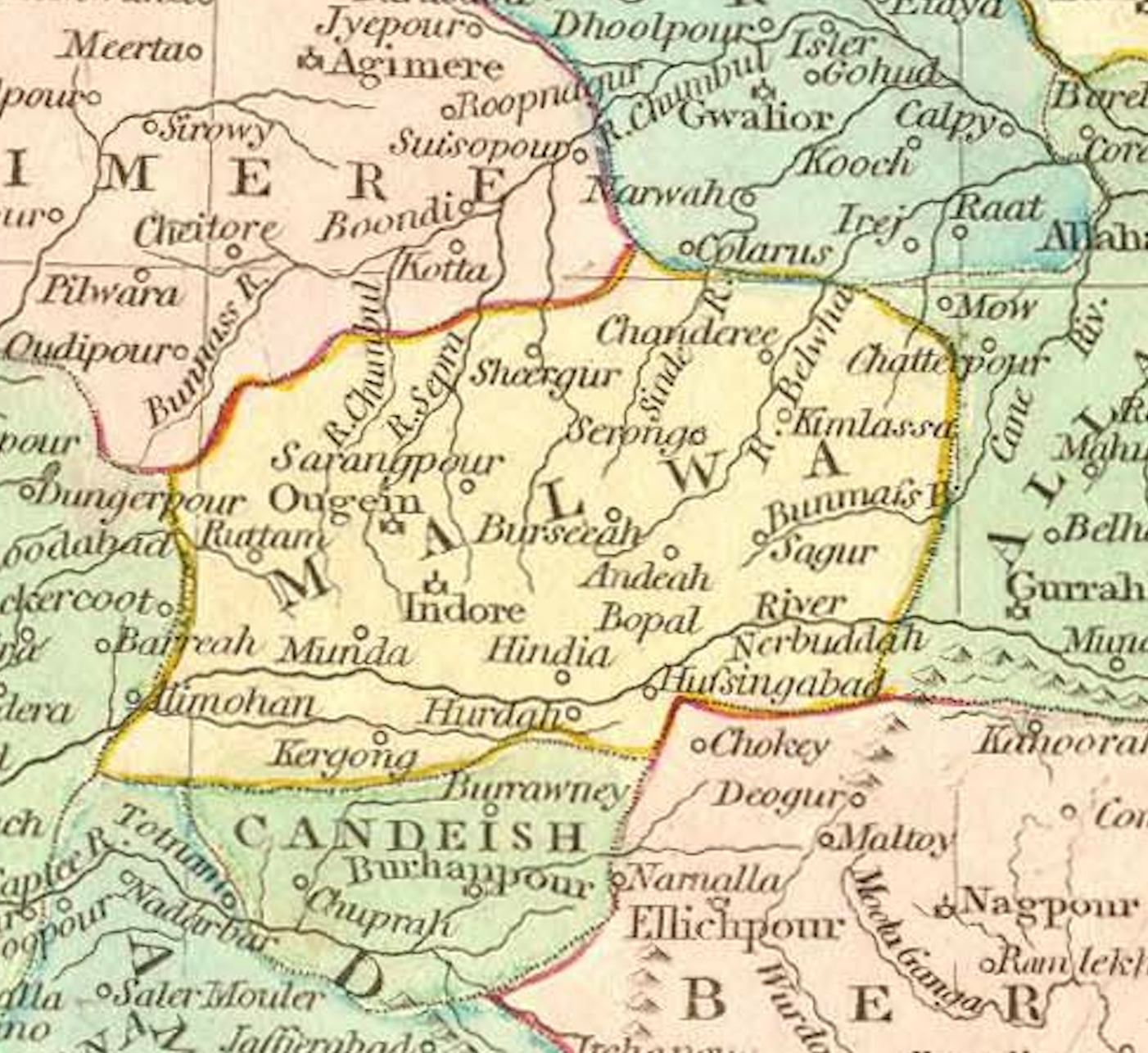
The Malwa Subah (Persian: صوبه ملوا) was one of the original twelve Subahs (provinces) of the Mughal Empire, including Gondwana, from 1568–1743. Its seat was Ujjain in the Malwa region. It shared borders with the autonomous and tributary chiefdoms in the east, as well as Berar, Khandesh, Ahmadnagar, Gujarat, Ajmer, Agra, and Illahabad subahs.
Before becoming part of the Mughal Empire, the Malwa region was an independent sultanate. Its last ruler, Baz Bahadur, was defeated and its capital, Mandu, was conquered in 1562 by the Mughal Emperor Akbar’s army led by Abdullah Khan, the Uzbeg. He was appointed its first governor. In 1564 he was replaced by Qara Bahadur Khan. In 1568 it became a subah of Mughal empire.[citation needed] One of its last governors was Sawai Jai Singh, who was the governor of the Subah for three times, from 1714-17, from 1729-30 and from 28 September 1732 to 4 August 1737. The Mughal hold on Malwa ended in 1743, when Peshwa Balaji Baji Rao obtained the formal grant of Naib-subahdari (deputy governorship) of Malwa.
Malwa Subah comprised 12 sarkars (districts): Ujjain, Chanderi, Raisen, Garha Mandla, Sarangpur, Bijagarh, Mandu, Handia, Nandurbar, Mandsaur, Gagron and Kotri-Parava. These sarkars are further divided into 301 parganas. The city of Ujjain was the capital of the subah.
The sarkars (districts) and the parganas (tehsils) of Malwa Subah were:
Hub AI
Malwa Subah AI simulator
(@Malwa Subah_simulator)
Malwa Subah
The Malwa Subah (Persian: صوبه ملوا) was one of the original twelve Subahs (provinces) of the Mughal Empire, including Gondwana, from 1568–1743. Its seat was Ujjain in the Malwa region. It shared borders with the autonomous and tributary chiefdoms in the east, as well as Berar, Khandesh, Ahmadnagar, Gujarat, Ajmer, Agra, and Illahabad subahs.
Before becoming part of the Mughal Empire, the Malwa region was an independent sultanate. Its last ruler, Baz Bahadur, was defeated and its capital, Mandu, was conquered in 1562 by the Mughal Emperor Akbar’s army led by Abdullah Khan, the Uzbeg. He was appointed its first governor. In 1564 he was replaced by Qara Bahadur Khan. In 1568 it became a subah of Mughal empire.[citation needed] One of its last governors was Sawai Jai Singh, who was the governor of the Subah for three times, from 1714-17, from 1729-30 and from 28 September 1732 to 4 August 1737. The Mughal hold on Malwa ended in 1743, when Peshwa Balaji Baji Rao obtained the formal grant of Naib-subahdari (deputy governorship) of Malwa.
Malwa Subah comprised 12 sarkars (districts): Ujjain, Chanderi, Raisen, Garha Mandla, Sarangpur, Bijagarh, Mandu, Handia, Nandurbar, Mandsaur, Gagron and Kotri-Parava. These sarkars are further divided into 301 parganas. The city of Ujjain was the capital of the subah.
The sarkars (districts) and the parganas (tehsils) of Malwa Subah were:
Recent media