


Community hub
Recent from talks
Contribute something to knowledge base
Content stats: 0 posts, 0 articles, 1 media, 0 notes
Members stats: 0 subscribers, 0 contributors, 0 moderators, 0 supporters
Subscribers
Supporters
Contributors
Moderators
Hub AI
Royal Exchange, Manchester AI simulator
(@Royal Exchange, Manchester_simulator)
Hub AI
Royal Exchange, Manchester AI simulator
(@Royal Exchange, Manchester_simulator)
Royal Exchange, Manchester
The Royal Exchange is a grade II listed building in Manchester, England. It is located in the city centre. The complex includes the Royal Exchange Theatre and the Royal Exchange Shopping Centre.
The cotton industry in Lancashire was served by the cotton importers and brokers based in Liverpool who supplied Manchester and surrounding towns with the raw material needed to spin yarns and produce finished textiles. The Liverpool Cotton Exchange traded in imported raw cotton. In the 18th century, the trade was part of the slave trade in which African slaves were transported to America where the cotton was grown and then exported to Liverpool where the raw cotton was sold. The raw cotton was processed in Manchester and the surrounding cotton towns and Manchester Royal Exchange traded in spun yarn and finished goods throughout the world including Africa. Manchester's first exchange opened in 1729 but closed by the end of the century.
As the cotton industry boomed, the need for a new exchange was recognised. Thomas Harrison designed the second exchange, completed in 1809, at the junction of Market Street and Exchange Street. Harrison designed the exchange in the Classical style. It had two storeys above a basement and was constructed in Runcorn stone. The cost, £20,000, was paid for in advance by 400 members who bought £50 shares and paid £30 each to buy the site. The semi-circular north façade had fluted Doric columns. The exchange room where business was conducted covered 812 square yards. The ground floor also contained the members' library with more than 15,000 books. The basement housed a newsroom lit by a dome and plate-glass windows, its ceiling was supported by a circle of Ionic pillars spaced 15 feet (4.6 m) from the walls. The first-floor dining-room was accessed by a geometrical staircase. The exchange opened to celebrate the birthday of George III in 1809. It also contained other anterooms and offices.
As the cotton trade continued to expand, larger premises were required and its extension was completed in 1849. The design featured a huge new Doric order portico. The Exchange was run by a committee of notable Manchester industrialists. From 1855 to 1860, the committee was chaired by Edmund Buckley.
The second exchange was replaced by a third designed by Mills & Murgatroyd, constructed between 1867 and 1874. It was extended and modified by Bradshaw Gass & Hope between 1914 and 1931 to form the largest trading hall in England. In order to maximise the internal space, these modifications required the demolition of a huge Corinthian order portico on the Cross Street frontage which had former part of the Mills & Murgatroyd design. The trading hall had three domes and was double the size of the current hall. The colonnade parallel to Cross Street marked its centre. On trading days merchants and brokers struck deals which supported the jobs of tens of thousands of textile workers in Manchester and the surrounding towns. Manchester's cotton dealers and manufacturers trading from the Royal Exchange earned the city the name, Cottonopolis.
The exchange was seriously damaged during the Second World War when it took a direct hit from a bomb during a German air raid in the Manchester Blitz at Christmas in 1940. Its interior was rebuilt with a smaller trading area. The top stages of the clock tower, which had been destroyed, were replaced in a simpler form. Trading ceased in 1968, and the building was threatened with demolition.
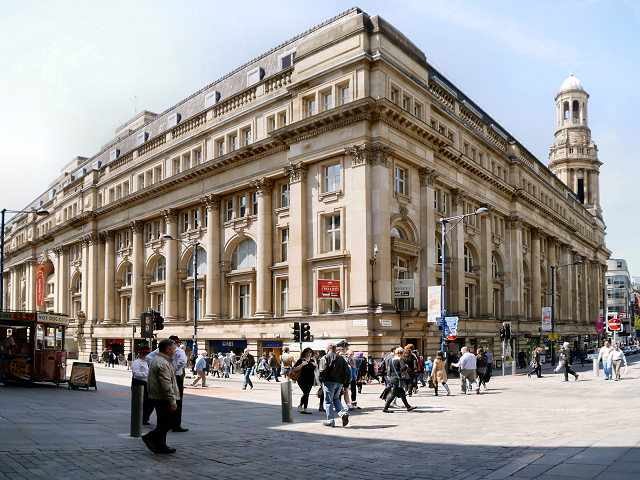
The exchange has four storeys and two attic storeys built on a rectangular plan in Darley Dale stone. It was designed in the Classical style. Its slate roof has three glazed domes and on the ground floor an arcade orientated east to west. It has a central atrium at first-floor level. The ground floor facade has channelled rusticated piers and the first, second and third floors have Corinthian columns with entablature and a modillioned cornice. The first attic storey has a balustraded parapet while the second attic storey has a mansard roof. At the north-west corner is a Baroque turret and there are domes over other corners. The west side has a massive round-headed entrance arch with wide steps up and the first and second floor windows have round-headed arches. The third floor and first attic storey have mullioned windows.
The building remained empty until 1973, when it was used to house a theatre company (69 Theatre Company); the company performed in a temporary theatre but there were plans for a permanent theatre whose cost was then estimated at £400,000. The Royal Exchange Theatre was founded in 1976 by five artistic directors: Michael Elliott, Caspar Wrede, Richard Negri, James Maxwell and Braham Murray. The theatre was opened by Laurence Olivier on 15 September 1976. In 1979, the artistic directorship was augmented by the appointment of Gregory Hersov.
Royal Exchange, Manchester
The Royal Exchange is a grade II listed building in Manchester, England. It is located in the city centre. The complex includes the Royal Exchange Theatre and the Royal Exchange Shopping Centre.
The cotton industry in Lancashire was served by the cotton importers and brokers based in Liverpool who supplied Manchester and surrounding towns with the raw material needed to spin yarns and produce finished textiles. The Liverpool Cotton Exchange traded in imported raw cotton. In the 18th century, the trade was part of the slave trade in which African slaves were transported to America where the cotton was grown and then exported to Liverpool where the raw cotton was sold. The raw cotton was processed in Manchester and the surrounding cotton towns and Manchester Royal Exchange traded in spun yarn and finished goods throughout the world including Africa. Manchester's first exchange opened in 1729 but closed by the end of the century.
As the cotton industry boomed, the need for a new exchange was recognised. Thomas Harrison designed the second exchange, completed in 1809, at the junction of Market Street and Exchange Street. Harrison designed the exchange in the Classical style. It had two storeys above a basement and was constructed in Runcorn stone. The cost, £20,000, was paid for in advance by 400 members who bought £50 shares and paid £30 each to buy the site. The semi-circular north façade had fluted Doric columns. The exchange room where business was conducted covered 812 square yards. The ground floor also contained the members' library with more than 15,000 books. The basement housed a newsroom lit by a dome and plate-glass windows, its ceiling was supported by a circle of Ionic pillars spaced 15 feet (4.6 m) from the walls. The first-floor dining-room was accessed by a geometrical staircase. The exchange opened to celebrate the birthday of George III in 1809. It also contained other anterooms and offices.
As the cotton trade continued to expand, larger premises were required and its extension was completed in 1849. The design featured a huge new Doric order portico. The Exchange was run by a committee of notable Manchester industrialists. From 1855 to 1860, the committee was chaired by Edmund Buckley.
The second exchange was replaced by a third designed by Mills & Murgatroyd, constructed between 1867 and 1874. It was extended and modified by Bradshaw Gass & Hope between 1914 and 1931 to form the largest trading hall in England. In order to maximise the internal space, these modifications required the demolition of a huge Corinthian order portico on the Cross Street frontage which had former part of the Mills & Murgatroyd design. The trading hall had three domes and was double the size of the current hall. The colonnade parallel to Cross Street marked its centre. On trading days merchants and brokers struck deals which supported the jobs of tens of thousands of textile workers in Manchester and the surrounding towns. Manchester's cotton dealers and manufacturers trading from the Royal Exchange earned the city the name, Cottonopolis.
The exchange was seriously damaged during the Second World War when it took a direct hit from a bomb during a German air raid in the Manchester Blitz at Christmas in 1940. Its interior was rebuilt with a smaller trading area. The top stages of the clock tower, which had been destroyed, were replaced in a simpler form. Trading ceased in 1968, and the building was threatened with demolition.
The exchange has four storeys and two attic storeys built on a rectangular plan in Darley Dale stone. It was designed in the Classical style. Its slate roof has three glazed domes and on the ground floor an arcade orientated east to west. It has a central atrium at first-floor level. The ground floor facade has channelled rusticated piers and the first, second and third floors have Corinthian columns with entablature and a modillioned cornice. The first attic storey has a balustraded parapet while the second attic storey has a mansard roof. At the north-west corner is a Baroque turret and there are domes over other corners. The west side has a massive round-headed entrance arch with wide steps up and the first and second floor windows have round-headed arches. The third floor and first attic storey have mullioned windows.
The building remained empty until 1973, when it was used to house a theatre company (69 Theatre Company); the company performed in a temporary theatre but there were plans for a permanent theatre whose cost was then estimated at £400,000. The Royal Exchange Theatre was founded in 1976 by five artistic directors: Michael Elliott, Caspar Wrede, Richard Negri, James Maxwell and Braham Murray. The theatre was opened by Laurence Olivier on 15 September 1976. In 1979, the artistic directorship was augmented by the appointment of Gregory Hersov.
Recent media
Recent media