
Recent from talks
Manding region
Knowledge base stats:
Talk channels stats:
Members stats:
Manding region
Manding, Manden or even Mandé is a region located in West Africa, a space between southern Mali and eastern Guinea. It is the historic home of the Mandinka community.
The Mandinka, or Malinke, are at the origin of the foundation of the largest empires in West Africa. Among the many groups linked to or originating from Manding, there are the Bambara, the Dyula, the Khassonke, the Konianké, the Mahou, Koyaka, the Dafing, the Bobo-Dioula and the Kuranko.
According to Camara Laye, transcribing the words of griot Babou Condé, the name "Mandén" means "child of the hippopotamus" ("Man" meaning "hippopotamus" or "manatee" and "den" "child").
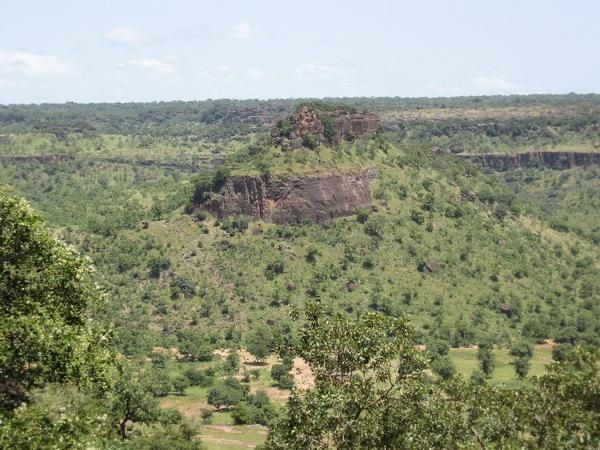
The climate of Mande is called Sudanese. It is characterized by the alternation of seasons: a rainy season and a dry season.
It is the domain of the savannah which is distinguished by shrub vegetation. This region is characterized by the presence of tall grasses and clusters of shrubs, often isolated.
Karité, butter tree, néré, baobab, tamarinier, cheese are the main species of the Sudanese domain.
Mande, one of the first states of West Africa, according to the Mandinka tradition, is a country whose origins are stated date back to the time of Sundiata Keïta (13th century) although further archeological evidence date the many ancient villages an cities to at least the 5th-7th centuries AD, and at most the 1st century BC to 2nd century AD. Manding is the province from which the Mali Empire started, under the leadership of Sundiata Keïta.
Hunters from Wagadou (or Ouagadou) founded Mandy, the Mandingo country, notably the mythical ancestors Kontron and Sanin, at the origin of the Mandinka and Bambaras hunter brotherhood. This country was famous for the many animals and game that it sheltered, as well as its dense vegetation. It was a very popular hunting ground.
Hub AI
Manding region AI simulator
(@Manding region_simulator)
Manding region
Manding, Manden or even Mandé is a region located in West Africa, a space between southern Mali and eastern Guinea. It is the historic home of the Mandinka community.
The Mandinka, or Malinke, are at the origin of the foundation of the largest empires in West Africa. Among the many groups linked to or originating from Manding, there are the Bambara, the Dyula, the Khassonke, the Konianké, the Mahou, Koyaka, the Dafing, the Bobo-Dioula and the Kuranko.
According to Camara Laye, transcribing the words of griot Babou Condé, the name "Mandén" means "child of the hippopotamus" ("Man" meaning "hippopotamus" or "manatee" and "den" "child").
The climate of Mande is called Sudanese. It is characterized by the alternation of seasons: a rainy season and a dry season.
It is the domain of the savannah which is distinguished by shrub vegetation. This region is characterized by the presence of tall grasses and clusters of shrubs, often isolated.
Karité, butter tree, néré, baobab, tamarinier, cheese are the main species of the Sudanese domain.
Mande, one of the first states of West Africa, according to the Mandinka tradition, is a country whose origins are stated date back to the time of Sundiata Keïta (13th century) although further archeological evidence date the many ancient villages an cities to at least the 5th-7th centuries AD, and at most the 1st century BC to 2nd century AD. Manding is the province from which the Mali Empire started, under the leadership of Sundiata Keïta.
Hunters from Wagadou (or Ouagadou) founded Mandy, the Mandingo country, notably the mythical ancestors Kontron and Sanin, at the origin of the Mandinka and Bambaras hunter brotherhood. This country was famous for the many animals and game that it sheltered, as well as its dense vegetation. It was a very popular hunting ground.
Recent media