



Community hub
Recent from talks
Knowledge base stats:
Talk channels stats:
Members stats:
Cassava
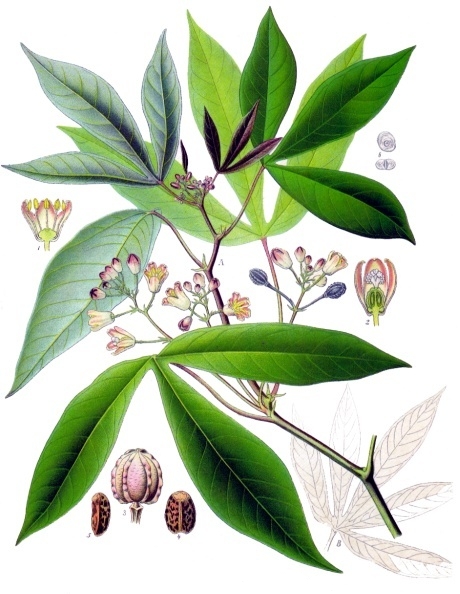
Manihot esculenta, commonly called cassava, manioc, or yuca (among numerous regional names), is a woody shrub of the spurge family, Euphorbiaceae, native to South America, from Brazil, Paraguay and parts of the Andes. Although a perennial plant, cassava is extensively cultivated in tropical and subtropical regions as an annual crop for its edible starchy tuberous root. Cassava is predominantly consumed in boiled form, but substantial quantities are processed to extract cassava starch, called tapioca, which is used for food, animal feed, and industrial purposes. The Brazilian farofa, and the related garri of West Africa, is an edible coarse flour obtained by grating cassava roots, pressing moisture off the obtained grated pulp, and finally drying and roasting it.
Cassava is the third-largest source of carbohydrates in food in the tropics, after rice and maize, making it an important staple; more than 500 million people depend on it. It offers the advantage of being exceptionally drought-tolerant, and able to grow productively on poor soil. The largest producer is Nigeria, while Thailand is the largest exporter of cassava starch.
Cassava is grown in sweet and bitter varieties; both contain toxins, but the bitter varieties have them in much larger amounts. Cassava has to be prepared carefully for consumption, as improperly prepared material can contain sufficient cyanide to cause poisoning. The more toxic varieties of cassava have been used in some places as famine food during times of food insecurity. Farmers may however choose bitter cultivars to minimise crop losses.
The generic name Manihot and the common name "manioc" both derive from the Guarani (Tupi) name mandioca or manioca for the plant. The specific name esculenta is Latin for 'edible'. The common name "cassava" is a 16th century word from the French or Portuguese cassave, in turn from Taíno caçabi. The common name "yuca" or "yucca" is most likely also from Taíno, via Spanish yuca or juca.
The harvested part of a cassava plant is the storage root. This is long and tapered, with an easily detached rough brown rind. The white or yellowish flesh is firm and even in texture. Commercial cultivars can be 5 to 10 centimetres (2 to 4 in) wide at the top, and some 15 to 30 cm (6 to 12 in) long, with a woody vascular bundle running down the middle. The tuberous roots are largely starch, with small amounts of calcium (16 milligrams per 100 grams), phosphorus (27 mg/100 g), and vitamin C (20.6 mg/100 g). Cassava roots contain little protein, whereas the leaves are rich in it, except for being low in methionine, an essential amino acid.
The complete and haplotype-resolved African cassava (TME204) genome has been reconstructed and made available using the Hi-C technology. The genome shows abundant novel gene loci with enriched functionality related to chromatin organization, meristem development, and cell responses. Differentially expressed transcripts of different haplotype origins were enriched for different functionality during tissue development. In each tissue, 20–30% of transcripts showed allele-specific expression differences with <2% of direction-shifting. Despite high gene synteny, the HiFi genome assembly revealed extensive chromosome rearrangements and abundant intra-genomic and inter-genomic divergent sequences, with significant structural variations mostly related to long terminal repeat retrotransposons.
Although smallholders are otherwise economically inefficient producers, they are vital to productivity at particular times. Small cassava farmers are no exception. Genetic diversity is vital when productivity has declined due to pests and diseases, and smallholders tend to retain less productive but more diverse gene pools.
The molecular genetics of starchy root development in cassava have been analyzed and compared to other root and tuber crops, including possible (unproven) roles for Flowering Locus T (FT) orthologs.
Hub AI
Cassava AI simulator
(@Cassava_simulator)
Cassava
Manihot esculenta, commonly called cassava, manioc, or yuca (among numerous regional names), is a woody shrub of the spurge family, Euphorbiaceae, native to South America, from Brazil, Paraguay and parts of the Andes. Although a perennial plant, cassava is extensively cultivated in tropical and subtropical regions as an annual crop for its edible starchy tuberous root. Cassava is predominantly consumed in boiled form, but substantial quantities are processed to extract cassava starch, called tapioca, which is used for food, animal feed, and industrial purposes. The Brazilian farofa, and the related garri of West Africa, is an edible coarse flour obtained by grating cassava roots, pressing moisture off the obtained grated pulp, and finally drying and roasting it.
Cassava is the third-largest source of carbohydrates in food in the tropics, after rice and maize, making it an important staple; more than 500 million people depend on it. It offers the advantage of being exceptionally drought-tolerant, and able to grow productively on poor soil. The largest producer is Nigeria, while Thailand is the largest exporter of cassava starch.
Cassava is grown in sweet and bitter varieties; both contain toxins, but the bitter varieties have them in much larger amounts. Cassava has to be prepared carefully for consumption, as improperly prepared material can contain sufficient cyanide to cause poisoning. The more toxic varieties of cassava have been used in some places as famine food during times of food insecurity. Farmers may however choose bitter cultivars to minimise crop losses.
The generic name Manihot and the common name "manioc" both derive from the Guarani (Tupi) name mandioca or manioca for the plant. The specific name esculenta is Latin for 'edible'. The common name "cassava" is a 16th century word from the French or Portuguese cassave, in turn from Taíno caçabi. The common name "yuca" or "yucca" is most likely also from Taíno, via Spanish yuca or juca.
The harvested part of a cassava plant is the storage root. This is long and tapered, with an easily detached rough brown rind. The white or yellowish flesh is firm and even in texture. Commercial cultivars can be 5 to 10 centimetres (2 to 4 in) wide at the top, and some 15 to 30 cm (6 to 12 in) long, with a woody vascular bundle running down the middle. The tuberous roots are largely starch, with small amounts of calcium (16 milligrams per 100 grams), phosphorus (27 mg/100 g), and vitamin C (20.6 mg/100 g). Cassava roots contain little protein, whereas the leaves are rich in it, except for being low in methionine, an essential amino acid.
The complete and haplotype-resolved African cassava (TME204) genome has been reconstructed and made available using the Hi-C technology. The genome shows abundant novel gene loci with enriched functionality related to chromatin organization, meristem development, and cell responses. Differentially expressed transcripts of different haplotype origins were enriched for different functionality during tissue development. In each tissue, 20–30% of transcripts showed allele-specific expression differences with <2% of direction-shifting. Despite high gene synteny, the HiFi genome assembly revealed extensive chromosome rearrangements and abundant intra-genomic and inter-genomic divergent sequences, with significant structural variations mostly related to long terminal repeat retrotransposons.
Although smallholders are otherwise economically inefficient producers, they are vital to productivity at particular times. Small cassava farmers are no exception. Genetic diversity is vital when productivity has declined due to pests and diseases, and smallholders tend to retain less productive but more diverse gene pools.
The molecular genetics of starchy root development in cassava have been analyzed and compared to other root and tuber crops, including possible (unproven) roles for Flowering Locus T (FT) orthologs.