



Community hub
Recent from talks
Contribute something to knowledge base
Content stats: 0 posts, 0 articles, 1 media, 0 notes
Members stats: 0 subscribers, 0 contributors, 0 moderators, 0 supporters
Subscribers
Supporters
Contributors
Moderators
Hub AI
Manti Utah Temple AI simulator
(@Manti Utah Temple_simulator)
Hub AI
Manti Utah Temple AI simulator
(@Manti Utah Temple_simulator)
Manti Utah Temple
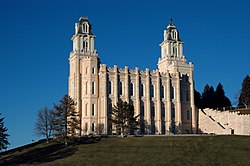
The Manti Utah Temple (formerly the Manti Temple) is the fifth constructed temple of the Church of Jesus Christ of Latter-day Saints. The temple construction was completed in 1888. Located in the city of Manti, Utah, it was the third Latter-day Saint temple built west of the Mississippi River, after the Mormon pioneers trekked west. (The St. George and Logan Utah temples preceded it.) The Manti Temple was designed by William Harrison Folsom, who moved to Manti while the temple was under construction. The temple dominates the Sanpete Valley and can be seen from many miles. Like all Latter-day Saint temples, only church members holding a valid temple recommend may enter. For many years, it was one of only two remaining Latter-day Saint temples in the world where a live portrayal was used in the endowment ceremony (the other was the Salt Lake Temple until its closure for renovation in December 2019). All temples now use a film in the presentation of the endowment, including the Manti Temple since its rededication in 2024. It is an early pioneering example of four rooms representing the journey of life.
Church president Brigham Young announced the decision to build a temple in Manti on June 25, 1875, and dedicated the site on April 25, 1877. On the day of the dedication, Young took Warren S. Snow to the southeast corner of the temple site and told him, "Here is the spot where the Prophet Moroni stood and dedicated this piece of land for a Temple site, and that is the reason why the location is made here, and we can't move it from this spot."
The Salt Lake Temple had been announced in 1847, but construction was still underway and not finished until 1893. The Manti Temple was built, along with the St. George and Logan temples, to satisfy the church's immediate need for these structures. The site for the temple was the Manti Stone Quarry, a large hill immediately northeast of town. Early pioneer settlers in the area prophesied that this would be the site of a temple. When Young announced the building of the temple, he also announced that the 27-acre (110,000 m2) plot would then be known as "Temple Hill."
The temple was completed in 1888, and a private dedication was held on May 17, 1888, with a prayer written by Wilford Woodruff. Three public dedications were held on May 21–23, 1888, and were directed by Lorenzo Snow. The Manti Temple's dedication was held during the apostolic interregnum following the death of church president John Taylor. It is one of three temples in church history dedicated during such an interregnum (the others being the Nauvoo Temple, dedicated in 1846 following the death of Joseph Smith, and the Elko Nevada Temple, dedicated in 2025 following the death of Russell M. Nelson).
The Manti Temple was the location of the Holy of Holies until the Salt Lake Temple was dedicated. The room was then used for sealings until it was closed in the late 1970s.
A 1966 study found that 52 percent of temple work was being done in either the Salt Lake, Logan, or Manti temples, even though there were 13 operating temples by that time. This led to the building of the Ogden and Provo temples to relieve the strain on the older pioneer-era temples.
The temple includes murals by several Latter-day Saint artists, including C. C. A. Christensen (Creation Room, 1886–87), Minerva Teichert (World Room, 1947, assisted by Frank Stevens), Robert L. Shepherd (Garden Room, 1946), John Hafen, J. B. Fairbanks, and Dan Weggeland. Some of the original murals, having been damaged and unable to be saved, had sail canvas placed over them in order for new murals to be painted. The temple houses the only pioneer-era mural to survive inside a of a temple. For instance, Weggeland's Garden Room mural still exists underneath Shepherd's original. The temple is also filled with other paintings. The mix of paintings has changed over time, but among the paintings originally intended for the building include two by Christensen. One of those depicts the hill where the temple would later sit with a Native American encampment in the foreground, with the other being the temple itself and its landscaped grounds.
Minerva Teichert was commissioned to create the World Room mural by church president George Albert Smith. She was the first woman in the church to be commissioned to paint. She was given $4,000 for the project. At the time of creating the murals, Teichert was suffering from the effects of lead poisoning, which can cause difficulties including nausea, abdominal pain, and optic neuritis. She created a deadline of a month to finish the project, and would occasionally give a whole day just to a specific section. She was known to ask for prayers for her health and would pray extra during times of difficulty working on the painting. Frank Stevens provided assistance with moving scaffolding and creating sketches under Teichert's supervision. Much of the work of painting took place high up on scaffolding stretching up to 28 feet, and both Stevens and Teichert faced fears about working so high. While working on the Tower of Babel scene, she fell off a scaffold and hurt her arm. After consulting a doctor, she resumed work a few hours later, out on the same ledge as before. The mural features 120 figures, Teichert referred to it as a "great pageant." At the end of the process, she related that she worked ‘very fast’ and that “No mural decorator in America ever beat that – nearly 4,000 square feet (370 m2) in 23 days.” More work remained on the temple, and she returned at different times to continue touching up the mural, which ended up being about 28 days in total, with the last of the touch ups ending in March 1948.
Manti Utah Temple
The Manti Utah Temple (formerly the Manti Temple) is the fifth constructed temple of the Church of Jesus Christ of Latter-day Saints. The temple construction was completed in 1888. Located in the city of Manti, Utah, it was the third Latter-day Saint temple built west of the Mississippi River, after the Mormon pioneers trekked west. (The St. George and Logan Utah temples preceded it.) The Manti Temple was designed by William Harrison Folsom, who moved to Manti while the temple was under construction. The temple dominates the Sanpete Valley and can be seen from many miles. Like all Latter-day Saint temples, only church members holding a valid temple recommend may enter. For many years, it was one of only two remaining Latter-day Saint temples in the world where a live portrayal was used in the endowment ceremony (the other was the Salt Lake Temple until its closure for renovation in December 2019). All temples now use a film in the presentation of the endowment, including the Manti Temple since its rededication in 2024. It is an early pioneering example of four rooms representing the journey of life.
Church president Brigham Young announced the decision to build a temple in Manti on June 25, 1875, and dedicated the site on April 25, 1877. On the day of the dedication, Young took Warren S. Snow to the southeast corner of the temple site and told him, "Here is the spot where the Prophet Moroni stood and dedicated this piece of land for a Temple site, and that is the reason why the location is made here, and we can't move it from this spot."
The Salt Lake Temple had been announced in 1847, but construction was still underway and not finished until 1893. The Manti Temple was built, along with the St. George and Logan temples, to satisfy the church's immediate need for these structures. The site for the temple was the Manti Stone Quarry, a large hill immediately northeast of town. Early pioneer settlers in the area prophesied that this would be the site of a temple. When Young announced the building of the temple, he also announced that the 27-acre (110,000 m2) plot would then be known as "Temple Hill."
The temple was completed in 1888, and a private dedication was held on May 17, 1888, with a prayer written by Wilford Woodruff. Three public dedications were held on May 21–23, 1888, and were directed by Lorenzo Snow. The Manti Temple's dedication was held during the apostolic interregnum following the death of church president John Taylor. It is one of three temples in church history dedicated during such an interregnum (the others being the Nauvoo Temple, dedicated in 1846 following the death of Joseph Smith, and the Elko Nevada Temple, dedicated in 2025 following the death of Russell M. Nelson).
The Manti Temple was the location of the Holy of Holies until the Salt Lake Temple was dedicated. The room was then used for sealings until it was closed in the late 1970s.
A 1966 study found that 52 percent of temple work was being done in either the Salt Lake, Logan, or Manti temples, even though there were 13 operating temples by that time. This led to the building of the Ogden and Provo temples to relieve the strain on the older pioneer-era temples.
The temple includes murals by several Latter-day Saint artists, including C. C. A. Christensen (Creation Room, 1886–87), Minerva Teichert (World Room, 1947, assisted by Frank Stevens), Robert L. Shepherd (Garden Room, 1946), John Hafen, J. B. Fairbanks, and Dan Weggeland. Some of the original murals, having been damaged and unable to be saved, had sail canvas placed over them in order for new murals to be painted. The temple houses the only pioneer-era mural to survive inside a of a temple. For instance, Weggeland's Garden Room mural still exists underneath Shepherd's original. The temple is also filled with other paintings. The mix of paintings has changed over time, but among the paintings originally intended for the building include two by Christensen. One of those depicts the hill where the temple would later sit with a Native American encampment in the foreground, with the other being the temple itself and its landscaped grounds.
Minerva Teichert was commissioned to create the World Room mural by church president George Albert Smith. She was the first woman in the church to be commissioned to paint. She was given $4,000 for the project. At the time of creating the murals, Teichert was suffering from the effects of lead poisoning, which can cause difficulties including nausea, abdominal pain, and optic neuritis. She created a deadline of a month to finish the project, and would occasionally give a whole day just to a specific section. She was known to ask for prayers for her health and would pray extra during times of difficulty working on the painting. Frank Stevens provided assistance with moving scaffolding and creating sketches under Teichert's supervision. Much of the work of painting took place high up on scaffolding stretching up to 28 feet, and both Stevens and Teichert faced fears about working so high. While working on the Tower of Babel scene, she fell off a scaffold and hurt her arm. After consulting a doctor, she resumed work a few hours later, out on the same ledge as before. The mural features 120 figures, Teichert referred to it as a "great pageant." At the end of the process, she related that she worked ‘very fast’ and that “No mural decorator in America ever beat that – nearly 4,000 square feet (370 m2) in 23 days.” More work remained on the temple, and she returned at different times to continue touching up the mural, which ended up being about 28 days in total, with the last of the touch ups ending in March 1948.
Recent media
Recent media