


Community hub
Recent from talks
Contribute something
Nothing was collected or created yet.
Temple (LDS Church)
View on Wikipedia

In the Church of Jesus Christ of Latter-day Saints (LDS Church), a temple is a building dedicated to be a House of the Lord. Temples are considered by church members to be the most sacred structures on earth.
Upon completion, temples are usually open to the public for a short period of time (an "open house"). During the open house, the church conducts tours of the temple with missionaries and members from the local area serving as tour guides, and all rooms of the temple are open to the public. The temple is then dedicated as a "House of the Lord", after which only members who are deemed "temple-worthy" by their congregational leaders are permitted entrance.[1]
Temples are not churches or meetinghouses designated for public weekly worship services, but rather are places of worship open only to the faithful where certain rites of the church must be performed.[2]
The LDS Church has 382 temples in various phases, which includes 210 dedicated temples (203 operating, 7 undergoing renovations[3]), 5 with dedications scheduled, 57 under construction, 1 with a groundbreaking ceremony scheduled, and 109 others announced (not yet under construction).[4] There are temples in many U.S. states, as well as in many countries across the world. Several temples are at historical sites of the LDS Church, such as Nauvoo, Illinois, Palmyra, New York, and Salt Lake City, Utah. The importance of temples is often emphasized in weekly meetings, and regular participation in "temple work" is strongly encouraged for all Latter-day Saints (LDS).
Within temples, members of the church make covenants, receive instructions, and perform sacred ceremonies and ordinances, such as baptism for the dead, washing and anointing (or "initiatory" ordinances), the endowment, and eternal marriage sealings. Ordinances are a vital part of the theology of the church, which teaches that they were practiced by the Lord's covenant people in all dispensations.


History
[edit]Biblical references
[edit]Latter-day Saints cite various Old Testament references to temple ordinances such as those found in Exodus 29:4–9, Exodus 28:2–43 and Leviticus 8:6–13. The words "HOLINESS TO THE LORD" can be found on LDS temples as referenced in Exodus 28:36.[7]
Likewise the Tabernacle was considered a "portable temple" by the children of Israel in the Old Testament.[8][clarification needed]
.svg)


 = Operating
 = Under construction
 = Announced
 = Temporarily Closed
Latter-day temples
[edit] | This article needs additional citations for verification. (December 2023) |
The first Latter-day Saint temple ceremonies were performed in Kirtland, Ohio, but differed significantly from the endowment performed on the second floor of Joseph Smith's Red Brick Store in Nauvoo, Illinois, and the Nauvoo Temple. Kirtland ordinances included washings and anointings (differing in many ways from the modern portion) and the washing of the feet ordinance. For nearly four years, beginning in 1842, Smith's Red Brick Store functioned as a de facto temple—the site of the first washings, anointings, endowments, and sealings. In contrast, the grand edifice known as the Nauvoo Temple was in operation for only two months before the Latter Day Saints left Illinois for the West.
Preparations to initiate the first members of Smith's Quorum of the Anointed,[9] or Holy Order, as it was also known, were made on May 3, 1842. The walls of the second level of the Red Brick Store were painted with garden-themed murals, the rooms fitted with carpets, potted plants, and a veil hung from the ceiling. All the while, the ground level continued to operate as Smith's general mercantile.
After the early events of the succession crisis, Brigham Young assumed control of the church's headquarters at Nauvoo, Illinois. While he and the rest of the Quorum of the Twelve made contingency plans for abandoning the city, he may have hoped that it would not prove necessary. For example, in early 1845, Young convened a conference at the Norwegian colony at Norway, Illinois, and announced a plan to build a Latter-day Saint town there with a temple for the use of the Norwegian Latter Day Saints.[10]
Meanwhile, Young urged the Latter-day Saints in Nauvoo to redouble their efforts to finish the temple. By the end of 1845, the building was sufficiently finished to allow temple ordinances to be performed. Ordinances continued to be performed in early 1846 as the Mormons were forced to abandon the city. A small crew remained in the city and continued to work on the temple until April 30, 1846, when it was formally dedicated in a private ceremony[11] by Joseph Young,[12] the senior of the Seven Presidents of the Seventy. It was used for three months, then abandoned in late summer 1846. The completed temple was eventually destroyed by fire, and the remaining structure was later demolished by a whirlwind.[13]

Upon reaching the Great Basin, Brigham Young began to build settlements based on the City of Zion plan and designated four of these to contain temples: Salt Lake City (1847), St. George (1871), Manti (1875), and Logan (1877). The St. George Temple was the first to be completed in 1877, followed by Logan (1884) and Manti (1888). The Salt Lake Temple took 40 years to complete because of various setbacks and delays. It was dedicated in 1893.
In the late 1880s and in 1890, a desire to continue the ordinance work in temples was a significant consideration preceding Wilford Woodruff's decision (announced in his Manifesto of September 1890) that the church would discontinue its practice of polygamy. In 1887 the US Congress passed the Edmunds–Tucker Act, which disincorporated the church and directed federal officials to begin seizing its assets, potentially including its temples. After a conversation with Woodruff, Logan Temple president Marriner W. Merrill stated that the contemplated public announcement prohibiting additional polygamist unions was "the only way to retain the possession of our temples and continue the ordinance work for the living and dead which was considered of more importance than continuing the practice of plural marriage for the present."[14]
Latter-day Saint temple building halted until the presidency of Joseph F. Smith, who announced two additional temples: Cardston, Alberta (1913), and Lāʻie, Hawaiʻi (1915). Cardston became the first Latter-day Saint temple dedicated outside of the United States. Smith broke with the previous tradition (established since Kirtland) of building temples with upper and lower courts. Temples previously had been ever larger, but the Laie Hawaii Temple was smaller than the Nauvoo Temple had been.
Both Cardston and Laie were dedicated under church president Heber J. Grant, as was a temple in Mesa, Arizona. George Albert Smith dedicated the next temple in Idaho Falls, Idaho. David O. McKay dedicated five additional temples including one in Bern, Switzerland—which was the first temple dedicated in Europe and the first temple to use film recording of the endowment rather than live actors. Joseph Fielding Smith dedicated a temple in Ogden, Utah, and Harold B. Lee dedicated its twin in Provo, Utah.

Spencer W. Kimball began a plan to build many more smaller temples according to standardized plans. Twenty-one temples were dedicated during his presidency, including the tiny Papeete Tahiti Temple—which has a floorspace of less than 10,000 square feet (900 m2). This trend has continued. Nine additional temples were dedicated in the presidency of Ezra Taft Benson and two in the brief presidency of Howard W. Hunter.
Under church president Gordon B. Hinckley, the church dedicated 77 temples. In 1997, Hinckley introduced a standardized, smaller temple plan designed to bring temple services to smaller or remote congregations at a reduced cost. The first of this new generation of temples was completed in 1998 with the Monticello Utah Temple. The original plan called for 6,800 square feet (630 m2), later increased to 10,700 square feet (990 m2). Subsequent revisions to the standard design further increased the size and complexity of the temples. The majority of the temples dedicated under Hinckley's tenure were of the smaller design. During Hinckley's administration, the temple in Nauvoo, Illinois was rebuilt, and is known as the Nauvoo Illinois Temple.
Hinckely's successor, Thomas S. Monson, dedicated 26 temples during his time as church president. His counselors in the First Presidency also dedicated a number of temples during Monson's administration.
As of October 2018, Monson's successor, Russell M. Nelson, has dedicated the Concepción Chile Temple. The LDS Church has 382 temples in various phases, which includes 210 dedicated temples (203 operating, 7 undergoing renovations[15]), 5 with dedications scheduled, 57 under construction, 1 with a groundbreaking ceremony scheduled, and 109 others announced (not yet under construction).[16] It has been suggested that recent temple construction represents an attempt by church leadership to “re-energize” congregations in the face of flat numerical growth.[17]

Symbolism in the temple
[edit]
Most temples are built facing east, the direction from which Jesus Christ is prophesied to return.[18][19] The spires and towers on the east end of multi-spired temples are elevated higher than spires and towers on the west side for this same reason, and to represent the Melchizedek, or higher, priesthood.
Some temples, such as Salt Lake, Chicago, and Washington D.C., have triple spires on each side of the temple representing three different offices in both the Melchizedek and Aaronic priesthood.[20]
A statue of the Angel Moroni stands atop many temples built after the Salt Lake Temple. The statue design represents the Latter-day Saint belief that Moroni was the angel spoken of in Revelation 14.[21]
Temple ordinances
[edit].JPG)
LDS Church members perform rituals (termed ordinances) within temples. They are taught that temple ordinances are essential to achieving the condition of exaltation after the final judgment. They are also taught that a vast number of dead souls exist in a condition termed as spirit prison, and that a dead individual upon whom the temple ordinances are completed will have a chance to be freed of this imprisoning condition. In this framework ordinances are said to be completed on behalf of either the participant, or a dead individual the same sex as the participant ("on behalf of the dead" or "by proxy").
Ordinances performed in the temple include:
- Baptism and confirmation on behalf of the dead
- Melchizedek priesthood ordination on behalf of deceased men
- Washing and anointing (also known as the "Initiatory" ordinances)
- The endowment
- Sealing ordinances (for opposite-sex couples and for parents and their children)
Most ordinances are performed by proxy only on participants who have already completed the ordinance. Similarly, most ordinances are completed only one time for a participant in a lifetime and all subsequent temple ordinance participation is seen as acting for a dead individual. Baptism, confirmation, and priesthood ordination are usually performed in temples only when on behalf of the dead. The initiatory, endowment, and sealing ceremonies are today performed only within a temple.
The sealing ordinance can be performed on behalf of dead couples; so long as the two living participants are of opposite sex they need not be married. It is also performed on behalf of living couples who wish to be legally married. In this manner, the ordinance is typically performed as a celestial marriage, with the idea the marriage bond lasts after their death, or for "time and all eternity". A "time only" modification can be made to the ordinance, such as when the surviving widow of a celestial marriage wishes to legally remarry.[22]
In addition to the ordinances listed above, 19th-century temples were host to other ordinances that are no longer practiced such as the baptism for health and baptism for renewal of covenants.[23] In 1922, Heber J. Grant discontinued the practice of baptisms for health in the church. The second anointing is a rare, but currently practiced ordinance for live participants,[24][25] and (less commonly) vicariously for deceased individuals,[26] though, it is usually only given in absolute secrecy to a small number of members after a lifetime of service.[27]
Entrance requirements
[edit]


The LDS Church booklet "Preparing to Enter the Holy Temple" explains that Latter-day Saints "do not discuss the temple ordinances outside the temples".[28]
To enter the temple, an individual must be baptized, and after one year, may seek a temple recommend, which authorizes admission to the temple. The person is interviewed by their bishop, during which the candidate is asked a series of questions to determine worthiness to enter the temple. The individual is also interviewed by his or her stake president. The bishop and stake president sign the recommend, indicating their approval of that member's worthiness. The individual also signs the recommend, acknowledging the responsibility to remain eligible to hold the recommend. Most recommends are valid for two years.
Ineligible groups of members
[edit]Temple ordinances have historically been unavailable to some members. For about 130 years (between 1847 and 1978) all LDS endowment-related temple ordinances were denied to all Black women and men in a controversial race-based policy.[29][30]: 164 [31]: 261 As of 2023[update], all temple ordinances are unavailable to lesbian, gay, or bisexual persons who are in a same-sex marriage or homosexual sexual relationship, and to all transgender individuals who are transitioning or have transitioned.[32][33][34] These restrictions have also garnered criticism from both outside,[35][36][37] and inside the LDS church.[38][39][40]
Worthiness interview
[edit]To qualify for a temple recommend, an LDS Church member must faithfully answer the following questions which affirm the individual's belief in essential church doctrine, and adherence to essential church practices:[46]
- Faith in and testimony of God the Father, Jesus Christ, and the Holy Ghost.
- Testimony of the atonement of Jesus Christ and his role as personal Savior and Redeemer.
- Testimony of the restoration of the gospel.
- Support of the President of the Church and his authority, and other general authorities and local church leaders.
- Moral cleanliness in thoughts and actions.
- Obeying the law of chastity.
- Following teachings of the church in public and private behavior with family members and others.
- Refraining from supporting or promoting any teaching, practice, or doctrine that conflicts with those of the church.
- Making a good faith effort to keep the Sabbath Day holy; attend meetings; prepare for and worthily partake of the sacrament; live life in accordance with the laws and commandments of the gospel.
- Honesty in everything.
- Paying a full tithe.
- Understanding and obeying the Word of Wisdom.
- Payment of and keeping current on child support or alimony, if applicable.
- If already received the endowment, keeping the covenants made in the temple and wearing the temple garment as instructed in the temple.
- Making a full confession of any serious sins to church leaders.
- Regarding oneself eligible to enter the temple and participate in ordinances therein.
History of interview questions
[edit]A list of questions were first introduced in 1857 and used to qualify whether an individual could enter the Endowment House, before the first temple in Utah was built. They reflected the context of the times, including questions about one's belief in polygamy, branding an animal that one did not own, and using another person's irrigation water.[47]: 168 [48][49]: 100
Since then, the temple recommend questions have changed significantly, though less so in recent years.[47]: 138
- In 1996, the first question about a belief in God, Jesus Christ, and the Holy Ghost was split into three questions. A second question was modified to ask if the member sustained the First Presidency and Quorum of the Twelve as prophets, seers, and revelators. The question about wearing the garments was qualified, adding a clause about wearing them as instructed in the temple.[50]
- In 1999, a simplified question about financial obligations was asked of all members, not just divorced members.[51]
- In October 2019's general conference, church president Russell M. Nelson announced revisions to the temple recommend questions. In addition to some clarifications and streamlining, the question about the law of chastity now includes "striving for moral cleanliness" in thoughts and behavior. The question about attending church meetings was expanded to include a more general question about Sabbath observance.[52]
Types of recommends
[edit]
The standard temple recommend authorizes a member who has been baptized at least one year prior to take part in all temple ordinances and is valid for two years.
A recommend for living ordinances is given to individuals who are participating in the endowment for the first time, being sealed to a spouse, or anyone being married in the temple for time only. It may only be used in conjunction with a standard temple recommend.[53]
A limited-use recommend is available to members who have not yet received their endowment or who have not been a member for one year. These may also be issued to a group for a single visit to the temple,[53] to youth 11 and older, or to others for specific cases.
Emergency access
[edit]Those without recommends occasionally need to enter temples after dedication during fires, medical emergencies, or building inspections. They are escorted by temple personnel during such visits. Temples may offer introductory tours to new local firefighters and emergency medical technicians during regularly scheduled maintenance periods.[54]
Temple weddings
[edit]The LDS temple wedding is a process which culminates in the participation by the couple in a ritual called the sealing ordinance; which involves pronouncing the couple as having a permanent marriage bond which persists even beyond death. This ceremony, among others, is taught as being vital to an individual's and family's exaltation status, following the final judgment.
With the sealing ordinance being held inside a temple, only church members in good standing who have a valid temple recommend are permitted to attend the ceremony. In many nations outside the United States, a civil ceremony, where required by the law of the land, has been immediately followed by a temple sealing.[citation needed]
Converts to the church must wait a year after their own confirmation before entering the temple.[55]
See also
[edit]
Notes
[edit]- ^ Duffy, John Charles; Howlett, David J. (2017). Mormonism: The Basics. New York City: Routledge. p. 109. ISBN 978-1-315-45396-5 – via Google Books.
- ^ "Of Chapels and Temples: Explaining Mormon Worship Services", News Release, Newsroom, LDS Church, November 15, 2007, retrieved October 10, 2012
- ^ Hill, Victoria (January 23, 2023). "Plans announced to rebuild, relocate Anchorage Alaska Temple". KUTV. Retrieved July 6, 2024. (The Anchorage Alaska Temple is being relocated and resized. While the new temple is under construction, the existing temple is open and will be decommissioned and demolished after the new one is dedicated).
- ^ Additionally, the church has 1 historic site temple. "Sacred Sites and Historic Documents Transfer to Church of Jesus Christ". newsroom.churchofjesuschrist.org. March 5, 2024. Retrieved July 6, 2024.
- ^ "150th Temple Is Dedicated: Provo City Center Temple becomes the 16th Utah temple", Newsroom, LDS Church, March 20, 2016
- ^ Walch, Tad (March 20, 2016), "Elder Oaks dedicates Provo City Center Temple as 150th temple of the LDS Church", Deseret News, archived from the original on March 23, 2016
- ^ "Temple", LDS Bible Dictionary, KJV (LDS), LDS Church
- ^ "Tabernacle", LDS Bible Dictionary, KJV (LDS), LDS Church
- ^ Anderson, Devery S.; Bergera, James, eds. (2005). Joseph Smith's Quorum of the Anointed, 1842-1845: A Documentary History. Salt Lake City: Signature Books. p. [page needed]. ISBN 1-56085-186-4. OCLC 57965858. Archived from the original on February 2, 2013.
- ^ Haslam, Gerald M. (2007). "The Illinois Milieu of the First Norwegian Converts to Mormonism in the Early 1840s". BYU Family Historian. 6. Retrieved November 22, 2019.
- ^ McBride, Mathew S. (July 2002). "The First Nauvoo Temple: So Great a Cause". The Church of Jesus Christ of Latter-day Saints. Archived from the original on September 29, 2020. Retrieved November 22, 2019.
- ^ Colvin, Don F. (2002). Nauvoo Temple: A Story of Faith (2002 ed.). Provo, Utah: Religious Studies Center, Brigham Young University. p. 250. ISBN 1-5915-6014-4. Retrieved November 22, 2019.
- ^ "The Nauvoo Temple: Destruction and Rebirth". history.churchofjesuschrist.org.
- ^ Lyman, Edward Leo (1994), "Manifesto (Plural Marriage)", Utah History Encyclopedia, University of Utah Press, ISBN 9780874804256, archived from the original on May 30, 2023, retrieved August 15, 2024
- ^ Hill, Victoria (January 23, 2023). "Plans announced to rebuild, relocate Anchorage Alaska Temple". KUTV. Retrieved July 6, 2024. (The Anchorage Alaska Temple is being relocated and resized. While the new temple is under construction, the existing temple is open and will be decommissioned and demolished after the new one is dedicated).
- ^ Additionally, the church has 1 historic site temple. "Sacred Sites and Historic Documents Transfer to Church of Jesus Christ". newsroom.churchofjesuschrist.org. March 5, 2024. Retrieved July 6, 2024.
- ^ Why so many new Mormon temples when LDS growth is flat? Religion News Service. May 20, 2021. Accessed December 1, 2023
- ^ Kenney, Wendy. "Looking Up to Moroni". www.churchofjesuschrist.org. Retrieved March 12, 2020.
- ^ Givens, George W. (2023). 500 Little-Known Facts About Nauvoo. Cedar Fort. p. 255. ISBN 978-1-4621-0033-0. Retrieved March 19, 2025.
- ^ Arave, Lynn (November 27, 2008). "Symbolism Can Be Seen in Architecture of S.L. Temple". Deseret News. LDS Church.
- ^ Talmage, James E. (1998) [1912]. The House of the Lord: A Study of Holy Sanctuaries, Ancient and Modern. Salt Lake City, Utah: Signature Books. p. 176. ISBN 1-56085-114-7.
- ^ Church Handbook of Instructions, Book 1: Stake Presidencies and Bishoprics, Salt Lake City, Utah: LDS Church, 2010, p. 71
- ^ Stapley, Jonathan; Wright, Kristine (2008). "'They Shall Be Made Whole': A History of Baptism for Health". Journal of Mormon History. SSRN 1664180.
- ^ Quinn, D. Michael (1992). "Mormon Women Have Had the Priesthood Since 1843". In Hanks, Maxine (ed.). Women and Authority: Re-emerging Mormon Feminism. Salt Lake City: Signature Books. p. 377. ISBN 1-56085-014-0.
Currently some women have received this 'fullness of the priesthood' with their husbands. In the Salt Lake temple, the second anointing still occurs in the 'Holy of Holies' room which James E. Talmage wrote 'is reserved for the higher ordinances in the Priesthood...' The second anointing for both men and women is distinct from ordination to church priesthood offices.
- ^ Buerger, David J. (December 15, 2002). "Joseph Smith's Ritual". The Mysteries of Godliness: A History of Mormon Temple Worship. Signature Books. p. 66. ISBN 978-1560851769.
In practice today the second anointing is actually the first of two parts comprising the fullness of the priesthood ceremony.
- ^ Buerger, David John (1983). ""The Fulness of the Priesthood": The Second Anointing in Latter-day Saint Theology and Practice" (PDF). Dialogue: A Journal of Mormon Thought. 16 (1): 42–43. doi:10.2307/45225125. JSTOR 45225125.
Nonetheless, occasional instances of present-day anointings have occurred. Vicarious second anointings are also performed, but are less frequent.
- ^ Kramer, Bradley H. (2014). Keeping the Sacred: Structured Silence in the Enactment of Priesthood Authority, Gendered Worship, and Sacramental Kinship in Mormonism (PDF) (PhD). University of Michigan. p. 33.
The public/open secrecy of temple-work in general stands in contrast to the actual and absolute secrecy of one particular feature of its ritual corpus: the ordinance known variously as the Second Anointing (or Second Anointings), second endowment, or the Fullness of the Priesthood. The blessings of this ordinance are conferred onto only a very small number of Mormons, usually after the better part of a lifetime of faithful and loyal service. ... These rites are a closed, absolute secret. Only those Mormons considered most trustworthy by high Church leadership are invited to participate, and they are expressly instructed not to disclose anything about the ordinance, including their own participation in it, to anyone, including family (only married couples participate in the rite).
- ^ "These Things Are Sacred", Preparing to Enter the Holy Temple, LDS Church, 2002
- ^ White, O. Kendall Jr. (March 1995). "Integrating Religious and Racial Identities: An Analysis of LDS African American Explanations of the Priesthood Ban". Review of Religious Research. 36 (3): 296–297. doi:10.2307/3511536. JSTOR 3511536.
'Celestial' or 'temple' marriage is a necessary condition for 'exaltation' ... Without the priesthood, Black men and women ... were denied complete exaltation, the ultimate goal of Mormonism.
- ^ Harris, Matthew L.; Bringhurst, Newell G. (2015). The Mormon Church and Blacks: A Documentary History. Chicago: University of Illinois Press. ISBN 978-0-252-08121-7. ProQuest 2131052022 – via Google Books.
- ^ Bush, Lester E. (1973). "Mormonism's Negro Doctrine: An Historical Overview" (PDF). Dialogue. 8 (1).
- ^ Simmons, Brian (December 2017). Coming out Mormon: An examination of religious orientation, spiritual trauma, and PTSD among Mormon and ex-Morman LGBTQQA adults (PDF) (PhD). Athens, Georgia: University of Georgia. p. 65.
[A] current temple recommend [allows one] to participate in temple ordinances. In order to hold a current temple recommend, a person must attest to their ecclesiastical leaders that they maintain faith in the LDS Church, and live according to the standards (including no sexual activity outside of heterosexual marriage and abstaining from coffee, tea, alcohol, tobacco, and illicit drugs).
- ^ "Temples". churchofjesuschrist.org. LDS Church. June 2019. Retrieved February 27, 2023.
- ^ Fletcher Stack, Peggy; Noyce, David (February 19, 2020). "LDS Church publishes new handbook with changes to discipline, transgender policy". Salt Lake Tribune.
- ^ Browning, Bill (December 21, 2021). "Utah billionaire leaves Mormon church with blistering accusation it is actively harming the world". LGBTQ Nation. San Francisco, California. Archived from the original on December 21, 2021. Retrieved February 27, 2023.
- ^ Winters, Rosemary (February 23, 2023). "Mormon apostle's words about gays spark protest". The Salt Lake Tribune. Salt Lake City, Utah. Retrieved November 16, 2016.
- ^ Bailey, Sarah Pulliam (November 11, 2016). "Mormon Church to exclude children of same-sex couples from getting blessed and baptized until they are 18". The Washington Post. Archived from the original on January 17, 2023. Retrieved February 27, 2023 – via Internet Archive.
- ^ Murphy, Caryle (December 18, 2015). "Most U.S. Christian groups grow more accepting of homosexuality". pewresearch.org. Pew Research Center. Retrieved February 27, 2023.
- ^ Levin, Sam (August 15, 2016). "'I'm not a Mormon': fresh 'mass resignation' over anti-LGBT beliefs". The Guardian. Retrieved February 27, 2023.
- ^ Hatch, Heidi (April 13, 2016). "Millennial Mormons leaving faith at higher rate than previous generations". Salt Lake City, Utah: CBS. KUTV. Retrieved February 27, 2023.
- ^ "Church Updates Temple Recommend Interview Questions", churchofjesuschrist.org, 6 October 2019.
- ^ Daniel H. Ludlow, ed. (1992). "Interviews". Encyclopedia of Mormonism. Macmillan Publishing Company. pp. 697–98.
- ^ Edward L. Kimball (1996–97). "Confession in LDS Doctrine and Practice". BYU Studies. 36 (2).
- ^ Edward L. Kimball (1998) "The History of LDS Temple Admission Standards". Journal of Mormon History 24 (1): 135–176
- ^ Lee Hale (November 12, 2018). "Why Do Mormon Bishops Talk To Youth About Sex?". KUER's RadioWest.
- ^ [41][42][43][44][45]
- ^ a b Edward L., Kimball (January 1, 1998). "The History of LDS Temple Admission Standards". Journal of Mormon History. Vol. 24, no. 1. JSTOR 23287671. Retrieved June 3, 2023 – via Utah State University.
- ^ Smith, Merina (2011). The New and Everlasting Order of Marriage: The Introduction and Implementation of Mormon Polygamy: 1830-1856 (PDF) (PhD thesis). University of California, San Diego. p. 85.
- ^ Buerger, David J. (December 15, 2002). "Joseph Smith's Ritual". The Mysteries of Godliness: A History of Mormon Temple Worship. Signature Books. ISBN 978-1560851769 – via Google Books.
- ^ "Church Makes Subtle Changes in Temple Recommend Interview" (PDF), Sunstone (News) (104): 87, September 1996, retrieved February 16, 2012
- ^ "Changes Made to Recommend Interview" (PDF), Sunstone (Update) (117): 73–74, February 2000, retrieved February 16, 2012
- ^ "Church Updates Temple Recommend Interview Questions: While standards to enter a temple stay the same, these modifications better prepare Latter-day Saints for worship in temples", Newsroom, LDS Church, October 6, 2019
- ^ a b Church Handbook of Instructions, Book 1, LDS Church, 2006, p. [page needed].
- ^ Federico, Hillary (May 25, 2012). "Mormon Temple, Massachusetts Neighbors Live In Peace". Hartford Courant. Retrieved May 25, 2012.[dead link]
- ^ "Couples Married Civilly Now Authorized for Immediate Temple Marriage: New policy sets single global standard", Newsroom, LDS Church, May 6, 2019
References
[edit]- Buerger, David John (2002). The Mysteries of Godliness: A History of Mormon Temple Worship (2nd ed.). San Francisco and Salt Lake City: Smith Research Associates and Signature Books. ISBN 1-56085-176-7. Archived from the original on March 23, 2006.
- Cowan, Richard O. (2011) [1998]. Temples to Dot the Earth. Springville, Utah: Cedar Fort. ISBN 978-1-55517-339-5.
- Kimball, Edward L. (1998). "The History of LDS Temple Admission Standards". Journal of Mormon History. 24 (1): 135–176. Archived from the original on June 13, 2011.
- Monesees, Laurie Smith, The Temple: Dedicated to Peace, Herald House: 1993.
- Packer, Boyd K. (1980). The Holy Temple. Salt Lake City, Utah: Bookcraft. ISBN 0-88494-411-5.
- Ricks, Stephen D. (2012). ""Build a House to My Name": The Idea of the Temple in Mormon History". In Cusack, Carol; Norman, Alex (eds.). Handbook of New Religions and Cultural Production. Brill Handbooks on Contemporary Religion. Vol. 4. Leiden: Brill Publishers. pp. 17–37. doi:10.1163/9789004226487_003. ISBN 978-90-04-22187-1. ISSN 1874-6691.
- Robison, Elwin C. (1997). The First Mormon Temple: Design, Construction, and Historic Context of the Kirtland Temple. Provo, Utah: Brigham Young University Press. ISBN 0-8425-2333-2.
- Speek, Vickie Cleverley. "God Has Made Us a Kingdom" James Strang and the Midwest Mormon. Signature Books.
- Talmage, James E. (1998) [1912]. The House of the Lord: A Study of Holy Sanctuaries, Ancient and Modern. Salt Lake City, Utah: Signature Books. ISBN 1-56085-114-7.
- Preparing to Enter the Holy Temple. LDS Church. 2002..
- "The Temple" British Broadcasting BBC, 2005-11-09. Article on Mormon temple worship from BBC Religion & Ethics website, last accessed 2006-09-19.
Further reading
[edit]- Barber, Allen (2006), Celestial Symbols: Symbolism in Doctrine, Religious Traditions and Temple Architecture, Cedar Fort, ISBN 0-88290-808-1
- Cowan, Richard O., Temples to Dot the Earth, January 1997, ISBN 1-55517-339-X
- Greene, Mark (2000), The Scriptural Temple, Cedar Fort, ISBN 0-88290-681-X
- Hawthorne, Christopher (February 14, 2002). "Latter-Day Fortresses: The spooky charisma of Mormon temples". Slate. New York City. Archived from the original on September 9, 2005. Retrieved May 7, 2021.
- Jackson, Richard W. (2007) [2003]. Places of Worship: 150 Years of Latter-day Saint Architecture (PDF). Provo, Utah: Religious Education at Brigham Young University. ISBN 978-1591563907. Retrieved May 7, 2021 – via Harold B. Lee Library.
- King, David (2000), Come to the House of the Lord, Cedar Fort, ISBN 0-88290-687-9
- Packer, Boyd K., The Holy Temple, June 1980, ISBN 0-88494-411-5
- Parry, Donald W, ed. (1994). Temples of the Ancient World: Ritual and Symbolism. Salt Lake City: Maxwell Institute. ISBN 087579811X. OCLC 28927139.
- Shields, Mark (2009), Your Endowment, Cedar Fort, ISBN 978-1-59955-287-3
- Talmage, James E., The House of the Lord Signature Books (reprint of the first edition) ISBN 1-56085-114-7
External links
[edit]


Temple (LDS Church)
View on GrokipediaHistorical Development
Biblical and Ancient Precedents
The concept of temples in Latter-day Saint theology draws from biblical descriptions of ancient sacred structures as places where God's presence manifested and covenants were enacted between deity and humanity. In the Old Testament, the Tabernacle constructed under Moses served as a portable precursor, housing the Ark of the Covenant within the Holy of Holies to symbolize divine dwelling amid the Israelites.[13] This evolved into the permanent Temple built by Solomon around 957 BCE, detailed as a rectangular edifice measuring approximately 90 feet long, 30 feet wide, and 45 feet high, overlaid with gold and featuring cherubim, palm trees, and floral motifs to evoke Edenic purity and cosmic order.[14][15] LDS doctrine interprets these as archetypes for dedicated spaces facilitating ritual purity, sacrificial atonement, and priestly mediation, with the high priest's annual entry into the veiled inner sanctuary on the Day of Atonement representing access to God's throne for covenant renewal.[16][17] Ancient Israelite temple rituals emphasized separation of the sacred from the profane, involving washings, anointings, and offerings to invoke divine presence, as seen in consecration rites for priests and the ongoing sacrificial system that underscored themes of obedience and reconciliation.[18] The Temple's courts accommodated communal gatherings for festivals like Passover and Pentecost, reinforcing collective covenants tied to Israel's election and land promises, while prophetic visions—such as Isaiah's throne-room encounter or Ezekiel's idealized future sanctuary—portrayed temples as loci for direct theophany and eschatological restoration.[19][20] Post-exilic reconstructions, including Zerubbabel's Temple (completed 516 BCE) and Herod's expansions, maintained this continuity despite scaled-down grandeur, preserving functions until Roman destruction in 70 CE.[21] In the New Testament, early Christians, including apostles like Peter and Paul, frequented the Jerusalem Temple for prayer, teaching, and healing until its fall, viewing it as a valid site for worship amid transition to messianic fulfillment.[22] Jesus' temple activities—cleansing merchants, discoursing with scribes, and predicting its desolation—highlighted its role in divine pedagogy, while Pauline epistles extended "temple" metaphorically to believers' bodies and the church community as indwelt by the Holy Spirit, signaling an internalized divine presence post-Christ's atonement.[23][24] Latter-day Saint teachings posit these physical and symbolic precedents as foreshadowing restored temple functions for eternal covenants, distinct from sacrificial cessation after 70 CE, though mainstream biblical scholarship attributes New Testament shifts to supersession rather than ongoing institutional templar rites.[16]Restoration and Early Temples (1830s–1840s)
In December 1832, Joseph Smith received a revelation recorded as Doctrine and Covenants 88, commanding the construction of "a house of God" in Kirtland, Ohio, to serve as a place for instruction and divine endowment.[25] [26] The revelation emphasized the temple's role in preparing the Saints for gathering and receiving "power from on high," amid the early church's efforts to establish communal practices following its organization in 1830.[27] Construction of the Kirtland Temple began in 1833, involving volunteer labor from approximately 100-200 Saints despite financial hardship and external opposition, with the structure completed by late 1835 at a cost exceeding $40,000 in period value.[28] It was dedicated on March 27, 1836, in a service attended by nearly 1,000 participants, during which Joseph Smith offered a prayer recorded in Doctrine and Covenants 109.[29] [30] One week later, on April 3, Joseph Smith and Oliver Cowdery reported visions in the temple's pulpits, including appearances of Jesus Christ accepting the structure, followed by Moses, Elias, and Elijah conferring priesthood keys for gathering Israel, gospel dispensation, and sealing powers, as documented in Doctrine and Covenants 110.[31] These events were cited by church leaders as foundational for subsequent temple ordinances, though contemporaneous accounts vary in detail and lack independent corroboration beyond participant testimonies. Following intensified persecution in Missouri, the church relocated to Nauvoo, Illinois, in 1839, where a January 19, 1841, revelation in Doctrine and Covenants 124 explicitly commanded temple construction as a condition for receiving promised blessings and exaltation.[32] Cornerstones were laid on April 6, 1841, with work progressing intermittently using local limestone, involving up to 1,000 workers at peak despite economic strain and threats from surrounding non-Mormon communities.[33] Construction faced delays from mob violence and internal challenges, including the controversial introduction of plural marriage, which heightened external hostilities. Prior to the temple's completion, Joseph Smith administered initial endowments to nine men on May 4, 1842, in the upper room of his Red Brick Store, adapting ceremonies for washing, anointing, and covenant-making as precursors to full temple rites.[34] Marriage sealings for eternity were also performed there, extending to plural unions for select leaders, with records indicating over 30 such sealings by mid-1843.[35] These innovations were presented as restorations of ancient practices essential for familial salvation, though they contributed to internal divisions and public backlash. Smith's assassination by a mob on June 27, 1844, amid charges related to destroying a newspaper exposing polygamy, accelerated persecution, yet leaders continued ordinances in the incomplete temple to fulfill the revelation's urgency before the Saints' exodus.[36] The Nauvoo Temple was partially dedicated on April 30, 1846, allowing endowments for about 5,000-7,000 Saints in the following months, but abandonment followed the February 1846 westward migration driven by mob incursions that damaged homes and crops.[34] The structure stood unfinished until arson destroyed its interior on October 9, 1848, with a subsequent tornado in 1850 toppling walls, symbolizing to adherents the causal necessity of temple work amid displacement, as unfulfilled commands were linked to withheld protections in church narratives.[37] [7] This period underscored the temple's role in doctrinal consolidation, with ordinances administered under duress reinforcing claims of divine imperative over temporal survival.Pioneer Era and Utah Settlement (1850s–1890s)
Following the exodus from Nauvoo, Illinois, in 1846–1847, Latter-day Saint pioneers under Brigham Young's leadership prioritized temple construction in the isolated Great Basin as a means to restore and standardize sacred ordinances disrupted by prior persecutions.[38] Brigham Young announced plans for multiple temples in Utah Territory shortly after arrival, viewing them as essential for doctrinal consolidation and self-sufficiency amid scarce resources and rudimentary infrastructure.[39] Labor was mobilized through tithing systems, with settlers contributing manual work, local stone, and timber despite ongoing settlement demands like irrigation and farming.[40] The St. George Utah Temple, the first completed west of the Mississippi River, exemplified these efforts. Brigham Young announced its construction on November 9, 1871, with groundbreaking that day in a small southern Utah community of fewer than 1,500 residents lacking sufficient skilled labor or machinery.[41] Workers quarried local red sandstone and volcanic rock for foundations, hauling materials by wagon over rough terrain, while the structure rose to four stories over five years.[42] Dedicated on April 6, 1877, by Young six months before his death, it enabled the full implementation of endowment and sealing ordinances for the first time since Nauvoo, standardizing practices that had been administered irregularly in endowments houses or Kirtland.[43] [44] This temple's completion, despite economic strains from grasshopper plagues and floods in the 1860s, underscored the church's commitment to temple worship as a doctrinal anchor during territorial isolation.[38] The Salt Lake Temple's protracted build highlighted escalating logistical and external pressures. Groundbreaking occurred on February 14, 1853, with cornerstone ceremonies on April 6, but progress stalled due to the pioneers' need to prioritize basic survival in a desert frontier, including the hand-cart migrations of 1856–1860 that diverted manpower.[45] Initial sandstone foundations were replaced with quarried granite blocks weighing up to 2,500 pounds each, transported 20 miles by oxen teams over ungraded roads, extending the timeline to 40 years.[40] Federal scrutiny intensified during the Utah War of 1857–1858, when U.S. troops were dispatched amid reports of theocratic governance and polygamy, though construction persisted under Young's direction as a symbol of resilience.[46] Anti-polygamy legislation, culminating in the Edmunds Act of 1882, led to church leaders' underground evasion and property seizures, yet the temple's capstone was laid in 1892 and dedicated on April 6, 1893, by Wilford Woodruff.[45] Parallel projects in Logan and Manti further demonstrated the church's decentralized building capacity amid hardships. The Logan Utah Temple site was dedicated on May 17, 1877, with construction using local brick and lumber, completed despite harsh Cache Valley winters and labor shortages from emigration calls.[47] Dedicated on May 17, 1884, by John Taylor, it served northern settlements, reinforcing doctrinal unity through vicarious work.[48] Similarly, the Manti Utah Temple, announced by Young on June 25, 1875, relied on Sanpete Valley pioneers for limestone quarried from nearby hills, with construction spanning 1877–1888 amid regional droughts.[39] Dedicated in May 1888, these temples correlated with claims of institutional self-reliance, as the church funded efforts through cooperative enterprises like ZCMI, even as federal opposition peaked over polygamy enforcement.[49] By the 1890s, these structures solidified temple centrality in pioneer society, enabling ordinance access without eastern travel.[43]20th-Century Expansion
Following the issuance of the 1890 Manifesto by Church President Wilford Woodruff, which discontinued the practice of plural marriage and facilitated Utah's statehood in 1896, The Church of Jesus Christ of Latter-day Saints shifted toward broader institutionalization and geographic expansion of temple construction beyond the continental United States. This period marked a transition from Utah-centric temple building to international outreach, aligning with increasing membership outside the intermountain West. The Laie Hawaii Temple, dedicated on November 27–30, 1919, by President Heber J. Grant, became the first temple outside the continental U.S. states, serving Pacific Island members and symbolizing early global aspirations.[50] Similarly, the Cardston Alberta Temple, dedicated August 26–29, 1923, by Grant, represented the first temple in Canada, constructed to accommodate growing Canadian congregations without requiring long-distance travel to Utah.[51] Mid-century temple development accelerated under President David O. McKay (1951–1970), who dedicated four temples, including the Bern Switzerland Temple on September 11–15, 1955—the first in Europe—despite Cold War-era political barriers in the region. McKay's emphasis on localized temple access reflected the Church's post-World War II membership growth in Europe and emphasized building up the faith in members' native lands rather than encouraging mass emigration to Utah. This era saw temples like the Los Angeles California Temple (dedicated 1956) extending access to western U.S. populations, supporting doctrinal priorities of vicarious ordinances amid rising convert baptisms.[52][53] The late 20th century witnessed a pronounced temple boom under Presidents Spencer W. Kimball (1973–1985) and Gordon B. Hinckley (1995–2008), driven by aggressive proselytizing that expanded global membership from approximately 2.5 million in 1970 to over 11 million by 2000. Kimball announced numerous temples in developing regions, prioritizing ordinance availability for international converts, while Hinckley introduced smaller, efficient designs in 1997 to accelerate construction, leading to dedications such as the Toronto Ontario Temple in 1990. By the end of 2000, operating temples numbered 102, a milestone tied to membership surges that necessitated localized facilities to sustain doctrinal practices like eternal sealings and endowments.[54][55][56]Contemporary Temple Boom (2000–Present)
Since becoming president of The Church of Jesus Christ of Latter-day Saints in January 2018, Russell M. Nelson has announced locations for 200 temples, initiating a phase of accelerated expansion that has contributed to a total of 382 temples worldwide—comprising dedicated, under construction, and announced sites—as of September 2025.[57][9] This surge builds on steady announcements from 2000 to 2017, when the church added approximately 80 temples, but has markedly intensified post-2018, with Nelson's announcements averaging over 20 per year during peak general conferences, such as the 20 revealed in April 2021.[57][58] The expansion reflects membership increases in regions with limited prior temple access, particularly Africa, Asia, and Latin America, where convert baptisms have driven congregational growth; for instance, church membership in Africa exceeded 500,000 by 2023, with countries like Mozambique doubling to over 31,000 members since 2021, while Latin American nations such as Brazil and Mexico host millions of adherents necessitating closer proximity to temples.[59][60] As of late 2025, approximately 60 temples remain under construction globally, including sites in high-growth areas like the Philippines and Congo, with 9 of Nelson's recent announcements advancing to groundbreaking by September 2025.[57][61] Recent milestones underscore the pace: dedications occurred for temples in Samoa and Texas in 2024–2025, alongside groundbreakings in Belgium (Brussels, November 22, 2025) and Oklahoma, with ongoing construction at projects like Houston South Texas and Brussels Belgium.[62][63] Under Nelson's leadership, 49 temples have been dedicated since 2018, pushing the number of operating temples past 200 by November 2024, with further dedications scheduled into 2026 to accommodate regional demand.[64][57]Theological Foundations and Symbolism
Core Doctrinal Purposes
In the theology of The Church of Jesus Christ of Latter-day Saints, temples serve as sacred spaces designated as "houses of the Lord" where worthy members enter into covenants with God that are deemed essential for achieving exaltation, the highest degree of salvation in the celestial kingdom. These covenants, revealed through modern scripture, distinguish temple worship from regular chapel services, which focus on weekly sacraments like the sacrament of the Lord's Supper for all baptized members; temples, by contrast, are reserved for advanced commitments that bind participants to divine laws of obedience, sacrifice, and consecration, enabling progression toward godliness.[65][6] A central doctrinal purpose emphasizes the eternal nature of family relationships, positioning temples as venues for ordinances that seal spouses and generations together beyond mortality, countering individualistic views of kinship prevalent in secular societies by affirming familial bonds as prerequisite to divine inheritance.[66][67] Church teachings hold that such sealings, rooted in revelations to Joseph Smith, extend salvation to the entire human family through vicarious provisions, fostering a cosmology where personal exaltation is inextricably linked to collective familial redemption.[68] Empirical observations within LDS demographics support claims of enhanced family cohesion among temple participants; for instance, couples married in temples exhibit divorce rates substantially lower than national averages—approximately 6 percent versus 40-50 percent in the broader U.S. population—attributed by church analyses to the stabilizing influence of these covenants and associated standards of conduct.[69] Frequent temple attendance correlates with higher reported family affection and lower relational instability in Mormon samples, per studies examining religiosity's role in marital durability.[70][71] These patterns align with doctrinal assertions that temple commitments cultivate resilience against societal pressures eroding traditional family structures.Architectural and Ritual Symbolism
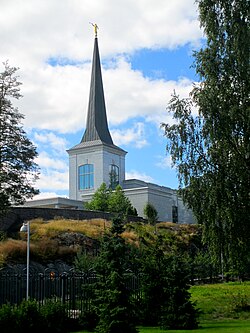
![Helsinki LDS Temple exterior showing spires][float-right] LDS temple architecture incorporates symbolic elements intended to evoke spiritual progression and divine order, with exterior features such as spires directing attention upward toward heaven and representing a connection to the divine.[72] These spires, often topped with the statue of the angel Moroni holding golden plates, symbolize the restoration of divine revelation and the proclamation of the gospel, drawing from biblical precedents of heavenly messengers.[73] While some critics interpret these vertical forms as reminiscent of ancient obelisks associated with pagan worship, LDS interpretations emphasize their role in pointing worshippers to Christ and celestial realms, rejecting occult connotations in favor of restorative symbolism aligned with scriptural motifs of ascent.[74][73] Interior spaces progress spatially and thematically to symbolize the journey from creation to exaltation, beginning with instruction rooms depicting stages such as the creation of the world, the Garden of Eden, and the fallen world, culminating in the celestial room as a representation of the divine presence and eternal rest.[75] This sequential arrangement mirrors the plan of salvation, where participants move through increasingly sacred environments, reflecting elevation through covenants and obedience.[76] The baptismal font, supported by twelve oxen statues, evokes the biblical brazen sea of Solomon's Temple, symbolizing the twelve tribes of Israel bearing the burden of vicarious ordinances for the dead and underscoring themes of atonement and tribal responsibility.[10][77] Ritual practices within these architectural frameworks employ typology and sacred geometry to convey first-principles of cosmic order and human deification, with elements like the celestial room's serene, light-filled design fostering meditation on exaltation in God's presence.[10] Defenders of these symbols, including LDS scholars, argue they restore esoteric rites from primitive Christianity and ancient temples, lost through apostasy, as evidenced by parallels in early Christian texts and Jewish traditions of graded sanctuaries.[78][79] Critiques, however, highlight borrowings from 19th-century Freemasonry introduced shortly before the endowment's formalization, viewing the esotericism as innovative rather than purely restorative, though church sources maintain divine origin supersedes historical influences.[80] This tension reflects broader debates on source credibility, where official narratives prioritize revelation over empirical historiography.[74]Temple Ordinances and Practices
The Endowment Ceremony
The temple endowment is a sacred ordinance administered within Latter-day Saint temples, consisting of instructional presentations and covenant-making rituals that outline the plan of salvation. Introduced by Joseph Smith on May 4, 1842, in the upper room of his Red Brick Store in Nauvoo, Illinois, the ceremony was initially presented to a small group of trusted associates before its expansion following the temple's completion.[81][82] It encompasses preparatory initiatory rites followed by a dramatic narrative depicting key doctrinal elements, including premortal councils, the creation of the earth, the fall of Adam and Eve, opposition in mortality, and the path of covenants leading to exaltation.[81][83] The initiatory portion involves symbolic washing and anointing with water and oil, signifying spiritual cleansing and consecration, after which participants are clothed in the temple garment—a white underclothing worn thereafter as a personal reminder of covenants and divine protection.[81][84] The core endowment presentation employs a scripted dialogue among divine and archetypal figures to instruct on humanity's eternal progression, emphasizing agency, opposition, and obedience to divine laws as prerequisites for returning to God's presence and achieving eternal life with Him.[81][85] Participants enter into five specific covenants during the ceremony: the law of obedience (striving to keep God's commandments); the law of sacrifice (willingness to support the Lord's work through service and repentance); the law of the gospel (exercising faith, repentance, baptism, and receiving the Holy Ghost); the law of chastity (sexual purity and fidelity); and the law of consecration (dedicating time, talents, and resources to building God's kingdom).[4][5] These commitments are accompanied by promised blessings of knowledge, power, and eternal increase, reinforcing the ordinance's role in preparing individuals for celestial glory.[4] The ceremony has undergone revisions to refine its presentation while preserving doctrinal content. In 1990, elements depicting symbolic penalties for covenant violation—such as ritual gestures representing self-inflicted consequences for revealing sacred signs and tokens—were removed to emphasize grace and avoid misinterpretation.[86] Further updates in January 2019, informed by feedback including from female temple leaders, shortened the proceedings, adjusted phrasing for clarity (e.g., aligning male and female covenant language to direct hearkening to God rather than spousal hierarchy), and eliminated practices like women's veiling during prayer, aiming to enhance focus on core teachings and participant experience.[87][88] These modifications reflect ongoing prophetic adaptation, as stated by church leadership, without altering the ordinance's foundational purpose.[81]Eternal Marriage Sealings
Eternal marriage sealings, known within The Church of Jesus Christ of Latter-day Saints as temple sealings, constitute an ordinance wherein a husband and wife, along with any children born or adopted to them, are united for "time and all eternity" rather than solely until death.[89] This rite is performed exclusively within dedicated temple sealing rooms by an officiant holding priesthood authority, referred to as the sealing power, which the church asserts was restored through Joseph Smith in 1843.[36][90] For living participants, a prior civil marriage is required, after which the couple enters the temple to receive the sealing, which the church teaches binds the family unit indissolubly in the afterlife if covenants are kept.[5] Children born after such a sealing are considered automatically sealed to their parents, while previously born or adopted children may receive a separate sealing ordinance to affirm this eternal linkage.[91] Proxy sealings extend this ordinance to deceased individuals, performed by living proxies on behalf of the dead to connect ancestral families across generations.[92] These vicarious rites include sealing deceased spouses to one another and parents to children, with eligibility generally beginning 30 days after death, though permissions may be sought earlier under specific circumstances such as for close relatives.[93] The church maintains that such sealings, when accepted by the deceased spirits, foster eternal family structures, positing a causal chain of familial continuity that transcends mortality and reinforces doctrinal commitments to genealogy and redemption of the dead.[94] While exact aggregate figures for proxy sealings are not publicly detailed in annual church reports, the scale of temple work implies millions of such ordinances have been conducted since the practice's inception, integrated with broader vicarious temple activities.[95] In doctrinal contrast to civil marriages, which the church views as temporal contracts dissolving at death, eternal sealings prioritize permanence and covenantal fidelity over cultural or legal formalities alone.[96] Civil ceremonies, while permissible for non-temple-eligible members, lack the asserted eternal efficacy, prompting encouragement for civilly married couples to later obtain temple sealings to secure family exaltation.[5] This emphasis underscores the church's teaching that only temple-performed unions, under proper authority, align with divine intent for human relationships, rendering non-sealed marriages preparatory but incomplete in the eternal framework.[90]Vicarious Ordinances for the Deceased
Vicarious ordinances in temples of The Church of Jesus Christ of Latter-day Saints encompass proxy baptisms, confirmations, initiatory washings and anointings, endowments, and sealings performed on behalf of deceased individuals, enabling them posthumous access to covenants believed essential for exaltation.[97] These practices originated with Joseph Smith's public announcement of baptism for the dead on August 15, 1840, during a funeral sermon in Nauvoo, Illinois, drawing scriptural precedent from 1 Corinthians 15:29 and Malachi 4:5–6.[98] A subsequent revelation in January 1841 specified that such baptisms occur in dedicated temples to ensure proper authority and setting.[98] Proxy baptisms for the dead occur in temple baptistries, where fonts are supported by twelve oxen statues symbolizing the twelve tribes of Israel and the burden of bearing salvific responsibilities.[72] The immersion in water represents burial and resurrection with Christ, as described in Romans 6:3–4, with the proxy descending into the font to enact the ordinance for the named deceased.[98] Confirmations follow immediately, performed by priesthood holders invoking the Holy Ghost on behalf of the deceased. Higher ordinances, such as endowments and sealings, extend these proxies to include covenant-making and family linkages, all recorded in church temple registries to prevent duplication. Names for vicarious work are primarily sourced through FamilySearch.org, the church's free genealogy platform, where members submit verified ancestor data prior to temple reservation.[97] Policies require a one-year waiting period post-death for most individuals, with additional clearances for those deceased less than 110 years ago to respect closest living relatives' permissions.[99] This system integrates doctrinal emphasis on universal salvation—allowing spirits in the postmortem realm to exercise agency in accepting or rejecting offered covenants—with rigorous record-keeping to ensure ordinances target unfulfilled proxies.[97] The imperative for vicarious work has empirically driven explosive growth in genealogical research among church members, transforming FamilySearch into a repository of billions of digitized historical records since its formal organization in 1894.[100] By 2021, the completion of microfilm digitization projects alone made billions of family history documents publicly accessible, correlating with sustained member engagement in ancestor identification to fuel temple submissions.[101] Proponents view these ordinances as a merciful extension of salvific opportunities to the deceased, predicated on the belief that rejecting such proxies would limit God's justice; critics, however, contend the practices rest on speculative interpretations of posthumous agency absent direct empirical validation beyond doctrinal claims.[98]Eligibility and Access Protocols
Temple Recommend Requirements
To obtain a temple recommend, members of The Church of Jesus Christ of Latter-day Saints must undergo worthiness interviews conducted first by a bishop or branch president and then by a stake or mission president, certifying adherence to specific doctrinal and behavioral standards.[102] These interviews verify affirmations of core beliefs, moral conduct, and covenant-keeping to ensure participants are prepared for the sacred nature of temple ordinances.[102] Limited-use recommends, permitting baptisms and confirmations for the dead or family sealings, are available to youth members ages 11 and older who have been baptized and confirmed for at least one year; full recommends for endowments and sealings require adulthood, typically age 18 or a full-time mission call, with the same worthiness criteria.[102] Recommends remain valid for two years from issuance, after which renewal interviews are required.[103] The standardized interview questions, updated in October 2019 by the First Presidency, cover faith, obedience, and loyalty:- Do you have faith in and a testimony of God the Eternal Father; His Son, Jesus Christ; and the Holy Ghost?[104]
- Do you have a testimony of the Atonement of Christ and of His role as your Savior and Redeemer?[104]
- Do you have a testimony of the Restoration of the gospel of Jesus Christ?[104]
- Do you sustain the President of the Church of Jesus Christ of Latter-day Saints as the prophet, seer, and revelator and as the only person on the earth who holds all priesthood keys?[104]
- Do you sustain the members of the First Presidency and the Quorum of the Twelve Apostles as prophets, seers, and revelators?[104]
- Do you strive for moral cleanliness in your thoughts and behavior?[104]
- Do you follow the teachings of the Church in your private and public behavior with family and others?[104]
- Do you support or promote any teachings, practices, or doctrine contrary to those of the Church?[104]
- Do you strive to keep the Sabbath day holy, attend meetings, prepare for and worthily partake of the sacrament, and live in harmony with God's laws and commandments?[104]
- Do you strive to be honest in all that you do?[104]
- Are you a full-tithe payer? (Omitted for limited-use recommends for youth baptisms.)[104]
- For endowed members: Do you keep the covenants made in the temple? Do you wear the sacred garment as instructed? Do you avoid profane language, vulgar or immoral media, or behaviors impairing sound decisions? Are there serious sins requiring resolution with priesthood leaders?[102]