



Community hub
Recent from talks
Knowledge base stats:
Talk channels stats:
Members stats:
Mantoux test
The Mantoux test (also called the Mendel–Mantoux test, tuberculin sensitivity test, or PPD test) is a method used to screen for tuberculosis (TB) infection. It has largely replaced older skin testing techniques such as the tine and Heaf tests. The test involves injecting a small amount of purified protein derivative (PPD) tuberculin just under the skin of the forearm. If performed correctly, the injection creates a small, pale bump called a wheal. The test site is examined a few days later for swelling or hardening of the skin, an immune response that would be expected if the person had been exposed to tuberculosis. However, additional tests are usually required to confirm active infection.
Tuberculin is a glycerol extract of the tubercle bacillus. Purified protein derivative (PPD) tuberculin is a precipitate of species-nonspecific molecules obtained from filtrates of sterilized, concentrated cultures. The tuberculin reaction was first described by Robert Koch in 1890. The test was first developed and described by the German physician Felix Mendel in 1908. It is named after Charles Mantoux, a French physician who built on the work of Koch and Clemens von Pirquet to create his test in 1907. However, the test was unreliable due to impurities in tuberculin which tended to cause false results.
Esmond R. Long and Florence B. Seibert identified the active agent in tuberculin as a protein. Seibert then spent a number of years developing methods for separating and purifying the protein from Mycobacterium tuberculosis, obtaining purified protein derivative (PPD) and enabling the creation of a reliable test for tuberculosis. Her first publication on the purification of tuberculin appeared in 1934. By the 1940s, Seibert's PPD was the international standard for tuberculin tests. In 1939, Russian M.A. Linnikova created a modified version of PPD. In 1954, the Soviet Union started mass production of PPD-L, named after Linnikova.
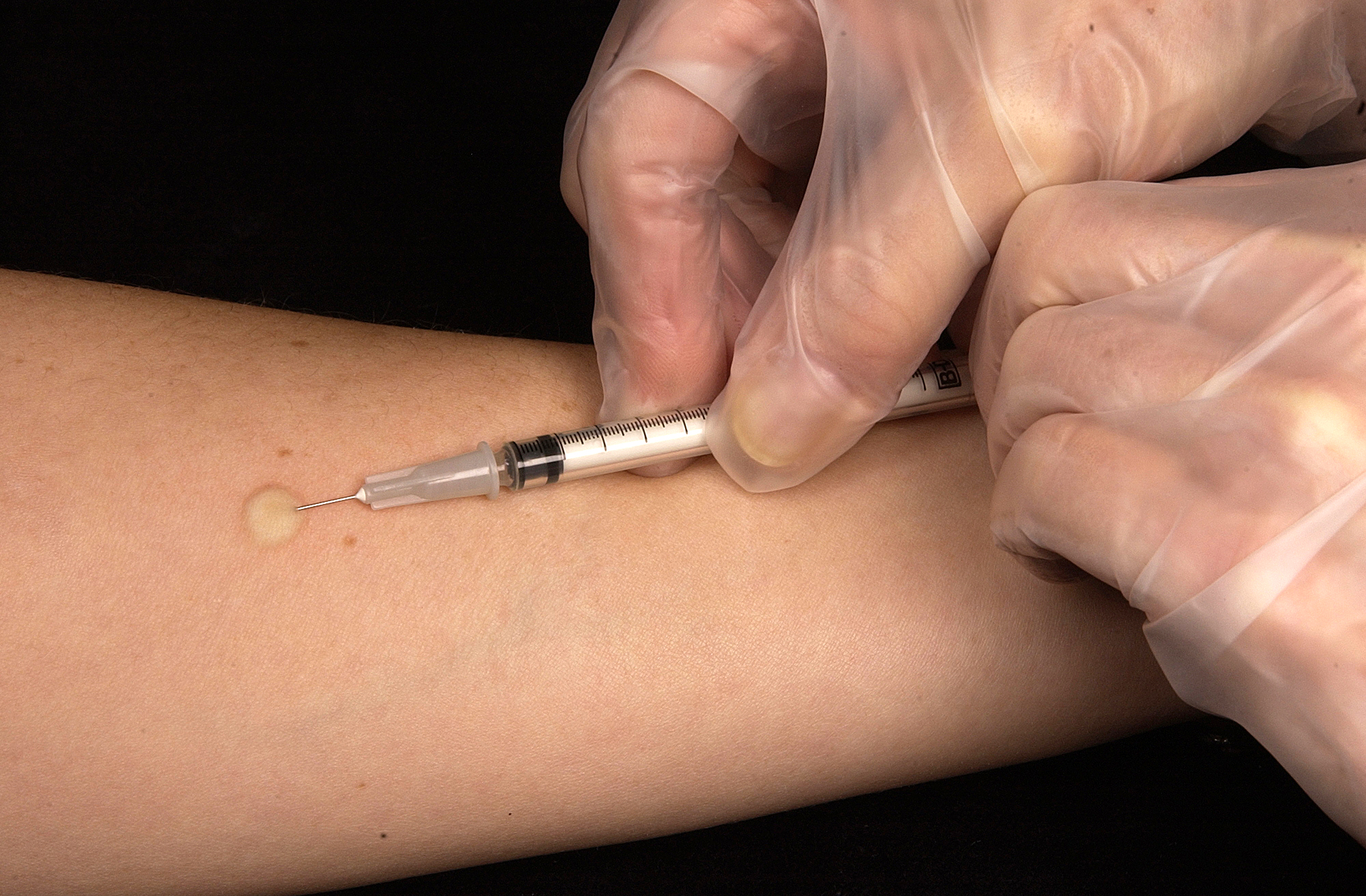
In the Mantoux test, a standard dose of tuberculin is injected intradermally (into the dermis, just beneath the outer layer of skin) on the forearm using a small syringe. The standard dose specified by the U.S. Centers for Disease Control and Prevention is 5 tuberculin units (TU) in 0.1 ml of solution, while the U.K. National Health Service specifies 2 TU in the same volume. The injection is given with the needle bevel facing upward, producing a small, pale, raised bump (called a wheal) about 6 to 10 mm in diameter if placed correctly. The test site is then examined 48–96 hours later—ideally at 72 hours—and the result is recorded based on the size of the reaction.
The reaction occurs because a person previously exposed to Mycobacterium tuberculosis is expected to mount an immune response to the injected proteins. This is a classic example of a delayed-type hypersensitivity (type IV) reaction, in which T cells and other immune cells gather at the site over 24 to 72 hours, producing localized inflammation. The response is measured by the diameter of induration (a firm, raised area of skin), recorded in millimeters across the forearm. Redness (erythema) is not measured. A result with no induration is recorded as "0 mm."
Earlier versions of the test, such as the Pirquet test, applied tuberculin to the skin through a shallow scratch (scarification).
The results of this test must be interpreted carefully. The person's medical risk factors determine at which increment (5 mm, 10 mm, or 15 mm) of induration the result is considered positive. A positive result indicates TB exposure.
A tuberculin test conversion is defined as an increase of 10 mm or more within a two-year period, regardless of age. Alternative criteria include increases of 6, 12, 15 or 18 mm.
Hub AI
Mantoux test AI simulator
(@Mantoux test_simulator)
Mantoux test
The Mantoux test (also called the Mendel–Mantoux test, tuberculin sensitivity test, or PPD test) is a method used to screen for tuberculosis (TB) infection. It has largely replaced older skin testing techniques such as the tine and Heaf tests. The test involves injecting a small amount of purified protein derivative (PPD) tuberculin just under the skin of the forearm. If performed correctly, the injection creates a small, pale bump called a wheal. The test site is examined a few days later for swelling or hardening of the skin, an immune response that would be expected if the person had been exposed to tuberculosis. However, additional tests are usually required to confirm active infection.
Tuberculin is a glycerol extract of the tubercle bacillus. Purified protein derivative (PPD) tuberculin is a precipitate of species-nonspecific molecules obtained from filtrates of sterilized, concentrated cultures. The tuberculin reaction was first described by Robert Koch in 1890. The test was first developed and described by the German physician Felix Mendel in 1908. It is named after Charles Mantoux, a French physician who built on the work of Koch and Clemens von Pirquet to create his test in 1907. However, the test was unreliable due to impurities in tuberculin which tended to cause false results.
Esmond R. Long and Florence B. Seibert identified the active agent in tuberculin as a protein. Seibert then spent a number of years developing methods for separating and purifying the protein from Mycobacterium tuberculosis, obtaining purified protein derivative (PPD) and enabling the creation of a reliable test for tuberculosis. Her first publication on the purification of tuberculin appeared in 1934. By the 1940s, Seibert's PPD was the international standard for tuberculin tests. In 1939, Russian M.A. Linnikova created a modified version of PPD. In 1954, the Soviet Union started mass production of PPD-L, named after Linnikova.
In the Mantoux test, a standard dose of tuberculin is injected intradermally (into the dermis, just beneath the outer layer of skin) on the forearm using a small syringe. The standard dose specified by the U.S. Centers for Disease Control and Prevention is 5 tuberculin units (TU) in 0.1 ml of solution, while the U.K. National Health Service specifies 2 TU in the same volume. The injection is given with the needle bevel facing upward, producing a small, pale, raised bump (called a wheal) about 6 to 10 mm in diameter if placed correctly. The test site is then examined 48–96 hours later—ideally at 72 hours—and the result is recorded based on the size of the reaction.
The reaction occurs because a person previously exposed to Mycobacterium tuberculosis is expected to mount an immune response to the injected proteins. This is a classic example of a delayed-type hypersensitivity (type IV) reaction, in which T cells and other immune cells gather at the site over 24 to 72 hours, producing localized inflammation. The response is measured by the diameter of induration (a firm, raised area of skin), recorded in millimeters across the forearm. Redness (erythema) is not measured. A result with no induration is recorded as "0 mm."
Earlier versions of the test, such as the Pirquet test, applied tuberculin to the skin through a shallow scratch (scarification).
The results of this test must be interpreted carefully. The person's medical risk factors determine at which increment (5 mm, 10 mm, or 15 mm) of induration the result is considered positive. A positive result indicates TB exposure.
A tuberculin test conversion is defined as an increase of 10 mm or more within a two-year period, regardless of age. Alternative criteria include increases of 6, 12, 15 or 18 mm.