



Community hub
Recent from talks
Knowledge base stats:
Talk channels stats:
Members stats:
Tuberculin
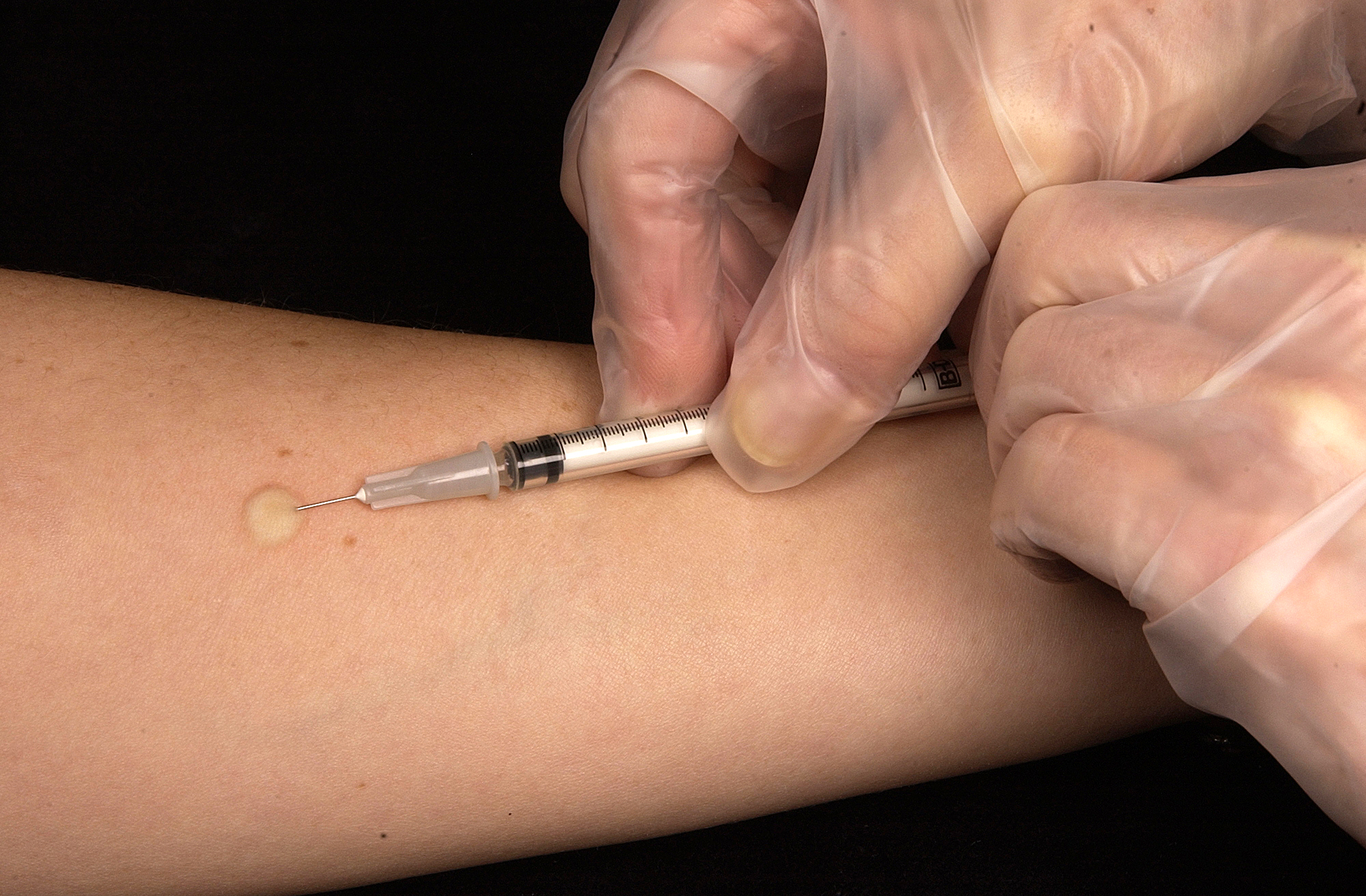
Tuberculin, known in its modern form as purified protein derivative (PPD), is a combination of proteins that are used in the diagnosis of tuberculosis by injection into the skin. Common side effects include redness, itchiness (pruritus), and pain at the site of injection. Allergic reactions may occasionally occur. Use is safe in pregnancy.
The original tuberculin, a glycerin extract of Mycobacterium tuberculosis, was discovered in 1890 by Robert Koch. Koch, best known for his work on the etiology (cause, origin) of tuberculosis (TB), laid down various rigorous guidelines that aided the establishment between a pathogen and the specific disease that followed that were later named Koch's postulates. Although he initially believed it would cure tuberculosis, this was later disproved. PPD was invented in 1934 by Florence B. Seibert, greatly improving the reliability of the skin test over Koch's extract.
PPD is on the World Health Organization's List of Essential Medicines.
Tuberculin/PPD is injected into the skin for the tuberculin skin test. After some time the amount of swelling is measured to determine the immune system's current level of activity against tuberculosis. A high level of swelling is considered proof for tuberculosis infection. The currently globally accepted method is the Mantoux test, named after French physician Charles Mantoux who pioneered using such a test in 1907. However, this test was not reliable enough until the replacement of crude tuberculin by PPD in the 1940s.
In the Mantoux test, the swelling is measured after 48 to 72 hours. If the area has a diameter more than a five to ten millimeters of swelling, the test is considered positive. Reliable administration of the skin test requires large amounts of training, supervision, and practice. The test may be falsely positive in those who have been previously vaccinated with BCG or have been infected by other types of mycobacteria. The test may be falsely negative within ten weeks of infection, in those less than six months old, and in those who have been infected for many years.
Alternative skin test methods include:
Purified protein derivative (PPD) tuberculin is a precipitate of non-species-specific molecules obtained from filtrates of sterilized, concentrated cultures. A number of "standards" were established to compare the potency of different batches of PPD, so they can be measured in a unit of activity called the international unit (IU) or tuberculin unit (TU). The IU is defined by a bioassay: the same number of international units should produce the same degree of reaction when used on similar animals. Because PPD is mostly used for the Mantoux test, this use is defined as intradermal injection, and its reaction the size of swelling.
The first (and current) international standard for PPD of human tuberculin was a batch created in 1939, called PPD-S. Each IU or TU is equivalent to 0.02 μg of the proteins in PPD. There has a constant fear of PPD-S stocks eventually running out, so many alternative standards have been made and calibrated against the PPD-S, including PPD-S2 (current US standard), RT 23 (current WHO recommendation for skin test), etc.
Hub AI
Tuberculin AI simulator
(@Tuberculin_simulator)
Tuberculin
Tuberculin, known in its modern form as purified protein derivative (PPD), is a combination of proteins that are used in the diagnosis of tuberculosis by injection into the skin. Common side effects include redness, itchiness (pruritus), and pain at the site of injection. Allergic reactions may occasionally occur. Use is safe in pregnancy.
The original tuberculin, a glycerin extract of Mycobacterium tuberculosis, was discovered in 1890 by Robert Koch. Koch, best known for his work on the etiology (cause, origin) of tuberculosis (TB), laid down various rigorous guidelines that aided the establishment between a pathogen and the specific disease that followed that were later named Koch's postulates. Although he initially believed it would cure tuberculosis, this was later disproved. PPD was invented in 1934 by Florence B. Seibert, greatly improving the reliability of the skin test over Koch's extract.
PPD is on the World Health Organization's List of Essential Medicines.
Tuberculin/PPD is injected into the skin for the tuberculin skin test. After some time the amount of swelling is measured to determine the immune system's current level of activity against tuberculosis. A high level of swelling is considered proof for tuberculosis infection. The currently globally accepted method is the Mantoux test, named after French physician Charles Mantoux who pioneered using such a test in 1907. However, this test was not reliable enough until the replacement of crude tuberculin by PPD in the 1940s.
In the Mantoux test, the swelling is measured after 48 to 72 hours. If the area has a diameter more than a five to ten millimeters of swelling, the test is considered positive. Reliable administration of the skin test requires large amounts of training, supervision, and practice. The test may be falsely positive in those who have been previously vaccinated with BCG or have been infected by other types of mycobacteria. The test may be falsely negative within ten weeks of infection, in those less than six months old, and in those who have been infected for many years.
Alternative skin test methods include:
Purified protein derivative (PPD) tuberculin is a precipitate of non-species-specific molecules obtained from filtrates of sterilized, concentrated cultures. A number of "standards" were established to compare the potency of different batches of PPD, so they can be measured in a unit of activity called the international unit (IU) or tuberculin unit (TU). The IU is defined by a bioassay: the same number of international units should produce the same degree of reaction when used on similar animals. Because PPD is mostly used for the Mantoux test, this use is defined as intradermal injection, and its reaction the size of swelling.
The first (and current) international standard for PPD of human tuberculin was a batch created in 1939, called PPD-S. Each IU or TU is equivalent to 0.02 μg of the proteins in PPD. There has a constant fear of PPD-S stocks eventually running out, so many alternative standards have been made and calibrated against the PPD-S, including PPD-S2 (current US standard), RT 23 (current WHO recommendation for skin test), etc.