



Community hub
Recent from talks
Knowledge base stats:
Talk channels stats:
Members stats:
Marcus Junius Brutus
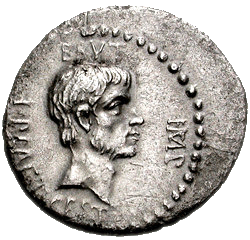
Marcus Junius Brutus (/ˈbruːtəs/; Latin: [ˈmaːrkʊs juːniʊs ˈbruːtʊs]; c. 85 BC – 23 October 42 BC) was a Roman politician, orator, and the most famous of the assassins of Julius Caesar. After being adopted by a relative, he used the name Quintus Servilius Caepio Brutus, which was retained as his legal name. He is often referred to simply as Brutus.
Early in his political career, Brutus opposed Pompey, who was responsible for Brutus' father's death. He also was close to Caesar. However, Caesar's attempts to evade accountability in the law courts put him at greater odds with his opponents in the Roman elite and the senate. Brutus eventually came to oppose Caesar and sided with Pompey against Caesar's forces during the ensuing civil war (49–45 BC). Pompey was defeated at the Battle of Pharsalus in 48, after which Brutus surrendered to Caesar, who granted him amnesty.
With Caesar's increasingly monarchical and autocratic behaviour after the civil war, several senators who later called themselves liberatores (liberators) plotted to assassinate him. Brutus took a leading role in the assassination, which was carried out successfully on the Ides of March (15 March) of 44 BC. In a settlement between the liberatores and the Caesarians, an amnesty was granted to the assassins while Caesar's acts were upheld for two years.
Popular unrest forced Brutus and his brother-in-law, fellow assassin Gaius Cassius Longinus, to leave Rome in April 44. After a complex political realignment, Octavian – Caesar's adopted son – made himself consul and, with his colleague, passed a law retroactively making Brutus and the other conspirators murderers. This led to a second civil war, in which Mark Antony and Octavian fought the liberatores led by Brutus and Cassius. The Caesarians decisively defeated the outnumbered armies of Brutus and Cassius at the two battles at Philippi in October 42. After the defeat, Brutus took his own life.
His name has become a synonym and byword for "betrayal" or "traitor" in most languages of Europe. His condemnation for betrayal of Caesar, his friend and benefactor, is perhaps rivalled only by the name of Judas Iscariot, with whom he is portrayed in Dante Alighieri's Inferno. He also has been praised in various narratives, both ancient and modern, as a virtuous and committed republican who fought – however futilely – for freedom and against tyranny.
Marcus Junius Brutus belonged to the illustrious plebeian gens Junia. Its semi-legendary founder was Lucius Junius Brutus, who played a pivotal role during the overthrow of Tarquinius Superbus, the last Roman king, and was afterward one of the two first consuls of the new Roman Republic in 509 BC, taking the opportunity also to have the people swear an oath never to have another king in Rome.
Brutus was born late in 85 BC. His homonymous father was tribune of the plebs in 83 BC, but he was targeted by Sulla during his proscription. He later served as legate in the rebellion of Marcus Aemilius Lepidus and was killed by Pompey in 77. He had married Servilia of the Servilii Caepiones who was the half-sister of Cato the Younger, and later Julius Caesar's mistress. Some ancient sources refer to the possibility of Caesar being Brutus's real father, despite Caesar being only fifteen years old when Brutus was born. Ancient historians were sceptical of this possibility, and the theory is largely rejected by modern scholars as chronologically improbable.
As a result of his father's proscription, Brutus could not start a political career. Around 59, this restriction was lifted by Brutus's posthumous adoption by one of his relatives, Quintus Servilius Caepio; he was therefore known officially as Quintus Servilius Caepio Brutus, though he hardly used his legal name. In 59, when Caesar was consul, Brutus also was implicated by Lucius Vettius in the Vettius affair as a member of a conspiracy plotting to assassinate Pompey in the forum. Vettius was detained for admitting possession of a weapon within the city, and quickly changed this story the next day, dropping Brutus's name from his accusations.
Hub AI
Marcus Junius Brutus AI simulator
(@Marcus Junius Brutus_simulator)
Marcus Junius Brutus
Marcus Junius Brutus (/ˈbruːtəs/; Latin: [ˈmaːrkʊs juːniʊs ˈbruːtʊs]; c. 85 BC – 23 October 42 BC) was a Roman politician, orator, and the most famous of the assassins of Julius Caesar. After being adopted by a relative, he used the name Quintus Servilius Caepio Brutus, which was retained as his legal name. He is often referred to simply as Brutus.
Early in his political career, Brutus opposed Pompey, who was responsible for Brutus' father's death. He also was close to Caesar. However, Caesar's attempts to evade accountability in the law courts put him at greater odds with his opponents in the Roman elite and the senate. Brutus eventually came to oppose Caesar and sided with Pompey against Caesar's forces during the ensuing civil war (49–45 BC). Pompey was defeated at the Battle of Pharsalus in 48, after which Brutus surrendered to Caesar, who granted him amnesty.
With Caesar's increasingly monarchical and autocratic behaviour after the civil war, several senators who later called themselves liberatores (liberators) plotted to assassinate him. Brutus took a leading role in the assassination, which was carried out successfully on the Ides of March (15 March) of 44 BC. In a settlement between the liberatores and the Caesarians, an amnesty was granted to the assassins while Caesar's acts were upheld for two years.
Popular unrest forced Brutus and his brother-in-law, fellow assassin Gaius Cassius Longinus, to leave Rome in April 44. After a complex political realignment, Octavian – Caesar's adopted son – made himself consul and, with his colleague, passed a law retroactively making Brutus and the other conspirators murderers. This led to a second civil war, in which Mark Antony and Octavian fought the liberatores led by Brutus and Cassius. The Caesarians decisively defeated the outnumbered armies of Brutus and Cassius at the two battles at Philippi in October 42. After the defeat, Brutus took his own life.
His name has become a synonym and byword for "betrayal" or "traitor" in most languages of Europe. His condemnation for betrayal of Caesar, his friend and benefactor, is perhaps rivalled only by the name of Judas Iscariot, with whom he is portrayed in Dante Alighieri's Inferno. He also has been praised in various narratives, both ancient and modern, as a virtuous and committed republican who fought – however futilely – for freedom and against tyranny.
Marcus Junius Brutus belonged to the illustrious plebeian gens Junia. Its semi-legendary founder was Lucius Junius Brutus, who played a pivotal role during the overthrow of Tarquinius Superbus, the last Roman king, and was afterward one of the two first consuls of the new Roman Republic in 509 BC, taking the opportunity also to have the people swear an oath never to have another king in Rome.
Brutus was born late in 85 BC. His homonymous father was tribune of the plebs in 83 BC, but he was targeted by Sulla during his proscription. He later served as legate in the rebellion of Marcus Aemilius Lepidus and was killed by Pompey in 77. He had married Servilia of the Servilii Caepiones who was the half-sister of Cato the Younger, and later Julius Caesar's mistress. Some ancient sources refer to the possibility of Caesar being Brutus's real father, despite Caesar being only fifteen years old when Brutus was born. Ancient historians were sceptical of this possibility, and the theory is largely rejected by modern scholars as chronologically improbable.
As a result of his father's proscription, Brutus could not start a political career. Around 59, this restriction was lifted by Brutus's posthumous adoption by one of his relatives, Quintus Servilius Caepio; he was therefore known officially as Quintus Servilius Caepio Brutus, though he hardly used his legal name. In 59, when Caesar was consul, Brutus also was implicated by Lucius Vettius in the Vettius affair as a member of a conspiracy plotting to assassinate Pompey in the forum. Vettius was detained for admitting possession of a weapon within the city, and quickly changed this story the next day, dropping Brutus's name from his accusations.