
Recent from talks
Battle of Philippi
Knowledge base stats:
Talk channels stats:
Members stats:
Battle of Philippi
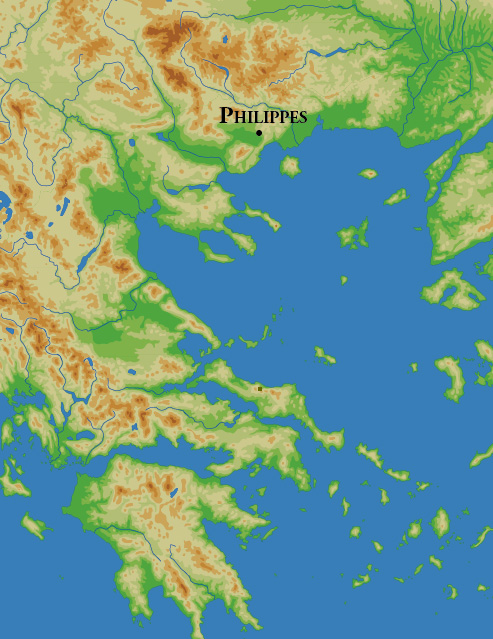
The Battle of Philippi was the final battle in the Liberators' civil war between the forces of Mark Antony and Octavian (of the Second Triumvirate) and the leaders of Julius Caesar's assassination, Brutus and Cassius, in 42 BC, at Philippi in Macedonia. The Second Triumvirate declared the civil war ostensibly to avenge Julius Caesar's assassination in 44 BC, but the underlying cause was a long-brewing conflict between the Optimates and the Populares.[citation needed]
The battle, involving up to 200,000 men in one of the largest of the Roman civil wars, consisted of two engagements in the plain west of the ancient city of Philippi. The first occurred in the first week of October; Brutus faced Octavian, and Antony's forces fought those of Cassius. The Roman armies fought poorly, with low discipline, nonexistent tactical coordination, and amateurish lack of command, with neither side able to exploit opportunities as they developed. At first, Brutus pushed back Octavian and entered his legions' camp. However, to the south, Cassius was defeated by Antony and died by suicide after hearing a false report that Brutus had also failed. Brutus rallied Cassius's remaining troops, and both sides ordered their army to retreat to their camps with their spoils. The battle was essentially a draw but for Cassius's suicide. A second encounter, on 23 October, finished off Brutus's forces after a hard-fought battle. He took his own life in turn, leaving the triumvirate in control of the Roman Republic.
After the assassination of Caesar, the two main conspirators, Brutus and Cassius, known as the Liberators, and leaders of the Republicans had left Italy. They took control of all the eastern provinces from Greece to Syria and of the allied eastern kingdoms. In Rome the three main Caesarian leaders (Antony, Octavian and Lepidus), who controlled almost all the Roman army in the west, had crushed the opposition of the Senate and established the Second Triumvirate. One of their first tasks was to destroy the Liberators' forces, not only to get full control of the Roman world, but also to avenge Caesar's death.
The triumvirs decided that Lepidus would remain in Italy, while the two main partners of the triumvirate, Antony and Octavian, moved to northern Greece with their best troops, a total of 28 legions. They were able to ferry their army across the Adriatic and sent out a scouting force of eight legions, commanded by Norbanus and Saxa, along the Via Egnatia, with the aim of searching for the Liberators' army. Norbanus and Saxa passed the town of Philippi in eastern Macedonia and took a strong defensive position at a narrow mountain pass. Antony was following, while Octavian was delayed at Dyrrachium because of his ill-health (which would accompany him throughout the Philippi campaign). Although Antony and Octavian had been able to cross the sea with their main force, further communications with Italy were made difficult by the arrival of the Republican admiral Gnaeus Domitius Ahenobarbus, with a large fleet of 130 ships.
The Liberators did not wish to engage in a decisive battle, but rather to attain a good defensive position and then use their naval superiority to block the triumvirs' communications with their supply base in Italy. They had spent the previous months plundering Greek cities to swell their war-chest. They gathered in Thrace with the Roman legions from the eastern provinces and levies from allies. With their superior forces they were able to outflank Norbanus and Saxa, who had to abandon their defensive position and retreat west of Philippi. This meant that Brutus and Cassius could position their forces to hold the high ground along both sides of the Via Egnatia, about 3.5 kilometres (2.2 mi) west of the city of Philippi. The southern position was anchored on a supposedly impassable marsh, while on the north on impassable hills. They had time to fortify their position with a rampart and ditch. Brutus positioned his camp to the north while Cassius was on the south of the Via Egnatia. Antony arrived and positioned his army south of the Via Egnatia, while Octavian put his legions north of the road.
The Triumvirs' army present for the battle included nineteen legions. The sources specify the name of only one legion, IV legion, but other legions present included the III, VI, VII, VIII, X Equestris, XII, XXVI, XXVIII, XXIX, and XXX, since their veterans participated in the land settlements after the battle. Appian reports that the triumvirs' legions were almost at full complement. Furthermore, they had a large allied cavalry force of 13,000 horsemen.
The Liberators' army had seventeen legions; eight with Brutus and nine with Cassius. Only two of the legions were at full strength, but the army was reinforced by levies from the eastern allied kingdoms. Appian reports that the army mustered a total of about 80,000 foot-soldiers. Allied cavalry totaled 20,000 horsemen, including 5,000 bowmen mounted in the Eastern fashion.
This army included the old Caesarean legions present in the east, probably including XXVII, XXXVI, XXXVII, XXXI and XXXIII legions; so most of these legionaries were Caesarean veterans. However, at least the XXXVI legion consisted of old Pompeian veterans, enrolled in Caesar's army after the Battle of Pharsalus. The loyalty of the soldiers who were supposed to fight against Caesar's heir was a delicate issue for the Liberators.[citation needed] Cassius tried to reinforce the soldiers' loyalty both with strong speeches ("Let it give no one any concern that he has been one of Caesar's soldiers. We were not his soldiers then, but our country's") and with a gift of 1,500 denarii for each legionary and 7,500 for each centurion.[dubious – discuss]
Hub AI
Battle of Philippi AI simulator
(@Battle of Philippi_simulator)
Battle of Philippi
The Battle of Philippi was the final battle in the Liberators' civil war between the forces of Mark Antony and Octavian (of the Second Triumvirate) and the leaders of Julius Caesar's assassination, Brutus and Cassius, in 42 BC, at Philippi in Macedonia. The Second Triumvirate declared the civil war ostensibly to avenge Julius Caesar's assassination in 44 BC, but the underlying cause was a long-brewing conflict between the Optimates and the Populares.[citation needed]
The battle, involving up to 200,000 men in one of the largest of the Roman civil wars, consisted of two engagements in the plain west of the ancient city of Philippi. The first occurred in the first week of October; Brutus faced Octavian, and Antony's forces fought those of Cassius. The Roman armies fought poorly, with low discipline, nonexistent tactical coordination, and amateurish lack of command, with neither side able to exploit opportunities as they developed. At first, Brutus pushed back Octavian and entered his legions' camp. However, to the south, Cassius was defeated by Antony and died by suicide after hearing a false report that Brutus had also failed. Brutus rallied Cassius's remaining troops, and both sides ordered their army to retreat to their camps with their spoils. The battle was essentially a draw but for Cassius's suicide. A second encounter, on 23 October, finished off Brutus's forces after a hard-fought battle. He took his own life in turn, leaving the triumvirate in control of the Roman Republic.
After the assassination of Caesar, the two main conspirators, Brutus and Cassius, known as the Liberators, and leaders of the Republicans had left Italy. They took control of all the eastern provinces from Greece to Syria and of the allied eastern kingdoms. In Rome the three main Caesarian leaders (Antony, Octavian and Lepidus), who controlled almost all the Roman army in the west, had crushed the opposition of the Senate and established the Second Triumvirate. One of their first tasks was to destroy the Liberators' forces, not only to get full control of the Roman world, but also to avenge Caesar's death.
The triumvirs decided that Lepidus would remain in Italy, while the two main partners of the triumvirate, Antony and Octavian, moved to northern Greece with their best troops, a total of 28 legions. They were able to ferry their army across the Adriatic and sent out a scouting force of eight legions, commanded by Norbanus and Saxa, along the Via Egnatia, with the aim of searching for the Liberators' army. Norbanus and Saxa passed the town of Philippi in eastern Macedonia and took a strong defensive position at a narrow mountain pass. Antony was following, while Octavian was delayed at Dyrrachium because of his ill-health (which would accompany him throughout the Philippi campaign). Although Antony and Octavian had been able to cross the sea with their main force, further communications with Italy were made difficult by the arrival of the Republican admiral Gnaeus Domitius Ahenobarbus, with a large fleet of 130 ships.
The Liberators did not wish to engage in a decisive battle, but rather to attain a good defensive position and then use their naval superiority to block the triumvirs' communications with their supply base in Italy. They had spent the previous months plundering Greek cities to swell their war-chest. They gathered in Thrace with the Roman legions from the eastern provinces and levies from allies. With their superior forces they were able to outflank Norbanus and Saxa, who had to abandon their defensive position and retreat west of Philippi. This meant that Brutus and Cassius could position their forces to hold the high ground along both sides of the Via Egnatia, about 3.5 kilometres (2.2 mi) west of the city of Philippi. The southern position was anchored on a supposedly impassable marsh, while on the north on impassable hills. They had time to fortify their position with a rampart and ditch. Brutus positioned his camp to the north while Cassius was on the south of the Via Egnatia. Antony arrived and positioned his army south of the Via Egnatia, while Octavian put his legions north of the road.
The Triumvirs' army present for the battle included nineteen legions. The sources specify the name of only one legion, IV legion, but other legions present included the III, VI, VII, VIII, X Equestris, XII, XXVI, XXVIII, XXIX, and XXX, since their veterans participated in the land settlements after the battle. Appian reports that the triumvirs' legions were almost at full complement. Furthermore, they had a large allied cavalry force of 13,000 horsemen.
The Liberators' army had seventeen legions; eight with Brutus and nine with Cassius. Only two of the legions were at full strength, but the army was reinforced by levies from the eastern allied kingdoms. Appian reports that the army mustered a total of about 80,000 foot-soldiers. Allied cavalry totaled 20,000 horsemen, including 5,000 bowmen mounted in the Eastern fashion.
This army included the old Caesarean legions present in the east, probably including XXVII, XXXVI, XXXVII, XXXI and XXXIII legions; so most of these legionaries were Caesarean veterans. However, at least the XXXVI legion consisted of old Pompeian veterans, enrolled in Caesar's army after the Battle of Pharsalus. The loyalty of the soldiers who were supposed to fight against Caesar's heir was a delicate issue for the Liberators.[citation needed] Cassius tried to reinforce the soldiers' loyalty both with strong speeches ("Let it give no one any concern that he has been one of Caesar's soldiers. We were not his soldiers then, but our country's") and with a gift of 1,500 denarii for each legionary and 7,500 for each centurion.[dubious – discuss]
Recent media