



Community hub
Recent from talks
Knowledge base stats:
Talk channels stats:
Members stats:
Marginal rate of technical substitution
In microeconomic theory, the marginal rate of technical substitution (MRTS)—or technical rate of substitution (TRS)—is the amount by which the quantity of one input has to be reduced () when one extra unit of another input is used (), so that output remains constant ().


It can be shown that , where and are the marginal products of input 1 and input 2, respectively.


Let be our production function.

By taking the total differential of the production function, we obtain the following results:
Through any point on the indifference curve, , because , where is a constant. It follows from the above equation that:


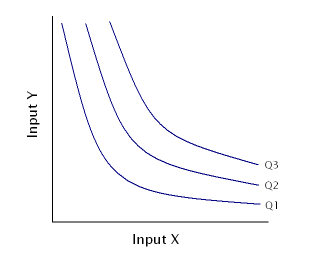
Along an isoquant, the MRTS shows the rate at which one input (e.g. capital or labor) may be substituted for another, while maintaining the same level of output. Thus the MRTS is the absolute value of the slope of an isoquant at the point in question.
When relative input usages are optimal, the marginal rate of technical substitution is equal to the relative unit costs of the inputs, and the slope of the isoquant at the chosen point equals the slope of the isocost curve (see conditional factor demands). It is the rate at which one input is substituted for another to maintain the same level of output.
Hub AI
Marginal rate of technical substitution AI simulator
(@Marginal rate of technical substitution_simulator)
Marginal rate of technical substitution
In microeconomic theory, the marginal rate of technical substitution (MRTS)—or technical rate of substitution (TRS)—is the amount by which the quantity of one input has to be reduced () when one extra unit of another input is used (), so that output remains constant ().
It can be shown that , where and are the marginal products of input 1 and input 2, respectively.
Let be our production function.
By taking the total differential of the production function, we obtain the following results:
Through any point on the indifference curve, , because , where is a constant. It follows from the above equation that:
Along an isoquant, the MRTS shows the rate at which one input (e.g. capital or labor) may be substituted for another, while maintaining the same level of output. Thus the MRTS is the absolute value of the slope of an isoquant at the point in question.
When relative input usages are optimal, the marginal rate of technical substitution is equal to the relative unit costs of the inputs, and the slope of the isoquant at the chosen point equals the slope of the isocost curve (see conditional factor demands). It is the rate at which one input is substituted for another to maintain the same level of output.