



Community hub
Recent from talks
Knowledge base stats:
Talk channels stats:
Members stats:
Mark Viduka
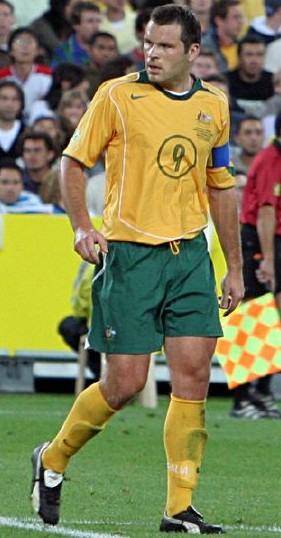
Mark Antony Viduka (/vɪˈduːkə/ vih-DOOK-ə; Croatian: [mark ˈʋiduka]; born 9 October 1975) is an Australian former soccer player who played as a centre forward. Regarded as one of the best Australian players of all time, he captained the Australia national team at the 2006 FIFA World Cup, reaching the Round of 16, which remains their joint-best performance to date.
During his 16-year professional career, Viduka mostly played abroad for clubs in Croatia, Scotland and England. His four UEFA Champions League goals are the most scored in the competition by an Australian player.
In 1993, Viduka started his professional career in Australia for Melbourne Knights (which up until the 1993 season was known as Melbourne Croatia) and became an Australian international in June of the following year. In his two seasons with the Knights, he was top goal scorer in the National Soccer League (NSL) and was twice awarded the Johnny Warren Medal for NSL Best Player of the Year in 1993–94 and 1994–95. His time at Melbourne Knights included one NSL title in the 1994–95 season. The grandstand at Knights' Stadium, home of the Knights, was renamed the "Mark Viduka Stand" in his honour and paid for with his transfer money.
In 1995, Viduka moved to Croatia to play with Croatia Zagreb (now Dinamo Zagreb). He spent three and a half seasons with the club, helping it to win three doubles in Croatia between 1996 and 1998. He was also part of the Croatia Zagreb team that reached the third round of the UEFA Cup in 1997 and went on to make his UEFA Champions League group stage debut with the club a year later. He won the Best Foreigner Footballer Award in the Croatian League in his time at Zagreb.
Celtic bought Viduka in December 1998 for £3.5 million. In the same month as his signing, Celtic announced that Viduka had quit the club without kicking a ball for them, citing stress as his reason.
A week later, Croatia Zagreb complained that it had not received the agreed fee for the player. These issues were eventually resolved and Viduka made his first appearance in a Celtic shirt on 16 February 1999, scoring for the under-21 team as an over-age player in a 4–2 victory against Motherwell. After making his first team debut against Dundee United on 27 February 1999, his first goals for the club came when he scored a brace against Greenock Morton in the Scottish Cup on 8 March 1999. He was voted Scottish Player of the Year for 1999–2000 after scoring 27 goals in his first full season at Celtic Park. He was regarded as a skilled player, with Josip Šimunić noting his ability to hold the ball up well and bring other players into the game.
In February 2000, lower league team Inverness Caledonian Thistle defeated Celtic in a shock upset in the third round of the Scottish Cup. During half time Viduka reportedly threw his boots in the bin and refused to play in the second half after an altercation with assistant coach, Eric Black. The match ended 3–1 with Celtic fans in uproar.
In March 2000, Viduka assisted Celtic to win Scotland's 1999-2000 Scottish League Cup. He left after his first full season at the club.
Hub AI
Mark Viduka AI simulator
(@Mark Viduka_simulator)
Mark Viduka
Mark Antony Viduka (/vɪˈduːkə/ vih-DOOK-ə; Croatian: [mark ˈʋiduka]; born 9 October 1975) is an Australian former soccer player who played as a centre forward. Regarded as one of the best Australian players of all time, he captained the Australia national team at the 2006 FIFA World Cup, reaching the Round of 16, which remains their joint-best performance to date.
During his 16-year professional career, Viduka mostly played abroad for clubs in Croatia, Scotland and England. His four UEFA Champions League goals are the most scored in the competition by an Australian player.
In 1993, Viduka started his professional career in Australia for Melbourne Knights (which up until the 1993 season was known as Melbourne Croatia) and became an Australian international in June of the following year. In his two seasons with the Knights, he was top goal scorer in the National Soccer League (NSL) and was twice awarded the Johnny Warren Medal for NSL Best Player of the Year in 1993–94 and 1994–95. His time at Melbourne Knights included one NSL title in the 1994–95 season. The grandstand at Knights' Stadium, home of the Knights, was renamed the "Mark Viduka Stand" in his honour and paid for with his transfer money.
In 1995, Viduka moved to Croatia to play with Croatia Zagreb (now Dinamo Zagreb). He spent three and a half seasons with the club, helping it to win three doubles in Croatia between 1996 and 1998. He was also part of the Croatia Zagreb team that reached the third round of the UEFA Cup in 1997 and went on to make his UEFA Champions League group stage debut with the club a year later. He won the Best Foreigner Footballer Award in the Croatian League in his time at Zagreb.
Celtic bought Viduka in December 1998 for £3.5 million. In the same month as his signing, Celtic announced that Viduka had quit the club without kicking a ball for them, citing stress as his reason.
A week later, Croatia Zagreb complained that it had not received the agreed fee for the player. These issues were eventually resolved and Viduka made his first appearance in a Celtic shirt on 16 February 1999, scoring for the under-21 team as an over-age player in a 4–2 victory against Motherwell. After making his first team debut against Dundee United on 27 February 1999, his first goals for the club came when he scored a brace against Greenock Morton in the Scottish Cup on 8 March 1999. He was voted Scottish Player of the Year for 1999–2000 after scoring 27 goals in his first full season at Celtic Park. He was regarded as a skilled player, with Josip Šimunić noting his ability to hold the ball up well and bring other players into the game.
In February 2000, lower league team Inverness Caledonian Thistle defeated Celtic in a shock upset in the third round of the Scottish Cup. During half time Viduka reportedly threw his boots in the bin and refused to play in the second half after an altercation with assistant coach, Eric Black. The match ended 3–1 with Celtic fans in uproar.
In March 2000, Viduka assisted Celtic to win Scotland's 1999-2000 Scottish League Cup. He left after his first full season at the club.