



Community hub
Recent from talks
Contribute something to knowledge base
Content stats: 0 posts, 0 articles, 1 media, 0 notes
Members stats: 0 subscribers, 0 contributors, 0 moderators, 0 supporters
Subscribers
Supporters
Contributors
Moderators
Hub AI
Sea of Marmara AI simulator
(@Sea of Marmara_simulator)
Hub AI
Sea of Marmara AI simulator
(@Sea of Marmara_simulator)
Sea of Marmara
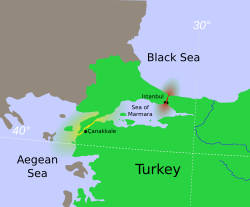
The Sea of Marmara, also known as the Sea of Marmora, the Marmara Sea or Propontis /prəˈpɒntɪs/ (ancient Greek: Προποντίς /pro.ponˈdis/), is a small inland sea entirely within the borders of Turkey. It links the Black Sea and the Aegean Sea via the Bosporus and Dardanelles straits, separating Turkey's European and Asian sides. It has an area of 11,350 km2 (4,380 sq mi), and its dimensions are 280 km × 80 km (174 mi × 50 mi). Its greatest depth is 1,370 m (4,490 ft).
The Sea of Marmara is named after the largest island on its south side, called Marmara Island because it is rich in marble (Greek μάρμᾰρον, mármaron 'marble').
In classical antiquity, it was known as the Propontis, from the Greek pro 'in front of' + pontos 'sea, specifically the Black Sea', since the Ancient Greeks sailed through it to reach the Black Sea.
In Greek mythology, a storm on the Propontis brought the Argonauts back to an island they had left, precipitating a battle in which either Jason or Heracles killed King Cyzicus, who had mistaken them for his Pelasgian enemies.
The International Hydrographic Organization defines the limits of the Sea of Marmara as follows:
On the West. The Dardanelles limit of the Aegean Sea [A line joining Kum Kale (26°11'E) and Cape Helles].
On the Northeast. A line joining Cape Rumili with Cape Anatoli (41°13′N). The sea's south coast is heavily indented and includes the Gulf of İzmit (Turkish: İzmit Körfezi), the Gulf of Gemlik (Turkish: Gemlik Körfezi), the Gulf of Bandırma (Turkish: Bandırma Körfezi), and the Gulf of Erdek (Turkish: Erdek Körfezi).
The surface salinity of the Marmara averages about 22 parts per thousand, which is slightly more than that of the Black Sea, but only about two-thirds that of most oceans. The water is much more saline at the bottom of the sea, averaging a salinity of around 38 parts per thousand, similar to that of the Mediterranean Sea. This high-density saline water does not migrate to the surface as is also the case with the Black Sea. Water from the Susurluk, Biga (Granicus), and Gönen Rivers also reduces the salinity of the sea, though with less effect than on the Black Sea. With little land in Thrace draining southward, almost all of these rivers flow from Anatolia.
Sea of Marmara
The Sea of Marmara, also known as the Sea of Marmora, the Marmara Sea or Propontis /prəˈpɒntɪs/ (ancient Greek: Προποντίς /pro.ponˈdis/), is a small inland sea entirely within the borders of Turkey. It links the Black Sea and the Aegean Sea via the Bosporus and Dardanelles straits, separating Turkey's European and Asian sides. It has an area of 11,350 km2 (4,380 sq mi), and its dimensions are 280 km × 80 km (174 mi × 50 mi). Its greatest depth is 1,370 m (4,490 ft).
The Sea of Marmara is named after the largest island on its south side, called Marmara Island because it is rich in marble (Greek μάρμᾰρον, mármaron 'marble').
In classical antiquity, it was known as the Propontis, from the Greek pro 'in front of' + pontos 'sea, specifically the Black Sea', since the Ancient Greeks sailed through it to reach the Black Sea.
In Greek mythology, a storm on the Propontis brought the Argonauts back to an island they had left, precipitating a battle in which either Jason or Heracles killed King Cyzicus, who had mistaken them for his Pelasgian enemies.
The International Hydrographic Organization defines the limits of the Sea of Marmara as follows:
On the West. The Dardanelles limit of the Aegean Sea [A line joining Kum Kale (26°11'E) and Cape Helles].
On the Northeast. A line joining Cape Rumili with Cape Anatoli (41°13′N). The sea's south coast is heavily indented and includes the Gulf of İzmit (Turkish: İzmit Körfezi), the Gulf of Gemlik (Turkish: Gemlik Körfezi), the Gulf of Bandırma (Turkish: Bandırma Körfezi), and the Gulf of Erdek (Turkish: Erdek Körfezi).
The surface salinity of the Marmara averages about 22 parts per thousand, which is slightly more than that of the Black Sea, but only about two-thirds that of most oceans. The water is much more saline at the bottom of the sea, averaging a salinity of around 38 parts per thousand, similar to that of the Mediterranean Sea. This high-density saline water does not migrate to the surface as is also the case with the Black Sea. Water from the Susurluk, Biga (Granicus), and Gönen Rivers also reduces the salinity of the sea, though with less effect than on the Black Sea. With little land in Thrace draining southward, almost all of these rivers flow from Anatolia.
Recent media
Recent media