


Community hub
Recent from talks
Contribute something to knowledge base
Content stats: 0 posts, 0 articles, 1 media, 0 notes
Members stats: 0 subscribers, 0 contributors, 0 moderators, 0 supporters
Subscribers
Supporters
Contributors
Moderators
Hub AI
Marsh Railway AI simulator
(@Marsh Railway_simulator)
Hub AI
Marsh Railway AI simulator
(@Marsh Railway_simulator)
Marsh Railway
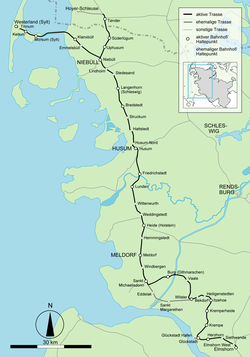
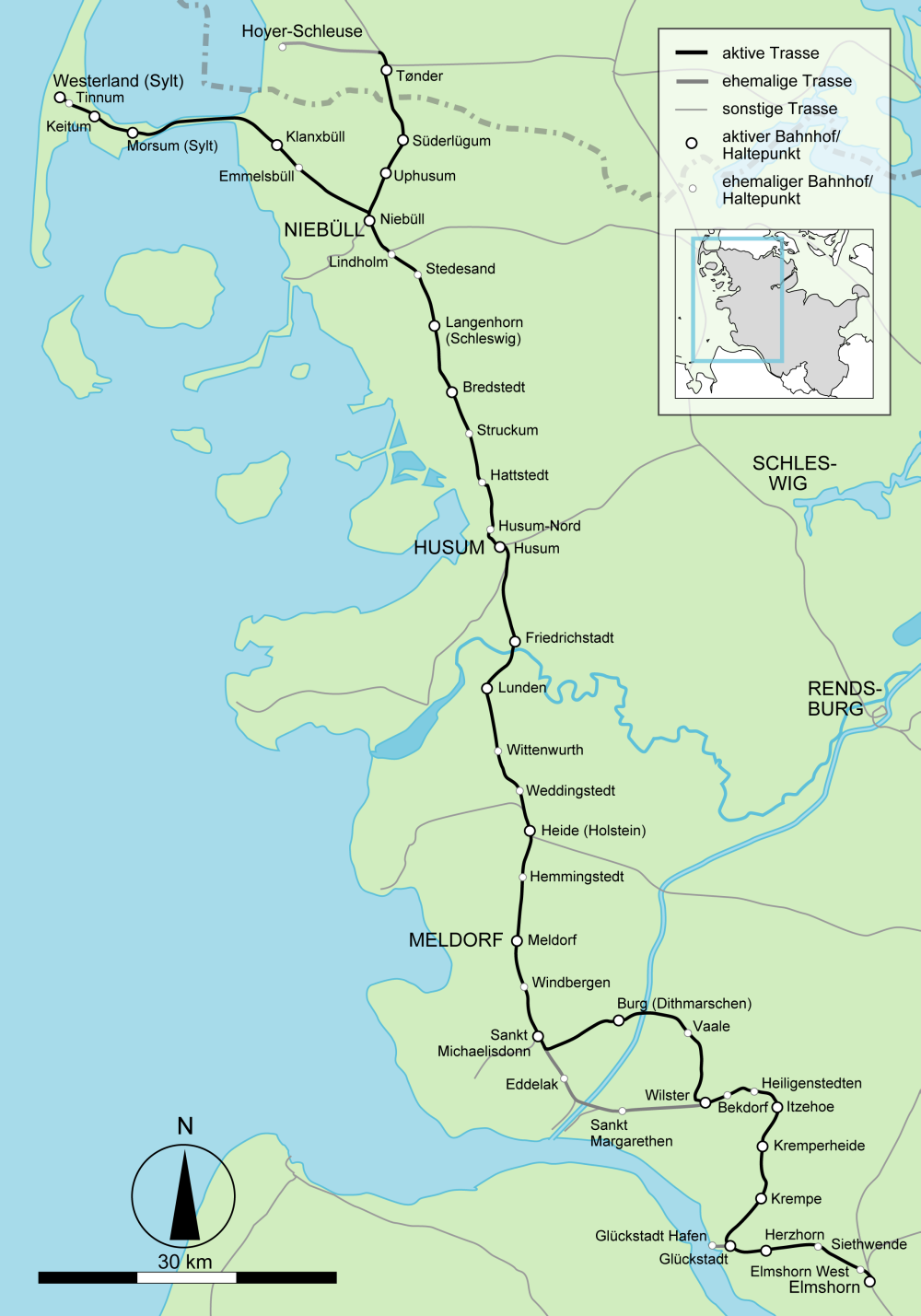
The Marsh Railway (German: Marschbahn) is a main line in the state of Schleswig-Holstein in Germany that links the stations of Elmshorn in the south and Westerland on the island of Sylt in the north. It is part of 237 km (147 mi) long route from Hamburg-Altona to Westerland (Sylt) and is listed in the Deutsche Bahn timetables as Kursbuchstrecke 130. The first part of it was opened in 1845 and is one of the oldest lines in Germany.
The Marsh Railway, as its name suggests, mainly runs through marshlands. There are also some sections of the line that run through the higher-lying geest. The line branches off the Hamburg-Altona-Kiel railway line in Elmshorn. From Elmshorn, it runs in an arc via Glückstadt to Itzehoe. The line then crosses the Kiel Canal on the 42 m (138 ft) high Hochdonn High Bridge. The bridge's total length is 2,218 m (7,277 ft) and its main span over the channel is 143 m (469 ft) long. There is also a bascule bridge north of Husum station. Between Klanxbüll and Morsum stations the line runs across the Hindenburgdamm (causeway) through the North Frisian mudflats.
The first section of the current Marsh Railway was built by the Glückstadt-Elmshorn Railway Company (Glückstadt-Elmshorner Eisenbahn-Gesellschaft) shortly after the opening of the Altona–Kiel line on 18 September 1844. The company opened a line from Elmshorn to Glückstadt port station on 20 July 1845. Twelve years later, on 15 October 1857, the line was realigned in Glückstadt and extended to the edge of the Stör river in Itzehoe. In 1878, a swing bridge was built across the Stör—which was replaced in 1910 during the duplication of the line by two bascule bridges—and the line was extended to the Heide station of the Neumünster–Heide–Karolinenkoog line, which opened on 22 August 1877.
On 1 January 1879 the Glückstadt-Elmshorn Railway Company became the Holstein Marsh Railway Company (Holsteinische Marschbahn-Gesellschaft). In 1888, this company was acquired by the Schleswig-Holstein Marsh Railway Company (Schleswig-Holsteinische Marschbahn-Gesellschaft). On 1 July 1890, the company was acquired by the Prussian government and it became part of the Prussian State Railways.
In 1886 construction began on an extension and on 1 September 1886 the line was opened via Lunden and a bridge over the Eider near Friedrichstadt to Husum, where it connected with the Flensburg–Husum–Tönning line. The line was extended further north to Bredstedt on 17 October 1887 and to Niebüll on 15 November 1887. The line was subsequently extended further north to Tønder, connecting to branch lines to Tinglev and Højer Sluse, which was the port for a ferry connection to Sylt. The line was extended to Bredebro, Scherrebek, Ribe and Bramming, where it connected with the Danish rail network.
In 1920 northern Schleswig became part of Denmark, and the border was established between Niebüll and Tønder. This meant that traffic to Sylt had to cross the German-Danish border twice, although the Danish authorities allowed sealed transit trains to operate, avoiding customs inspections of passengers. The operation of transit trains and the Hoyer–Sylt ferry ended with the inauguration of the Hindenburg causeway in 1927.
Originally, the Marsh Railway ran from Wilster directly to St. Michaelisdonn. During the construction of the Kiel Canal a swing bridge was built on the line at Taterpfahl near St. Margarethen. During the widening of the canal in 1920, a new non-opening high bridge was built on the geest at Hochdonn on a 5.8 km long bypass route. The new train route with the new bridge was originally planned directly from Itzehoe to Meldorf, but because of protests from Wilster and Sankt Michaelisdonn, the line was elongated and rerouted to include these towns. The old track was rebuilt to run from Wilster to Brunsbüttelkoog and on the north side to Brunsbüttel Nord.
Significant changes took place on 1 June 1927 with the opening of Hindenburg causeway, which was prepared in 1922 by prolonging the line from Niebüll to Klanxbüll to enable material transports. Deutsche Reichsbahn (German State Railways) opened a new station at Westerland together with the connecting part of the line. The Sylt Island Railway lost its traffic between Munkmarsch and Westerland, because the ferry service between Hoyer and Sylt had been closed. The Island Railway built a station next to the Reichsbahn station, with a simple reception building.
Marsh Railway
The Marsh Railway (German: Marschbahn) is a main line in the state of Schleswig-Holstein in Germany that links the stations of Elmshorn in the south and Westerland on the island of Sylt in the north. It is part of 237 km (147 mi) long route from Hamburg-Altona to Westerland (Sylt) and is listed in the Deutsche Bahn timetables as Kursbuchstrecke 130. The first part of it was opened in 1845 and is one of the oldest lines in Germany.
The Marsh Railway, as its name suggests, mainly runs through marshlands. There are also some sections of the line that run through the higher-lying geest. The line branches off the Hamburg-Altona-Kiel railway line in Elmshorn. From Elmshorn, it runs in an arc via Glückstadt to Itzehoe. The line then crosses the Kiel Canal on the 42 m (138 ft) high Hochdonn High Bridge. The bridge's total length is 2,218 m (7,277 ft) and its main span over the channel is 143 m (469 ft) long. There is also a bascule bridge north of Husum station. Between Klanxbüll and Morsum stations the line runs across the Hindenburgdamm (causeway) through the North Frisian mudflats.
The first section of the current Marsh Railway was built by the Glückstadt-Elmshorn Railway Company (Glückstadt-Elmshorner Eisenbahn-Gesellschaft) shortly after the opening of the Altona–Kiel line on 18 September 1844. The company opened a line from Elmshorn to Glückstadt port station on 20 July 1845. Twelve years later, on 15 October 1857, the line was realigned in Glückstadt and extended to the edge of the Stör river in Itzehoe. In 1878, a swing bridge was built across the Stör—which was replaced in 1910 during the duplication of the line by two bascule bridges—and the line was extended to the Heide station of the Neumünster–Heide–Karolinenkoog line, which opened on 22 August 1877.
On 1 January 1879 the Glückstadt-Elmshorn Railway Company became the Holstein Marsh Railway Company (Holsteinische Marschbahn-Gesellschaft). In 1888, this company was acquired by the Schleswig-Holstein Marsh Railway Company (Schleswig-Holsteinische Marschbahn-Gesellschaft). On 1 July 1890, the company was acquired by the Prussian government and it became part of the Prussian State Railways.
In 1886 construction began on an extension and on 1 September 1886 the line was opened via Lunden and a bridge over the Eider near Friedrichstadt to Husum, where it connected with the Flensburg–Husum–Tönning line. The line was extended further north to Bredstedt on 17 October 1887 and to Niebüll on 15 November 1887. The line was subsequently extended further north to Tønder, connecting to branch lines to Tinglev and Højer Sluse, which was the port for a ferry connection to Sylt. The line was extended to Bredebro, Scherrebek, Ribe and Bramming, where it connected with the Danish rail network.
In 1920 northern Schleswig became part of Denmark, and the border was established between Niebüll and Tønder. This meant that traffic to Sylt had to cross the German-Danish border twice, although the Danish authorities allowed sealed transit trains to operate, avoiding customs inspections of passengers. The operation of transit trains and the Hoyer–Sylt ferry ended with the inauguration of the Hindenburg causeway in 1927.
Originally, the Marsh Railway ran from Wilster directly to St. Michaelisdonn. During the construction of the Kiel Canal a swing bridge was built on the line at Taterpfahl near St. Margarethen. During the widening of the canal in 1920, a new non-opening high bridge was built on the geest at Hochdonn on a 5.8 km long bypass route. The new train route with the new bridge was originally planned directly from Itzehoe to Meldorf, but because of protests from Wilster and Sankt Michaelisdonn, the line was elongated and rerouted to include these towns. The old track was rebuilt to run from Wilster to Brunsbüttelkoog and on the north side to Brunsbüttel Nord.
Significant changes took place on 1 June 1927 with the opening of Hindenburg causeway, which was prepared in 1922 by prolonging the line from Niebüll to Klanxbüll to enable material transports. Deutsche Reichsbahn (German State Railways) opened a new station at Westerland together with the connecting part of the line. The Sylt Island Railway lost its traffic between Munkmarsch and Westerland, because the ferry service between Hoyer and Sylt had been closed. The Island Railway built a station next to the Reichsbahn station, with a simple reception building.
Recent media
Recent media