Hubbry Logo
Murder of Martha MorrisonMurder of Martha MorrisonMain
Open search
Murder of Martha Morrison
Community hub
Murder of Martha Morrison
logo
7 pages, 0 posts
0 subscribers
Be the first to start a discussion here.
Murder of Martha Morrison
from Wikipedia

Martha Marie Morrison (1957 – September 1974) was a 17-year-old American girl who was murdered in 1974, and whose remains went unidentified for over 40 years after their discovery.

Key Information

Morrison, a resident of Portland, Oregon, disappeared under mysterious circumstances in September 1974. On October 12, 1974, human remains of two women were found in Dole Valley near Vancouver, Washington.[2] One was immediately identified as Carol Platt Valenzuela, but the other individual was unable to be identified at the time.[2][3] In 2015, the remains were identified by means of DNA profiling as those of Morrison.[4]

After Morrison's remains were identified, law enforcement encouraged the public to submit tips, as the murder was still unsolved.[5] In August 2017, a bloodstain on a pistol owned by a longtime suspect, Warren Forrest, was matched to Morrison through DNA testing.[6] Prior to Forrest's identification as a suspect, serial killers Ted Bundy and Randall Woodfield had both been considered a person of interest in Morrison and Valenzuela's murders. Forrest was charged with Morrison’s murder in 2020, and found guilty of first degree murder in February 2023.[7]

Background

[edit]

Morrison reportedly grew up in foster care while living in Lane County, Oregon near Eugene. Her sister, Reba, recalls that their mother was deaf and that Martha was skilled in sign language.[1][8] She attended Roosevelt High School in Portland and the Corvallis Farm School in Corvallis.[9][3] Subsequently, she went to Arizona to participate in the Job Corps program.[3][10]

She had a history of drug use and of running away from the homes of both her biological and foster families, and the Corvallis Farm School as well.[9][3][2]

She was last seen leaving her apartment, which she and a man had rented. The couple reportedly quarreled, and Martha subsequently went missing.[10][11] Shortly before her disappearance on September 1, 1974, Morrison had visited her family in Eugene with the man.[12]

Investigation

[edit]

After the remains were discovered on October 12, 1974, the bones of the victims were examined nationwide in hopes of identifying them. One of the victims was quickly identified via dental records as 18-year-old Carol Platt Valenzuela, but those of the second victim were unknown.[13] Valenzuela had been reported missing on August 4 by her husband after she failed to return home after hitchhiking to Vancouver on August 2. Investigators hoped that her identification would perhaps increase the likelihood of identification for the then-unidentified Morrison. They intended to question Valenzuela's husband following her identification, yet he was recovering from an aspirin overdose at the time.[14] He was arrested but eventually released after passing a polygraph test on October 25.[15]

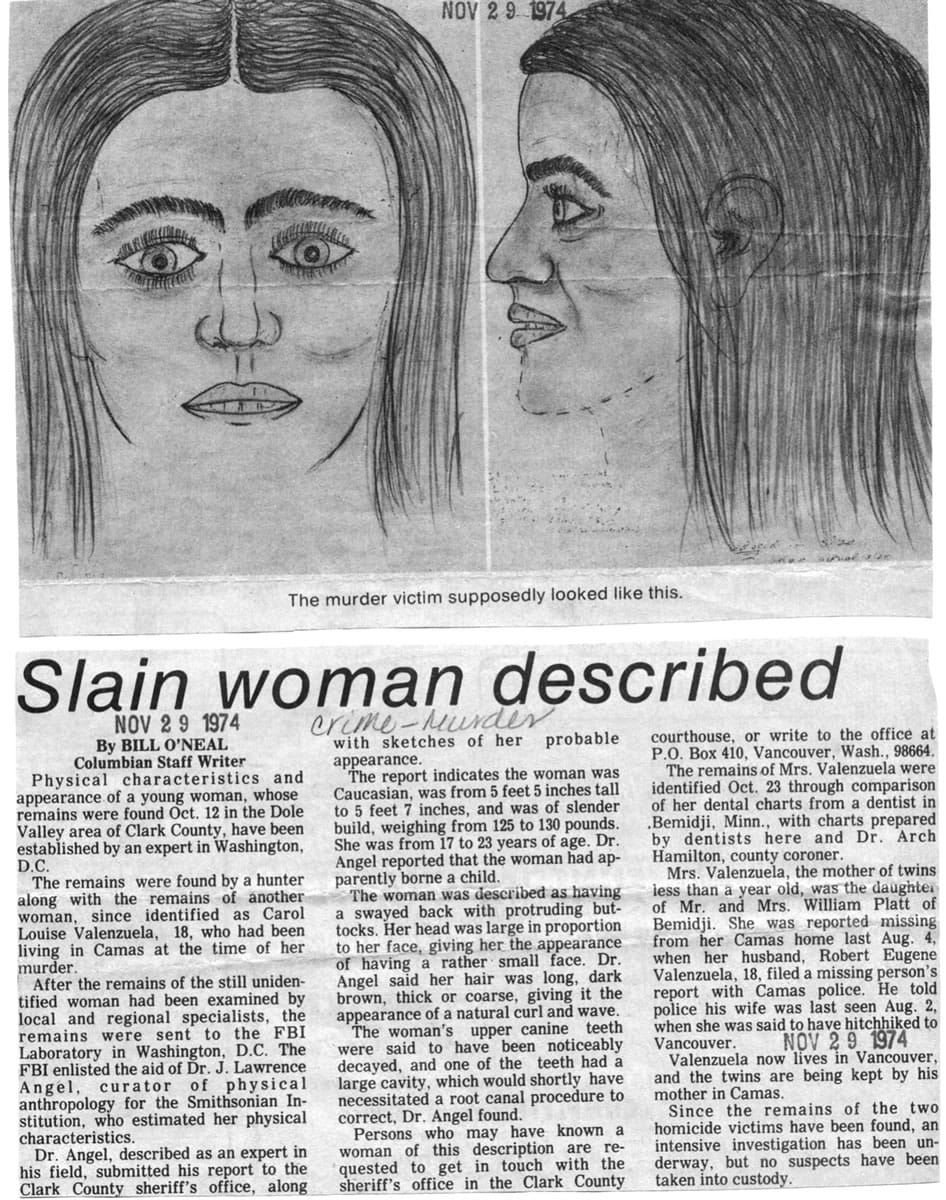
All examinations were unsuccessful in identifying the second victim, originally estimated to be 20 to 25 years old.[5][9][16] The remains were originally examined by an anthropologist from the University of Washington.[17] Forensic facial reconstructions were created of the victim from both frontal and profile views and released through a newspaper, but went unrecognized by the public. The victim's physical description was also listed, including the fact that she had curly-textured hair and dental hygiene problems. The victim also appeared to have given birth at some point, although it is unknown if Morrison ever had a child.[18] Police returned to the scene following the initial discovery in order to possibly obtain more evidence.[16] A new metal detector, borrowed from a Snohomish County resident was also used.[17]

Examination indicated the victims had been deceased for at least two weeks prior. Decomposition and animal activity had made it difficult to estimate the time or cause of death, although authorities presumed they were murdered. The remains may have also been deposited at the location at different times.[15] Several missing persons at the time were considered, including Patty Hearst (who was later found alive).[17]

Investigator Nikki Costa stated in an interview conducted after the identification that a great deal of time had been spent on the investigation, including following leads that may have linked the case to serial killer Gary Ridgway.[5] Ted Bundy was also listed as a person of interest in both Morrison's and Valenzuela's case prior to 2017, when Warren Leslie Forrest was identified as the prime suspect.[19][20]

Morrison, while a missing person, was ruled out as the possible identity of a female homicide victim, nicknamed “Orange Socks", who was estimated to have been between 15 and 30 when she was located in Texas in 1979.[21] This latter victim was identified in August 2019 as Debra Jackson.[22]

Identification

[edit]

DNA was obtained from Martha Morrison's sister and half-brother which was used to develop a genetic profile to compare to potential matches. After the testing was complete, it was compared to the currently unidentified remains, whose DNA profile was developed in 2012. Similarities were noted, yet a definite match was not established.[5][3] Both Morrison and the unidentified victim were eventually entered into the National Missing and Unidentified Persons System, which specializes in locating missing people and identifying human remains.[11][4] Ten missing people were excluded as possible identities of the remains until the identification was made in July 2015.[4] Morrison's skull and some other bones were mislabeled as Carol Platt Valenzuela's while they were in storage. Investigator Nikki Costa said this was one of the reasons why the remains were unidentified for so long. In 2011, this problem was discovered when the skull's teeth were noticed to be different from Valenzuela's dental records.[5][23]

After previous unsuccessful testing, the National Center for Missing & Exploited Children stated they would pay for an exhumation of the victim's father in order to retrieve DNA and compare it with the unidentified remains.[9] The result of this last test was a definitive indication that the remains were those of Martha Morrison (probability of 99.999998%).[5][9]

Investigators continued to look at suspected serial killer Warren Leslie Forrest. At the time, Forrest was incarcerated for the murder of Krista Kay Blake in July 1974. He was arrested on October 2, 1974 just ten days before the bodies of Martha Morrison and Carol Platt Valenzuela were found in Dole Valley.[2] Law enforcement officials conducted DNA testing on a blood stain found on an air pistol owned by Forrest, which was previously believed to have belonged to a different womanone of six others he had attacked during his years at large. Officials later stated that the results proved he not only killed Morrison, but also Valenzuela, due to the fact that the two bodies were found together.[6] Forrest is also a suspect in the 1974 disappearance of Diane Gilchrist and the 1971 disappearance of Jamie Grissom.[24]

In March 2016, police appealed to the public for assistance with identifying Morrison's boyfriend at the time. He was not a suspect in the case, but investigators believed he could have relevant information.[25]

On February 1, 2023, Warren Leslie Forrest was found guilty of first degree murder for Morrison's killing.[7]

See also

[edit]

References

[edit]
Revisions and contributorsEdit on WikipediaRead on Wikipedia
from Grokipedia
The Murder of Martha Morrison was the abduction and killing of 17-year-old Martha Marie Morrison from Portland, Oregon, in September 1974 by Warren Leslie Forrest, a suspected serial killer active in rural Clark County, Washington. Morrison disappeared after an argument with her boyfriend, and her skeletal remains were discovered by hunters on October 12, 1974, in a wooded area of Dole Valley, approximately two months later. The remains went unidentified for over four decades until 2015, when DNA analysis confirmed her identity. The case remained a cold investigation until 2017, when forensic DNA testing linked Morrison's genetic material to a dart gun grip seized from Forrest's home during a 1974 unrelated assault probe. This evidence, combined with witness testimony from other survivors of Forrest's attacks and his pattern of targeting young women in the region, led to his 2020 indictment for first-degree murder. Forrest, who had been serving a life sentence since 1979 for the 1974 aggravated murder of 20-year-old Krista Kay Blake, for which he was convicted in 1979, was tried in January 2023; a Clark County jury deliberated for about 90 minutes before finding him guilty on February 1, 2023. He received a second life sentence without parole on February 17, 2023. Forrest is suspected in at least nine unsolved disappearances and deaths of young women between 1971 and 1974 in Clark County, including the 1973 vanishing of 16-year-old Jamie Grissim, whose remains have never been located. Authorities continue to analyze evidence from these cases, with recent efforts in 2024 focusing on potential additional DNA matches to close more cold cases linked to him. The Morrison conviction marked a significant breakthrough in one of the Pacific Northwest's longest-standing investigations, highlighting advances in forensic technology.

Victim

Early Life

Martha Marie Morrison was born in 1957 and grew up primarily in , where she was placed in at an early age due to family circumstances. Her mother was deaf, leading Morrison to become fluent in as a means of communication within the family. She occasionally ran away from her foster placements and biological family homes, reflecting an unstable and transient childhood marked by frequent relocations and a "free spirit" disposition. She was an accomplished guitarist, singer, and tarot card reader. Morrison's education was similarly disrupted; she attended Jefferson Junior High School and Roosevelt High School in Eugene, Oregon, but briefly enrolled at the Corvallis Farm School, a residential facility, from which she also ran away. These patterns of running away contributed to her vulnerability, as she navigated life without consistent support structures during her teenage years. In her mid-teens, Morrison developed a history of recreational drug use, including marijuana and amphetamines, which aligned with her rebellious lifestyle and further distanced her from stable environments. Around 1973, while participating in the Job Corps training program in Phoenix, Arizona, she met a boyfriend—a thin, tall, light-skinned African American man—who accompanied her on travels, including a visit to her family in Eugene. The couple later rented an apartment together in Portland, Oregon, where their relationship dynamics grew strained, characterized by arguments amid plans for him to work as a welder in a local shipyard.

Disappearance

Martha Marie Morrison, aged 17, vanished from her apartment in , on September 1, 1974. She had recently relocated to the city from with her boyfriend and was last seen departing the residence following a disagreement with him. Morrison, described by family as a free spirit known to hitchhike, left without taking personal belongings and was never seen or heard from again. Her disappearance went unreported to for over 35 years due to a miscommunication among members, with her half-brother finally filing a report with the Eugene Police Department in January 2010. This significant delay resulted in no immediate investigation or leads at the time, as authorities were unaware of her vanishing amid her history of independent travel and family instability. The lack of prompt action highlighted challenges in tracking young women who exhibited runaway tendencies in that era. In the 1970s, Portland's urban environment posed heightened risks for runaway and alienated youth, who often gravitated to the city's counterculture hubs like amid economic shifts and family breakdowns. This subculture, influenced by hippie movements and widespread drug use including marijuana and , exposed teens to dangers such as violence, sexual exploitation, and trafficking, with organizations like Outside In emerging in 1968 to provide medical and support services for street-involved youth. Morrison's profile as a hitchhiking teenager placed her particularly vulnerable in this landscape of transient street life and limited safeguards for runaways.

Discovery of Remains

Finding the Body

On October 12, 1974, skeletal remains of two females were discovered in a remote, densely wooded area of Dole Valley in eastern , approximately 200 feet from a nearby road. One set was soon identified as 18-year-old Carol Platt Valenzuela, while the other remained unidentified until DNA analysis in 2015 confirmed it as that of Martha Morrison. The remains were found by 19-year-old Robert Matthews and his stepfather, Don Matthews, who were part of a hunting party navigating through thick brush near a log. The discovery occurred in the early morning as the men were hunting, with first spotting the remains partially obscured by vegetation. The skeletal elements, including ribs, teeth, a , and backbone, were scattered across an area roughly 100 by 100 feet, suggesting exposure to the elements for several weeks following Morrison's disappearance from , on September 1, 1974. Upon noticing among the bones, Robert Matthews alerted authorities, and marked a trail with to guide responders to the site.

Initial Forensic Analysis

Following the discovery of the skeletal remains on October 12, 1974, in a densely wooded area of Dole Valley in eastern , the bones were collected from a scattered area approximately 100 by 100 feet and transported to forensic anthropologists at for immediate examination. The analysis confirmed the remains were those of a single individual, a white female estimated to be between 15 and 20 years old, with an approximate height of 5 feet 2 inches to 5 feet 5 inches and a medium build. Dental records indicated poor hygiene, including multiple cavities and missing teeth, while the overall condition suggested the victim had been deceased for at least two weeks prior to discovery. The and forensic evaluation ruled the death a , though the precise cause—potentially involving strangulation or blunt force trauma—could not be conclusively established due to extensive , , and damage from animal scavenging and environmental exposure. No remained to reveal ligature marks or other trauma indicators, and the limited forensic technology available in 1974 precluded advanced analyses such as or recovery beyond basic skeletal metrics. Evidence collected was primarily the fragmented bones, including the skull, ribs, vertebrae, and teeth, which were preserved for potential future comparison but yielded no immediate leads. Identification efforts proved unsuccessful at the time, as comparisons against local and regional missing persons reports drew no matches, hampered by the era's fragmented and incomplete record-keeping systems that lacked a national database for cross-jurisdictional searches. The victim's profile—consistent with a young female runaway or transient—further complicated tracing, as many such cases went unreported or under-investigated in the pre-digital age. By 1977, after exhaustive anthropological and odontological reviews, authorities archived the remains as an unidentified victim, closing the initial phase of inquiry without resolution.

Initial Investigation

Search Efforts

Following Martha Morrison's disappearance from Portland, Oregon, in September 1974, initial search efforts were severely hampered by a lack of formal reporting to local authorities. Although her boyfriend conducted a personal search for her in the Eugene-Springfield area after a reported disagreement led to her departure, no official missing person report was filed with Portland police at the time due to family miscommunications. A preliminary report was taken by Eugene police, as Morrison was last seen heading toward her mother's home there, but this documentation was later lost in a Lane County office flood, limiting any coordinated response. Canvassing in Portland focused narrowly on interviews with Morrison's known contacts, including friends, her boyfriend, and individuals associated with her background, but these yielded few leads amid the transient nature of her lifestyle. Efforts tapered quickly without broader resources, reflecting 1970s policing constraints such as the absence of national missing persons databases like NCIC in its modern form and reliance on local networks for disseminating descriptions. By late 1974, the case received minimal active pursuit, transitioning into an informal cold status. The discovery of skeletal remains on October 12, 1974, in a wooded area of Dole Valley, eastern Clark County, Washington, prompted immediate investigative linkage attempts by the Clark County Sheriff's Office. One set of remains was quickly identified as 18-year-old Carol Platt Valenzuela through dental records and family confirmation, but the second—believed to be a teenage female—remained unidentified. Investigators compared the unidentified remains to regional missing teens reported in the , distributing descriptions and requesting dental or skeletal comparisons from nearby jurisdictions, but no matches emerged due to the lack of a corresponding entry for Morrison. Forensic analysis was confined to basic and odontology without advanced tools like , which were unavailable until decades later. These efforts continued sporadically through the end of 1974 but diminished by early 1975 as leads dried up, contributing to the case going cold amid overloaded caseloads and limited inter-agency coordination.

Early Suspects

In the weeks following Martha Morrison's disappearance from , in September 1974, local police prioritized interviewing her known associates, including her boyfriend with whom she shared an apartment. Morrison, then 17, had argued with her boyfriend—a thinly built, light-skinned African American man taller than her 5-foot-4-inch frame who worked as a in the shipyards—and left the residence carrying a , as observed by the building's landlady. The boyfriend was questioned extensively but provided a verifiable alibi for the time of her vanishing and was subsequently cleared of involvement. Other acquaintances from Morrison's social circle in Portland were also scrutinized as potential leads, with investigators verifying alibis and timelines to rule out personal conflicts or foul play within her immediate network. Despite these efforts, no concrete evidence emerged to implicate locals, and the inquiry broadened amid the discovery of her unidentified remains in rural , on October 12, 1974. Given the case's location in the during a period of heightened serial killings, notorious offender emerged as an early ; Bundy was actively operating in Washington and in 1974, targeting young women in a similar manner, though investigators found no evidentiary link and his movements were corroborated elsewhere. Similarly, Randall —the so-called I-5 Bandit, active along the corridor through and Washington during that era—was considered due to his pattern of abductions and murders in the region, but a lack of direct connections or physical evidence eliminated him as a suspect. By 1978, the investigation had stalled without viable leads, exacerbated by the unidentified status of Morrison's remains and the overwhelming number of unsolved homicides in the Pacific Northwest at the time, leading authorities to reclassify the case as cold.

Suspect Profile: Warren Forrest

Background and Criminal History

Warren Leslie Forrest was born on June 29, 1949, in Washington state. Little is publicly known about his early life or upbringing, though he later worked as a parks maintenance employee in Clark County during the 1970s. On October 1, 1974, Forrest was arrested following the abduction and of a 20-year-old woman near Lacamas Lake in . He lured the victim into his van, bound and tortured her using a , sexually assaulted her, strangled and stabbed her multiple times, and left her covered with logs in the woods; she survived, escaped, and reported the attack, leading to his arrest. Charged with , , and first-degree , Forrest pleaded not guilty by reason of and was acquitted in 1975, resulting in his commitment to Western State Hospital for psychiatric evaluation and treatment. He remained there until his release in October 1978. Shortly after his release, Forrest was charged with the 1974 murder of 20-year-old Krista Kay Blake, whose remains had been discovered in 1976 near Tukes Mountain in Clark County. Blake had disappeared while , and evidence linked Forrest to her abduction, , and strangulation. In 1979, he was convicted of first-degree and sentenced to without parole at the , where he has remained incarcerated since. Forrest has long been suspected of being a , with investigators linking him to at least nine other unsolved disappearances and deaths of young women in Clark County during the early 1970s, including those of Jamie Grissim in 1971, Barbara Ann Derry in 1972, Gloria Knutson in 1974, and Carol Valenzuela in 1974. These cases share similarities with his confirmed crimes, such as victims being hitchhikers or encountered in remote areas, though no additional charges have been filed in those matters as of 2025.

Connection to the Case

Warren Forrest's connection to the murder of Martha Morrison emerged from his documented presence and criminal activities in the , area during the time of her disappearance in September 1974. As an employee of the Clark County Parks Department, Forrest possessed detailed knowledge of the county's remote and wooded regions, including the Dole Valley area near the border where Morrison's skeletal remains were discovered on October 12, 1974, in a shallow grave approximately 100 feet from another victim's. Forrest resided in nearby Battle Ground with his family and frequently patrolled or accessed these isolated sites as part of his job responsibilities. Only ten days prior to the discovery of the remains, on October 1, 1974, Forrest was arrested following the abduction, , and of a 20-year-old woman from , whom he lured into his van under false pretenses before driving her to a secluded spot near Lacamas Lake Park. During the arrest, seized an air pistol from Forrest's possession, a tool he had used to shoot his victim with metal darts to subdue her, along with bindings and other items consistent with his methods of control. Although these items were not immediately tied to Morrison's case, they were cataloged in evidence files from the period. Forrest's prior convictions for similar assaults in the region further aligned his profile with the circumstances of Morrison's presumed abduction and disposal in a remote Clark County location. Investigators in the 1970s noted Forrest as a potential in Morrison's due to the temporal proximity of his and the shared geographic patterns of his known crimes, but he was ultimately dismissed as a lead owing to the absence of corroborating physical proof at the time. His behavioral patterns—luring young women, binding them, transporting them to wooded isolation for , and abandoning victims in shallow graves—mirrored the forensic indicators at the Dole Valley site, fostering long-standing suspicions among detectives even as the case went .

Cold Case Developments

DNA Identification

The remains of the female discovered on October 12, 1974, in Dole Valley near , remained unidentified for over four decades despite initial forensic efforts. In 2011, Clark County Sheriff's Office cold case investigator Nikki Costa rediscovered the evidence, which had been archived and mislabeled under the case number of another victim, Carol Platt Valenzuela, leading to years of confusion and presumed loss of the samples. Advancements in enabled a familial DNA search in the mid-2010s. In early 2012, a DNA profile was developed from the skull and entered into national databases, including CODIS and the National Missing and Unidentified Persons System (). Mitochondrial DNA samples were collected from Morrison's sister, Reba, and half-brother, Michael, yielding a preliminary familial match that was initially statistically weak due to the degraded quality of the remains after decades of storage. To resolve the ambiguity, additional reference samples were obtained, including preserved tissue from Morrison's mother stored at a medical facility in , and DNA from her father's exhumed remains—buried in , since 1976—with exhumation funded by the National Center for Missing & Exploited Children. These comparisons, conducted by Bode Cellmark Forensics using analysis, confirmed the identity with over 99% certainty on July 13, 2015, resolving the prior mislabeling and storage complications that had hindered earlier investigations.

Reopening and Charges

In the years following the 2015 identification of Martha Morrison's remains, the Clark County Sheriff's Office cold case unit revived the investigation by re-examining long-stored evidence from the 1970s, including items seized from Warren Forrest's possession. A significant breakthrough occurred in 2017 when forensic analysis revealed that bloodstains on the grip of an air pistol recovered from Forrest's home in October 1974 matched Morrison's DNA profile, directly linking him to her murder. This evidence, processed by the Washington State Crime Laboratory, matched the bloodstains on the air pistol to Morrison's DNA profile. Forrest was charged with first-degree murder in Morrison's death. He made his initial court appearance on January 6, 2020, in Clark County Superior Court, where bail was set at $5 million. He was arraigned on January 10, 2020. Already serving a life sentence at Washington State Penitentiary for the 1974 murder of Krista Blake, Forrest was held on $5 million bail; unable to post it, he remained in custody pending trial.

Trial and Conviction

Warren Forrest was arraigned on February 7, 2020, in Clark County Superior Court, where he entered a plea of not guilty to the charge of first-degree murder in the 1974 death of Martha Morrison. The initial arraignment date of January 10, 2020, had been postponed at the request of Forrest's attorney to allow time for reviewing case materials. The trial, originally scheduled to begin on April 6, 2020, faced multiple postponements due to the COVID-19 pandemic, which disrupted court operations across Washington state. From 2020 to 2022, the pre-trial phase included several evidentiary hearings addressing the admissibility of key evidence. The defense filed motions to exclude references to Forrest's prior convictions and related incidents, such as the 1974 Lacamas Lake attack, arguing that such evidence could prejudice the . The court ultimately ruled the from that attack and evidence from Lacamas Lake admissible, as they contained DNA linking Forrest to Morrison's case. Additional delays arose when the lead transitioned to a judgeship, further extending the timeline before the case proceeded to trial. The prosecution's strategy centered on forensic DNA evidence, temporal alignments, and behavioral patterns to establish Forrest's involvement. Central to their case was the DNA profile developed from Morrison's in 2012 by Bode Technology, which matched family reference samples and confirmed her identity in July 2015. Blood on the grip of an air pistol—recovered from the October 1974 Lacamas Lake attack and re-tested in 2014 at the crime lab—matched Morrison's DNA, providing a direct physical link to Forrest. Prosecutors highlighted timeline consistencies, noting Morrison's disappearance between September 1 and October 12, 1974, alongside the October 1 attack on a survivor using the same weapon and the discovery of her remains on October 12 in a rural Clark County wooded area. Pattern evidence was presented through witness testimony, including a survivor's account of abduction, with a , and abandonment in a secluded wooded site, mirroring tactics in other 1974 incidents like the luring of young women to isolated locations. The defense countered by challenging the scope and interpretation of the presented. They argued that the cause of Morrison's death remained undetermined as homicidal violence and that no direct proof existed of Forrest's premeditated intent or involvement in her killing. Efforts focused on questioning the admissibility of prior crime details to avoid undue , and they emphasized discrepancies between Morrison's case and Forrest's established attacks, such as differences in the handling of remains. While specific challenges to the DNA were not prominently detailed in court coverage, the defense scrutinized the forensic processes, including the long-term storage and re-testing of the air from 1974. Jury selection commenced on January 23, 2023, in Clark County Superior Court, with 88 potential jurors summoned to the pool. Proceedings continued into , beginning with questionnaires to assess biases related to the case's notoriety and Forrest's prior convictions. Approximately a dozen jurors were excused for hardships during the initial session, followed by attorney-led in the afternoon to further evaluate suitability. Three alternate jurors were ultimately selected to ensure continuity over the anticipated three-week trial, which began later that week.

Verdict and Aftermath

On February 1, 2023, a Clark County jury unanimously convicted of first-degree murder in the 1974 killing of 17-year-old Martha Morrison after deliberating for less than two hours. Forrest was sentenced on February 17, 2023, to life in prison without the possibility of for Morrison's , with the term ordered to run consecutively to the life sentence he was already serving for the 1974 of Krista Blake. During the sentencing hearing, Morrison's brother, Michael Morrison, addressed the court and Forrest directly, expressing the family's long-awaited relief while urging Forrest to provide closure to the relatives of his other suspected victims by revealing their locations. The conviction prompted renewed investigative efforts into Forrest's links to additional unsolved murders from the early 1970s in the Portland-Vancouver area, with Clark County authorities applying advanced DNA analysis to evidence from potential cases to identify further victims. As of 2025, detectives continue to analyze DNA evidence from unsolved cases potentially linked to Forrest, seeking public tips to close more cold cases.

References

Add your contribution
Related Hubs
User Avatar
No comments yet.