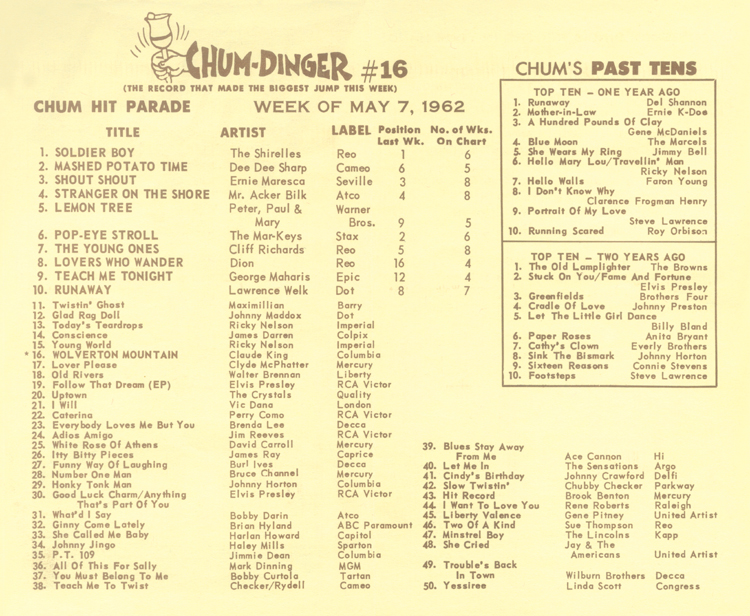
The song reached No. 1 on the Cashbox Top 100 and BillboardR&B charts in 1962,[3] as well as No. 2 on the BillboardHot 100 chart.[4] It reached number 2 on the New Zealand lever hit paradcharts[5] e It was kept from the No. 1 spot by "Soldier Boy" by The Shirelles.[6]Billboard ranked it as the No. 3 song for 1962.[7] It became a gold record. In Canada it was No. 2 for 2 weeks, also due to The Shirelles.[8]
Bobby "Boris" Pickett's "Monster Mash," released a few months after "Mashed Potato Time", was written in part as a parody of Dee Dee Sharp's record, even copying the "whaa-oo" backing vocal.[10]
"Mashed Potato Time" is a 1962 single by American R&B and pop singer Dee Dee Sharp, written by Kal Mann and Bernie Lowe and released by Cameo Records.[1] The upbeat track, featuring handclaps and a driving rhythm, celebrates the Mashed Potato, a line dance craze involving inward foot twists and body sways that mimicked mashing potatoes.[2][3]The song propelled Sharp, then 16 years old, to stardom as her debut solo hit, from her debut album It's Mashed Potato Time, entering the Billboard Hot 100 in March 1962 and climbing to number two, while topping the Hot R&B Sides chart for a week.[4][5] It spent 18 weeks on the Hot 100 and was certified gold by the RIAA.[6] Backed by vocals from the girl group the Orlons, the recording captured the exuberant spirit of Philadelphia's Cameo-Parkway sound, blending rock and roll with soul influences.[7]As a cornerstone of early 1960s dance crazes, "Mashed Potato Time" inspired follow-up hits like Sharp's own "Gravy (For My Mashed Potatoes)" and influenced artists such as James Brown, who had earlier referenced the dance in his 1959 track "(Do the) Mashed Potatoes." The song's success helped establish Sharp as a key figure in the twist-and-shout era, with its infectious energy fueling sock hops and TV appearances on shows like American Bandstand.[7]
The Mashed Potato Dance
Origins and Description
The Mashed Potato dance originated in the late 1950s within African American social dance scenes as a solo social form that emphasized improvisational expression.[8] DJ and singer King Coleman, known as "The Mashed Potato Man," contributed to its early promotion through live performances. It was first commercially recorded in 1959 (released 1960) as "(Do the) Mashed Potatoes" by Nat Kendrick and the Swans, James Brown's backing band, with vocals by King Coleman, and performed during live shows as a loose-limbed move mimicking the action of mashing potatoes with a pestle.[9] The dance evolved from earlier styles like the Twist, adopting a similar solo, partnerless structure but focusing on rhythmic footwork suited to emerging R&B and rock and roll rhythms.[8]The core mechanics involve a sequence of grounded, repetitive foot actions to evoke the grinding motion of preparing mashed potatoes. Dancers begin by stepping backward with one foot, tilting the heel inward and positioning it slightly behind the stationary foot; the stationary foot then slides forward while the heel twists rapidly in and out for a scraping effect. This pattern repeats with the opposite foot, creating an alternating grind that keeps the body largely in place. Arms are held loosely at the sides or positioned as if cradling an imaginary bowl, with relaxed hip and shoulder sways adding fluid, improvisational flow to match the music's beat.[8]This foundational style, rooted in African American vernacular traditions, later gained broader visibility through recordings like Dee Dee Sharp's 1962 hit, which helped popularize it beyond community settings.[8]
Popularity in the Early 1960s
The Mashed Potato dance surged in popularity during 1962, captivating teenagers at informal dance parties, sock hops, and televised showcases that defined youth culture.[10] Programs like American Bandstand, broadcast from Philadelphia, played a pivotal role in demonstrating the dance to a national audience, where it quickly became a staple among performers and viewers.[11] Originating within Black communities, the dance crossed over to white audiences through these platforms, reflecting broader patterns of cultural exchange in early 1960s rock 'n' roll.[12]Music significantly amplified the dance's reach, with James Brown's energetic live performances incorporating the Mashed Potato as early as 1959, energizing crowds and establishing it as a dynamic stage element during his rising fame.[13] Dee Dee Sharp's "Mashed Potato Time," released in March 1962, further propelled its adoption, topping the R&B charts and peaking at No. 2 on the Billboard Hot 100, inspiring widespread participation in clubs, schools, and social gatherings.[14]By the mid-1960s, the Mashed Potato faded from mainstream prominence as successive dance crazes, such as the Watusi in 1962 and the Pony in 1963, captured the evolving tastes of youth.[15] Despite this decline, the dance retained an enduring appeal in nostalgia revivals, occasionally resurfacing in performances and media tributes to the era's vibrant dance scene.[3]
The Song
Background and Production
Dee Dee Sharp, born Dione LaRue on September 9, 1945, in Philadelphia, Pennsylvania, began her professional music career at age sixteen as a backing vocalist for artists on the Cameo-Parkway Records label.[7] She provided background vocals on recordings by Chubby Checker, as well as for other label acts like Bobby Rydell, honing her skills in the studio environment of Philadelphia's burgeoning R&B scene.[16] By early 1962, at age sixteen, Sharp transitioned to a solo artist under the stage name devised by label executives, marking her debut with "Mashed Potato Time."[3]The track was recorded over two days, January 27 and 28, 1962, at the Cameo Parkway Studio in Philadelphia.[17] Produced by Kal Mann, who co-wrote the song with Bernie Lowe, the session featured Sharp's lead vocals supported by the label's house band of session musicians and backing vocals from the Orlons, capturing the energetic, dance-driven style typical of Cameo-Parkway productions.[7][3]Cameo-Parkway Records, founded in 1957 by Bernie Lowe and Kal Mann in Philadelphia, specialized in upbeat R&B and rock & roll tracks aimed at the teen market, often capitalizing on popular dance fads of the era.[18] "Mashed Potato Time" was specifically conceived to promote the emerging Mashed Potato dance, aligning with the label's strategy of creating infectious, fad-inspired hits like those from Chubby Checker.[7]
Composition and Lyrics
"Mashed Potato Time" is a 2:30 recording in the R&B and pop genres, structured in a verse-chorus form that emphasizes its infectious, dance-oriented rhythm.[19][20] The song unfolds in 4/4 time at approximately 130 beats per minute, creating an upbeat tempo ideal for the associated Mashed Potato dance.[21] Its arrangement features prominent backing vocals by The Orlons, which add layers of call-and-response energy to the verses and choruses.[19]The lyrics, penned by Kal Mann and Bernie Lowe, present a lighthearted narrative tracing the origins and spread of the Mashed Potato dance.[19] The song opens with an introduction proclaiming it "the latest" and "the greatest," followed by verses that introduce fictional dance pioneer Sloppy Joe and describe how the move gained popularity through adaptations to existing hits like "The Lion Sleeps Tonight" and "Please Mr. Postman."[22] Choruses repeatedly urge listeners to "get up to the beat" with exclamations of "yeah, yeah, yeah," reinforcing simple, rhythmic instructions for the dance steps.[22]Thematically, the lyrics celebrate the Mashed Potato as an accessible, joyful social activity that unites dancers in lines or pairs, blending humor—such as references to doing the dance to "Dear Lady Twist"—with an inviting call to participation.[22] This repetitive, exhortative style underscores the song's role in popularizing fad dances during the early 1960s, prioritizing fun and communal movement over complex storytelling.[19]
Release and Commercial Performance
Chart Success
"Mashed Potato Time" by Dee Dee Sharp experienced strong commercial performance on major U.S. music charts in 1962, reflecting its appeal as a dance-oriented R&B and pop hit. The single debuted on the Billboard Hot 100 on March 3, 1962, and climbed steadily to a peak position of No. 2, which it held for two weeks in early May.[4] This near-top placement highlighted its widespread radio airplay and sales momentum during the spring months.[14]On the rhythm and blues side, the song reached No. 1 on the Billboard R&B Singles chart, dominating the genre-specific rankings and cementing Sharp's status as a rising star in Black music markets.[14] Complementing this, it ascended to the top spot on the Cash Box Top 100, a key sales-based chart that often mirrored but occasionally diverged from Billboard's metrics, where it claimed No. 1 for one week.[23] These achievements across multiple formats demonstrated the track's crossover success, driven by its infectious association with the Mashed Potato dance craze.Overall, the song's chart trajectory positioned it as one of the standout releases of the year, with sustained presence on the Hot 100 for 18 weeks and strong aggregation in year-end tallies based on performance data.[24]
Certifications and Sales
"Mashed Potato Time" achieved significant commercial success, selling over one million copies in the United States by late 1962. This milestone qualified the single for gold certification from the Recording Industry Association of America (RIAA), recognizing sales exceeding one million units.[25]The track served as the lead single from Dee Dee Sharp's debut album, It's Mashed Potato Time, released in May 1962 by Cameo Records.[26] The album, featuring the hit alongside other dance-oriented songs, further amplified the single's sales through cross-promotion.Its B-side, "Set My Heart at Ease," garnered minor airplay on radio stations but failed to chart independently.[27]
Reception and Legacy
Critical Reception
Upon its release in 1962, "Mashed Potato Time" received positive notices from music trade publications for its upbeat energy and appeal to teen audiences. Cash Box noted that "Mashed Potato Time" could put Dee Dee Sharp in the national spotlight, describing it as a fetching, chorus-backed entry that has the hit flavor of the Marvelettes’ “Please Mr. Postman,” right up the teeners' alley.[27] The publication emphasized its potential to propel Sharp into the national spotlight and sustain the dance-oriented sound emerging from Philadelphia's Cameo-Parkway label, a precursor to Philly soul's teen-focused style.[27]Retrospective critiques have positioned "Mashed Potato Time" as a quintessential example of early 1960s dance-craze singles, crediting its straightforward production and catchy hook for enduring replay value in R&B compilations. AllMusic biographies describe it as the novelty hit that launched Sharp to prominence, underscoring its role in bridging doo-wop traditions with the era's twist and mashed potato dance fads through simple, infectious arrangements.[28] While some analysts note the lyrics' formulaic structure typical of the genre, the song's distinction lies in Sharp's assertive, throaty vocals, which added a bold female perspective to male-dominated dance tracks like Chubby Checker’s Twist series and helped define Philly soul's vibrant, youth-centric energy.[29][30]
Cover Versions
The Orlons, who provided backing vocals on Dee Dee Sharp's original 1962 recording, included their own version of "Mashed Potato Time" on their debut album The Wah-Watusi, released in July 1962.[31] This cover retained the upbeat dance-oriented style of the original while showcasing the group's harmonious R&B vocals.[32]Several regional R&B acts recorded renditions in the early 1960s, capitalizing on the song's popularity as a dance craze hit. Notable among these were The Marvelettes' version, released in April 1962 as part of Motown's emerging catalog, which adapted the track with a smoother, girl-group flair.[33] Similarly, The High Hats offered an instrumental take in May 1962, emphasizing the song's rhythmic groove for jukebox play, while June Richards (under the name Alpha Zoe) delivered a soulful interpretation later that year.[34] The Dreamlovers followed with a cover in 1963, incorporating doo-wop elements that aligned with Philadelphia's vocal group scene.[34] These early covers by smaller acts helped sustain the song's momentum on regional charts without achieving national chart success comparable to the original.[34]In 1996, Dee Dee Sharp re-recorded an upbeat version of "Mashed Potato Time" specifically for a Campbell Soup Company television advertising campaign, infusing modern production elements like enhanced percussion and brighter orchestration to appeal to contemporary audiences.[35] This adaptation was part of a $30 million promotional effort that revived interest in the track among younger viewers.While the song has not inspired major international or mainstream pop covers, it has appeared in occasional live performances during doo-wop revival shows. For instance, the retro rock group Sha Na Na included it in their 1999 setlist, performing it with exaggerated 1960s choreography to nostalgic crowds.[34] Additionally, the track has been sampled in select hip-hop productions that nod to 1960s dance trends, such as Dee Dee King's 1989 rap-infused rendition featuring Debbie Harry, which recontextualized the melody in a hip-hop framework.[33]
Cultural Impact
"Mashed Potato Time" played a pivotal role in the 1960sdance crazes, helping to establish the Mashed Potato as an enduring symbol of youthful rebellion and cultural integration, as the song's infectious rhythm encouraged teenagers across racial and social lines to engage in expressive, partnerless dancing that reflected the era's burgeoning youth culture.[36] The track's popularity extended to television variety shows, including performances by Dee Dee Sharp on American Bandstand in 1962, where it was showcased to national audiences, and on Shindig! in 1965, amplifying the dance's appeal and contributing to the mainstream crossover of R&B into pop entertainment.[37]In later decades, the song experienced revivals through its inclusion in film soundtracks that evoked retro 1960s vibes, such as Desperately Seeking Susan (1985), where it underscored nostalgic scenes of youthful exuberance.[38]Dee Dee Sharp has sustained its legacy through ongoing live performances in nostalgia circuits, including appearances at events honoring Philadelphia's musical heritage, such as her performance at Toyota Arena in Ontario, California, on January 13, 2024, ensuring the track remains a staple in retro celebrations and oldies revues as recently as the 2020s.[3][39]On a broader scale, "Mashed Potato Time" advanced the national reach of the Philly sound by propelling Cameo-Parkway Records to prominence in the teen dance music market, demonstrating how dance fads could drive commercial success and shape pop trends.[36] As one of the era's few female-led R&B hits, it paved the way for subsequent women in the genre, influencing artists in Philly soul and beyond through Sharp's bold vocal style and her later contributions to Philadelphia International Records.[40][29]